
Abstract
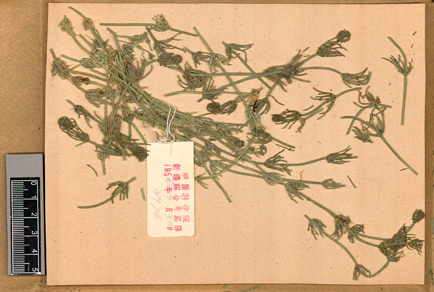
The extant species Chara sinkiangensis F.S. Han & P.C. Tuan in Han et al. (1978) is a homonym of the name of the fossil species C. sinkiangensis Lu (1944). Hence, the former name was replaced here with C. hanii, nom. nov., honoring one of its authors, Han Fu-Shan, a prominent Chinese charophytologist. For this species, only male plants were known from one location in Xinjiang. Examination of specimens collected during Chinese-Soviet expeditions to Xinjiang, People’s Republic of China, during 1957–1959 and stored in the Komarov Botanical Institute of the Russian Academy of Sciences revealed an isotype of C. sinkiangensis. A study of this specimen provided new data improving the description of the species. According to morphological traits, C. hanii belongs to the section Chara and could be attributed to either subsection Chara or subsection Hartmania. Phylogenetic analyses based on chloroplast gene rbcL placed this species to the subsection Hartmania, making it the third dioecious species in the subsection.
References
- Agardh, C.A. (1824) Systema algarum. Literis Berlingianis [Berling], Lundae [Lund], 312 pp. https://doi.org/10.5962/bhl.title.1829
- Akaike, H. (1974) A new look at the statistical model identification. IEEE Transactions on Automatic Control 19 (6): 716–723. https://doi.org/10.1109/TAC.1974.1100705
- Allen, T.F. (1882) Development of the cortex in Chara. Illustrated by a series of American species. Bulletin of the Torrey Botanical Club 9 (4): 37–47, plates XV–XXII. https://doi.org/10.2307/2479660
- Arbeitsgruppe Armleuchteralgen Deutschlands (Becker, R., Blindow, I., Doege, A., Franke, T., Gregor, T., Hamann, U., Jäger, D., Jorda, C., Kabus, T., Korsch, H., Korte, E., Kusber, W.-H., Pätzold, F., Raabe, U., Schubert, H., Teppke, M., van de Weyer, K. & Wolff, P.) (2016) Beschreibung der Characeen-Arten Deutschlands. In: Arbeitsgruppe Characeen Deutschlands Lehrstuhl für Ökologie der Universität Rostock (Eds.) Armleuchteralgen. Die Characeen Deutschlands. Springer-Verlag, Berlin, Heidelberg, pp. 209–572. https://doi.org/10.1007/978-3-662-47797-7_12
- Bernhardt, K.G. & Gregor, T. (2024) Chara contraria. In: Schubert, H., Blindow, I., Nat, E., Korsch, H., Gregor, T., Denys, L., Stewart, N., van de Weyer, K, Romanov, R. & Casanova, M.T. (Eds.) Charophytes of Europe. Springer Nature Switzerland AG, Cham, pp. 375–385. https://doi.org/10.1007/978-3-031-31898-6_25
- Blindow, I., Marquardt, R., Schories, D. & Schubert, H. (2018) Charophyceae of Chile—taxonomy and distribution. Part 1. Subfamily Chareae. Nova Hedwigia 107 (1–2): 1–47. https://doi.org/10.1127/nova_hedwigia/2017/0452
- Bonfield, J.K., Smith, K.F. & Staden, R. (1995) A new DNA sequence assembly program. Nucleic Acids Research 23 (24): 4992–4999. https://doi.org/10.1093/nar/23.24.4992
- Braun, A. (1849) Charae australes antarcticae, or characters and observations on the Characeae of Australia and the southern circumpolar regions. Hooker’s Journal of Botany & Kew Garden Miscellany 1: 193–203.
- Braun, A. (1857) Über Parthenogenesis bei Pflanzen. Abhandlungen der Koniglichen Akademie der Wissenschaften zu Berlin 1856: 311–376. https://doi.org/10.3931/e-rara-76056
- Braun, A. & Nordstedt, C.F.O. (1882) Fragmente einer Monographie der Characeen von Hrn. A. Braun. Nach den hinterlassenen Manuscripten A. Braun’s herausgegeben von Hrn. Dr. Otto Nordstedt. Abhandlungen der Königlich Preussischen Akademie der Wissenschaften 1882 (1): 1–211, 7 pls.
- Braun, A., Rabenhorst, L. & Stizenberger, E. (1857) Die Characeen Europa’s in getrockneten Exemplaren. Fasc. 1. Nr. 1–25. Dresden, iii–iv, 1–25 pp.
- Braun, A., Rabenhorst, L. & Stizenberger, E. (1859) Die Characeen Europa’s in getrockneten Exemplaren. Fasc. 2. Nr. 26–50. Dresden, 26–50 pp.
- Bruinsma, J., Casanova, M.T., Jäger, D., Lambert, E., Nat, E., Schubert, H. & Stewart, N. (2024) Glossary. In: Schubert, H., Blindow, I., Nat, E., Korsch, H., Gregor, T., Denys, L., Stewart, N., van de Weyer, K, Romanov, R. & Casanova, M.T. (Eds.) Charophytes of Europe. Springer Nature Switzerland AG, Cham, pp. 1085–1130. https://doi.org/10.1007/978-3-031-31898-6_87
- Bruzelius, A. (1824) Observationes in genus Chara. Ord. Philos. Lund, respondente Eberhard Liljevalch. [Dissertation]. Ex Officina Berlingiana, Londini Gothorum, 24 pp.
- Cáceres, E.J. (1985) Novedades caroloìgicas argentinas. III. Chara andina en la Repuìblica Argentina. Physis, Secciones B 43 (104): 57–61.
- Casanova, M.T. (2005) An overview of Chara L. in Australia (Characeae, Charophyta). Australian Systematic Botany 18 (1): 25–39. https://doi.org/10.1071/SB04027
- Casanova, M.T. (2007) Typification and circumscription of Nitella sonderi (Characeae, Charophyceae). Australian Systematic Botany 20 (5): 464–472. https://doi.org/10.1071/SB06038
- Casanova, M.T. (2009) An overview of Nitella (Characeae, Charophyceae) in Australia. Australian Systematic Botany 22 (3): 193–218. https://doi.org/10.1071/SB08039
- Casanova, M.T. (2013) Lamprothamnium in Australia (Characeae, Charophyceae). Australian Systematic Botany 26 (4): 268–290. https://doi.org/10.1071/SB13026
- Casanova, M.T. (2014) A revision of Chara sect. Charopsis (Characeae: Charophyceae) in Australia, including specimens collected for Bush Blitz. Australian Systematic Botany 27 (6): 403–414. https://doi.org/10.1071/SB14032
- Casanova, M.T. & Karol, K.G. (2008) Monoecious Nitella species from south-eastern mainland Australia including Nitella paludigena sp. nov. Australian Systematic Botany 21 (3): 201–216. https://doi.org/10.1071/SB07026
- Casanova, M.T. & Karol, K.G. (2014) A revision of Chara sect. Protochara, comb. et stat. nov. (Characeae: Charophyceae). Australian Systematic Botany 27 (1): 23–37. https://doi.org/10.1071/SB13016
- Casanova, M.T. & Karol, K.G. (2023a) Charophytes of Australia’s Northern Territory—I. Tribe Chareae. Australian Systematic Botany 36 (1): 38–79. https://doi.org/10.1071/SB22023
- Casanova, M.T. & Karol, K.G. (2023b) Charophytes of Australia’s Northern Territory—II. Tribe Nitelleae. Australian Systematic Botany 36 (4): 322–353. https://doi.org/10.1071/SB22029
- Casanova, M.T. & Nicol, J.M. (2009) Chara canescens (Characeae, Charophyceae) in the southern hemisphere. Charophytes 1 (2): 55–60. https://doi.org/10.13140/2.1.3285.8245
- Casanova, M.T. & Porter, J.L. (2013) Two new species of Nitella (Characeae, Charophyceae) from arid-zone claypan wetlands in Australia. Muelleria 31: 53–59. https://doi.org/10.5962/p.295677
- Casanova, M.T., de Winton, M.D., Karol, K.G. & Clayton, J.S. (2007) Nitella hookeri A. Braun (Characeae, Charophyceae) in New Zealand and Australia: implications for endemism, speciation and biogeography. Charophytes 1 (1): 2–18. https://doi.org/10.13140/2.1.4989.7604
- Chen, K.X., Qing, R.W., Fu, H.L., Ren, L.X., Liu, K.H., Cao, S.J. & Lan, L.Q. (2018) Identification of a new characteristic species of Nitella (Charophyceae) from southwestern China based on morphology and molecular phylogeny. Plant Systematics and Evolution 304 (1): 123–132. https://doi.org/10.1007/s00606-017-1456-1
- Chen, W.Q., Wang, G.X. & Han, F.S. (1990) Some new species and a new record of Characeae from Jiangsu Province. Oceanologia and Limnologia Sinica 21 (6): 563–570.
- Darriba, D., Taboada, G.L., Doallo, R. & Posada, D. (2012) jModelTest 2: more models, new heuristics and parallel computing. Nature Methods 9: 772. https://doi.org/10.1038/nmeth.2109
- Durieu de Maisonneuve, M.C. (1846–1869) Atlas de la Flore D’Algerie ou Illustrations d’un grand nombre de plantes nouvelles ou rares de ce pays choisies surtout parmi celles qui ont été recueillies par les soins de la commission scientifique de 1839 a 1844. Les planches ont toutes été dessinées d’aprés nature par Vaillant. Planches 1846–1849. Texte 1868. In: Exploration scientifique de l’Algérie publiée par ordre du gouvernement. Sciences naturelles. Botanique, [Cryptogamie. Vol. 1.] Imprimerie Impériale, Paris, pp. i–ii, 1–39, plates 1–90, 1–7.
- Echt, C.S., Erdahl, L.A. & McCoy, T.J. (1992) Genetic segregation of random amplified polymorphic DNA in diploid cultivated alfalfa. Genome 35 (1): 84–87. https://doi.org/10.1139/g92-014
- Filarszky, N. (1937) Idegenfoldi Charafelek hatarozasa—Determinatio Characearum exoticarum. Magyar Tudományos Akadémia Budapest 55: 476–495 [In Hungarian]
- Galtier, N., Gouy, M. & Gautier, C. (1996) Seaview and phylo-win: two graphic tools for sequence alignment and molecular phylogeny. Computer Applications in the Biosciences 12 (6): 543–548. https://doi.org/10.1093/bioinformatics/12.6.543
- García, A. (1996) Nitella ignescens sp. nov. and N. ungula sp. nov. (Charales, Charophyta) from Australia. Phycologia 37 (1): 53–59. https://doi.org/10.2216/i0031-8884-37-1-53.1
- García, A. (1999) Charophyte flora of south-eastern South Australia and southwestern Victoria, Australia: systematics, distribution and ecology. Australian Journal of Botany 47 (3): 407–426. https://doi.org/10.1071/BT97084
- García, A. & Chivas, A.R. (2006) Diversity and ecology of extant and Quaternary Australian charophytes (Charales). Cryptogamie. Algologie 27 (4): 323–340. https://doi.org/10.5962/bhl.title.13687
- Groves, H. & Groves, J. (1881) Notes on the British Characeæ. Journal of Botany 18: 353–356.
- Grubov, V.I. & Lavrenko, E.M. (1968) To the memory of Alexandr Afanasiyevich Yunatov (25 XII 1909–24 X 1967). Botanicheskii Zhurnal 53 (10): 1493–1500. [In Russian]
- Guerlesquin, M. (1981) Contribution à la connaissance des characées d’Amérique du Sud (Bolivie, Equateur, Guyane française). Revue d’Hydrobiologie Tropicale 14 (4): 381–404.
- Guiry, M.D. & Guiry, G.M. (2025 [continuously updated]) AlgaeBase. World-wide electronic publication. National University of Ireland, Galway. Available from: http://www.algaebase.org (accessed 18 November 2025)
- Han, F.S. & Li, Y.Y. (Eds.) (1994) Flora Algarum Sinicarum Aquae Dulcis. Vol. 3: Charophyta. Science Press, Beijing, 267 pp. [In Chinese]
- Han, F.S., Tuan, P.C. & Chen, C.L. (1978) New taxa of charophytes from North-Western China. Acta Phytotaxonomica Sinica 16 (3): 89–94. [In Chinese and Latin]
- Hartman, C.J. (1820) Handbok i Skandinaviens flora, innefattande sveriges och norriges vexter, till och med mossorna: Med inledning, af handlande grunderna for botanikens studium, samt tvanne plancher. Z. Haeggstrom, Stockholm, 1–32, i–lxiii, 1–488 pp., 12 leaves: ill., 2 folded pl.
- Hasslow, O.J. (1939) Einige Characeenbestimmungen. Botaniska Notiser 1939 (2): 295–301.
- Hoang, D.T., Chernomor, O., von Haeseler, A, Minh, B.Q. & Vinh, L.S. (2018) UFBoot2: Improving the ultrafast bootstrap approximation. Molecular Biology and Evolution 35 (2): 518–522. https://doi.org/10.1093/molbev/msx281
- Hollerbach, M.M. (1981) De specie nova Chara neglecta Hollerb. (Charophyta). Systematicae Plantarum non Vascularium 18: 3–9. [In Russian and Latin]
- Hollerbach, M.M. & Krassavina, L.K. (1983) The identification manual of freshwater algae of the USSR. Iss. 14. The charophytes—Charophyta. Nauka, Leningrad, 190 pp. [In Russian and Latin]
- Kiselev, K.V., Dubrovina, A.S. & Tyunin, A.P. (2015) The methylation status of plant genomic DNA influences PCR efficiency. Journal of Plant Physiology 175 (1): 59–67. https://doi.org/10.1016/j.jplph.2014.10.017
- Kützing, F. (1834) Beschreibung einiger neuer Arten der Gattung Chara. Flora (Jena) 17: 705–707.
- Kützing, F.T. (1845) Phycologia germanica d.i. Deutschlands Algen in bündigen Beschreibungen. Nebst einer Anleitung zum Untersuchen und Bestimmen dieser Gewächse für Anfänger. Wilh. Köhne, Nordhausen, x, (2), 340 pp.
- Langangen, A. (2010) Chara hellenica spec. nov. and other charophytes collected in Corfu and Amorgos islands (Greece) in 2008. Studia Botanica Hungarica 41: 21–30.
- Lange, J. (1856–1859) Haandbog den Danske Flora. Anden omarbeidede Udgave. C.A. Reitzels Forlag, Kjøbenhavn, [iii]–lxvi, 1–764 pp. https://doi.org/10.5962/bhl.title.9747
- Lessing, C.F. (1835) Beitrag zur Flora des südlichen Urals und der Steppen. Linnaea 9: 145–213.
- Ling, Y.J., Xie, S.L. & Langangen, A. (2000) Charales of China. Nova Hedwigia 71 (1–2): 69–94. https://doi.org/10.1127/nova/71/2000/69
- Linnaeus, C. (1753) Species Plantarum. Tomus II. Impensis Laurentii Salvii, Holmiae [Stockholm], [i], 561–1200, [1–30, index], [i, err.] pp. https://doi.org/10.5962/bhl.title.669
- Lu, Y.H. (1944) The Charophyta from the Kucha Formation near Kucha, Sinkiang. Bulletin of the Geological Society of China 24 (1–2): 33–36, 1 plate. https://doi.org/10.1111/j.1755-6724.1944.mp241-2005.x
- Migula, W. (1904) Characeae Rossicae ex herbario horti Petropolitani. Trudy Imperatorskago S.-Peterburgskago Botanicheskago Sada. Acta Horti Petropolitani 23: 533–539.
- Muller, S.D., Rhazi, L. & Soulié-Märsche, I. (2017) Diversity and distribution of Characeae in the Maghreb (Algeria, Morocco, Tunisia). Cryptogamie, Algologie 38 (3): 201–251. https://doi.org/10.7872/crya/v38.iss3.2017.201
- Proctor, V.W. (1980) Historical biogeography of Chara (Charophyta): An appraisal of the Braun-Wood classification plus a falsifiable alternative for future consideration. Journal of Phycology 16 (2): 218–233. https://doi.org/10.1111/j.1529-8817.1980.tb03023.x
- Qiu, L.C. & Ling, Y.J. (2005) Charophyte flora in China. Acta Botanica Boreali-Occidentalia Sinica 25 (8): 1682–1684. [In Chinese]
- Rambaut, A., Drummond, A.J., Xie, D., Baele, G. & Suchard, M.A. (2018) Posterior summarisation in Bayesian phylogenetics using Tracer 1.7. Systematic Biology 67 (5): 901–904. https://doi.org/10.1093/sysbio/syy032
- Reichenbach, H.G.L. (1832) Flora Germanica excursoria ex affinitate regni vegetabilis naturali disposita, sive principia synopseos plantarum in Germania terrisque in Europa media adjacentibus sponte nascentium cultarumque frequentius. Vol. 2. addenda et corrigenda. Apud Carolum Cnobloch (Dresden, gedruckt in der Gärtner’schen Buchdruckerei), Lipsiae [Leipzig], 843–873 pp.
- Romanov, R.E. (2021) Typification of Chara (Charales, Charophyceae) species described by C.F. Lessing, F.J. Ruprecht and M.M. Hollerbach. Notulae Algarum 213: 1–7.
- Romanov, R.E. (2022) Typification and clarification of species concepts of Chara fischeri Migula and C. gobiana Vilhelm. Notulae Algarum 233: 1–4.
- Romanov, R.E., Anisimova, O.V., Anishchenko, L.N., Efimov, D.Y., Kapitonova, O.A., Kipriyanova, L.M., Konechnaya, G.Yu., Kopyrina, L.I., Kotovshchikov, A.V., Kurganov, A.A., Nikolaenko, S.A., Shilov, M.P., Smirnova, E.V., Vodeneeva, E.L., Zarubina, E.Y. & Zhakova, L.V. (2022a) The noteworthy new records of charophytes (Charales, Charophyceae) from Russian regions: improvement of species distribution ranges in Eurasia. Botanicheskii Zhurnal 107 (5): 466–477. https://doi.org/10.31857/S0006813622050076
- Romanov, R.E., Barinova, S.S., Nikulin, V.Yu. & Gontcharov, A.A. (2022b) Chara lipkinii (Charales, Charophyceae): a new dioecious Mediterranean species under risk of extinction in the wild and some implications for the taxonomy of the genus Chara. Fottea, Olomouc 22 (1): 1–12. https://doi.org/10.5507/fot.2021.012
- Romanov, R.E., Nikulin, A.Yu, Nikulin, V.Yu. & Gontcharov, A.A. (2022c) New species Chara oryzae and a new section Corillionia of Chara (Charales, Charophyceae) from European Mediterranean rice fields. European Journal of Phycology 57 (3): 328–342. https://doi.org/10.1080/09670262.2021.1987527
- Romanov, R.E., Nikulin, V.Yu, Nikulin, A.Yu, Zhakova, L.V, Ivanov, S.D, Stepanova, V.A, Efremov, A.N. & Gontcharov, A.A. (2025a) Description of new species Tolypella iranica (Charophyceae, Characeae) and update of the species distribution range of T. mongolica. Phytotaxa 698 (1): 1–14. https://doi.org/10.11646/phytotaxa.698.1.1
- Romanov, R.E., Nikulin, V.Yu, Vishnyakov, V.S, Tsegmid, B, Efremov, A.N, Zhakova, L.V. & Gontcharov, A.A. (2024) Tolypella mongolica (Charophyceae, Characeae): A new dioecious charophyte species from the center of Eurasia and implications for charophyte taxonomy, including the validation of T. porteri and the new combination for T. jwalae. Phytotaxa 659 (1): 24–40. https://doi.org/10.11646/phytotaxa.659.1.2
- Romanov, R.E., Vidal-Russell, R, Nikulin, V.Yu, Gontcharov, A.A. & Quiroga, M.P. (2022d) Nitella sonderi (Charales, Charophyceae)—a new record for South America, and first record from outside Australia. Cryptogamie, Algologie 43 (13): 201–213. https://doi.org/10.5252/cryptogamie-algologie2022v43a13
- Romanov, R.E., Zhakova, L.V., Efremov, A.N., Konechnaya, G.Y., Boldina, O.N., Afanasyev, D.F., Akatova, T.V. & Melnikov, D.G. (2025b) The charophytes (Characeae, Charophyceae) of the Caucasus. Plants 14: 1788. https://doi.org/10.3390/plants14121788
- Ronquist, F. & Huelsenbeck, J.P. (2003) MrBayes 3: Bayesian phylogenetic inference under mixed models. Bioinformatics 19 (12): 1572–1574. https://doi.org/10.1093/bioinformatics/btg180
- Ruprecht, F.J. (1845) Distributio cryptogamarum vascularium in Imperio Rossico. Beiträge der Pflanzenkunde des Russischen Reiches. Dritte Liefrung. Buchdruckerei der Kaiserlichen Akademie der Wissensehaften, Petropoli [St Petersburg], pp. [1]–56.
- Salemi, D., Troia, A., Ilardi, V. & Schubert, H. (2024) Aberrant haplostichous cortication of Chara tomentosa—another argument for matrix keys. Rostocker Meeresbiologische Beiträge 33: 130–134.
- Schneider, S.C., Rodrigues, A., Moe, T.F., Ballot, A. & de Clerck, O. (2015) DNA barcoding the genus Chara: Molecular evidence recovers fewer taxa than the classical morphological approach. Journal of Phycology 51 (2): 367–380. https://doi.org/10.1111/jpy.12282
- Schneider, S.C., Nowak, P., Ammon, U.V. & Ballot, A. (2016) Species differentiation in the genus Chara (Charophyceae): Considerable phenotypic plasticity occurs within homogenous genetic groups. European Journal of Phycology 51 (3): 282–293. https://doi.org/10.1080/09670262.2016.1147085
- Schubert, H., Blindow, I., Nat, E., Korsch, H., Gregor, T, Denys, L, Stewart, N, van de Weyer, K, Romanov, R. & Casanova, M.T. (Eds.) (2024) Charophytes of Europe. Springer Nature Switzerland AG, Cham, pp. [i]–xiii, [1]–1144. https://doi.org/10.1007/978-3-031-31898-6
- Song, Q., Liu, X., Nan, F., Liu, Q., Lv, J., Feng, J., Li, R. & Xie, S. (2022) Chara zhengzhouensis (Characeae, Charophyta), a new freshwater algal species described from North China. Diversity 14: 864. https://doi.org/10.3390/d14100864
- Su, W.T., Wang, Z.X. & Wang, Y.J. (1990) Some new taxa of Charophyta in China. Acta Phytotaxonomica Sinica 28 (4): 333–340.
- Swofford, D.L. (2002) PAUP*. Phylogenetic Analysis Using Parsimony (*and other methods). Version 4. Sinauer Associates, Sunderland, USA, 142 pp.
- Thiers, B. (2025 [continuously updated]) Index herbariorum: A global directory of public herbaria and associated staff. New York Botanical Garden’s Virtual Herbarium. Available from: http://sweetgum.nybg.org/ih/ (accessed 27 December 2025)
- Turland, N.J., Wiersema, J.H., Barrie, F.R., Gandhi, K.N., Gravendyck, J, Greuter, W, Hawksworth, D.L., Herendeen, P.S., Klopper, R.R., Knapp, S, Kusber, W.-H., Li, D.-Z., May, T.W., Monro, A.M., Prado, J, Price, M.J., Smith, G.F. & Zamora Señoret, J.C. (Eds.) (2025) International code of nomenclature for algae, fungi, and plants (2025 Edition Madrid Code). Regnum Vegetabile 162. The University of Chicago Press, Chicago & London, pp. [i]–xlvii, 1–303.
- Urbaniak, J. & Combik, M. (2013) Genetic and morphological data fail to differentiate Chara intermedia from C. baltica, or C. polyacantha and C. rudis from C. hispida. European Journal of Phycology 48 (3): 253–259. https://doi.org/10.1080/09670262.2013.805249
- Urbaniak, J. & Kwiatkowski, P. (2019) Taxonomic studies on the Chara section Hartmania in Poland based on morphological and molecular data. PhytoKeys 135: 71–90. https://doi.org/10.3897/phytokeys.135.36714
- Urbaniak, J. & Sakayama, H. (2017) Taxonomical analysis of closely related species of Chara L. section Hartmania (Streptophyta: Charales) based on morphological and molecular data. Fottea 17 (2): 222–239. https://doi.org/10.5507/fot.2017.004
- Vilhelm, J. (1928) Characeae Europae orientalis et Asiae ex herbario instituti cryptogamici horti botanici reipublicae rossicae (ante Petropolitani). Spisy vydávané Prirodovedeckov Fakultov Karlovy University (Publications de la Faculté des Sciences de l’Université Charles, Praha) 80: 1–24, 1 pl.
- Volkova, E.A. & Rachkovskaya, E.I. (2009) A contribution by A.A. Yunatov to the knowledge of the vegetation of Xinjiang (to his 100th anniversary). Vegetation of Russia 15: 113–126. [In Russian] https://doi.org/10.31111/vegrus/2009.15.113
- von Leonhardi, H. (1864) Die bisher bekannten österreichischen Armleuchter-Gewächse besprochen von morphogenetischen Standpuncte. Verhandlungen der naturforschende Vereins zu Brünn 2, 1863: 122–224.
- Wahlstedt, L.J. (1862) Bidrag till kännedomen om de Skandinaviska Arterna af Växtfamiljen Characeæ. Lund, i–viii, 1–43 pp.
- Wood, R.D. (1962) New combinations and taxa in the revision of Characeae. Taxon 11 (1): 7–25. https://doi.org/10.2307/1216853
- Wood, R.D. (1971) Characeae of Australia. Nova Hedwigia 22 (1–2): 1–120.
- Wood, R.D. & Imahori, K. (1964) Iconograph of the Characeae. In: Wood, R.D. & Imahori, K. (Eds.) A revision of the Characeae, 2. J. Cramer, Weinheim, pp. v–xv, 1–5, icons 1–395.
- Wood, R.D. & Imahori, K. (1965) A revision of the Characeae. In: Wood, R.D. & Imahori, K. (Eds.) A revision of the Characeae, 1, J. Cramer, Weinheim, pp. i–xxiv, 1–904.
- Yunatov, A.A. (1960) On some ecological and geographical patterns of vegetation cover in the Xinjiang Uyghur Autonomous Region. In: Murzaev, E.M. & Zhou, L.S. (Eds.) The natural conditions of Xinjiang, Publishing house of the Academy of Sciences of the USSR, Moscow, pp. 8–40. [In Russian]
- Zheng, Y.M. (1989) Charophytes from Qinghai, Gansu and Ningxia and its two new species. Journal of Shanxi University (Natural Science Edition) 12 (3): 331–338. [In Chinese and Latin]