
Abstract
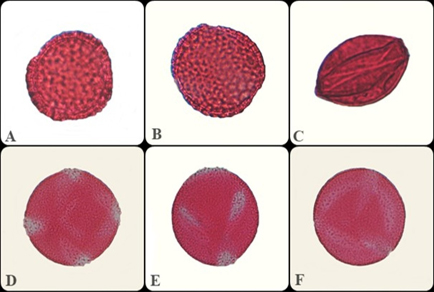
The present study was conducted to investigate the systematic importance of Tribes Ranunculeae and Anemoneae in Ranunculaceae from Pakistan. Using light microscopy and scanning electron microscopy, this study presented the first detailed palynological analysis of the tribes. Quantitative and qualitative features of pollen grains were investigated for accurate identification of plant species. The results showed that pollen was endoaperturate, with studied apertures as tricolpate, tricolporate, tetracolpate, and trizonocolpate. The parasyncolpate type of aperture was present only in Ranunculus repens in the present study. The ornamentation of colpi varied from species to species within the same genus, while scabrate, gemmate, and verrucate colpus patterns with micro-spinule-like projections were the most predominant in the tribes. The highest pollen diameter was observed in Ranunculus arvensis (65.6 µm), while the lowest was in Clematis grata (23.8 µm). Microechinate, scabrate, fossulate, striate, and verrucate microperforated surface ornamentation types were recorded through scanning electron microscopy for accurate taxa identification. Our results suggest that palynological features are effective tools for resolving ambiguities among closely related species, such as Ranunculus, and for revealing taxonomic relationships at the tribal and genus levels.
References
- Abdullah, M., Ahmad, M., Ullah, Z., Khan, A., Ahmad, S., Shah, H., Ullah, A., Farah, M.A., Emmanuel, O., Iqbal, R. & Ozodbek, A. (2025) Palynological diversity in the Rosaceae flora of Northern Khyber Pakhtunkhwa, Pakistan. Genetic Resources and Crop Evolution 72 (4): 4361–4379. https://doi.org/10.1007/s10722-024-02221-x
- Ahmad, M., Zafar, M., Sultana, S., Ahmad, M., Abbas, Q., Ayoub, M., Bahadur, S. & Ullah, F. (2018) Identification of green energy ranunculaceous flora of district Chitral, Northern Pakistan using pollen features through scanning electron microscopy. Microscopy Research and Technique 81 (9): 1004–1016. https://doi.org/10.1002/jemt.23066
- Ahmad, S., Zafar, M., Ahmad, M., Alamer, K.H., Abid, A., Rozina, S.J., Ullah, A., Shah, H., Shafeeq, U., Manzoor, M. & Gillani, S.W. (2025) Insect pollinators and plant interactions: Identification of selected melliferous plants using pollen morphological features. Polish Journal of Environmental Studies 34 (4): 4567–4576. https://doi.org/10.15244/pjoes/190619
- Applequist, W.L. (2024) Report of the Nomenclature Committee for Vascular Plants: 76. Taxon 73 (6): 1510–1522. https://doi.org/10.1002/tax.13266
- Aslam, M.S., Choudhary, B.A., Uzair, M. & Ijaz, A.S. (2012) The genus Ranunculus: A phytochemical and ethnopharmacological review. International Journal of Pharmaceutical Sciences 4 (5): 15–22.
- Becker, A., Bachelier, J.B., Carrive, L., Conde e Silva, N., Damerval, C., Del Rio, C., Deveaux, Y., Di Stilio, V.S., Gong, Y., Jabbour, F. & Kramer, E.M. (2024) A cornucopia of diversity—Ranunculales as a model lineage. Journal of Experimental Botany 75 (7): 1800–1822. https://doi.org/10.1093/jxb/erad492
- Bot, J. & Van Der Spoel‐Walvius, M. (1968) Description of Ranunculus repens L. and Ranunculus arvensis L. pollen. Acta Botanica Neerlandica 17 (3): 173–182. https://doi.org/10.1111/j.1438-8677.1968.tb00070.x
- Cronk, Q.C. (2025) How to lose a whorl: The evolutionary and developmental biology of apetaly. Journal of Experimental Botany eraf211. https://doi.org/10.1093/jxb/eraf211
- Endress, P.K. (2019) The morphological relationship between carpels and ovules in angiosperms: Pitfalls of morphological interpretation. Botanical Journal of the Linnean Society 189 (3): 201–227. https://doi.org/10.1093/botlinnean/boy083
- Emadzade, K., Lehnebach, C., Lockhart, P. & Hörandl, E. (2010) A molecular phylogeny, morphology and classification of genera of Ranunculeae (Ranunculaceae). Taxon 59 (3): 809–828. https://doi.org/10.1002/tax.593011
- Erdtman, G. (1952) On pollen and spore terminology. Journal of Palaeosciences 1: 169–176. https://doi.org/10.54991/jop.1952.382
- Heidary Baladehi, M., Habibi, M. & Azizian, D. (2013) Pollen morphology of Iranian species of Anemone L. & Pulsatilla Mill. (Ranunculaceae) and its implications. Acta Botanica Gallica 160 (1): 19–26. https://doi.org/10.1080/12538078.2012.758497
- Hörandl, E. & Emadzade, K. (2011) The evolution and biogeography of alpine species in Ranunculus (Ranunculaceae): A global comparison. Taxon 60 (2): 415–426. https://doi.org/10.1002/tax.602011
- Hörandl, E. & Emadzade, K. (2012) Evolutionary classification: A case study on the diverse plant genus Ranunculus L. (Ranunculaceae). Perspectives in Plant Ecology, Evolution and Systematics 14 (4): 310–324. https://doi.org/10.1016/j.ppees.2012.04.001
- Hu, S., Shi, W., Huang, Y., Zhang, Z., Lin, Q. & Shi, C. (2024) Comparative analysis of complete chloroplast genomes of five Anemone species and phylogenetic analysis within Tribe Anemoneae (Ranunculaceae). Journal of Plant Biochemistry and Biotechnology 33 (3): 271–287. https://doi.org/10.1007/s13562-024-00910-3
- Isik, S., Donmez, E.O., Aydin, Z.U. & Donmez, A.A. (2019) Pollen morphology in the tribe Nigelleae (Ranunculaceae): A worldwide palynological investigation into the species. Acta Biologica Cracoviensia. Series Botanica 61 (1): 93–102. https://doi.org/10.24425/abcsb.2019.127738
- Karahan, F., İlçim, A., Türkoğlu, A. & Haliloğlu, K. (2022) Molecular phylogeny based on ITS sequences of nrDNA of Adonis (Linnaeus, 1753) (Ranunculaceae) from various ecological sites of Turkey. Molecular Biology Reports 49: 5831–5842. https://doi.org/10.21203/rs.3.rs-1339936/v1
- Khan, K., Malik, K., Ahmad, M., Ahmad, S., Ullah, A., Shah, H. & Ullah, I. (2025) Pollen morphology and taxonomic implications of bee-foraged plant taxa using microscopic techniques. Genetic Resources and Crop Evolution 72: 1–16. https://doi.org/10.1007/s10722-025-02416-w
- Kurşat, M., Ozdag, N., Baser, B., Ozbey, F. & Emre, I. (2022) A palynological investigation of some taxa of the genus Ranunculus L. (Ranunculaceae) in Turkey and its taxonomic value. Palynology 46 (4): 1–3. https://doi.org/10.1080/01916122.2022.2095053
- Lehtonen, S., Christenhusz, M.J. & Falck, D. (2016) Sensitive phylogenetics of Clematis and its position in Ranunculaceae. Botanical Journal of the Linnean Society 182 (4): 825–867. https://doi.org/10.1111/boj.12477
- Palmer, J.D. (1994) Phylogenetic relationships in Anemone (Ranunculaceae) based on morphology and chloroplast DNA. Systematic Botany 19 (1): 169–200. https://doi.org/10.2307/2419720
- Park, B.K., Son, D.C. & Ghimire, B. (2021) Taxonomic relevance of petiole anatomical and micro-morphological characteristics of Clematis L. (Ranunculaceae) taxa from South Korea. PeerJ 9: e11669. https://doi.org/10.7717/peerj.11669
- Perveen, A. & Qaiser, M. (2006) Pollen flora of Pakistan-L. Ranunculaceae. Pakistan Journal of Botany 38 (3): 499.
- Punt, W., Hoen, P.P., Blackmore, S., Nilsson, S. & Le Thomas, A. (2007) Glossary of pollen and spore terminology. Review of Palaeobotany and Palynology 143 (1–2): 1–81. https://doi.org/10.1016/j.revpalbo.2006.06.008
- Ren, Y.I., Chang, H.L. & Endress, P.K. (2010) Floral development in Anemoneae (Ranunculaceae). Botanical Journal of the Linnean Society 162 (1): 77–100. https://doi.org/10.1111/j.1095-8339.2009.01017.x
- Sadia, H., Malik, K., Qureshi, R., Mehmood, K., Khan, K., Hassan, A., Ahmad, S., Shah, H., Gul, H., Alkahtani, J. & Almunqedhi, B.M. (2025) Pollen morphology of Cucurbitaceae using microscopic techniques for accurate taxa identification. Genetic Resources and Crop Evolution 72: 1–24. https://doi.org/10.1007/s10722-025-02624-4
- Sarwar, A.K.M.G. & Takahashi, H. (2024) Systematic position of Miyakea integrifolia Miyabe & Tatew. in the infrageneric classification of Pulsatilla (Ranunculaceae)—Palynological challenges. Bangladesh Journal of Plant Taxon 31: 187–195. https://doi.org/10.3329/bjpt.v31i1.74402
- Schoch, C.L., Seifert, K.A., Huhndorf, S., Robert, V., Spouge, J.L., Levesque, C.A., Chen, W. & Voigt, K. (2012) Nuclear ribosomal internal transcribed spacer (ITS) region as a universal DNA barcode marker for Fungi. Proceedings of the National Academy of Sciences 109 (16): 6241–6246. https://doi.org/10.1073/pnas.1117018109
- Shah, H., Ahmad, M., Zafar, M., Farah, M.A., Ahmad, S., Ullah, A., Khan, A., Abdullah, M., Anwar, T., Iqbal, R. & Aghayeva, S. (2024) Pollen morphology and its taxonomic significance in the genus Euphorbia L. (Euphorbiaceae), from northern Pakistan: Insights for honeybees‐plant interactions. Entomological Research 54 (11): e70000. https://doi.org/10.1111/1748-5967.70000
- Sheidai, M., Habibi, M., Azizian, D. & Khatamsaz, M. (2009) Cytology and palynology of the Clematis L. species (Ranunculaceae) in Iran. Acta Botanica Croatica 68 (1): 67–77.
- Tobe, H. (1980) Morphological studies on the genus Clematis Linn: VII. Reinvestigation of Clematis Williamsii A. Gray and proposal of its taxonomic transfer to Clematopsis. The Botanical Magazine=Shokubutsu-gaku-zasshi 93 (2): 135–148. https://doi.org/10.1007/BF02489120
- Xiang, K.L., Cao, G.L., Peng, H.W., Li, X.Q., Erst, A.S., Lian, L., Erst, T.V., Jabbour, F., Ortiz, R.D.C. & Wang, W. (2025) Molecular phylogeny of Anemone (Ranunculaceae), with special emphasis on the origin of alpine species. Taxon 74 (2): 292–306. https://doi.org/10.1002/tax.13297
- Xie, L. & Li, L.Q. (2012) Variation of pollen morphology, and its implications in the phylogeny of Clematis (Ranunculaceae). Plant Systematics and Evolution 298 (8): 1437–1453. https://doi.org/10.1007/s00606-012-0648-y
- Xu, Z. & Deng, M. (2017) Ranunculaceae. In: Identification and Control of Common Weeds: Volume 2. Dordrecht: Springer Netherlands, pp. 375–404. https://doi.org/10.1007/978-94-024-1157-7_34
- Zetter, R., Farabee, M.J., Pigg, K.B., Manchester, S.R., DeVore, M.L. & Nowak, M.D. (2011) Palynoflora of the late Paleocene silicified shale at Almont, North Dakota, USA. Palynology 35 (2): 179–211. https://doi.org/10.1080/01916122.2010.501164