
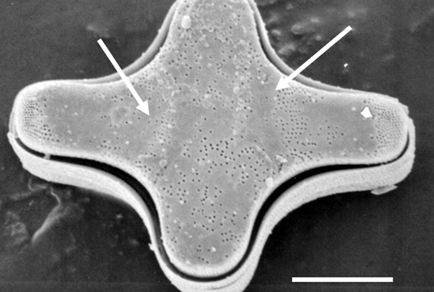

Abstract
A review of species currently placed in the genus Tubulariella P.C.Silva (=Tubularia Brun) is provided. Three species are discussed: Tubulariella pistillaris, T. tabellarioides and an unnamed taxon as no specimens for light microscopy are available. Comments are made on additional specimens that may or may not belong to Tubulariella. The relationships of Tubulariella are discussed.
References
- Barker, J.W. & Meakin, S.H. (1948) New and rare diatoms. Journal of the Quekett Microscopical Club ser. 4 2 (5): 233–235.
- Beraldi-Campesi, H. (2005) Microfossils as biosignatures. In: Hoover, R.B., Levin, G.V., Rozanov, A.Y. & Gladstone, G.R. (Eds.) Astrobiology and Planetary Missions, Proceedings of SPIE, The International Society for Optical Engineering 59060O (22 September 2005). https://doi.org/10.1117/12.637213
- Beraldi-Campesi, H. & Cevallos-Ferriz, S.R.S. (2005) Diversidad de microfósiles en la Formación Tarahumara, Sonora. Revista Mexicana de Ciencias Geológicas 22: 261–271.
- Beraldi-Campesi, H., Cevallos-Ferriz, S.R.S. & Chacón-Baca, E. (2004) Microfossil algae associated with Cretaceous stromatolites in the Tarahumara Formation, Sonora, Mexico. Cretaceous Research 25 (2): 249–265. https://doi.org/10.1016/j.cretres.2003.12.002
- Beraldi-Campesi, H., Mann, D.G. & Cevallos-Ferriz, S.R.S. (2015) Life cycle of 70 Ma-old non-marine pennate diatoms. Cretaceous Research 56: 662–672. https://doi.org/10.1016/j.cretres.2015.07.004
- Brun, J. (1894) Espèces nouvelles. Le Diatomiste 2 (17): 86–88.
- Chacón-Baca, E., Beraldi-Campesi, H., Cevallos-Ferriz, S.R.S., Knoll, A. & Golubic, S. (2002) 70 Ma nonmarine diatoms from northern Mexico. Geology 30: 279–281. https://doi.org/10.1130/0091-7613(2002)030%3C0279:MNDFNM%3E2.0.CO;2
- Chambers, P.M. (1997) Late Cretaceous and Paleocene marine diatom floras. Doctoral thesis (Ph.D), UCL (University College London). [https://discovery.ucl.ac.uk/id/eprint/10104676/]
- Desikachary, T.V. & Sreelatha, P.M. (1989) Oamaru Diatoms. Bibliotheca Diatomologica, vol. 19. 330 pp., 145 pls.
- Gersonde, R. & Harwood, D.M. (1990) Lower Cretaceous diatoms from ODP Leg 113 Site 693 (Weddell Sea). Part 1: Vegetative cells. Proceedings of the Ocean Drilling Program, Scientific Results 113: 365–402. https://doi.org/10.2973/odp.proc.sr.113.127.1990
- Hajós, M. & Stradner, H. (1975) Late Cretaceous Archaeomonadaceae, Diatomaceae, and Silicoflagellatae from the South Pacific Ocean, Deep Sea Drilling Project, Leg 29, Site 275. Initial Reports of the Deep Sea Drilling Project 29: 913–1009. [http://deepseadrilling.org/29/volume/dsdp29_26.pdf]
- Heck, P. (2015) Die fossilen Diatomeen Oamarus (Neuseeland) aus den ammlungen von Bernard Hartley und Nigel Charles. Privately published, 190 pp.
- Hendey, N.I. (1993) Observations on Gladiopsis from the Moreno shale, California. Beihefte zür Nova Hedwigia 106: 269–273.
- Kociolek, J.P., Escobar, L. & Richardson, S. (1996) Taxonomy and ultrastructure of Stoermeria, a new genus of diatoms (Bacillariophyta). Phycologia 35: 70–78. https://doi.org/10.2216/i0031-8884-35-1-70.1
- Kützing, F.T. (1844 [7–9th Nov.]) Die Kieselschaligen. Bacillarien oder Diatomeen. Nordhausen, W. Köhne, 152 pp., 30 pls.
- Nees von Esenbeck, C.G. (1820) Horae physicae Berolinenses :collectae ex symbolis virorum doctorum H. Linkii [...]. Bonnae, Adolphi Marcus.
- Nikolaev, V.A., Kociolek, J.P., Fourtanier, E., Barron, J.A. & Harwood, D.M. (2001) Late Cretaceous Diatoms (Bacillariophyceae) from the Marca Shale Member of the Moreno Formation, California. Occasional Papers of the California Academy of Sciences 152: 1–119.
- Novelo, E. & Tavera, R. (2011) Un panorama gráfico de las algas de agua dulce de México. A graphic panorama of the freshwater algae from Mexico. Hidrobiológica 21 (3): 333–341.
- Long, J.A., Fuge, D.P. & Smith, J. (1946) Diatoms of the Moreno Shale. Journal of Paleontology 20: 89–118. [https://www.jstor.org/stable/1299377]
- Ross, R., Cox, E.J., Karayeva, N.I., Mann, D.G., Paddock, T.B.B., Simonsen, R. & Sims, P.A. (1979) A suggested terminology for the siliceous components of the diatom cell. Beihefte zur Nova Hedwigia 64: 513–533.
- Roussel, H.F.A. (1806) Flore du Calvados. Poisson, Caen.
- Schrader, H.-J. (1969a) Die Pennaten Diatomeen aus dem Obereozän von Oamaru, Neuseeland. Beihefte zur Nova Hedwigia 28: 1–163, 39 pls.
- Schrader, H.-J. (1969b) Neue Gattungen und Arten fossiler Diatomceen. Diagnosen der neuen Gattungen und Arten zu der Arbeit: Die pennaten Diatomeen aus dem Obereozän von Oamaru, Neuseeland. Nova Hedwigia 17: 427–432.
- Schulz, P. (1935) Diatomeen aus senonen Schwammgesteinen der Danziger Bucht. Zugleich ein Beitrag zur Entwicklungsgeschichte der Diatomeen. Botanisches Archiv 37: 383–413.
- Schütt, F. (1896) Bacillariales (Diatomeae). In: Engler, A. & Prantl, K. (Eds.) Die natürlichen Pflanzenfamilien. Verlag von Wilhelm Engelmann, Leipzig, I, 1b: 31–150.
- Silva, P.C. (1970) Remarks on algal nomenclature. IV. Taxon 19: 941–945. https://doi.org/10.2307/1218317
- Sims, P.A., Ashworth, M.P., Theriot, E.C. & Manning, S.R. (2022 ‘2023’) Molecular and morphological analysis of Biddulphia sensu lato: a new diagnosis of Biddulphia, with a description of the new genera Biddulphiella and Neobrightwellia. Marine Micropaleontology 178 (102186): 1–21. https://doi.org/10.1016/j.marmicro.2022.102186
- Sims, P.A., Mann, D.G. & Medlin, L.K. (2006) Evolution of the diatoms: insights from fossil, biological and molecular data. Phycologia 45: 361–402. https://doi.org/10.2216/05-22.1
- Siver, P.A., Velez, M., Cliveti, M. & Binda, P. (2018) Early freshwater diatoms from the Upper Cretaceous Battle formation in Western Canada. PALAIOS 33 (12): 525–534. https://doi.org/10.2110/palo.2018.045
- Smith, H.L. (1872) Conspectus of the families and genera of the Diatomaceae. The Lens 1: 1–19; 72–93; 154–157.
- Van Heurck, H. (1896) A Treatise on the Diatomaceae, translated by W.E. Baxter. William Wesley & Son, London, 558 pp., 35 pls.
- Williams, D.M. (2001) Comments on the structure of ‘post-auxospore’ valves of Fragilariforma virescens. In: Jahn, R., Kociolek, J.P., Witkowski, A & Compere, P. (Eds.) Lange–Bertalot–Festschrift, Studies on diatoms, pp. 103–117.
- Williams, D.M. & Ebach, M.C. (2020) Cladistics: A Guide to Biological Classification. Cambridge University Press, Cambridge.
- Williams, D.M. & Kociolek, J.P. (2011) An overview of diatom classification with some prospects for the future. In: Seckbach, J & Kociolek, J.P. (Eds.) The Diatom World (Series: Cellular Origin, Life in Extreme Habitats and Astrobiology, Vol. 19), Springer, pp. 47–91. [http://link.springer.com/chapter/10.1007/978-94-007-1327-7_3]