
Abstract
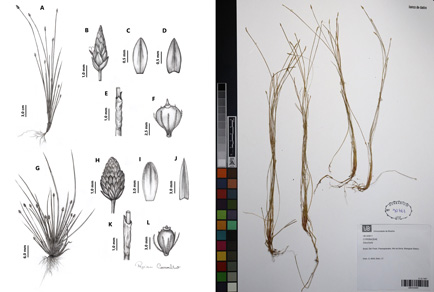
Here, two new species of aquatic sedges are described. Both new species belong to Eleocharis ser. Maculosae (Cyperaceae). They are endemic and occur in humid environments within the Atlantic Forest (in São Paulo state, Southeastern Brazil) and Caatinga (in Pernambuco state, Northeastern Brazil) biomes. Diagnostic morphological characters, illustrations, habitat descriptions, distribution maps, and an identification key are provided. Preliminary conservation assessments assert E. paranapiacabensis as Critically Endangered and E. raquellyrae as Endangered, highlighting the need for urgent conservation actions.
References
- Andrade-Lima, D. (1981) The Caatinga dominium. Revista Brasileira Botânica 4: 149–153.
- Araujo, H.F.P., Machado, C.C.C. & Silva, J.M.C. (2024) The distribution and conservation of areas with microendemic species in a biodiversity hotspot: a multi-taxa approach. PeerJ 12: e16779. https://doi.org/10.7717/peerj.16779
- Bachman, S., Moat, J., Hill, A.W., de la Torre, J. & Scott, B. (2011) Supporting Red List threat assessments with GeoCAT: geospatial conservation assessment tool. ZooKeys 150: 117–126. https://doi.org/10.3897/zookeys.150.2109
- Boeckeler, J.O. (1884) Neue Cyperaceen. In: Engler, A. (Ed.) Botanische Jahrbücher für Systematik, Pflanzengeschichte und Pflanzengeographie. Vol. 5. Wilhelm Engelmann, Leipzig, pp. 497–521.
- Boeckeler, J.O. (1886) Neue Cyperaceen von Argentinien, Mexiko, Alaska und dem Kilimandscharo. In: Engler, A. (Ed.) Botanische Jahrbücher für Systematik, Pflanzengeschichte und Pflanzengeographie. Vol. 7. Wilhelm Engelmann, Leipzig, pp. 273–280.
- Brown, R. (1810) Prodromus Florae Novae Hollandiae 1. R.Taylor, London, 224 pp.
- Cria (2025) Centro de Referência em Informação Ambiental. SpeciesLink. Available from: http://www.splink.org.br/ (accessed 19 February 2025)
- Gardner, R.C. & Finlayson, C.M. (2018) Global Wetland Outlook: State of the World’s Wetlands and their Services to People. Ramsar Convention Secretariat, Gland, Switzerland, 84 pp.
- Gil, A.S.B. & Bove, C.P. (2007) Eleocharis R.Br. (Cyperaceae) no Estado do Rio de Janeiro, Brasil. Biota Neotropica 7: 163–193. https://doi.org/10.1590/S1676-06032007000100020
- González-Elizondo, M.S. & Peterson, P.M. (1997) A classification of and key to the supraspecific taxa in Eleocharis (Cyperaceae). Taxon 46: 433–449. https://doi.org/10.2307/1224386
- González-Elizondo, M.S. & Tena-Flores, J.A. (2000) Eleocharis (Cyperaceae) in the New World. In: Wilson, K.L. & Morrison, D.A. (Eds.) Monocots: Systematics and evolution. CSIRO Publishing, Melbourne, pp. 637–643.
- Harris, J.G. & Harris, M.W. (2001) Plant identification terminology: an illustrated glossary. 2nd ed. Spring Lake Publishing, Utah, 198 pp.
- Hofstra, D., Schoelynck, J., Ferrell, J., Coetzee, J., Winton, M., Bickel, T.O., Champion, P., Madsen, J., Bakker, E.S., Hilt, S., Matheson, F., Netherland, M. & Gross, E.M. (2020) On the move: New insights on the ecology and management of native and alien macrophytes. Aquatic botany 162: 1–7. https://doi.org/10.1016/j.aquabot.2019.103190
- IUCN [International Union for the Conservation of Nature] (2022) Guidelines for using the IUCN Red List Categories and Criteria. Version 15.1. Standards and Petitions committe. Available from: https://www.iucnredlist.org/resources/redlistguidelines (accessed 5 April 2025)
- Jabot (2025) Jardim Botânico do Rio de Janeiro. The botanical collections management system, version 2.0. Available from: http://jabot.jbrj.gov.br/v3/consulta.php (accessed 20 February 2025)
- Joly, C.A., Metzger, J.P. & Tabarelli, M. (2014) Experiences from the Brazilian Atlantic forest: ecological findings and conservation initiatives. New Phytologist 204: 459–473. https://doi.org/10.1111/nph.12989
- Junk, W.J., An, S., Finlayson, C.M., Gopal, B., Kvet, J., Mitchell, S.A., Mitsch, W.J. & Robarts, R.D. (2013) Current state of knowledge regarding the world’s wetlands and their future under global climate change: a synthesis. Aquatic Sciences 75: 151–167. https://doi.org/10.1007/s00027-012-0278-z
- Kronka, F.J.N., Nalon, M.A., Matsukuma, C.K., Kanashiro, M.M., Ywane, M.S.S., Pavão, M., Durigan, G., Lima, L.M.P.R., Guillaumon, J.R., Baitello, J.B., Borgo, S.C., Manetti, L.A., Barradas, A.M.F., Fukuda, J.C., Shida, C.N., Barbosa, O., Soares, A.P., Joly, C.A. & Couto, H.T.Z. (2005) Inventário florestal da vegetação natural do Estado de São Paulo. Páginas e Letras, São Paulo, 200 pp.
- Kunth, K.S. (1837) Enumeratio Plantarum Omnium Hucusque Cognitarum. Vol. 2. Sumtibus J. G. Cottae, Stutgardiae, 591 pp.
- Larridon, I., Zuntini, A.R., Léveillé-Bourret, É., Barrett, R.L., Starr, J.R., Muasya, A.M., Villaverde, T., Bauters, K., Brewer, G.E., Bruhl, J.J., Costa, S.M., Elliott, T.L., Epitawalage, N., Escudero, M., Fairlie, I., Goetghebeur, P., Hipp, A.L., Jiménez-Mejías, P., Kikuchi, I.A.B.S., Luceño, M., Márquez-Corro, J.I., Martín-Bravo, S., Maurin, O., Pokorny, L., Roalson, E.H., Semouri, I., Simpson, D.A., Spalink, D., Thomas, W.W., Wilson, K.L., Xanthos, M., Forest, F. & Baker, W.J. (2021) A new classification of Cyperaceae (Poales) supported by phylogenomic data. Journal of Systematics and Evolution 59: 852–895. https://doi.org/10.1111/jse.12757
- Linnaeus, C. (1753) Species Plantarum. Laurentii Salvii, Stockholm, pp. 560.
- Leal, I.R., Silva, J.M.C., Tabarelli, M. & Lacher, T.E. Jr (2005) Changing the course of biodiversity conservation in the Caatinga of northeastern Brazil. Conservation Biology 19: 701–706. https://doi.org/10.1111/j.1523-1739.2005.00703.x
- MMA – Ministério do Meio Ambiente (2021) Plano Nacional de Recuperação da Vegetação Nativa – PLANAVEG 2021–2026. MMA, Brasília. Available from: https://www.gov.br/mma/pt-br/assuntos/ecossistemas/planaveg (accessed 5 April 2025)
- Mora-Osejo, L.E. (1978) Nueva Ciperacea de la laguna de Tota (Boyaca, Colombia). Caldasia 12: 277–281.
- Murray, B.R., Thrall, P.H., Gill, A.M. & Nicotra, A.B. (2017) How plant life-history and ecological traits relate to species rarity and commonness at varying spatial scales. Austral Ecology 42: 536–545. https://doi.org/10.1046/j.1442-9993.2002.01181.x
- Nunes, C.S., Maciel-Silva, J.F., Trevisan, R., Gil, A.S.B. Eleocharis in Flora e Funga do Brasil. Jardim Botânico do Rio de Janeiro. Available from: https://floradobrasil.jbrj.gov.br/FB7194 (accessed 17 December 2025)
- Oliveira-Filho, A.T. & Fontes, M.A.L. (2000) Patterns of floristic differentiation among Atlantic forests in southeastern Brazil, and the influence of climate. Biotropica 32: 793–810. https://doi.org/10.1111/j.1744-7429.2000.tb00619.x
- Poiret, J.L.M. (1804) Encyclopédie Methodique. Botanique. H. Agasse, Paris, pp. 786.
- Pott, V.J. & Pott, A. (2000) Plantas aquáticas do Pantanal. Embrapa, Brasilia, 404 pp.
- Presl, J.S. & Presl, C.B. (1828) Reliquiae Haenkeanae. Vol. 1. Apud J. G. Calve, Pragae, 356 pp.
- QGIS Development Team. (2023) QGIS 3.26 Brighton software. Geographic Information System. Open Source Geospatial Foundation Project. Available from: https://www.qgis.org/resources/hub/ (accessed 20 September 2024)
- Radford, A.E., Dickison, W.C., Massey, J.R. & Bell, C.R. (1974) Vascular Plant Systematics. Harper Collins, New York, 891 pp.
- Retzius, A.J. (1788) Observationes botanicae. Vol 5. Siegfried Leberecht Crusius, Leipzig, pp. 66.
- Ribeiro, M.C., Metzger, J.P., Martensen, A.C., Ponzoni, F.J. & Hirota, M.M. (2009) The Brazilian Atlantic Forest: How much is left, and how is the remaining forest distributed? Biological Conservation 142: 1141–1153. https://doi.org/10.1016/j.biocon.2009.02.021
- Roalson, E.H., Hinchliff, C.E., Trevisan, R. & Silva, C.R.M. (2010) Phylogenetic relatioships in Eleocharis (Cyperaceae): C4 photosynthesis origins and patterns of diversification in the spikerushes. Systematic Botany 35: 257–271. https://doi.org/10.1600/036364410791638270
- Roemer, J.J. & Schultes, J.A. (1817) Systema Vegetabilium. J. G. Cottae, Stuttgart, pp. 964.
- Santos, J.C., Leal, I.R., Almeida-Cortez, J.S., Fernandes, G.W. & Tabarelli, M. (2011) Caatinga: the scientific negligence experienced by a dry tropical forest. Tropical Conservation Science 4: 276–286. https://doi.org/10.1177/194008291100400306
- Silva, J.M.C., Leal, I.R. & Tabarelli, M. (2017) Caatinga: the largest Tropical Dry Forest region in South America. Springer, Cham, 482 pp. https://doi.org/10.1007/978-3-319-68339-3
- Silva, J.M.C. & Casteleti, C.H.M. (2003) Estado da biodiversidade da Mata Atlântica brasileira. In: Galindo-Leal, C. & Câmara, I.G. (Eds.) Biodiversidade da Mata Atlântica: áreas e ações prioritárias para a conservação. Ministério do Meio Ambiente, Brasília, pp. 43–59. Available from: https://ecologia.ib.usp.br/ecovegetal/leituras/CapituloVEstadodabiodiversidadedaMataAtlanticabrasileira.pdf (accessed 30 April 2025)
- Silva, J.M.C., Sousa, M.C. & Castelletti, C.H.M. (2004) Areas of endemism for passerine birds in the Atlantic forest, South America. Global Ecology and Biogeography 13: 85–92. https://doi.org/10.1111/j.1466-882X.2004.00077.x
- Simpson, D.A. (1993) New species and a new combination in Cyperaceae from Brazil: Notes on Brazilian Cyperaceae VI. Kew Bulletin 48: 699–713. https://doi.org/10.2307/4118848
- Svenson, H.K. (1929) Monographic studies in the genus Eleocharis. Rhodora 31: 57–242. https://doi.org/10.5962/p.336116
- Svenson, H.K. (1934) Monographic studies in the genus Eleocharis. Rhodora 36: 377–389.
- Svenson, H.K. (1937) Monographic studies in the genus Eleocharis. Rhodora 39: 236–273.
- Svenson, H.K. (1939) Monographic studies in the genus Eleocharis. Rhodora 41: 90–110.
- Svenson, H.K. (1957) Eleocharis R.Br. In: Britton, N.L. & Underwood, L.M. (Eds.) North American Flora 18. The New York Botanical Garden, New York, pp. 509–540.
- Thiers, B. (2025) Index Herbariorum: a global directory of public herbaria and associated staff. New York Botanical Garden’s Virtual Herbarium. Available from: http://sweetgum.nybg.org/science/ih/ (accessed 10 January 2025)
- Thomas, W.W., De Carvalho, A.M.V, Amorim, A.M.A., Garrison, J. & Arbeláez, A.L. (1998) Plant endemism in two forests in southern Bahia, Brazil. Biodiversity and Conservation 7: 311–322. https://doi.org/10.1023/A:1008825627656
- Trevisan, R. & Boldrini, I.I. (2008) O gênero Eleocharis R.Br. (Cyperaceae) no Rio Grande do Sul, Brasil. Revista Brasileira de Biociências 6: 7–67.
- Trevisan, R. & Boldrini, I.I. (2010) Novelties in Eleocharis ser. Tenuissimae (Cyperaceae), and a key to the species of the series occurring in Brazil. Systematic Botany 35: 504–511. https://doi.org/10.1600/036364410792495836
- Urban, I. (1903) Symbolae Antillanae: seu fundamenta florae Indiae occidentalis. Fratres Borntraeger, Leipzig, pp. 771.
- Vahlii, M. (1805) Enumeratio Plantarum: vel ab aliis, vel ab ipso observatarum, cum earum differentiis specificis, synonymis selectis et descriptionibus succinctis. Johann Heinrich Schubothe, Copenhagen & Leipzig, pp. 397. https://doi.org/10.5962/bhl.title.7564