

Abstract
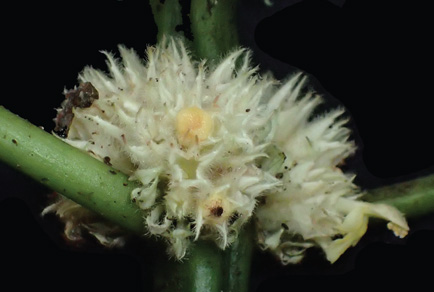
Paraphlomis aristata, a perennial herbaceous plant belonging to the mint family (Lamiaceae), was discovered in Northern Luzon, Philippines, and is herein described and illustrated. The new species shares phenetic similarity with P. javanica in having a stem with quadrangular, obtuse corners, covered with fine hairs, and with elliptic leaves that are confined to the upper stem. In addition, the species have globose verticillaster inflorescences, and mature nutlets have a rounded apex. Paraphlomis aristata is notably differentiated by its light-yellow flowers with calyces that have a strongly involute margin, which are constantly densely villose on the abaxial surface throughout both flowering and fruiting stages. Moreover, the calyx lobes are narrowly triangular, each with a needle-like, filiform, or bristle-like apex.
References
- Bendiksby, M., Thorbek, L., Scheen, A.C., Charlotte, L. & Olof, R. (2011) An updated phylogeny and classification of Lamiaceae subfamily Lamioideae. Taxon 60 (2): 471–484. https://doi.org/10.1002/tax.602015
- Casella, F., Vurro, M., Valerio, F., Perrino, E.V., Mezzapesa, G.N. & Boari, A. (2023) Phytotoxic Effects of Essential Oils from Six Lamiaceae Species. Agronomy 13: 257.
- Chen, Y.P., Liu, A., Yu, X.L. & Xiang, C.L. (2021) A preliminary phylogenetic study of Paraphlomis (Lamiaceae) based on molecular and morphological evidence. Plant Diversity 43 (3): 206–215. https://doi.org/10.1016/j.pld.2021.3.002
- Chen, Y.P., Xiao, J.F., Xiang, C.L. & Li, X. (2022) Paraphlomis hsiwenii (Lamiaceae), a new species from the limestone area of Guangxi, China. PhytoKeys 212: 85–96. https://doi.org/10.3897/phytokets.212.91174
- Elmer, A.D.E. (1908) A Century of New Plants. Leaflets of Philippine Botany 272: 359.
- Guo, G.X., Zhao, W.Y., Chen, Y.P., Xiao, J.H., Li, Y.Q. & Fan, Q. (2023) Paraphlomis yingdeensis (Lamiaceae), a new species from Guangdong (China). PhytoKeys 219: 107–120. https://doi.org/10.3897/phytokeys.219.97547
- Harlry, R.M., Atkins, S., Budantsev, A.L., Cantino, P.D., Conn, B.J., Grater, R., Harley, M.M., de Kok, R., Krestovskaja, T., Morales, R., Patron, A.J., Ryding, O. & Upson, T. (2004) Labiatae. In: Kubitzki, K. & Kardereit, J.W. (Eds.) The families and genera of vascular plants, Vol. 7. Springer, Berlin and Heidelber, pp. 167–275. https://doi.org/10.1007/978-3-642-18617-2_11
- IUCN (2024) Guidelines for Using the IUCN Red list Categories and Criteria. Version 14. Prepared by the Standards and Petitions Committee. Available from: http://www.iucnredlist.org/documents/RedListGuidelines.pdf (accessed 1 July 2025)
- Ko, S.C., Lee, Y.M., Chung, K.S., Son, D.C., Nam, B.M. & Chung, G.Y. (2014) A new species of Paraphlomis (Lamiaceae) from Korea: An additional genus to the Korean flora. Phytotaxa 175 (1): 51–54. https://doi.org/10.11646/phytotaxa.175.1.6
- Li, H.W. & Hedge, I.C. (1994) Lamiaceae. In: Wu, C.Y. & Raven, P.H. (Eds.) Flora of China, vol. 17. Science Press, Beijing and Missouri Botanical Garden Press, St. Louis, pp. 269–291.
- Liu, A., Chen, H.B. & Chen, Y.P. (2025) Paraphlomis anisochila (Lamiaceae), a new species from Hunan, China. PhytoKeys 259: 249–262. https://doi.org/10.3897/phytokeys.259.153345
- Makino, T. (1915) Two new genera Matsumurella Makino and Ajugoides Makino. The Botanical Magazine (Tokyo) 29: 379–383.
- Martinov, I.I. (1820) Tekhno-Botanicheskīĭ Slovarʹ: na latinskom i rossīĭskom i͡azykakh. Sanktpeterburgie, 355 pp.
- National Integrated Protected Areas System Act of 1992. (1992) Republic Act No. 7586. Available from: https://ficiawww.oflgazette/gov.ph/1992/06/01/republic-act-no-7586/ (accessed 10 July 2025)
- Pelser, P.B., Barcelona, J.F. & Nickrent, D.L. (Eds.) (2011–onwards) Co’s Digital Flora of the Philippines. Available from: http://www.philippineplants.org (accessed 29 November 2023)
- Perrino, E.V., Wagensommer, R.P., Mezzapesa, G.N. & Trani, A. (2024) Stachys italica Mill.: synecology, functional compounds and potential use of an Italian endemic taxon. Planta 260: 138. https://doi.org/10.1007/s00425-024-04571-3
- POWO (2025) Plants of the World Online. Facilitated by the Royal Botanic Gardens, Kew. Published on the Internet. Available from: http://www.plantsoftheworldonline.org (accessed 29 June 2025).
- Prain, D. (1901) Paraphlomis Prain. Annals of Royal Botanical Gardens 9: 59–60.
- Prain, D. (1908) Paraphlomis Prain. Journal of the Asiatic Society of Bengal, Part 2, Natural History 74: 721.
- Republic Act 7586. (1992) An Act Providing for the Establishment and Management of National Integrated Protected Areas System, Defining its Scope and Coverage, and for other purposes. Available from: http://www.philchm.ph/wp-content/uploads/2019/03/ra7586.pdf (accessed 10 July 2025)
- Shomurodov, H.F., Khuzhanazarov, U.E., Beshko, N.Y., Akhmadalieva, B. & Sharipova, V.K.A. (2017) Demographic structure of populations of Salvia lilacinocoerulea Nevski, a rare species endemic to the Western Pamir-Alay (Uzbekistan, Turkmenistan). American Journal of Plant Science 8: 1411.
- Thiers, B. (2025) Index Herbariorum: A global directory of public herbaria and associated staff. New York Botanical Garden’s Virtual Herbarium. Available from: http://sweetgum.nybg.org/ih./ (accessed 28 October 2025)
- Uikey, J. (2024) Reviewing of plant belonging to Lamiaceae family. International Journal of Scientific Development and Research 9: 186–191. https://doi.org/10.5281/zenodo.13309903
- Wagensommer, R.P. (2023) Floristic studies in the light of biodiversity knowledge and conservation. Plants 12 (16): 2973. https://doi.org/10.3390/plants12162973
- Yan, K.J., Huang, Y.F., Li, X., Hu, R.C. & Wu, W.H. & Chen, Y.P. (2023) Paraphlomis caloneura (Lamiaceae), a new species from Guangxi, China. Systematic Botany 48: 346–353.
- Yeddes, W., Wannes, W.A., Hammami, M., Smida, M., Chebbi, A., Marzouk, B. & Tounsi, M.S. (2018) Effect of environmental conditions on the chemical composition and antioxidant activity of essential oils from Rosmarinus officinalis L. growing wild in Tunisia. Journal of Essential Oil Bearing Plants 21 (4): 972–986.
- Yuan, J.C., Liu, A., Takano, A., Maki, M., Hodel, R.G.J., Chen, Y.P. & Xiang, C.L. (2024) Plastid phylogenomics with broad taxon sampling provides insights into the generic delimitation of Paraphlomideae (Lamiaceae). Taxon 73 (4): 1016–1029. https://doi.org/10.1002/tax.13222