

Abstract
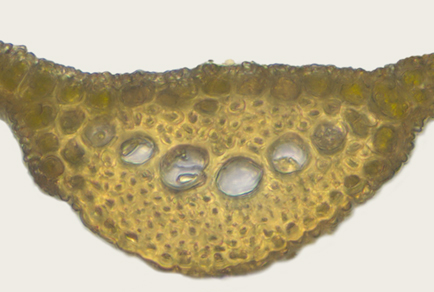
A new moss species, Trichostomum basilatinervium sp. nov., is described and illustrated from the Mediterranean region of Chile. Trichostomum basilatinervium is distinguished morphologically from other Trichostomum species by its imbricate leaves towards the stem base, appressed, sometimes contorted, with the apical ones incurved and crispate when dry, margins weakly denticulate or crenulate at the transitional area, lamina prolonging towards the mucro, costa broadest at base, in cross-section with 8–16 guide cells in two incomplete layers, usually with pairs of guide cells at the edges, and gymnostomous capsules. Drawings and light microscope photographs of the new species are provided, and possible confusion with other closely related taxa is discussed. Distribution of the new species is mapped.
References
- Alonso, M., Jiménez, J.A., Nylinder, S., Hedenäs, L. & Cano, M.J. (2016) Disentangling generic limits in Chionoloma, Oxystegus, Pachyneuropsis and Pseudosymblepharis (Bryophyta: Pottiaceae): An inquiry into their phylogenetic relationships. Taxon 65 (1): 3–18. https://doi.org/10.12705/651.1
- Alonso, M., Jiménez, J.A. & Cano, M.J. (2018) Taxonomic identity of Chionoloma bombayense (Pottiaceae, Bryophyta). Nova Hedwigia 106 (1–2): 5–15. https://doi.org/10.1127/nova_hedwigia/2017/0441
- Brinda, J.C. & Atwood, J.J. (eds.) (2025) The Bryophyte Nomenclator. Available from: https://www.bryonames.org/ (accessed 3 August 2025)
- Crosby, M.R., Magill, R.E., Allen, B. & He, S. (1999) A checklist of the mosses. Missouri Botanical Garden Press, St. Louis, 320 pp.
- Dusén, P. (1906) Beiträge zur Bryologie der Magellansländer, von Westpatagonien und Südchile. 4. Arkiv för Botanik 6 (8): 1–40.
- Gradstein, S.R., Churchill, S.P. & Salazar-Allen, N. (2001) Guide to the bryophytes of Tropical America. Memoirs of the New York Botanical Garden 86: 1–577.
- Guerra, J. (2006) Trichostomum Bruch. In: Guerra, J., Cano, M.J. & Ros, R.M. (Eds.) Flora briofítica ibérica (Vol. III). Sociedad Española de Briología, Universidad de Murcia, Murcia, pp. 76–83.
- Herzog, T. (1954) Zur Bryophytenflora Chiles. Revue Bryologique et Lichénologique 23 (1–2): 27–99.
- Larraín, J., Cano, M.J. & Jiménez, J.A. (2020) New bryophyte records from the Mediterranean region of Chile. Cryptogamie, Bryologie 41 (11): 131–140. https://doi.org/10.5252/cryptogamie-bryologie2020v41a11
- Larraín, J. & Drapela, P. (2022) Catálogo de los briófitos del Parque Nacional La Campana (Región de Valparaíso, Chile). Lilloa 59 (2): 127–187. https://doi.org/10.30550/j.lil/2021.59.1/2022.07.19
- Magill, R.E. (1981) Bryophyta Part 1. Mosses. Fascicle 1. Sphagnaceaeae–Grimmiaceae. In: Leistner, O.A. (Ed.) Flora of southern Africa which deals with the territories of South Africa, Transkei, Lesotho, Swaziland, Bophuthatswana, South West Africa/Namibia, Botswana and Venda. Botanical Research Institute, Pretoria, pp. 1–291.
- Ros, R.M., Werner, O. & Porley, R.D. (2022) Herzog vindicated: Integrative taxonomy reveals that Trichostomum brachydontium (Pottiaceae, Bryophyta) comprises several species. Taxonomy 2 (1): 57–88. https://doi.org/10.3390/taxonomy2010005
- Thériot, I. (1921) Contribution a la flore bryologique du Chili. Revista Chilena de Historia Natural 25: 289–312.
- Tropicos.org. (2025) Missouri Botanical Garden. Saint Louis. Available from: https://tropicos.org (accessed 3 August 2025)
- William, R.S. (1915) Mosses from the west coast of South America. Bulletin of the Torrey Botanical Club 42: 393–404. https://doi.org/10.2307/2479488
- Zander, R.H. (1993) Genera of the Pottiaceae: mosses of harsh environments. Bulletin of the Buffalo Society of Natural Sciences 32: 1–378.