
Abstract
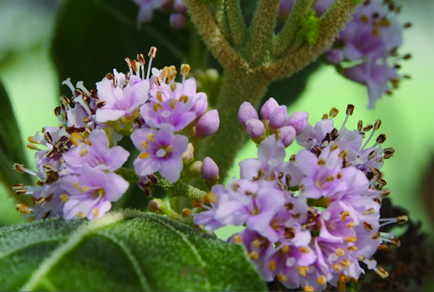
Two newly identified species of Callicarpa (Lamiaceae), C. boninensis and C. hahajimensis, along with a new natural hybrid, C. × chibusensis, are described. All were identified on Hahajima Island in the Ogasawara Islands, Japan. A comprehensive key to Callicarpa taxa in the Ogasawara Islands is also provided. Callicarpa boninensis, morphologically most similar to C. subpubescens, is distinguished by persistent stellate hairs on mature leaves and elongated petioles. Callicarpa hahajimensis, resembling C. parvifolia in the Chichijima Islands, differs in having reduced stellate hair density on both leaf surfaces and thinner leaves. Callicarpa × chibusensis, considered a natural hybrid between C. subpubescens and C. boninensis, is characterized by intermediate stellate hair densities—higher than in C. subpubescens but lower than in C. boninensis—on both leaf surfaces, smaller leaves than those of C. subpubescens, and an earlier flowering phenology compared to C. boninensis.
References
- Bramley, G.L.C. (2013) The genus Callicarpa (Lamiaceae) in the Philippines. Kew Bulletin 68: 369–418. https://doi.org/10.1007/s12225-013-9456-y
- Cantino, P., Harley, R. & Wagstaff, S. (1992) Genera of Labiatae: status and classification. In: Harley, R. & Reynolds, T. (Eds.) Advances in labiate science. Royal Botanic Gardens Kew, Richmond, pp. 511–22.
- Chen, S.L. & Gilbert, M.G. (1994) Verbenaceae. In: Wu, Z.-Y. & Raven, P.H. (Eds.) Flora of China, vol. 17. Science Press, Missouri Botanical Garden Press, Beijing, St. Louis, pp. 1–49.
- Harley, R.M., Atkins, S., Budantsey, A.L., Cantino, P.D., Conn, B.J., Grayer, R., Harley, M.M., Kok, R.de, Krestovskaja, T., Morales, R., Paton, A.J., Ryding, O. & Upson, T. (2004) Labiatae. In: Kubitzki, K. & Kadereit, J.W. (Eds.) Families and Genera of Vascular Plants, vol. 7, Flowering Plants: Dicotyledons; Lamiales (except Acanthaceae including Avicenniaceae). Springer, Berlin, pp. 167–275. https://doi.org/10.1007/978-3-642-18617-2_11
- Hooker, W.J. & Arnott, G.A.W. (1841) The botany of Captain Beechey’s voyage : comprising an account of the plants collected by Messrs Lay and Collie, and other officers of the expedition, during the voyage to the Pacific and Bering’s strait, performed in His Majesty’s Ship Blossom, under the command of Captain F.W. Beechey in the years 1825, 26, 27 and 28. Henry G. Bohn, London.
- IUCN (2012) Red List Categories and Criteria: Version 3.1. Second edition. IUCN, Gland, Cambridge.
- Kawakubo, N. (1986) Morphological variation of three endemic species of Callicarpa (Verbenaceae) in the Bonin (Ogasawara) Islands. Plant Species Biology 1: 59–68. https://doi.org/10.1111/j.1442-1984.1986.tb00015.x
- Kawakubo, N. (1998) Evolution of cryptic dioecy in Callicarpa (Verbenaceae) on the Bonin Islands. In: Stuessy, T.F. & Ono, M. (Eds.) Evolution and speciation of island plants. Cambridge University Press, Cambridge, pp. 155–68.
- Koidzumi, G. (1918) Contributiones ad Floram Asiae Orientalis (Continued from Vol. XXXI, p. 262.). The Botanical Magazine, Tokyo 32: en53–en63. https://doi.org/10.15281/jplantres1887.32.375_53
- Li, B., Cantino, P.D., Olmstead, R.G., Bramley, G.L.C., Xiang, C.L., Ma, Z.H., Tan, Y.H. & Zhang, D.X. (2016) A large-scale chloroplast phylogeny of the Lamiaceae sheds new light on its subfamilial classification. Scientific Reports 6: 34343. https://doi.org/10.1038/srep34343
- Li, B. & Olmstead, R.G. (2017) Two new subfamilies in Lamiaceae. Phytotaxa 313: 222–226. https://doi.org/10.11646/phytotaxa.313.2.9
- Linnaeus, C. (1753) Species plantarum, exhibentes plantas rite cognitas, ad genera relatas, cum differentiis specificis, nominibus trivialibus, synonymis selectis, locis natalibus, secundum systema sexuale digestas, vol. 1. Impensis Laurentii Salvii, Holmiae.
- Mori, K., Kaneko, S., Isagi, Y., Murakami, N. & Kato, H. (2008) Isolation and characterization of 10 microsatellite loci in Callicarpa subpubescens (Verbenaceae), an endemic species of the Bonin Islands. Molecular Ecology Resources 8: 1423–25. https://doi.org/10.1111/j.1755-0998.2008.02194.x
- Ono, M. (1991) The flora of the Bonin (Ogasawara) Islands. Aliso: a journal of systematic evolutionary botany 13: 95–105. https://doi.org/10.5642/aliso.19911301.04
- Setsuko, S., Narita, S., Tamaki, I., Sugai, K., Nagano, A.J., Ujino-Ihara, T., Kato, H. & Isagi, Y. (2024b) Adaptive radiation of the Callicarpa genus in the Bonin Islands revealed through double-digest restriction site-associated DNA sequencing analysis. Ecology and Evolution 14: e70216. https://doi.org/10.1002/ece3.70216
- Setsuko, S., Sugai, K., Tamaki, I., Hayama, K. & Kato, H. (2024a) Ecotype variation in the endemic tree Callicarpa subpubescens on small oceanic islands: genetic, phenotypic, and environmental insights. Heredity 132: 309–319. https://doi.org/10.1038/s41437-024-00684-3
- Setsuko, S., Sugai, K., Uchiyama, K., Katoh, S., Kato, H., Narita, S. & Isagi, Y. (2018) Development of microsatellite markers for Callicarpa subpubescens (Lamiaceae), an endemic species of the Bonin Islands. Jornal of Forest Research 23: 393–97. https://doi.org/10.1080/13416979.2018.1520624
- Shimizu, Y. (2008) What is dry scrub in the Ogasawara Islands? Annual Report of Ogasawara Research 31: 1–17 [in Japanese]. [http://hdl.handle.net/10748/2366]
- Shimizu, Y. & Tabata, H. (1991) Forest structures, composition, and distribution on a Pacific island, with reference to ecological release and speciation. Pacific Science 45: 28–49. Available from: http://hdl.handle.net/10125/1375 (accessed on 22 December 2025)
- Sugai, K., Mori, K., Murakami, N. & Kato, H. (2019) Strong genetic structure revealed by microsatellite variation in Callicarpa species endemic to the Bonin (Ogasawara) Islands. Journal of Plant Research 132: 759–75. https://doi.org/10.1007/s10265-019-01144-4
- Yamamoto, T., Yonekura, K., Abe, A., Amano, M., Toyama, H., Shitara, T., Tagane, S., Hasegawa, F., Kashima, M., Kajita, T., Soejima, A. & Naiki, A. (2023) New or noteworthy distribution records of some vascular plants from Iriomote Island, Okinawa, Japan. The Journal of Japanese Botany 98: 178–91. [in Japanese with English abstract] https://doi.org/10.51033/jjapbot.jjapbot.ID0151
- Yamazaki, T. (1993) Verbenaceae. In: Iwatsuki, K., Yamazaki, T., Boufford, D.E. & Ohba, H. (Eds.) Flora of Japan, vol. IIIa. Kodansha Ltd., Tokyo, pp. 259–71.
- Yonekura, K. (2017) Lamiaceae (Labiatae). In: Ohashi, H., Kadota, Y., Murata, J., Yonekura, K. & Kihara, H. (Eds.) Wild flowers of Japan, vol. 5, Convolvulaceae-Caprifoliaceae. Heibonsha, Tokyo, pp. 101–43. [in Japanese]
- Zhao, F., Chen, Y.P., Salmaki, Y., Drew, B.T., Wilson, T.C., Scheen, A.C., Celep, F., Brauchler, C., Bendiksby, M., Wang, Q., Min, D.Z., Peng, H., Olmstead, R.G., Li, B. & Xiang, C.L. (2021) An updated tribal classification of Lamiaceae based on plastome phylogenomics. BMC Biology 19: 1–27. https://doi.org/10.1186/s12915-020-00931-z