
Abstract
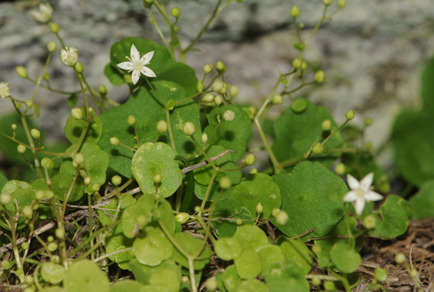
Umbilicus choripetalus is described as a new species from Ödemiş district in the province of İzmir in western Anatolia (Türkiye), based on morphological and molecular evidence. Diagnostic characteristics, a full description, and comprehensive photographs are provided. It is morphologically related to U. tropaeolifolius and U. paniculiformis, but can be distinguished both morphologically and ecologically. The most notable distinguishing feature is the corolla morphology: U. choripetalus has a stellate corolla with deeply divided petals, a unique feature within the genus. Other characteristic features include a linear and obtuse calyx structure and longer pedicels (2–15 mm). This species is distinct in its sparsely branched inflorescence, bearing a significantly reduced number of flowers (three to seventeen) arranged in a raceme or simple panicle. This situation starkly contrasts with profusely flowered and more robust paniculate inflorescences in related taxa. U. choripetalus is ecologically confined to volcanic substrates. Its relatives are restricted to limestone, indicating a significant degree of edaphic specialization . The combination of its morphological and ecological traits unequivocally establishes Umbilicus choripetalus as a distinct and isolated lineage within the genus Umbilicus.
References
- Adanson, M. (1763) Familles des plantes. Contenant une Préface Historike sur l’état ancien & actuel de la Botanike, & une Téorie de cette Science. II. Partie. Chez Vincent, Imprimeur-Libraire de Mgr le Comte de Provence, rue S. Severin, Paris, 640 pp.
- Al-Khulaidi, A.W.A., Gushash, A. & Algarni, A.A. (2020) Umbilicus tropaeolifolius Boiss. (Crassulaceae) a New Record to the Flora of the Arabian Peninsula. International Journal of Advanced Research 8 (09): 945–949. https://doi.org/10.21474/IJAR01/11746
- Borisova, A.G. (1939) Crassulaceae J.St.-Hil. Pp. 8–106 In: Komarov, V.L. & Yuzepchuk, S.V. (ed.) Flora of the U.S.S.R. 9. Moskva-Leningrad: Izdatel’stvo Akademii Nauk.
- Boissier, E. (1843) Diagnoses Plantarum Orientalium Novarum, ser. 1, vol. 3. Genevae / Lipsiae, 130 pp.
- Carlström, A. (1984) New species of Alyssum, Consolida, Origanum and Umbilicus from the SE Aegean Sea. Willdenowia 14: 15–26.
- Chamberlain, D.F. (1972) Umbilicus DC. Pp. 210–214 In: Davis, P.H. (ed.) Flora of Turkey and the East Aegean Islands 4. Edinburgh: Edinburgh University Press.
- Davis, P.H. (1972) Flora of Turkey and the East Aegean Islands (Supplement). 4. Edinburgh: Edinburgh University Press.
- Davis, P.H., Mill, R.R. & Tan, K. (1988) Flora of Turkey and the East Aegean Islands (Supplement). 10. Edinburgh: Edinburgh University Press.
- Eggli, U. (ed.) (2003) Illustrated Handbook of Succulent Plants: Crassulaceae. Springer Science & Business Media, 506 pp. https://doi.org/10.1007/978-3-642-55874-0
- Candolle, A.P. de (1801) Extrait d’un mémoire sur la famille des Joubarbes. Bulletin des Sciences par la Société Philomathique de Paris 3 (49): 1–2.
- GBIF (2025) Global Biodiversity Information Facility. Available from: https://www.gbif.org/ (accessed 13 July 2025).
- Güner, A., Aslan, S., Ekim, T., Vural, M. & Babaç, M.T. (2012) Türkiye Bitkileri Listesi (Damarlı Bitkiler). İstanbul: Nezahat Gökyiğit Botanik Bahçesi ve Flora Araştırmaları Derneği Yayınları.
- Hameed, M.A., Uzun, A. & Saeed, J.F. (2016) Vascular Plant Taxa of Hujran Basin, Erbil, Iraq. KSU J. Nat. Sci. 19 (3): 279–295.
- Harita Genel Müdürlüğü (2024) T. C. Milli Savunma Bakanlığı Harita Genel Müdürlüğü. Published at: https://www.harita.gov.tr/urun/denizlifiziki-il-haritasi/422 (accessed 25 September 2024).
- Hedberg, I. & Edwards, S. (1989) Flora of Ethiopia 3 Pittosporaceae to Araliaceae. The National Herbarium, Biology Department, Science faculty, Addis Ababa univ. Ethiopia and the department of systematic. Sweden, 660 pp.
- IUCN (2024) Guidelines for Using the IUCN Red List Categories and Criteria. Version 15.1. Prepared by the Standards and Petitions Committee, International Union for Conservation of Nature, Gland and Cambridge. Published at: https://www.iucnredlist.org/documents/RedListGuidelines.pdf (accessed 10 October 2024).
- Jansson, C.A. & Rechinger, K.H. (1970) Crassulaceae. J.St.-Hil. In: Rechinger, K.H. (ed.) Flora Iranica. Austria: Akademische Druck-u. Verlagsanstalt Graz, pp. 41.
- Kanani, M.R. (2016) Conservation and ecological assessment of plants in Bamou National Park, Iran. Environmental Sciences 14 (3): 173–186.
- Kumar, S., Stecher, G., Li, M., Knyaz, C. & Tamura, K. (2018) MEGA X: Molecular Evolutionary Genetics Analysis across Computing Platforms. Molecular Biology and Evolution 35 (6): 1547–1549. https://doi.org/10.1093/molbev/msy096
- Menemen, Y., Kandemir, A. & Aytaç, Z. (2016) Türkçe bilimsel bitki adları yönergesi (Directive of Turkish scientific plant names). Bağbahçe Bilim Dergisi 3: 1–3.
- OpenAI (2025) ChatGPT (version gpt-5.1). Large language model developed by OpenAI. Available at: https://www.openai.com/chatgpt (accessed 21 August 2025).
- POWO (2024) [continuously updated] Plants of the World Online. Facilitated by the Royal Botanic Gardens, Kew. Published at: http://www.plantsoftheworldonline.org/ (accessed 5 October 2024).
- Ronquist, F. & Huelsenbeck, J.P. (2003) MrBayes 3: Bayesian phylogenetic inference under mixed models. Bioinformatics 19 (12): 1572–1574. https://doi.org/10.1093/bioinformatics/btg180
- Rüstemoğlu, M. & Beçet, L. (2015) The flora of Mezraa/Turkey district and its surroundings 2. Biological Diversity and Conservation 8 (3): 25–41.
- Saygılı, R. (2015) Coğrafya Harita. Türkiye Dilsiz Haritası. Published at: http://cografyaharita.com/turkiye-dilsiz-haritalari.html (accessed 25 September 2024).
- Stamatakis, A. (2006) RA×ML-VI-HPC: Maximum Likelihood-Based Phylogenetic Analyses with Thousands of Taxa and Mixed Models. Bioinformatics 22: 2688–2690. https://doi.org/10.1093/bioinformatics/btl446
- Thiede, J. & Eggli, U. (2007) Crassulaceae J.St.-Hil. In: Kubitzki, K., Bayer, C. & Stevens, P.F. (ed.) The Families and Genera of Vascular Plants IX. Germany: Springer, pp. 83–118. https://doi.org/10.1007/978-3-540-32219-1_12
- Thiers, B. (2024) [continuously updated] Index Herbariorum. A global directory of public herbaria and associated staff. New York Botanical Garden’s Virtual Herbarium. Published at: http://sweetgum.nybg.org/ih/ (accessed 15 October 2024).
- Thulin, M. (2008) Flora of Somalia, Vol. 1 (1993; updated by M. Thulin 2008). Royal Botanic Gardens, Kew.
- Veiskarami, G.H. & Sharifi-Tehrani, M. (2017) Plant species diversity in the Central Zagros Region of Iran. Phytologia Balcanica 23 (1): 101–118.
- White, T.J., Bruns, T., Lee, S. & Taylor, J. (1990) Amplification and direct sequencing of fungal ribosomal RNA genes for phylogenetics. In: Innis, M.A., Gelfand, D.H., Sninsky, J.J. & White, T.J. (Eds.) PCR protocols: a guide to methods and applications. Academic Press, New York, pp. 315–322. https://doi.org/10.1016/B978-0-12-372180-8.50042-1
- Wickens, G.E. (1997) A New Species of Umbilicus (Crassulaceae) from the Sudan Republic. Kew Bulletin 33 (3): 421–422. https://doi.org/10.2307/4110142
- Wikipedia (2025) Wikipedia, The Free Encyclopedia. Available from: https://en.wikipedia.org/ (accessed 13 July 2025).
- Yıldırım, H., Özdöl, T., Can, I.D., Erdem, S., Oğur, E. & Özüdoğru, B. (2022) Knautia goecmenii (Caprifoliaceae): an unexpected caespitose suffrutescent new species from the Western Anatolia, Turkey. Phytotaxa 531 (2): 97–110. https://doi.org/10.11646/phytotaxa.531.2.2