
Abstract
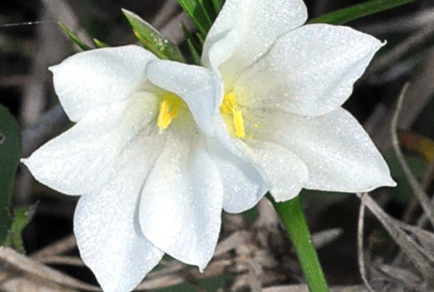
Two new species of Cipura are described from the Cerrado Biome (Brazil): Cipura kalunga, from the northern mesoregion of Goiás state, and C. mestrensis, previously confused with C. formosa, and found in the states of Bahia, Goiás, and Tocantins. A comprehensive review of herbarium specimens combined with fieldwork enabled molecular and morphological analyses to elucidate the phylogenetic relationships within Cipura and assess the taxonomic status of the two new species. The new taxonomic entities are described, illustrated, compared with morphologically related species and an amended description of C. formosa is proposed. Distribution maps and phenological data are also provided. Taxonomical and nomenclatural notes, typifications, conservation assessments and an identification key for the different species of Cipura are included. Phylogenetic analyses revealed two major lineages, distinguished by the morphology of the inner tepals, and 12 distinct taxa are recognized within the genus, of which three are only known from morphology.
References
- Alves, L.I.F., Lima, S.A.A. & Felix, L.P. (2011) Chromosme characterization and variability in some Iridaceae from Northeastern Brazil. Genetics and Molecular Biology 34: 259–267. https://doi.org/10.1590/S1415-47572011000200016
- Aublet, F. (1775) Histoire des plantes de la Guiane Françoise, vol. 1. Didot jeune, Londres, 621 pp.
- Bachman, S., Moat, J., Hill, A.W., de la Torre, J. & Scott, B. (2011) Supporting Red List threat assessments with GeoCAT: geospatial conservation assessment tool. ZooKeys 150: 117–126. https://doi.org/10.3897/zookeys.150.2109
- Báez-Lizarazo, M.R., Eggers, L., Aguiar, A.J.C. & Chauveau, O. (2021) Contrasting patterns of plant-pollinator interactions among four oil-secreting species of Iridaceae from Pampean and Cerrado provinces (Brazil). Botanical Journal of the Linnean Society 196: 256–277. https://doi.org/10.1093/botlinnean/boaa104
- Baker, J.G. (1892) Handbook of the Irideae. George Bell & Sons, London, 248 pp. https://doi.org/10.5962/bhl.title.15431
- Bartha, L., Macalik, K. & Keresztes, L. (2014) Molecular evidence for the hybrid origin of Hepatica transsilvanica (Ranunculaceae) based on nuclear gene sequences. Studia Universitatis Babes-Bolyai Biologia 59: 55–62.
- Beentje, H. (2016) The Kew Plant Glossary: an illustrated dictionary of plant terms. 2nd ed. Royal Botanic Gardens Kew, Richmond, 184 pp.
- Bohs, L. (2007) Phylogeny of the Cyphomandra clade of the genus Solanum (Solanaceae) based on ITS sequence data. Taxon 56: 1012–1026. https://doi.org/10.2307/25065901
- Carvalho, L.C.D. (2022) Variabilidade intraespecífica de Herbertia quareimana Ravenna (Iridaceae): uma abordagem citogenética, morfológica e ecológica. Universidade Federal do Rio Grande do Sul, Porto Alegre, 35 pp.
- Celis, M., Goldblatt, P. & Betancur, J. (2003) A new species of Cipura (Iridaceae) from Colombia and Venezuela. Novon 13: 419–422. https://doi.org/10.2307/3393372
- Chauveau, O., Eggers, L., Raquin, C., Silvério, A., Brown, S., Couloux, A., Cruaud, C., Kaltchuk-Santos, E., Yockteng, R., Souza-Chies, T.T. & Nadot, S. (2011) Evolution of oil producing trichomes in Sisyrinchium (Iridaceae): insights from the first comprehensive phylogenetic analysis of the genus. Annals of Botany (Oxford) 107: 1287–1312. https://doi.org/10.1093/aob/mcr080
- Chauveau, O., Eggers, L., Souza-Chies, T.T. & Nadot, S. (2012) Oil-producing flower within the Iridoideae (Iridaceae): evolutionary trends in the flower of the New World genera. Annals of Botany (Oxford) 110: 713–729. https://doi.org/10.1093/aob/mcs134
- Choi, B. & Jang, T.S. (2024) Natural hybridization between Iris minutoaurea Makino and Iris odaesanensis Y.N. Lee in Korea: evidence from cytological traits. Caryologia 77: 65–72. https://doi.org/10.36253/caryologia-2404
- Damasceno, R.G.L. & Gil, A.S.B. (2016) Flora das cangas da Serra do Carajás, Pará, Brasil: Iridaceae. Rodriguésia 67: 1373–1376. https://doi.org/10.1590/2175-7860201667534
- Doyle, J.J. & Doyle, J.L. (1990) A rapid total DNA preparation procedure for fresh plant tissue. Focus 12: 13–15.
- Eggers, L. & Chauveau, O. (2025) Larentia in Flora e Funga do Brasil. Jardim Botânico do Rio de Janeiro. Available from: https://floradobrasil.jbrj.gov.br/FB115399 (accessed: 15 February 2025)
- Foster, R.C. (1945) Studies in the Iridaceae III. Contributions from the Gray Herbarium of Harvard University 155: 3–54.
- Foster, R.C. (1950) Studies in the Iridaceae VI. Miscellaneous novelties and transfers. Contributions from the Gray Herbarium of Harvard University 171: 22–28.
- García, G., Raven, P.H. & Meerow, A.W. (2024) Pierfelice Ravenna (1938–2022) – Life, new names, and confusion. Annals of the Missouri Botanical Garden 109: 490–516. https://doi.org/10.3417/2024933
- Gil, A.S.B. & Damasceno, R.G.L. (2025) Cipura in Flora e Funga do Brasil. Jardim Botânico do Rio de Janeiro. Available from: https://floradobrasil.jbrj.gov.br/FB8042 (accessed: 15 February 2025)
- Goldblatt, P. & Celis, M. (2010) Zygella S. Moore, a synonym of Larentia Klatt (Iridaceae). Novon 20: 412–413. https://doi.org/10.3417/2009132
- Goldblatt, P. & Henrich, J.E. (1987) Notes on Cipura (Iridaceae) in South and Central America, and a new species from Venezuela. Annals of the Missouri Botanical Garden 74: 333–340. https://doi.org/10.2307/2399404
- Goldblatt, P. & Henrich, J.E. (1991) Calydorea Herbert (Iridaceae-Tigridieae): notes on this New World genus and reduction to synonymy of Salpingostylis, Cardiostigma, Itysa and Catila. Annals of the Missouri Botanical Garden 78: 504–511. https://doi.org/10.2307/2399577
- Goldblatt, P. & Manning, J.C. (2008) The iris family – natural history and classification. Timber Press, Portland, 290 pp.
- Goldblatt, P., Rodriguez, A., Powell, M.P., Davies, T.J., Manning, J.C., van der Bank, M. & Savolainen, V. (2008) Iridaceae ‘out of Australasia’? Phylogeny, biogeography, and divergence time based on plastid DNA sequences. Systematic Botany 33: 495–508. https://doi.org/10.1600/036364408785679806
- Grisebach, A. (1866) Cipura cubensis. Catalogus Plantarum Cubensium: 251–252.
- Henrich, J.E. & Goldblatt, P. (1994) Iridaceae. In: Davidse, G., Sousa, M.S. & Chater, A.O. (Eds.) Flora Mesoamericana. Vol. 6. Alismataceae a Cyperaceae. UNAM, México, pp. 71–80.
- Herbert, W. (1839) Phalocallis plumbea lead-coloured Phalocallis. Curtis’s Botanical Magazine 65 (n. ser. v. 12): t. 3710.
- Herbert, W. (1840) Gelasine azurea. Curtis’s Botanical Magazine 66 (n. ser. v. 13): t. 3779.
- Herbert, W. (1843a) Eleutherine. Edwards’s Botanical Register 29: t.57.
- Herbert, W. (1843b) Calydorea. Edwards’s Botanical Register 29 (misc.): 85.
- Humboldt, A., Bonpland, A. & Kunth, K.S. (1816) Nova Genera et Species Plantarum (quarto ed.) 1. Librairie Grecque–Latine–Allemande, Paris, 377 pp.
- Inácio, C.D., Chauveau, O., Souza-Chies, T.T., Sauquet, H. & Eggers, L. (2017) An updated phylogeny and infrageneric classification of the genus Sisyrinchium (Iridaceae): challenges of molecular and morphological evidence. Taxon 66: 1317–1348. https://doi.org/10.12705/666.4
- iNaturalist (2025 [continuously updated]) iNaturalist Database. Available from: https://www.inaturalist.org (accessed: 17 March 2025)
- IUCN Standards and Petitions Subcommittee (2024) Guidelines for Using the IUCN Red List Categories and Criteria. Version 16. Available from: https://www.iucnredlist.org/documents/RedListGuidelines.pdf (accessed: 17 March 2025)
- Katoh, K., Rozewicki, J. & Yamada, K.D. (2019) MAFFT online service: multiple sequence alignment, interactive sequence choice and visualization. Briefings in Bioinformatics 20: 1160–1166. https://doi.org/10.1093/bib/bbx108
- Kenton, A. & Heywood, C.A. (1984) Cytological studies in South American Iridaceae. Plant Systematics and Evolution 146: 87–104. https://doi.org/10.1007/BF00984056
- Klatt, F.W. (1871) Irideae. In: Martius, C.F.P. von & Eichler, A.G. (Eds.) Flora Brasiliensis 3(1). Wolf, C. et fil. & Minsinger, S., Munich, pp. 510–548. https://doi.org/10.5962/bhl.title.454
- Klatt, F.W. (1882) Ergänzungen und berichtigungen zu Baker’s Systema Iridacearum. Abhandlungen der Naturforschenden Gesellschaft zu Halle 15: 337–404.
- Levin, R.A., Watson, K. & Bohs, L. (2005) A four-gene study of evolutionary relationships in Solanum section Acanthophora. American Journal of Botany 92: 603–612. https://doi.org/10.3732/ajb.92.4.603
- Li, M., Wunder, J., Bissoli, G., Scarponi, E., Gazzani, S., Barbaro, E., Saedler, H. & Varotto, C. (2008) Development of COS genes as universally amplifiable markers for phylogenetic reconstructions of closely related plant species. Cladistics 24: 727–745. https://doi.org/10.1111/j.1096-0031.2008.00207.x
- Miller, M.A., Pfeiffer, W. & Schwartz, T. (2010) Creating the CIPRES Science Gateway for inference of large phylogenetic trees. In: Proceedings of the Gateway Computing Environments Workshop (GCE), New Orleans, LA, USA, pp. 1–8. https://doi.org/10.1109/GCE.2010.5676129
- Moraes, A.P., Souza-Chies, T.T., Stiehl-Alves, E.M., Burchardt, P., Eggers, L., Siljak-Yakovlev, S., Brown, S.C., Chauveau, O., Nadot, S., Bourge, M., Viccini, L.F. & Kaltchuk-Santos, E. (2015) Evolutionary trends in Iridaceae: new cytogenetic findings from the New World. Botanical Journal of the Linnean Society 177: 27–49. https://doi.org/10.1111/boj.12232
- Mosolygó-Lukács, A., Sramkó, G., Barabás, S., Czeglédi, L., Jávor, A., Molnár, V.A. & Surányi, G. (2016) Molecular genetic evidence for allotetraploid hybrid speciation in the genus Crocus L. (Iridaceae). Phytotaxa 258: 121–136. https://doi.org/10.11646/phytotaxa.258.2.2
- Müller, K. (2005) SeqState – primer design and sequence statistics for phylogenetic DNA data sets. Applied Bioinformatics 4: 65–69. https://doi.org/10.2165/00822942-200504010-00008
- Munguía-Lino, G., Vargas-Amado, G., Vázquez-García, L.M. & Rodríguez, A. (2015) Riqueza y distribución geográfica de la tribu Tigridieae (Iridaceae) en Norteamérica. Revista Mexicana de Biodiversidad 86: 80–98. https://doi.org/10.7550/rmb.44083
- Munguía-Lino, G., Vargas-Ponce, O. & Rodríguez, A. (2017) Tigridieae (Iridaceae) in North America: floral diversity, flower preservation methods and keys for the identification of genera and species. Botanical Sciences 95: 473–502. https://doi.org/10.17129/botsci.727
- Nuttall, T. (1837) Collection towards a flora of the territory of Arkansas. Transactions of the American Philosophical Society 5: 139–203.
- Nylander, J.A.A. (2004) MrModeltest v2. Program distributed by the author. Evolutionary Biology Centre, Uppsala University. Available from: https://github.com/nylander/MrModeltest2 (accessed: 7 May 2024)
- Park, I., Choi, B., Weiss-Schneeweiss, H., So, S., Myeong, H.H. & Jang, T.S. (2022) Comparative analyses of complete chloroplast genomes and karyotypes of allotetraploid Iris koreana and its putative diploid parental species (Iris Series Chinenses, Iridaceae). International Journal of Molecular Sciences 23: 10929. https://doi.org/10.3390/ijms231810929
- Pastori, T., Eggers, L., Souza-Chies, T.T. & Chauveau, O. (2018) Iterative taxonomy based on morphological and molecular evidence to estimate species boundaries: a case study in Cypella (Iridaceae: Iridoideae). Plant Systematics and Evolution 304: 1117–1140. https://doi.org/10.1007/s00606-018-1536-x
- POWO (2024) Plants of the World Online. Facilitated by the Royal Botanic Gardens, Kew. Published on the Internet; Available from: https://powo.science.kew.org/ (accessed: 10 September 2024)
- QGIS.org (2014) QGIS Geographic Information System. QGIS Association. Available from: http://www.qgis.org (accessed: 2 May 2024)
- Raca, I., Blattner, F.R., Waminal, N.E., Kerndorff, H., Randelovic, V. & Harpke, D. (2023) Disentangling Crocus Series Verni and its polyploids. Biology 12: 303. https://doi.org/10.3390/biology12020303
- Ravenna, P. (1964) Notas sobre Iridaceae. Revista del Instituto Municipal de Botanica 2: 51–60.
- Ravenna, P. (1984) Notes on Iridaceae VI. Phytologia 56: 193–195.
- Ravenna, P. (1977) Notas sobre Iridaceae V. Noticiario Mensual del Museo Nacional de Historia Natural 249: 7–9.
- Ravenna, P. (1988) Revisional studies in the genus Cipura (Iridaceae). Onira Botanical Leaflets 1: 35–44.
- Ravenna, P. (2003) Flora de Paraguay - Iridaceae. Botanica Australis 4: 1–60.
- Rodriguez, A. & Sytsma, K.J. (2006) Phylogenetics of the "tiger-flower" group (Tigridieae: Iridaceae): molecular and morphological evidence. Aliso 22: 412–424. https://doi.org/10.5642/aliso.20062201.33
- Ronquist, F., Teslenko, M., van der Mark, P., Ayres, D.L., Darling, A., Höhna, S., Larget, B., Liu, L., Suchard, M.A. & Huelsenbeck, J.P. (2012) MrBayes 3.2: Efficient Bayesian phylogenetic inference and model choice across a large model space. Systematic Biology 61: 539–542. https://doi.org/10.1093/sysbio/sys029
- Ronquist, F., Huelsenbeck, J.P., Teslenko, M., Zhang, C. & Nylander, J.A.A. (2020) MrBayes version 3.2 manual: tutorials and model summaries. Available from: http://nbisweden.github.io/MrBayes/manual.html (accessed: 7 May 2024)
- Rudall, P. (1991) Leaf anatomy in Tigridieae (Iridaceae). Plant Systematics and Evolution 175: 1–10. https://doi.org/10.1007/BF00942141
- Simmons, M.P., Müller, K. & Norton, A.P. (2007) The relative performance of indel-coding methods in simulations. Molecular Phylogenetics and Evolution 44: 724–740. https://doi.org/10.1016/j.ympev.2007.04.001
- Stamatakis, A. (2014) RAxML version 8: A tool for phylogenetic analysis and post-analysis of large phylogenies. Bioinformatics 30: 1312–1313. https://doi.org/10.1093/bioinformatics/btu033
- Stiehl-Alves, E.M., Flores, A.M., Silvério, A., Heck, J., Eggers, L., Kaltchuk-Santos, E., Mariath, J.E.A. & Souza-Chies, T.T. (2016) Differentiation between two self-compatible cytotypes of Herbertia lahue (Iridaceae): evidence from genotypic and phenotypic variation. Plant Systematics and Evolution 302: 669–682. https://doi.org/10.1007/s00606-016-1297-3
- Stiehl-Alves, E.M., Vieira, A.T., Trevelin, C., Martins, A.C., Souza-Chies, T.T. & Kaltchuk-Santos, E. (2024) Can ploidy levels explain the variation of Herbertia lahue (Iridaceae). Genetics and Molecular Biology 46: e20230137. https://doi.org/10.1590/1678-4685-GMB-2023-0137
- Tamura, K., Stecher, G. & Kumar, S. (2021) MEGA11: Molecular Evolutionary Genetics Analysis version 11. Molecular Biology and Evolution 38: 3022–3027. https://doi.org/10.1093/molbev/msab120
- Thiers, B. (2025 [continuously updated]) Index Herbariorum: A global directory of public herbaria and associated staff. New York Botanical Gardens’ Virtual Herbarium. Available from: http://sweetgum.nybg.org/ih/ (accessed: 9 January 2025)
- Turland, N.J., Wiersema, J.H., Barrie, F.R., Greuter, W., Hawksworth, D.L., Herendeen, P.S., Knapp, S., Kusber, W.-H., Li, D.-Z., Marhold, K., May, T.W., McNeill, J., Monro, A.M., Prado, J., Price, M.J. & Smith, G.F. (Eds.) (2018) International Code of Nomenclature for algae, fungi, and plants (Shenzhen Code) adopted by the Nineteenth International Botanical Congress Shenzhen, China, July 2017. Regnum Vegetabile 159. Koeltz Botanical Books, Glashütten. https://doi.org/10.12705/Code.2018
- Ulloa, C.U., Acevedo-Rodriguez, P., Beck, S., Belgrano, M.J., Bernal, R., Berry, P.E., Brako, L., Celis, M., Davidse, G., Forzza, R.C., Gradstein, S.R., Hokche, O., León, B., León-Yánez, S., Magill, R.E., Neill, D.A., Nee, M., Raven, P.H., Stimmel, H., Strong, M.T., Villaseñor, J.L., Zarucchi, J.L., Zuloaga, F.O. & Jørgensen, P.M. (2017) An integrated assessment of the vascular plant species of the Americas. Science 358: 1614–1617. https://doi.org/10.1126/science.aao0398
- UNEP-WCMC (2021) Protected Area Profile for Sitio Histórico e Patrimonio Cultural Kalunga from the World Database of Protected Areas, December 2021. Available from: http://www.protectedplanet.net (accessed: 22 December 2023)
- Xiao, Y.E., Yu, F.Y. & Zhou, X.F. (2021) A new natural hybrid of Iris (Iridaceae) from Chongqing, China. Phytokeys 174: 1–12. https://doi.org/10.3897/phytokeys.174.62306