

Abstract
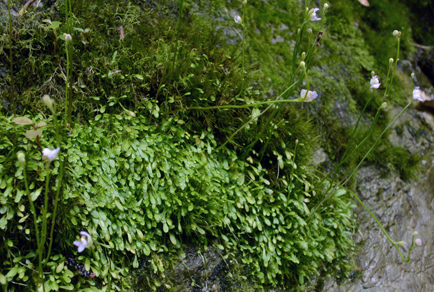
Utricularia damingshanensis (Lentibulariaceae), a new species from Guangxi, China, is described and illustrated. It resembles U. caerulea and U. warburgii but differs in having a corolla palate with four hooked processes on the distal margin; lower calyx lobe distinctly shorter than the upper; distinctly striped corolla with 8–15 deep violet lines on the lower lip and 6–9 radiating lines on the upper lip, as well as a helmet-like swelling at the base of the lower lip. Phylogenetic analysis based on nrITS, rps16, and trnD–trnT strongly supported its placement in sect. Nigrescentes as sister to U. warburgii. Both morphological and molecular evidence support its status as a new species.
References
- Gamble, J.S. (1924) Flora of the presidency of Madras. Volume 2. West, Newman and Adlard, London, 983 pp.
- Goebel, K. (1891) Morphologische und biologische Studien. Annales du Jardin Botanique de Buitenzorg 9: 64.
- Good, R.D. (1924) New tropical African Lentibulariaceae. The Journal of Botany 537: 161–165.
- IUCN (2012) IUCN Red List Categories and Criteria. Version 3. Edited by P. by the I. S. S. Commission. Gland, Switzerland and Cambridge, UK. [https://portals.iucn.org/library/node/10315]
- Jobson, R.W., Baleeiro, P.C. & Guisande, C. (2018) Systematics and evolution of Lentibulariaceae: III. Utricularia. In: Ellison, A.M. & Adamec, L. (eds.) Carnivorous plants: Physiology, ecology, and evolution. Oxford University Press, Oxford, pp. 89–104. https://doi.org/10.1093/oso/9780198779841.003.0008
- Jobson, R.W. & Baleeiro, P.C. (2025) Molecular phylogeny of Utricularia sections Meionula and Nigrescentes (Subg. Bivalvaria; Lentibulariaceae) with a new species for the mound springs of the Great Artesian Basin, Australia. Telopea 29: 71–81. https://doi.org/10.7751/telopea20197
- Kalyaanamoorthy, S., Minh, B.Q., Wong, T.K.F., von Haeseler, A. & Jermiin, L.S. (2017) ModelFinder: fast model selection for accurate phylogenetic estimates. Nature Methods 14: 587–589. https://doi.org/10.1038/nmeth.4285
- Komiya, S. (1973) New subdivision of the Lentibulariaceae. The Journal of Japanese Botany 48: 147–153.
- Krishnapriya, M.P., Silva, S.R., Miranda, V.F.O. & Nampy, S. (2024) Revisiting Utricularia section Nigrescentes (Lentibulariaceae) in India and re-instating Utricularia roseopurpurea, integrating morphological and molecular data. Rheedea 34: 20–38. https://doi.org/10.22244/rheedea.2024.34.01.02
- Kurz, W.S. (1874) Description of Utricularia nivea Vahl. Journal of Botany, British and Foreign 12: 53–54.
- Lan, T., Renner, T., Ibarra-Laclette, E., Farr, K.M., Chang, T.H., Cervantes-Pérez, S.A., Zheng, C., Sankoff, D., Tang, H., Purbojati, R.W., Putra, A., Drautz-Moses, D.I., Schuster, S.C., Herrera-Estrella, I. & Albert, V.A. (2017) Long-read sequencing uncovers the adaptive topography of a carnivorous plant genome. Proceedings of the National Academy of Sciences 114: E4435–E4441. https://doi.org/10.1073/pnas.1702072114
- Lehmann, J.G.C. (1844) Utricularia. Botanische Zeitung (Berlin) 2: 109–110.
- Li, Z.Y. (2007) Lentibulariaceae. In: Wu, Z.Y., Raven, P.H. & Hong, D.Y. (eds.) Flora of China. Volume 19. Science Press, Beijing and Missouri Botanical Garden Press, St. Louis, pp. 480–491.
- Li, Z.Z., Liao, K., Zou, C.Y., Liu, Y., Hu, G.W., Wang, Q.F. & Chen, J.M. (2018) Ottelia guanyangensis (Hydrocharitaceae), a new species from southwestern China. Phytotaxa 361: 294–300. https://doi.org/10.3897/phytokeys.135.38531
- Linnaeus, C. (1753) Species plantarum 1. Salvius, Stockholm, 572 pp.
- Müller, K.F., Borsch, T., Legendre, L., Porembski, S. & Barthlott, W. (2006) Recent progress in understanding the evolution of carnivorous Lentibulariaceae (Lamiales). Plant Biology 8: 748–757. https://doi.org/10.1055/s-2006-924706
- Nguyen, L.T., Schmidt, H.A., Von Haeseler, A. & Minh, B.Q. (2015) IQ-TREE: a fast and effective stochastic algorithm for estimating maximum-likelihood phylogenies. Molecular Biology and Evolution 32: 268–274. https://doi.org/10.1093/molbev/msu300
- Oliver, D. (1859) The Indian species of Utricularia. Botanical Journal of the Linnean Society 3: 170–190. https://doi.org/10.1111/j.1095-8339.1859.tb02053.x
- POWO. (2025) Plants of the World Online. Facilitated by the Royal Botanic Gardens, Kew. Available from: http://www.plantsoftheworldonline.org/ (accessed 15 April 2025)
- Ronquist, F. & Huelsenbeck, J.P. (2003) MrBayes 3: Bayesian phylogenetic inference under mixed models. Bioinformatics 19: 1572–1574. https://doi.org/10.1093/bioinformatics/btg180
- Silva, S.R., Gibson, R., Adamec, L., Domínguez, Y. & Miranda, V.F. (2018) Molecular phylogeny of bladderworts: A wide approach of Utricularia (Lentibulariaceae) species relationships based on six plastidial and nuclear DNA sequences. Molecular Phylogenetics and Evolution 118: 244–264. https://doi.org/10.1016/j.ympev.2017.10.010
- Stanford, A.M., Harden, R. & Parks, C.R. (2000) Phylogeny and biogeography of Juglans (Juglandaceae) based on matK and ITS sequence data. American Journal of Botany 87: 872–882.
- Taylor, P. (1986) New Taxa in Utricularia (Lentibulariaceae). Kew Bulletin 41: 1–18.
- Taylor, P. (1989) The Genus Utricularia - a taxonomic monograph. The Royal Botanic Gardens Kew, London, 736 pp.
- White, T.J., Bruns, T., Lee, S. & Taylor, J.W. (1990) Amplification and direct sequencing of fungal ribosomal RNA genes for phylogenetics. In: Innis, M.A., Gelfand, D.H., Sninsky, J.J. & White, T.J. (eds.) PCR protocols: a guide to methods and applications. Academic Press, Inc., New York, pp. 315–322.