

Abstract
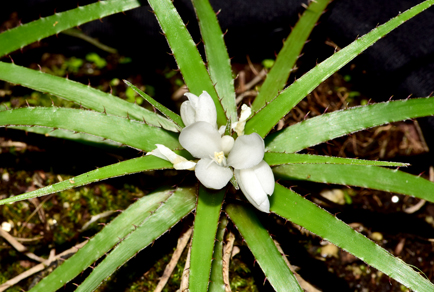
A new species of Hoplocryptanthus, a member of the bromelioid “Cryptanthoid complex”, is described based on plants discovered in a ferruginous rupestrian grassland located in the southern Iron Quadrangle region, Minas Gerais state, Brazil. Hoplocryptanthus serrapiresensis is endemic to the Pires Range, a region under strong threat by mining exploitation. The morphological characters of H. serrapiresensis are discussed in comparison with H. knegtianus and H. tiradentesensis. This microendemic species is assessed as Critically Endangered (CR), reinforcing the need for a strategy to protect the biodiversity of the region. Characters related to leaves proved useful in the taxonomic delimitation of this new species. Morphological analyses also validated and reinforced the diagnostic floral and inflorescence characters used in the circumscription of Hoplocryptanthus.
References
- Bachman, S., Moat, J., Hill, A.W., De la Torre, J. & Scott, B. (2011) Supporting Red List threat assessments with GeoCAT: geospatial conservation assessment tool. ZooKeys 150: 117–126. https://doi.org/10.3897/zookeys.150.2109
- Barfuss, M.H.J., Till, W., Leme, E.M.C., Pinzón, J.P., Manzanares, J.M., Halbritter, H., Samuel, R. & Brown, G.K. (2016) Taxonomic revision of Bromeliaceae subfam. Tillandsioideae based on a multi-locus DNA sequence phylogeny and morphology. Phytotaxa 279: 1–97. https://doi.org/10.11646/phytotaxa.279.1.1
- Carmo, F.F., Mota, R.C., Kamino, L.H.Y. & Jacobi, C.M. (2018) Check-list of vascular plant communities on ironstone ranges of south-eastern Brazil: dataset for conservation. Biodiversity Data Journal 6:e27032. https://doi.org/10.3897/BDJ.6.e27032
- Castro, J.L.L.M. (2024) Florística e conservação de uma área de canga na região do quadrilátero ferrífero, Minas Gerais, Brasil. MSc Thesis. Federal University of Juiz de Fora, 115 pp. [https://repositorio.ufjf.br/jspui/handle/ufjf/18097]
- Fidalgo, O. & Bononi, V.L.R. (1984) Técnicas de coleta, preservação e herborização de material botânico, manual n° 4. Instituto de Botânica, São Paulo, 62 pp.
- Gouda, E.J., Butcher, D. & Gouda, C.S. (2025 [continuously updated]) Encyclopaedia of Bromeliads, Version 4. University Botanic Gardens, Utrecht. Available from: http://bromeliad.nl/encyclopedia/ (accessed: 28 January 2025)
- Halbritter, H. (1992) Morphologie und systematische Bedeutung des Pollens der Bromeliaceae. Grana 31: 197–212. https://doi.org/10.1080/00173139209432032
- Halbritter, H. (1998) Preparing living pollen material for scanning electron microscopy using 2,2-dimethoxypropane (DMP) and criticalpoint drying. Biotechnic and Histochemistry 73: 137–143. https://doi.org/10.3109/10520299809140519
- Halbritter, H. & Hesse, M. (1993) Sulcus morphology in some monocot families. Grana 32: 87–99.
- Halbritter, M., Ulrich, S., Grímsson, F., Weber, M., Zetter, R., Hesse, M., Buchner, R., Svojka, M. & Frosch-Radivo, A. (2018) Illustrated Pollen Terminology. Springer, Wien, New York, 483 pp. https://doi.org/10.1007/978-3-319-71365-6
- IUCN Standards & Petitions Committee (2024) Guidelines for Using the IUCN Red List Categories and Criteria. Available from: https://www.iucnredlist.org/documents/RedListGuidelines.pdf (accessed: 1 May 2025)
- Jacobi, C.M. & Carmo, F.D. (2008) Diversidade dos campos rupestres ferruginosos no Quadrilátero Ferrífero, MG. Megadiversidade 4 (1): 24–32. Available from: https://institutopristino.org.br/wp content/uploads/2020/04/17_Diversidade_dos_campos_rupestres_ferruginosos-1.pdf (accessed: 1 May 2025)
- Leme, E.M.C. (2007) Three subtle new Cryptanthus species from Espinhaço range, Minas Gerais, Brazil. Journal of the Bromeliad Society 57: 259–271.
- Leme, E.M.C., Heller, S., Zizka, G. & Halbritter, H. (2017) New circumscription of Cryptanthus and new Cryptanthoid genera and subgenera (Bromeliaceae: Bromelioideae) based on neglected morphological traits and molecular phylogeny. Phytotaxa 318: 1–88. https://doi.org/10.11646/phytotaxa.318.1.1
- Leme, E.M.C, Ribeiro, O.B.C, Souza, F.V.D., Souza, E.H., Kollmann, L.J.C. & Fontana, A.P. (2020) Miscellaneous new species in the “Cryptanthoid complex” (Bromeliaceae: Bromelioideae) from Eastern Brasil. Phytotaxa 430: 157–202. https://doi.org/10.11646/phytotaxa.430.3.2
- Lobo, J.L. & Cioni, I.F. (2024) Unidades de Conservação e movimentos sociais na conservação dos campos rupestres ferruginosos: um estudo no Quadrilátero Aquífero-Ferrífero (Minas Gerais). AMBIENTES: Revista de Geografia e Ecologia Política 6 (1): 28–68. https://doi.org/10.48075/amb.v6i1.33162
- Martius, C.F.P. von (1824) Nova genera et species plantarum Brasiliensium, vol 1. Typis Lindaueri, Monachii (Munich), 158 pp.
- Mez, C. (1891) Bromeliaceae. In: Martius, C.F.P. von, Eichler, A.W. & Urban, I. (Eds.) Flora Brasiliensis 3 (3). F. Fleischer, Leipzig, pp. 173–280.
- Punt, W., Horn, P.P., Blackmore, S., Nilsson, S. & Thomas, A. (2007) Glossary of pollen and spore terminology. Review of Paleobotany and Palynology 143: 1–81. https://doi.org/10.1016/j.revpalbo.2006.06.008
- Saadi, A. (1995) A geomorfologia da Serra do Espinhaço em Minas Gerais e de suas margens. Geonomos 3 (1): 41–63. https://doi.org/10.18285/geonomos.v3i1.215
- Salles, D.M., do Carmo, F.F. & Jacobi, C.M. (2019) Habitat loss challenges the conservation of endemic plants in mining-targeted Brazilian mountains. Environmental Conservation 46 (2): 140–146. https://doi.org/10.1017/S0376892918000401
- Scharf, U. & Gouda, E.J. (2008) Bringing Bromeliaceae back to homeland botany. Journal of the Bromeliad Society 58: 123–129.
- Smith, L.B. & Downs, R.J. (1974) Bromeliaceae (Pitcairnioideae). Flora Neotropica Monograph 14: 1–662.
- Smith, L.B. & Downs, R.J. (1977) Bromeliaceae (Tillandsioideae). Flora Neotropica Monograph 14: 663–1492.
- Smith, L.B. & Downs, R.J. (1979) Bromeliaceae (Bromelioideae). Flora Neotropica Monograph 14: 1493–2142.
- Thiers, B. (2025 [continuously updated]) Index Herbariorum: A global directory of public herbaria and associated staff. New York Botanical Garden’s Virtual Herbarium. Available from: http://sweetgum.nybg.org/ih/ (accessed: 28 January 2025)