

Abstract
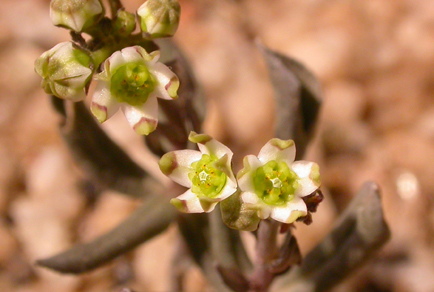
A new species of Ceropegia, named C. ornata, is described from the Albany Thicket Biome in the Eastern Cape Province of South Africa. Under the traditional generic concepts, the new species would belong to Brachystelma based on its open-rotate flowers and flattened tuber. However, following the recently enlarged concept of Ceropegia s.l., which includes Brachystelma and the stapeliads, we provisionally place the new species in Ceropegia s.l. Ceropegia ornata is morphologically closest to C. delicata (≡ Brachystelma delicatum) but differs in several reproductive and vegetative characters, such as shorter stems, smaller leaves, different corolla colouration, and distinct corona structure. Ceropegia ornata may also be confused with the more distantly related C. huttonii (≡ B. huttonii) and differences to this species are discussed as well. A complete description is presented for the new species, and illustrations of all three species under discussion are provided.
References
- Brummitt, R.K. (2008) Letter to the editor: evolution in taxonomic perspective. Taxon 57: 1049–1050. https://doi.org/10.1002/tax.574002
- Bruyns, P.V. (1995) New records and new species of Asclepiadaceae from Namibia. Bothalia 25: 155–172. https://doi.org/10.4102/abc.v25i2.725
- Bruyns, P.V., Klak, C. & Hanáček, P. (2015) Recent radiation of Brachystelma and Ceropegia (Apocynaceae) across the Old World against a background of climatic change. Molecular Phylogenetics and Evolution 90: 49–66. https://doi.org/10.1016/j.ympev.2015.04.015
- Bruyns, P.V., Klak, C. & Hanáček, P. (2017) A revised, phylogenetically-based concept of Ceropegia (Apocynaceae). South African Journal of Botany 112: 399–436. https://doi.org/10.1016/j.sajb.2017.06.021
- Dyer, R.A. (1976) Notes on African plants. Asclepiadaceae. New species of Brachystelma. Bothalia 12 (1): 53–64. https://doi.org/10.4102/abc.v12i1.1371
- Dyer, R.A. (1980) Asclepiadaceae (Brachystelma, Ceropegia, Riocreuxia). In: Leistner, O.A. (Ed.) Flora of southern Africa, 27 (4). Botanical Research Unit, 91 pp.
- Dyer, R.A. (1983) Ceropegia, Brachystelma and Riocreuxia in southern Africa. A.A. Balkema, Rotterdam, 242 pp.
- Grobler, A., Vlok, J., Cowling, R., van der Merwe, S., Skowno, A.L. & Dayaram, A. (2018) Technical Report: Integration of the Subtropical Thicket Ecosystem Project (STEP) vegetation types into the VEGMAP national vegetation map 2018.
- Harvey, W.H. (1863) Thesaurus Capensis or illustrations of the South African flora, vol. 2. John Van Voorst, London, 68 pp.
- Heiduk, A. (2023a) Ceropegia stylesii (Apocynaceae-Asclepiadoideae)—a novel species with rotate flowers from Ngome, South Africa. Phytotaxa 579 (2): 117–124. https://doi.org/10.11646/phytotaxa.579.2.5
- Heiduk, A. (2023b) Ceropegia cryptobarbata sect. Chamaesiphon (Apocynaceae—Asclepiadoideae), a novel tuberous species from the Drakensberg foothills in South Africa. Phytotaxa 613 (2): 162–170. https://doi.org/10.11646/phytotaxa.613.2.5
- Heiduk, A. & Styles, D.G.A. (2023) Ceropegia strophanthiflora (Apocynaceae—Asclepiadoideae)—a magnificent and rare new species from South Africa at the brink of extinction. Phytotaxa 632 (1): 27–37. https://doi.org/10.11646/phytotaxa.632.1.2
- Heiduk, A., Brake, I., Shuttleworth, A. & Johnson, S.D. (2023) ‘Bleeding’ flowers of Ceropegia gerrardii (Apocynaceae—Asclepiadoideae) mimic wounded insects to attract kleptoparasitic fly pollinators. New Phytologist 239: 1490–1504. https://doi.org/10.1111/nph.18888
- Heiduk, A., Brake, I., von Tschirnhaus, M., Göhl, M., Jürgens, A., Johnson, S.D., Meve, U. & Dötterl, S. (2016) Ceropegia sandersonii mimics attacked honeybees to attract kleptoparasitic flies for pollination. Current Biology 26: 2787–2793. https://doi.org/10.1016/j.cub.2016.07.085
- Heiduk, A., Brake, I., von Tschirnhaus, M., Haenni, J.P., Miller, R., Hash, J., Prieto-Benítez, S., Jürgens, A., Johnson, S.D., Schulz, S., Liede-Schumann, S. & Meve, U. (2017) Floral scent and pollinators of Ceropegia trap flowers. Flora 232: 169–182. https://doi.org/10.1016/j.flora.2017.02.001
- Heiduk, A., Gaimari, S., Whittington, A., Johnson, S.D. & Shuttleworth, A. (2025) Rocksitter flies (Lauxaniidae: Cestrotus) are key-pollinators of Ceropegia pulchellior—A threatened and localised South African endemic with foetid-scented flowers. Journal of Applied Entomology 149: 888–900. https://doi.org/10.1111/jen.13392
- Heiduk, A., Kong, H., Brake, I., von Tschirnhaus, M., Tolasch, T., Tröger, A., Wittenberg, E., Francke, W., Meve, U. & Dötterl, S. (2015) Deceptive Ceropegia dolichophylla fools its kleptoparasitic fly pollinators with exceptional floral scent. Frontiers in Ecology and Evolution 3: 66. https://doi.org/10.3389/fevo.2015.00066
- Hoare, D., Mucina, L., Rutherford, M.C., Vlok, J.H.J., Euston-Brown, D.I.W., Palmer, A.R., Powrie, L.W., Lechmere-Oertel, R.G., Proches, S.M., Dold, A.P. & Ward, R.A. (2006) Albany Thicket Biome. In: Mucina, L. & Rutherford, M.C. (Eds.) The Vegetation of South Africa, Lesotho and Swaziland. Strelitzia 19. South African National Biodiversity Institute, Pretoria, pp. 541–567.
- Huber, H. (1957) Revision der Gattung Ceropegia. Memorias da Sociedade Broteriana 12: 1–203.
- IPNI. (2025) The International Plant Names Index. Available from: http://www.ipni.org (accessed April 2025)
- Kambale, S.S. & Yadav, S.R. (2019) Taxonomic revision of Ceropegia (Apocynaceae: Ceropegieae) in India. Rheedea 29. https://doi.org/10.22244/rheedea.2019.29.1.01
- Linnaeus, C. (1753) Species plantarum. Salvius, Stockholm, 1200 pp. https://doi.org/10.5962/bhl.title.37656
- Leistner, O.A. & Morris, J.W. (1976) Southern African place names. Annals of the Cape Provincial Museum 12: 1–565.
- Meve, U. & Liede, S. (2004) Subtribal division of Ceropegieae (Apocynaceae-Asclepiadoideae). Taxon 53 (1): 61–72. https://doi.org/10.2307/4135489
- Meve, U. & Liede-Schumann, S. (2007) Ceropegia (Apocynaceae, Ceropegieae, Stapeliinae): Paraphyletic but still taxonomically sound. Annals of the Missouri Botanical Garden 94: 392–406. https://doi.org/10.3417/0026-6493(2007)94[392:CACSPB]2.0.CO;2
- Meve, U., Heiduk, A. & Liede-Schumann, S. (2017) Origin and early evolution of Ceropegieae (Apocynaceae-Asclepiadoideae). Systematics and Biodiversity 15: 143–155. https://doi.org/10.1080/14772000.2016.1238019
- Mucina, L., Rutherford, M.C., Palmer, A.R., Milton, S.J., Scott, L., Lloyd, W., van der Merwe, B., Hoare, D., Bezuidenhout, H., Vlok, J.H.J., Euston-Brown, D.I.W., Powrie, L.W. & Dold, A.P. (2006) Nama-Karoo Biome. In: Mucina, L. & Rutherford, M.C. (Eds.) Vegetation of South Africa, Lesotho and Swaziland. Strelitzia 19. South African National Biodiversity Institute, Pretoria, pp. 324–347.
- Paramesh, L., Prasad, K., Sadasivaiah, B. & Vijaya Bhasker Reddy, A. (2021) Brachystelma ananthagiriense (Apocynaceae), a new species from Ananthagiri hills, Telangana, India. Nordic Journal of Botany 2021: e03003. https://doi.org/10.1111/njb.03003
- du Plessis, M., Johnson, S.D., Nicolson, S.W., Bruyns, P.V. & Shuttleworth, A. (2018) Pollination of the “carrion flowers” of an African stapeliad (Ceropegia mixta: Apocynaceae): the importance of visual and scent traits for the attraction of flies. Plant Systematics and Evolution 304: 357–372. https://doi.org/10.1007/s00606-017-1481-0
- Rodda, M. & Meve, U. (2017) Ceropegia laotica (Apocynaceae, Asclepiadoideae): the first new species of Ceropegia described from Laos. Gardens’ Bulletin Singapore 69 (2): 285–293. https://doi.org/10.26492/gbs69(2).2017-07
- Shuttleworth, A., Johnson, S.D. & Jürgens, A. (2017) Entering through the narrow gate: a morphological filter explains specialized pollination of a carrion-scented stapeliad. Flora 232: 92–103. https://doi.org/10.1016/j.flora.2016.09.003
- Sims, J. (1822) Brachystelma tuberosa. Tuberous-rooted Brachystelma. Botanical Magazine 49: t. 2343.
- Surveswaran, S., Kambale, S.S., Srivastav, M., Punekar, S.A., Yadav, S.R. & Karanth, K.P. (2021) Origin and diversification of Indian Ceropegieae (Apocynaceae) and its possible relation to the Indian monsoon. Journal of Systematic and Evolution 59 (1): 93–112. https://doi.org/10.1111/jse.12578
- Thiers, B. (2025) [continuously updated] Index Herbariorum: A global directory of public herbaria and associated staff. New York Botanical Garden’s Virtual Herbarium. Available from: http://sweetgum.nybg.org/ih/ (accessed April 2025)
- Turland, N.J., Wiersema, J.H., Barrie, F.R., Greuter, W., Hawksworth, D.L., Herendeen, P.S., Knapp, S., Kusber, W-H., Li, D-Z., Marhold, K., May, T.W., McNeill, J., Monro, A.M., Prado, J., Price, M.J. & Smith, G.F. (Eds) (2018) International Code of Nomenclature for algae, fungi, and plants (Shenzhen Code) adopted by the Nineteenth International Botanical Congress Shenzhen, China, July 2017. [Regnum Vegetabile 159]. Koeltz Scientific Books, Glashütten. https://doi.org/10.12705/Code.2018
- Vlok, J.H.J. & Euston-Brown, D.I.W. (2002) The patterns within, and the ecological processes that sustain, the subtropical thicket vegetation in the planning domain of the Subtropical Thicket Ecosystem Planning (STEP) project. Terrestrial Ecology Research Unit Report No. 40, University of Port Elizabeth, Port Elizabeth, South Africa.