
Abstract
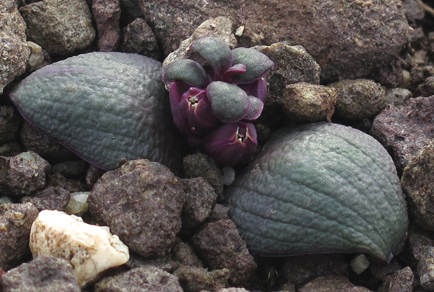
Based on morphological and ecological grounds, and its reproductive strategy, Eucomis nubigena is here described. This is a diminutive new dwarf species found at high elevations in both South Africa and Lesotho, limited in distribution to the Maloti Alpine Sub-centre of the Drakensberg Mountain Centre. This cryptic geophyte is restricted to basaltic substrates, growing in full sun in shallow pockets of gravel overlying basalt pavements. It is easily differentiated from its closest relatives based on its overall diminutive size, the production of flowers that are exclusively cleistogamous and autogamous rather than chasmogamous and entomophilous, and its prominently succulent coma bracts. Eucomis nubigena is the first species in a widely distributed family of ca. 1000 species to be documented as cleistogamous, and the first genus member to exhibit basal placentation. A complete illustration and morphological description of the new species are provided, including data regarding its biology, ecology, and distribution. The relationship of E. nubigena to other genus members is assessed.
References
- Ali, S.S., Yu, Y., Pfosser, M. & Wetschnig, W. (2012) Inferences of biogeographical histories within subfamily Hyacinthoideae using S-DIVA and Bayesian binary MCMC analysis implemented in RASP (Reconstruct Ancestral State in Phylogenies). Annals of Botany 109 (1): 95–107. https://doi.org/10.1093/aob/mcr274
- Andrews, H.C. (1809) Erica lanuginosa. In: The Heathery, or a monograph of the genus Erica, Vol. 3. The author, London, t. 122.
- Baker, J.G. (1873) Revision of the genera and species of Scilleae and Chlorogaleae. The Journal of the Linnean Society, Botany 13: 209–292. [https://www.biodiversitylibrary.org/item/8364#page/213/mode/1up]
- Baker, J.G. (1876) On two new Amaryllidaceae from Natal. Journal of Botany, British and Foreign 14: 66. [https://www.biodiversitylibrary.org/page/9103255#page/88/mode/1up]
- Baker, J.G. (1878a) New garden plants. Eucomis amaryllidifolia n. sp. and Eucomis bicolor n. sp. The Gardener’s Chronicle ser. 2, 10: 492. [https://www.biodiversitylibrary.org/item/84202#page/510/mode/1up]
- Baker, J.G. (1878b) On two new genera of Amaryllidaceae from Cape Colony. Journal of Botany, British and Foreign 16: 74–77. [https://www.biodiversitylibrary.org/page/8956467#page/86/mode/1up]
- Baker, J.G. (1886) New garden plants: Eucomis zambesiaca, Baker, n. sp. The Gardeners’ Chronicle ser. 2, 25: 9. [https://www.biodiversitylibrary.org/page/26085806#page/23/mode/1up]
- Baker, J.G. (1895) CCCCLXIV—Diagnoses Africanae, VI. Eucomis humilis. Kew Bulletin of Miscellaneous Information 1895: 141–155. [https://www.biodiversitylibrary.org/item/127378#page/145/mode/1up]
- Billings, W.D. & Mooney, H.A. (1968) The ecology of arctic and alpine plants. Biological Reviews 43 (4): 481–529. https://doi.org/10.1111/j.1469-185X.1968.tb00968.x
- Buerki, S., Jose, S., Yadav, S.R., Goldblatt, P., Manning, J.C. & Forest, F. (2012) Contrasting biogeographic and diversification patterns in two mediterranean-type ecosystems. PLoSONE 7 (6): e39377 [pp. 1–11]. https://doi.org/10.1371/journal.pone.0039377
- Carbutt, C. (2019) The Drakensberg Mountain Centre: A necessary revision of southern Africa’s high-elevation centre of plant endemism. South African Journal of Botany 124: 508–529. https://doi.org/10.1016/j.sajb.2019.05.032
- Carbutt, C. & Edwards, T.J. (2015) Reconciling ecological and phytogeographical spatial boundaries to clarify the limits of the montane and alpine regions of sub-Sahelian Africa. South African Journal of Botany 98: 64–75. https://doi.org/10.1016/j.sajb.2015.01.014
- Carbutt, C., Edwards, T.J., Fynn, R.W.S. & Beckett, R.P. (2013) Evidence for temperature limitation of nitrogen mineralisation in the Drakensberg Alpine Centre. South African Journal of Botany 88: 447–454. https://doi.org/10.1016/j.sajb.2013.09.001
- Chittenden, F.J. (1951) Eucomis autumnalis. The Royal Horticultural Society Dictionary of Gardening, 1st Edition, vol. 2: 787.
- Compton, R.H. (1967) Plantae Novae Africanae. Series XXXII: Eucomis montana. Journal of South African Botany 33: 293–304. [https://www.biodiversitylibrary.org/item/335731#page/309/mode/1up]
- Compton, J. (1990) Eucomis L’Héritier. The Plantsman 12: 129–139.
- Crouch, N.R. (2010) An adaptation of Reyneke’s key to the genus Eucomis. PlantLife 39 & 40: 45–52. [https://opus.sanbi.org/items/f011b1af-5340-4872-b477-0fcb5011afdd]
- Crouch, N.R., Martínez-Azorín, M., Lötter, M.C., Burrows, J.E. & Condy, G. (2019) Eucomis sonnetteana. Hyacinthaceae. Flowering Plants of Africa 66: 46–55.
- Culley, T.M. & Klooster, M.R. (2007) The cleistogamous breeding system: A review of its frequency, evolution, and ecology in Angiosperms. The Botanical Review 73 (1): 1–30. [https://www.jstor.org/stable/27571184]
- Duncan, G.D. (2007) Lesser known Eucomis. The Plantsman 6: 98–103.
- Gleditsch, J.G. (1771) Histoire de l’Academie Royale des Sciences et Belles Lettres, Berlin, 25, pp. 66. [https://archive.org/details/berlin-histoire-1769-pub1771]
- Grab, S., Linde, J. & De Lemos, H. (2017) Some attributes of snow occurrence and snowmelt/sublimation rates in the Lesotho Highlands: environmental implications. Water SA 43 (2): 333–442. https://doi.org/10.4314/wsa.v43i2.16
- Harvey, W.H. (1868) Liliaceae. In: Hooker, J.D. (Ed.) The genera of South African plants, arranged according to the natural system, 2nd edition. J.C. Juta, Cape Town, pp. 391–403. [https://archive.org/details/generaofsouth00harv/page/390]
- Hilliard, O.M. & Burtt, B.L. (1987) The botany of the southern Natal Drakensberg. National Botanic Gardens, Cape Town, 253 pp.
- Houttuyn, M. (1780) Natuurlijke Historie of uitvoerige Beschryving der Dieren, Planten en Mineraalen, volgens het Samenstel van der Heer Linnaeus II, 12. De Erven van F. Houttuyn, Amsterdam, 558 pp., 10 pls. https://doi.org/10.5962/bhl.title.66921
- IPNI (2025+) The International Plant Names Index. Available from: https://www.ipni.org/ (continuously updated; accessed August 2025)
- Jacquin, N.J. (1791) DXV. Eucomis bifolia. Collectanea ad botanicam, chemiam, et historiam naturalem spectantia, cum figuris. Ex Officina Wappleriana, Vindobonae. Volume 4: 215. [https://bibdigital.rjb.csic.es/viewer/11972/?offset=#page=215&viewer=picture&o=bookmark&n=0&q=]
- Killick, D.J.B. (1978) Further data on the climate of the alpine vegetation belt of eastern Lesotho. Bothalia 12 (3): 567–572. https://doi.org/10.4102/abc.v12i3.1814
- Knight, J. & Grab, S. (2015) The Drakensberg Escarpment: Mountain Processes at the Edge. In: Grab, S. & Knight, J. (Eds) Landscapes and Landforms of South Africa, World Geomorphological Landscapes. Springer International Publishing, Switzerland, pp. 47–55.
- Körner, C., Neumayer, M., Menendez-Riedl, S.P. & Smeets-Scheel, A. (1989) Functional morphology of mountain plants. Flora 182 (5-6): 353–383. https://doi.org/10.1016/S0367-2530(17)30426-7
- Kunth, C.S. (1843) Enumeratio plantarum omnium hucusque cognitarum, secundum familias naturales disposita, adjectis characteribus, differentiis et synonymis 4. Cottae, J.G., Stuttgardiae et Tubingae, 752 pp. https://doi.org/10.5962/bhl.title.67381
- Laundré, J.W., Hernández, L. & Ripple, W.J. (2010) The landscape of fear: ecological implications of being afraid. The Open Ecology Journal 3 (3): 1–7. [https://www.academia.edu/13946072/The_landscape_of_fear_ecological_implications_of_being_afraid]
- L’Héritier, C.L. (1789) Sertum Anglicum, seu plantae rariores quae in hortis juxta Londinum imprimis in horto regio Kewensi excoluntur, ab anno 1786 ad annum 1787 observatae. Parisiis, Petri Francisci Didot, 20 pp. https://doi.org/10.5962/bhl.title.11440
- Lindley, J. (1835) Daubenya aurea. Edwards’s Botanical Register 21: t. 1813. [https://www.biodiversitylibrary.org/item/28975#page/331/mode/1up]
- Lindley, J. & Paxton, J. (1851) Drimiopsis maculata. Paxton’s Flower Garden. Volume 2. Bradbury & Evans, London, 186 pp. https://doi.org/10.5962/bhl.title.10722
- Linnaeus, C. (1753) Species plantarum. Salvius, Stockholm, 1200 pp. https://doi.org/10.5962/bhl.title.37656
- Lombardi, G.C., Peter, C.I., Turner, R.C. & Midgley, J.J. (2017) The unusual, closed flowers of Erica lanuginosa (Ericaceae) are adapted for rodent-pollination and not cleistogamy. South African Journal of Botany 111: 189–193. https://doi.org/10.1016/j.sajb.2017.03.020
- Lord, E.M. (1981) Cleistogamy: a tool for the study of floral morphogenesis, function and evolution. The Botanical Review 47 (4): 421–449. [https://www.jstor.org/stable/4353990]
- Luo, Y., Dong, X., Yu, T., Xuan, S., Li, Z., Yang, W., Widmer, A. & Karrenberg, S. (2015) A single nucleotide deletion in Gibberellin20oxidase1 causes alpine dwarfism in Arabidopsis. Plant Physiology 168 (3): 930–937. https://doi.org/10.1104/pp.15.00005
- Manning, J.C., Goldblatt, P. & Fay, M.F. (2004) A revised generic synopsis of Hyacinthaceae in Sub-Saharan Africa, based on molecular evidence, including new combinations and the new tribe Pseudoprospereae. Edinburgh Journal of Botany 60 (3): 533–568. https://doi.org/10.1017/S0960428603000404
- Martínez-Azorín, M., Crespo, M.B., Alonso, M.Á., Pinter, M., Crouch, N.R., Dold, A.P., Mucina, L., Pfosser, M. & Wetschnig, W. (2023) A generic monograph of the Hyacinthaceae subfam. Urgineoideae. Phytotaxa 610 (1): 1–143. https://doi.org/10.11646/phytotaxa.610.1.1
- Martínez-Azorín, M., Crespo M.B. & Juan, A. (2007) Taxonomic revision of Ornithogalum subg. Cathissa (Salisb.) Baker (Hyacinthaceae). Anales del Jardín Botánico de Madrid 64 (1): 7–25. https://doi.org/10.3989/ajbm.2007.v64.i1.47
- Martínez-Azorín, M., Crespo, M.B. & Juan, A. (2009) Taxonomic revision of Ornithogalum subg. Beryllis (Hyacinthaceae) in the Iberian Peninsula and the Balearic Islands. Belgian Journal of Botany 142 (2): 140–162. https://www.jstor.org/stable/41427183
- Miller, P. (1768) The Gardeners Dictionary, Ed. 8, vol. 2. London. https://doi.org/10.5962/bhl.title.541
- Mathew, B. (1989) Eucomis schijffii. Hyacinthaceae. Curtis’s Botanical Magazine 6 (2): 51–54. [https://www.jstor.org/stable/45066723]
- Mucina, L., Hoare, D.B., Lötter, M.C., Du Preez, J., Rutherford, M.C., Scott-Shaw, C.R., Bredenkamp, G.J., Powrie, L.W., Scott, L., Camp, K.G.T., Cilliers, S.S., Bezuidenhout, H., Mostert, T.H., Siebert, S.J., Winter, P.J.D., Burrows, J.E., Dobson, L., Ward, R.A., Stalmans, M., Oliver, E.G.H., Siebert, F., Schmidt, E., Kobisi, K. & Kose, L. (2006) Grassland Biome. In: Mucina, L. & Rutherford, M.C. (Eds) The vegetation of South Africa, Lesotho and Swaziland. Strelitzia 19. South African National Biodiversity Institute, Pretoria, pp. 349–436. [https://archive.org/details/vegetationofsout19muci/page/349]
- Murray, J.A. (1784) Linnaeus. Systema vegetabilium, ed. 14. Dieterich, J.C., Göttingen, 987 pp. https://doi.org/10.5962/bhl.title.549
- Pannell, J.R. (2009) On the problems of a closed marriage: celebrating Darwin 200. Biology Letters 5 (3): 332–335. https://doi.org/10.1098/rsbl.2009.0142
- Pfosser, M. & Speta, F. (1999) Phylogenetics of Hyacinthaceae based on plastid DNA sequences. Annals of the Missouri Botanical Garden 86 (4): 852–875. https://doi.org/10.2307/2666172
- Pfosser, M., Wetschnig, W., Ungar, S. & Prenner, G. (2003) Phylogenetic relationships among genera of Massonieae (Hyacinthaceae) inferred from plastid DNA and seed morphology. Journal of Plant Research 116: 115–132. https://doi.org/10.1007/s10265-003-0076-8
- Pfosser, M., Wetschnig, W. & Speta, F. (2006) Drimia cryptopoda, a new combination in Hyacinthaceae from Madagascar. Linzer Biologische Beiträge 38 (2): 1731–1739. [https://archive.org/details/linzer-lbb-0038-2-1731-1739]
- Reyneke, W.F. (1972) ’n Monografiese studie van die genus Eucomis L’Hérit. in Suid-Afrika. Unpublished M.Sc thesis, University of Pretoria.
- Reyneke, W.F. (1976) A new species of Eucomis L’Hérit. (Liliaceae) from South Africa. Journal of South African Botany 42 (4): 361–364. [https://archive.org/details/biostor-290773]
- Reyneke, W.F. (1980) Notes on African plants. Three subspecies of Eucomis autumnalis. Bothalia 13 (1-2): 140–142. https://doi.org/10.4102/abc.v13i1/2.1303
- Roth, A.W. (1821) Novae plantarum species praesertim Indiae orientalis Ex collectione doct. Benj. Heynii: cum descriptionibus et observationibus. Sumptibus H. Vogleri, Halberstadii, 412 pp. https://doi.org/10.5962/bhl.title.10723
- Smith, G.F., Figueiredo, E., Victor, J. & Klopper, R.R. (2023) Plant poaching in southern Africa is aided by taxonomy. Is a return to Caput bonae spei inevitable? Taxon 72 (4): 717–723. https://doi.org/10.1002/tax.12882
- Shuttleworth, A. & Johnson, S.D. (2009) A key role for floral scent in a wasp-pollination system in Eucomis (Hyacinthaceae). Annals of Botany 103 (5): 715–725. https://doi.org/10.1093/aob/mcn261
- Shuttleworth, A. & Johnson, S.D. (2010) The missing stink: sulphur compounds can mediate a shift between fly and wasp pollination systems. Proceedings of the Royal Society B 277: 2811–2819. https://doi.org/10.1098/rspb.2010.0491
- Suetsugu, K., Fukushima, K., Makino, T., Ikematsu, S., Sakamoto, T. & Kimura, S. (2023) Transcriptomic heterochrony and completely cleistogamous flower development in the mycoheterotrophic orchid Gastrodia. New Phytologist 237 (1): 323–338. https://doi.org/10.1111/nph.18495
- Thiers, B. (2025+) Index herbariorum: a global directory of public herbaria and associated staff. New York Botanical Garden’s Virtual Herbarium. Available from: http://sweetgum.nybg.org/ih/ (continuously updated; accessed August 2025)
- Turland, N.J., Wiersema, J.H., Barrie, F.R., Gandhi, K.N., Gravendyck, J., Greuter, W., Hawksworth, D.L., Herendeen, P.S., Klopper, R.R., Knapp, S., Kusber, W.-H., Li, D.-Z., May, T.W., Monro, A.M., Prado, J., Price, M.J., Smith, G.F. & Zamora Señoret, J.C. (Eds) (2025) International Code of Nomenclature for algae, fungi, and plants (Madrid Code). Regnum Vegetabile 162. University of Chicago Press, Chicago, 288 pp. https://doi.org/10.7208/chicago/9780226839479.001.0001
- Van Wyk, A.E. & Smith, G.F. (2001) Regions of floristic endemism in southern Africa. A review with emphasis on succulents. Umdaus Press, Hatfield, Pretoria, 199 pp.
- Wester, P., Stanway, R. & Pauw, A. (2009) Mice pollinate the Pagoda Lily, Whiteheadia bifolia (Hyacinthaceae)—First field observations with photographic documentation of rodent pollination in South Africa. South African Journal of Botany 75 (4): 713–719. https://doi.org/10.1016/j.sajb.2009.07.005
- Wester, P., Johnson, S.D. & Pauw, A. (2019) Scent chemistry is key in the evolutionary transition between insect and mammal pollination in African pineapple lilies. New Phytologist 222 (3): 1624–1637. https://doi.org/10.1111/nph.15671
- Wehrhahn, H.R. (1929) Die Gartenstauden, vol. 1. Paul Parey, Berlin, 624 pp.
- Wetschnig, W. & Pfosser, M. (2003) The Scilla plumbea puzzle—present status of the genus Scilla sensu lato in Southern Africa and description of Spetaea lachenaliiflora, a new genus and species of Massonieae (Hyacinthaceae). Taxon 52 (1): 75–92. https://doi.org/10.2307/3647303
- Williams, R. (2000) Hyacinthaceae. In: Leistner, O.A. (Ed.) Seed plants of southern Africa: families and genera. Strelitzia 10. South African National Biodiversity Institute, Pretoria, pp. 610–619.
- Winter, P.J.D. & Condy, G. (2009) Eucomis zambesiaca. Hyacinthaceae. Flowering Plants of Africa 61: 18–23. [https://www.sanbi.org/wp-content/uploads/2024/05/2009_FPA61.pdf]
- Zonneveld, B.J.M & Duncan, G.D. (2010) Genome sizes of Eucomis L’Hér. (Hyacinthaceae) and a description of the new species Eucomis grimshawii G.D.Duncan & Zonneveld. Plant Systematics and Evolution 284: 99–109. https://doi.org/10.1007/s00606-009-0236-y