

Abstract
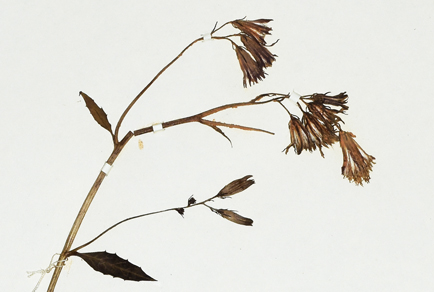
Gynura Cassini (1825: 391) (Asteraceae: Senecioneae) is a medium-sized genus comprising approximately 45 species (Vanijajiva & Kadereit 2011; van der Ent & Vanijajiva 2014; Li et al. 2022; Calvo et al. 2025; Zhu et al. 2025a, 2025b). The genus is primarily distributed in tropical and subtropical regions of Asia and Africa, with Southeast Asia representing the major center of its diversity (Vanijajiva & Kadereit 2011). Morphologically, Gynura is characterized by homogamous discoid capitula and erect, exserted style branches with long, subulate appendages.
References
- Calvo, J., Ibrahim, Y. & Callmander, M.W. (2025) A new, overlooked species of Gynura (Compositae) endemic to Comoros. Kew Bulletin 80: 363–368. https://doi.org/10.1007/s12225-025-10260-5
- Candolle, A.P. de (1838) Prodromus Systematis Naturalis Regni Vegetabilis, vol. 6. Sumptibus Sociorum Treuttel & Würtz, Paris, 687 pp.
- Cassini, H. (1825) Gynura H. Cass. In: Cuvier, F. (Ed.) Dictionnaire des Sciences Naturelles, ed. 2, vol. 34. F. G. Levrault, Strasbourg, pp. 391–393.
- Chang, C.C. (1937) An enumeration of Hainan Compositae. Sunyatsenia 3: 270–304.
- Chen, Y.L. & Liu, D.J. (1989) Gynura. In: Chen, Y.L. & Shi, Z. (Eds.) Flora Guizhouensis, vol. 9. Sichuan Ethnic Publishing House, Chengdu, pp. 219–223.
- Chen, Y.L. (1999) Flora Reipublicae Popularis Sinicae, vol. 77(1). Science Press, Beijing, 369 pp.
- Chen, Y.L. & Nordenstam, B. (2011) Gynura. In: Wu, Z.Y. & Raven, P.H. (Eds.) Flora of China, vols. 20–21. Science Press, Beijing & Missouri Botanical Garden Press, St. Louis, pp. 538–542.
- Davies, F.G. (1979) The genus Gynura (Compositae) in Eastern Asia and the Himalayas. Kew Bulletin 33: 629–640. https://doi.org/10.2307/4109805
- Lauener, L.A. (1976) Catalogue of the names published by Hector Léveillé: IX [Compositae]. Notes from the Royal Botanic Garden Edinburgh 34: 327–402.
- Kerr, A.F.G. (1935) Contributions to the Flora of Siam. Additamentum XXXIX. Bulletin of Miscellaneous Information (Royal Botanic Gardens, Kew) 1935: 326–335. https://doi.org/10.2307/4107139
- Koyama, H. (1968) Taxonomic studies on the tribe Senecioneae of eastern Asia (II): Enumeration of the species of eastern Asia. Memoirs of the Faculty of Science, Kyoto University, Series of Biology, New series 2: 19–60.
- Léveillé, H. (1914) Novae Gynurae Sineneses. Bulletin de Géographie Botanique 24: 283–284.
- Li, C.S., Wu, H.S., Fei, W.Q. & Ren, C. (2022) Validation of the name Gynura villosa (Asteraceae-Senecioneae). Phytotaxa 570 (2): 229–230. https://doi.org/10.11646/phytotaxa.570.2.9
- Liu, S.W. (2004) Gynura. In: Wu, Z.Y. (Ed.) Flora Yunnanica, vol. 13. Science Press, Beijing, pp. 369–375.
- Loureiro, J. de (1790) Flora Cochinchinensis, vol. 2. Typis et Expensis Academicis, Lisbon, 388 pp.
- Merrill, E.D. (1923) An enumeration of Philippine flowering plants, vol. 3. Bureau of Printing, Manila, 628 pp. https://doi.org/10.5962/bhl.title.49412
- Roxburgh, W. (1814). Hortus Bengalensis. Mission Press, Serampore, 300 pp.
- Roxburgh, W. (1832) Flora Indica, vol. 3. W. Thacker and Co., Calcutta & Parbury, Allen and Co., London, Serampore, 875 pp.
- Stafleu, F.A. (1972) The Willdenow herbarium. Taxon 21 (5/6): 685–692. https://doi.org/10.2307/1219177
- Van der Ent, A. & Vanijajiva, O. (2014) Gynura tambuyukonensis (Asteraceae), an obligate ultramafic species endemic to Mount Tambuyukon (Kinabalu Park, Sabah, Malaysia). Phytotaxa 158 (3): 291–296. https://doi.org/10.11646/phytotaxa.158.3.9
- Vanijajiva, O. (2009) The genus Gynura (Asteraceae: Senecioneae) in Thailand. Thai Journal of Botany 1: 25–36.
- Vanijajiva, O. & Kadereit, J.W. (2011) A revision of Gynura (Asteraceae: Senecioneae). Journal of Systematics and Evolution 49: 285–314. https://doi.org/10.1111/j.1759-6831.2011.00139.x
- Willdenow, C.L. (1804) Species Plantarum, vol. 3(3). G.C. Nauk, Berlin, 933 pp.
- Zhu, L.C., Hariri, M.R., Li, C.S. & Ren, C. (2025) Clarification of the taxonomic and nomenclatural confusions with three Gynura names (Asteraceae: Senecioneae) based on Zollinger’s collections from Java, Indonesia. Phytotaxa 697 (3): 219–233. https://doi.org/10.11646/phytotaxa.697.3.1
- Zhu, L.C., Hariri, M.R., Li, C.S. & Ren, C. (2025) Crassocephalum teysmannianum is a validly published and earlier name for Gynura daviesiae (Asteraceae: Senecioneae). Phytotaxa 702 (2): 226–230. https://doi.org/10.11646/phytotaxa.702.2.11
- Zhu, Z.Y. (2006) Two new species of Gynura from Mountain Emei, Sichuan. Bulletin of Botanical Research 26: 644–647.