
Abstract
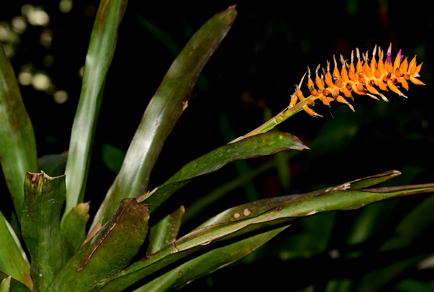
The authors describe and illustrate one new species of Wittmackia, W. aurantiolilacina, endemic to the Atlantic Forest of the region of Alto Cariri, on the border of the states of Bahia and Minas Gerais, Brazil, with a restricted geographical range, being considered Critically Endangered (CR) mainly due to habitat loss, fragmentation, and increasing frequency in fire events. The new taxon, collected during an expedition conducted as part of the Conservation Action Plan for Threatened Trees of Hiléia Baiana, a highly biodiverse region with significant gaps in botanical knowledge, is herein compared with its closely morphological relative, W. altocaririensis. The main differences of W. aurantiolilacina are the shape of its leaves with broader blades and green or reddish apex, the shape of the floral bracts, the longer flowers, the shape of the longer but narrower sepals, which are orange, and the longer ovary of orange color. It is also compared to other species of Wittmackia presenting similar stature and color pattern. The addition of this new species of Wittmackia brings the number of members of the “Brazilian clade” to 30.
References
- Aguirre-Santoro, J. (2017) Taxonomy of the Ronnbergia alliance (Bromeliaceae: Bromelioideae): new combinations, synopsis, and new circumscriptions of Ronnbergia and the resurrected genus Wittmackia. Plant Systematics and Evolution 303: 615–640. https://doi.org/10.1007/s00606-017-1394-y
- Bachman, S., Moat, J., Hill, A.W., Torre, J. & Scott, B. (2011) Supporting Red List threat assessments with GeoCAT: geospatial conservation assessment tool. In: Smith, V. & Penev, L. (Ed.) e-Infrastructures for data publishing in biodiversity science. ZooKeys 150: 117–126. https://doi.org/10.3897/zookeys.150.2109
- Brown, M.J.M., Bachman, S.P. & Nic Lughadha, E. (2023) Three in four undescribed plant species are threatened with extinction. New Phytologist 240: 1340–1344. https://doi.org/10.1111/nph.19214
- Convention on Biological Diversity (1993) Article 9. Available from: The Secretariat of the Convention on Biological Biodiversity website. https://www.cbd.int/ (accessed 28 October 2024)
- Fidalgo, O. & Bononi, V.L.R. (1984) Técnicas de coleta, preservação e herborização de material botânico. Instituto de Botânica, São Paulo, 62 pp.
- Gouda, E.J., Butcher, D. & Dijkgraaf, L. (2025 [cont. updated]) Encyclopedia of Bromeliads, version 5. Utrecht, University Botanic Garden. Available from: http://bromeliad.nl/encyclopedia University Botanical Garden, Utrecht (accessed 9 February 2025)
- Hawksworth, D.L. (2010) Terms used in bionomenclature, the name of organisms (and plant communities). Global Biodiversity Information Facility, Copenhagen, 215 pp.
- IUCN Standards and Petitions Committee (2022) Guidelines for Using the IUCN Red List Categories and Criteria. Version 15.1. Prepared by the Standards and Petitions Committee. [https://www.iucnredlist.org/documents/RedListGuidelines.pdf]
- IUCN—International Union for Conservation of Nature (2012) IUCN RedList Categories and Criteria: Version 3.1 (2nd ed.). [https://www.iucnredlist.org/resources/categories-and-criteria]
- Jordão, L.S.B., Ferreira, G.C., Bicalho, M. et al. (2022) O MapBiomas e a avaliação do risco de extinção da flora brasileira. In: 4a Edição do Prêmio MapBiomas. Available from: https://brasil.mapbiomas.org/premio-mapbiomas-4-edicao (accessed 30 March 2023)
- Leme, E.M.C. (2005) Three new miscellaneous species of Bromeliaceae from Bahia, Brazil. Journal of the Bromeliad Society 55: 13–22.
- Leme, E.M.C., Fontana, A.P. & Ribeiro, O.B.C. (2010) Neues von Alcantarea: eine new, groβe Artund “Pseudoviviparie” bei A. glaziouana. Die Bromelie 3: 112–125.
- Leme, E.M.C. & Fontana, A.P. (2010) Studies on Orthophytum—Part XI. Three new species from Bahia and Minas Gerais. Journal of the Bromeliad Society 60: 56–70.
- Leme, E.M.C. & Kollmann, L.J.C. (2010) Studies on Orthophytum—Part X. Two small-sized new species. Journal of the Bromeliad Society 60: 5–13.
- Leme, E.M.C. & Kollmann, L.J.C. (2011a) New species and a new combination of Brazilian Bromeliaceae. Phytotaxa 16: 1–36. https://doi.org/10.11646/phytotaxa.16.1.1
- Leme, E.M.C. & Kollmann, L.J.C. (2011b) Two new species from Alto Cariri State Park, Minas Gerais, Brazil. Journal of the Bromeliad Society 6a: 54–64.
- Leme, E.M.C. & Kollmann, L.J.C. (2013) Miscellaneous new species of Brazilian Bromeliaceae. Phytotaxa 108: 1–40. https://doi.org/10.11646/phytotaxa.108.1.1
- Leme, E.M.C. & Kollmann, L.J.C. (2020) Two subtle new bromelioids from the Brazilian Atlantic Forest Domain. Journal of the Bromeliad Society 70: 120–134. https://doi.org/10.11646/phytotaxa.108.1.1
- Leme, E.M.C. & Luther, H.E. (1998) Miscellaneous new species of Brazilian Bromeliaceae—II. Selbyana 19: 183–190.
- Leme, E.M.C. & Luther, H.E. (2003) Two New species of Aechmea from the Bahia, Brazil. Journal of the Bromeliad Society 53: 3–9.
- Leme, E.M.C. & Siqueira-Filho, J.A. (2006a) Taxonomia das bromélias dos fragmentos de Mata Atlântica de Pernambuco e Alagoas. In: Siqueira-Filho, J.A. & Leme, E.M.C. (Eds.) Fragmentos de Mata Atlântica do nordeste, biodiversidade, conservação e suas bromélias, A. Jakobsson Es0túdio, Rio de Janeiro, pp. 190–381.
- Leme, E.M.C. & Siqueira-Filho, J.A. (2006b) Taxonomic considerations correlated with the Bromeliaceae in Pernambuco and Alagoas. In: Siqueira-Filho, J.A. & Leme, E.M.C. (Eds.) Fragments of the Atlantic Forest of Northeastern Brazil, Biodiversity, Conservation and its Bromeliads, A. Jakobsson Estúdio, Rio de Janeiro, pp. 383–407.
- Leme, E.M.C., Souza, E.H., Aona, L.Y.S. & Souza, F.V.D. (2023) Two new Wittmackia species (Bromeliaceae: Bromelioideae) from Bahia, Brazil. Phytotaxa 583: 241–250. https://doi.org/10.11646/phytotaxa.583.3.2
- Leme, E.M.C., Souza, E.H., Till, W., Barfuss, M.H.J., Siqueira-Filho, J.A., Kollmann, L.J.C., Couto, D.R., Fraga, C.N., Fontana, A.P., Farias-Castro, A.S. & Silva, J.B.F. (2025) Twenty miscellaneous new species and one new nothogenus and nothospecies in Brazilian Bromeliaceae. Phytotaxa 692: 1–60. https://doi.org/10.11646/phytotaxa.692.1.1
- Leme, E.M.C., Till, W., Kollmann, L.J.C., Moura, R.L. & Ribeiro, O.B.C. (2014) Miscellaneous new species of Brazilian Bromeliaceae III. Phytotaxa 177: 61–100. https://doi.org/10.11646/phytotaxa.177.2.1
- Linnaeus, C. (1753) Species plantarum. Impensis Laurentii Salvii, Stockholm, 500 pp.
- Melo, F.R., Chiarello, A.G., Faria, M.B., Oliveira, P.A., Freitas, R.L.A., Lima, F.S. & Ferraz, D.S. (2004) Novos registros de Muriqui-do-Norte (Brachyteles hypoxanthus) no vale do Jequitinhonha, Minas Gerais e Bahia. Neotropical Primates 12: 139–143.
- MapBiomas (2022a) Projeto MapBiomas—Coleção 6 da Série Anual de Mapas de Cobertura e Uso de Solo do Brasil, dados de 2020. Município: Alvarenga (MG). Available from: https://mapbiomas.org (accessed 15 December 2022)
- MapBiomas (2022b) Projeto MapBiomas—Coleção 6 da Série Anual de Mapas de Cobertura e Uso de Solo do Brasil, dados de 1985 e 2020. Available from: https://mapbiomas.org (accessed 15 December 2022)
- MapBiomas (2024a) Collection 3 of Annual burned area maps of Brazil (1985–2023). MapBiomas Data, V1. https://doi.org/10.58053/MapBiomas/XUFVIC
- MapBiomas Project (2024b) Collection 9 of the Annual Land Cover and Land Use Maps of Brazil (1985–2023). MapBiomas Data, V1. https://doi.org/10.58053/MapBiomas/XXUKA8
- Mez, C. (1891) Bromeliaceae. In: Martius, K.F.P. von, Eichler, A.G. & Urban, I. (Eds.) Flora Brasiliensis. Vol. 3 (3). Frid. Fleischer, Lipsiae, pp. 176–286.
- Mez, C. (1896) Bromeliaceae. In: De Candolle, C. (Ed.) Monographiae Phanerogamarum 9. Sumptibus Masson & Ciae, Paris, 990 pp. https://doi.org/10.5962/bhl.title.45961
- Morren, É. & André, É. (1874) Ronnbergia morreniana, Linden & André—Ronnbergia de Morren. L’Illustration Horticole 21: 120‒121.
- Pereira, E. (1979) Species novae in Brasilia Bromeliacearum—XIII. Bradea 2: 307–310.
- Rolim, S.G. & Chiarello, A.G. (2004) Slow death of Atlantic forest trees in cocoa agroforestry in southeastern Brazil. Biodiversity and Conservation 13: 2679–2694.
- Scharf, U. & Gouda, E.J. (2008) Bringing Bromeliaceae back to homeland botany. Journal of the Bromeliad Society 58: 123–129.
- Schultes, J.A. & Schultes, J.H. (1830) Classis VL, Hexandria. In: Roemer, J.J. & Schultes, J.A. (Eds.) Systema Vegetabilium 7 (2). Cottaem, Stuttgart, pp. 755–1816.
- Smith, L.B. (1955) The Bromeliaceae of Brazil. Smithsonian Miscellaneous Collections 126: 1–290.
- Smith, L.B. & Downs, R.J. (1979) Bromelioideae (Bromeliaceae). Flora Neotropica 14: 1493–2142.
- Thiers, B.M. (2024 [cont. updated]) Index Herbariorum. New York Botanical Garden. Available from: http://sweetgum.nybg.org/science/ih/ (accessed 28 October 2024)
- Turland, N.J., Wiersema, J.H., Barrie, F.R., Greuter, W., Hawksworth, D.L., Herendeen, P.S., Knapp, S., Kusber, W.-H., Li, D.-Z., Marhold, K., May, T.W., McNeill, J., Monro, A.M., Prado, J., Price, M.J. & Smith, G.F. (Eds.) (2018) International Code of Nomenclature for algae, fungi, and plants (Shenzhen Code) adopted by the Nineteenth International Botanical Congress Shenzhen, China, July 2017. Regnum Vegetabile 159. Glashütten: Koeltz Botanical Books. https://doi.org/10.12705/Code.2018
- Verdi, M., Saleme, F., Waga, I.M., Silva, I.C. de C., Deccache, L.S.J., Andrade, R.S., Borges, R.L., Dória, T.A.F., Gontijo, A.B., Versiane, A.F.A., Sena, A.O.V., Aguiar, A.V., Amorim, A.M.A., Lisboa, B. de A.R., Vendramini, B.F., Santos, C. de S., Moraes, C.E., Fraga, C.N. de, Gomes, C.V., Costa, C.B.N., Almeida, D.S. de, Faria, D.M. de, Rezende, D.H.C. de, Fernandez, E.P., Drechsler-Santos, E.R., Souza, E.H. de, Corrêa, F.F., Gaiotto, F.A., Fraga, F.R. de M., Siqueira, G.S., Antar, G. de M., Affonso, G.U. de M., Lima, H.C. de, Rocha, J.I. da S., Jardim, J.G., Costa, J.A.S., Fortuna, J.L., Paixão, J.L., Fukuda, J.C., Freire, J.M., Alves, K.A., Santos, L.R., Aona, L.Y.S., Barbosa, L.M., Canêz, L. da S., Campostrini, L.G., Magnago, L.F.S., Santos, M.A. dos, Lopes, M.M.M., Crepaldi, M.O.S., Sousa, M.V., Albuquerque, N.C.B., Barros, R.L.C., Borges, R., Quoos, R.D., Alves, S.M. de B., Wiederhecker, S.C., Camargos, V.L. de & Barazetti, V.M. (2023) Plano de Ação Nacional para a Conservação de Árvores Ameaçadas de Extinção do Sul da Bahia—PAN Hileia Baiana. CNCFlora, JBRJ, Rio de Janeiro, 68 pp.