
Abstract
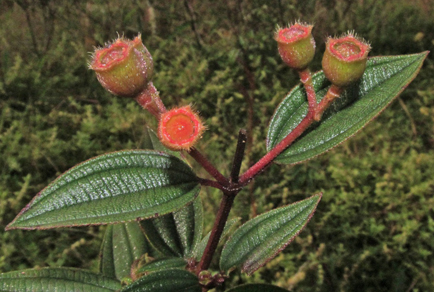
We present the description of Pleroma × venosum, a natural hybrid discovered in the Pedra da Macela region, municipality of Paraty, State of Rio de Janeiro, Brazil. This hybrid shows intermediate characters between Pleroma sellowianum and Pleroma echinatum, both also common in the same area, all of them with overlapping flowering periods. Pleroma × venosum has distinct morphological traits that set it apart from each one of its putative parent species, including differences in the type of indumentum covering the plant, leaf shape and number of veins, color and the dimensions of some floral structures. The hybrid differs from P. sellowianum by its leaves with five veins, flowers grouped in inflorescences, two bracteoles surrounding the floral bud, and flowers at anthesis with lilac petals, and yellow appendages on the pedoconnective in both stamen cycles. If compared to P. echinatum, it differs by the rugose adaxial surface of its leaves, which are covered with shorter trichomes and have a rugose (non-bullate) base, as well as by its larger, sericeous hypanthium and larger petals. For the new hybrid, a complete description is provided, as well as taxonomic comments, illustrations based on dehydrated specimens, photos of live specimens, a distribution map, and an identification key for the species of the genus that occur at Pedra da Macela. According to our assessments based on IUCN criteria, P. × venosum is Critically Endangered, because its occurrence is restricted and known from only two living plants, despite several attempts to locate more plants in the field. This is the first hybrid formally described for the genus Pleroma.
References
- Abbott, R., Albach, D., Ansell, S., Arntzen, J.W., Baird, S.J.E., Bierne, N., Boughman, J., Brelsford, A., Buerkle, C.A., Buggs, R., Butlin, R.K., Dieckmann, U., Eroukhmanoff, F., Grill, A., Cahan, S.H., Hermansen, J.S., Hewitt, G., Hudson, A.G., Jiggins, C., Jones, J., Keller, B., Marczewski, T., Mallet, J., Martinez-Rodriguez, P., Most, M., Mullen, S., Nichols, R., Nolte, A.W., Parisod, C., Pfennig, K., Rice, A.M., Ritchie, M.G., Seifert, B., Smadja, C.M., Stelkens, R., Szymura, J.M., Väinola, R., Wolf, J.B.W. & Zinner, D. (2013) Hybridization and speciation. Journal of Evolutionary Biology 26: 229–246. https://doi.org/10.1111/j.1420-9101.2012.02599.x
- Alvear, M. & Almeda, F. (2019) Revision of Monochaetum (Melastomataceae: Melastomateae) in Colombia. Systematic Botany Monographs 109: 1–153.
- Aublet, J.B.C.F. (1775) Histoire des Plantes de la Guiane Françoise. Pierre François Didot, London, 621 pp. https://doi.org/10.5962/bhl.title.674
- Bartling, F.G. (1830) Ordines naturales plantarum eorumque characteres et affinitates; adjecta generum enumeratione. Dieterich, Göttingen, 498 pp. https://bibdigital.rjb.csic.es/idurl/1/14384
- Bueno, V.R., Cassol, A.P.V., Leroy, C.J., Bueno, M.L. & Heiden, G. (2023) Calea × crassa (Neurolaeneae: Asteraceae), a new nothospecies from Paraná state, Brazil. Phytotaxa 618: 133–148. https://doi.org/10.11646/phytotaxa.618.2.3
- Cai, Y., Wang, F., Tan, G., Hu, Z., Wang, Y., Lun Ng, W., Wu, W., Liu, Y. & Zhou, R. (2019) Hybridization of Bornean Melastoma: implications for conservation of endemic plants in Southeast Asia. Botany Letters 166: 117–124. https://doi.org/10.1080/23818107.2019.1585284
- Catharino, E.L.M. & Coelho, M.A.N. (2010) Uma espécie nova de Anthurium Schott (Araceae), endêmica na Serra da Bocaina, município de Bananal, São Paulo, Brasil. Rodriguésia 61: 69–72. https://doi.org/10.1590/2175-7860201061105
- Chamisso, A. (1835) De plantis in expeditione speculatoria Romanzoffiana et in herbariis Regiis Berolinensibus observatis – Melastomaceae Americanae. Linnaea 9: 368–402.
- Cogniaux, A.C. (1885) Melastomataceae. In: Martius, C.F.P., Eichler, A.G. & Urban, I. (Eds.) Flora Brasiliensis 14. Lipsiae, Frid. Fleischer, Munich, 655 pp. https://doi.org/10.5962/bhl.title.454
- Cogniaux, A.C. (1891) Mélastomaceés. In: Candolle, A. & Candolle, C. (Eds.) Monographiae Phanerogamarum 7. G. Masson, Paris, 1256 pp. https://doi.org/10.5962/bhl.title.45961
- Coelho, M.A.N. & Catharino, E.L.M. (2005) Duas espécies novas de Anthurium schott (Araceae) para o Brasil. Rodriguésia 56: 35–41. https://doi.org/10.1590/2175-78602005568804
- De Candolle, A.P. (1828) Melastomaceae. In: Prodromus systematis naturalis regni vegetabilis 3. Tretttel et Würtz, Paris, pp. 99–202. https://doi.org/10.5962/bhl.title.286
- Don, D. (1823) An illustration of natural family of plants called Melastomataceae. Memoirs of the Wernerian Natural History Society 4: 276–329.
- Fioravanti, C. (2011) Quando os híbridos são férteis; cruzamentos improváveis podem gerar novas espécies de plantas e animais. Pesquisa Fapesp 185. Available from: https://revistapesquisa.fapesp.br/quando-os-h%C3%ADbridos-s%C3%A3o-f%C3%A9rteis/ (accessed 3 April 2025)
- Gardner, G. (1843) Contributions toward a flora of Brazil. Part II. In: Hooker, W.J. (Ed. II) The London journal of botany. London Journal of Botany, London, pp. 329–355.
- Giudicelli, G.C., Pezzi, P.H., Guzmán-Rodriguez, S., Turchetto, C., Bombarely, A. & Freitas, L.B. (2024) Historical and ongoing hybridisation in Southern South American grassland species. Scientific Reports 14: 27989. https://doi.org/10.1038/s41598-024-79584-9
- Goldenberg, R., Gonella, P.M. & Meyer, F.S. (2022) Four new species of Pleroma (Melastomataceae) from campos rupestres and vegetation on granitic inselbergs in Eastern Minas Gerais, Brazil. Edinburgh Journal of Botany 79: 1–30. https://doi.org/10.24823/EJB.2022.624
- Goulet, B.E., Roda, F. & Hopkins, R. (2016) Hybridization in Plants: Old Ideas, New Techniques. Plant Physiology 173: 65–78. https://doi.org/10.1104/pp.16.01340
- Guimarães, P.J.F. (1997) Estudos taxonômicos de Tibouchina sect. Pleroma (D. Don) Cogn. (Melastomataceae). PhD Thesis, Universidade Estadual de Campinas, Campinas, São Paulo, Brazil, 191 pp. Available from: http://repositorio.unicamp.br/jspui/handle/ REPOSIP/315439 (accessed 17 March 2025)
- Guimarães, P.J.F. & Oliveira, C.M.S. (2009) Tibouchina Aubl. In: Martins, S.E., Wanderley, M.G.L., Shepherd, G.J., Giulietti, A.M. & Melhem, T.S. (Eds.) Flora Fanerogâmica do Estado de São Paulo, vol. 6. Instituto de Botânica, São Paulo, pp. 127–149.
- Guimarães, P.J.F., Michelangeli, F.A., Sosa, K. & Gomez, J.R.S. (2019) Systematics of Tibouchina and allies (Melastomataceae: Melastomateae): a new taxonomic classification. Taxon 68: 937–1002. https://doi.org/10.1002/tax.12151
- Guimarães, P.J.F., Silva, D.N., Araújo, I.M. & Romero, R. (2022) A new species of Pleroma (Melastomataceae) from the Southern Espinhaço, Minas Gerais, Brazil. Webbia 77: 247–256. [https://digital.casalini.it/5474903]
- Harrison, R.G. & Larson, E.L. (2014) Hybridization, introgression, and the nature of species boundaries. Journal of Heredity 105: 795–809. https://doi.org/10.1093/jhered/esu033
- Herbário ESA (2017) A Pedra da Macela. Available from: https://projetopedradamacela.wordpress.com/2017/01/23/a-pedra-da-macela/ (accessed 13 March 2025)
- Herbário ESA (2018) O Projeto Pedra da Macela. Available from: https://projetopedradamacela.wordpress.com/2018/11/28/o-projeto-pedra-da-macela/ (accessed 13 March 2025)
- Hickey, M. & King, C. (2000) The Cambridge Illustrated Glossary of Botanical Terms. Cambridge University Press, Cambridge, 208 pp.
- Hooker, W.J. & Arnott, G.A.W. (1841) The botany of Captain Beechey’s voyage. Edward Krull, Glasgow, 485 pp. https://doi.org/10.5962/bhl.title.246
- IBGE—Instituto Brasileiro de Geografia e Estatística (2012) Manual Técnico da Vegetação Brasileira, nº1, 2ª Ed. IBGE, Rio de Janeiro, 271 pp.
- ISA—Instituto Sócio Ambiental (2025) Unidades de Conservação no Brasil - Parque Nacional da Serra da Bocaina. Available from: https://uc.socioambiental.org/pt-br/arp/851 (accessed 17 March 2025)
- ICMBio—Instituto Chico Mendes de Conservação da Biodiversidade (2025) Parque Nacional da Serra da Bocaina. Available from: https://www.icmbio.gov.br/parnaserradabocaina/quem-somos.html (accessed 12 March 2025)
- IUCN—International Union for Conservation of Nature (2022) Guidelines for Using the IUCN Red List Categories and Criteria, version 15. Prepared by the Standards and Petitions Committee. Available from: https://www.iucnredlist.org/resources/redlistguidelines (accessed 9 June 2023)
- Johnson, N. (2008) Hybrid incompatibility and speciation. Nature Education 1: 20. Available from: https://www.nature.com/scitable/topicpage/hybrid-incompatibility-and-speciation-820/ (accessed 4 April 2023)
- Jussieu, A.L. de (1789) Genera plantarum secundum ordines naturales disposita, juxta methodum in horto regio parisiensi exaratum, anno 1774. Apud viduam Herissant et Theophilum Barrois, Paris, 498 pp. https://doi.org/10.5962/bhl.title.284
- Lima, J.S. de & Peralta, D.F. (2021) Brioflora do Parque Nacional da Serra da Bocaina, de São Paulo, Brasil. Hoehnea 48: e802020. https://doi.org/10.1590/2236-8906-80/2020
- Linnaeus, C. von (1753) Species plantarum :exhibentes plantas rite cognitas, ad genera relatas, cum differentiis specificis, nominibus trivialibus, synonymis selectis, locis natalibus, secundum systema sexuale digestas; v. 1. Impensis Laurentii Salvii, Stockholm, 560 pp. https://doi.org/10.5962/bhl.title.669
- Liu, T., Chen, Y., Chao, L., Wang, S., Wu, W., Dai, S., Wang, F., Fan, Q. & Zhou, R. (2014) Extensive hybridization and introgression between Melastoma candidum and M. sanguineum. Plos One 9: e96680. https://doi.org/10.1371/journal.pone.0096680
- Lutz, B. (1926) The Flora of Serra da Bocaina. Proceedings of the American Philosophical Society 65: 27–43. [https://www.jstor.org/stable/984286]
- Machado, A.I.M.R., Romero, R. & Guimarães, P.J.F. (2023) Pleroma goyazense (Melastomataceae), a new species from Goiás state, Brazil, and a new synonym in Pleroma. Phytotaxa 622: 215–226. https://doi.org/10.11646/phytotaxa.622.3.4
- Martins, A.B. & Almeda, F. (2017) A Monograph of the Brazilian endemic genus Lavoisiera (Melastomataceae: Microlicieae). Phytotaxa 315: 1–194. https://doi.org/10.11646/phytotaxa.315.1.1
- Martins, S.E. & Wanderley, M.G.L. (2021) A new species of Vriesea Lindl. (Bromeliaceae) from the Atlantic Rainforest of São Paulo State, Brazil. Hoehnea 48: e1022020. https://doi.org/10.1590/2236-8906-102/2020
- Meyer, F.S. (2016) Estudos Sistemáticos no clado de Chaetogastra DC. e gêneros aliados (Melastomataceae: Melastomeae). PhD Thesis, Instituto de Biologia Vegetal, Universidade Estadual de Campinas, Campinas, São Paulo, 325 pp. Available from: http://www.bibliotecadigital.unicamp.br/document/?code=000968781 (accessed 4 April 2025)
- Meyer, F.S. & Goldenberg, R. (2014) Two new species of Pleroma (Melastomataceae: Melastomeae) from Brazil. Kew Bulletin 69: 95–27. https://doi.org/10.1007/s12225-014-9527-8
- Meyer, F.S., Guimarães, P.J.F. & Goldenberg, R. (2010) Tibouchina (Melastomataceae) do estado do Paraná, Brasil. Rodriguésia 61: 615–638. https://doi.org/10.1590/2175-7860201061405
- Meyer, F.S., Goldenberg, R. & Kollmann, L.J.C. (2016) Three new species of Pleroma (Melastomataceae) from Inselbergs of Espírito Santo, Brazil. Phytotaxa 282: 197–210. https://doi.org/10.11646/phytotaxa.282.3.3
- Meyer, F.S., Kollmann, L.J.C., Fraga, C.N. & Goldenberg, R. (2018) Four new rupicolous species of Pleroma (Melastomataceae) endemic to Espírito Santo, Brazil. Phytotaxa 348: 235–253. https://doi.org/10.11646/phytotaxa.348.4.1
- Meyer, F.S., Pacifico, R.B. & Almeda, F. (2022a) A new species of Pleroma (Melastomataceae: Melastomateae) endemic to Southern Cadeia do Espinhaço, Minas Gerais, Brazil. Phytotaxa 560: 30–42. https://doi.org/10.11646/phytotaxa.560.1.2
- Meyer, F.S., Brotto, M.L. & Goldenberg, R. (2022b) Pleroma joelsilvae (Melastomataceae): a new and endemic species from Paraná, Brazil. Phytotaxa 554: 257–268. https://doi.org/10.11646/phytotaxa.554.3.4
- Meyer, F.S. & Goldenberg, R. (2023) A new species of Pleroma (Melastomataceae) from high-altitude grasslands of the state of São Paulo, Brazil. Phytotaxa 616: 89–98. https://doi.org/10.11646/phytotaxa.616.1.7
- Meyer, F.S., Arantes, F.M. & Goldenberg, R. (2024) Two new species and a new combination in Pleroma (Melastomataceae) from the Brazilian Atlantic Forest. Phytotaxa 638: 209–226. https://doi.org/10.11646/phytotaxa.638.3.1
- Meyer, K. (2001) Revision of Southeast Asian genus Melastoma (Melastomataceae). Blumea 46: 351–398.
- Naudin, C.V. (1845) Additions a la Flore du Brésil Méridional. Annales des Sciences Naturelles, Botanique 4: 48–57.
- Necker, N.M.J. (1838) Bellucia Neck. In: Rafinesque, C.S. (Ed.) New Genera and Species of Trees and Shrubs of North America, and Other Regions of the Earth : Omitted or Mistaken by the Botanical Authors and Compilers, or Not Properly Classified, Now Reduced by Their Natural Affinities to the Proper Natural Orders and Tribes. Printed for the author and publisher, Philadelphia, 184 pp. https://doi.org/10.5962/bhl.title.248
- Neri, J., Wendt, T. & Palma-Silva, C. (2018) Natural hybridization and genetic and morphological variation between two epiphytic bromeliads. Aob Plants 10: 1–16. https://doi.org/10.1093/aobpla/plx061
- Ng, W.L., Huang, G., Wu, W., Zhou, Q., Liu, Y. & Zhou, R. (2020) Molecular confirmation of natural hybridization between Melastoma sanguineum and M. malabathricum (Melastomataceae). Gardens' Bulletin Singapore 72: 65–75. https://doi.org/10.26492/gbs72(1).2020-07
- Pacifico, R., Almeda, F., Penneys, D.S. & Fidanza, K. (2022) Systematics of the Trembleya sensu stricto clade of Microlicia (Melastomataceae, Lavoisiereae). PhytoKeys 216: 1–101. https://doi.org/10.3897/phytokeys.216.91032
- Pinheiro, F., Barros, F.de, Palma-Silva, C., Meyer, D., Fay, M.F., Suzuki, R.M., Lexer, C. & Cozzolino, S. (2010) Hybridization and introgression across different ploidy levels in the Neotropical orchids Epidendrum fulgens and E. puniceoluteum (Orchidaceae). Molecular Ecology 19: 1–14. https://doi.org/10.1111/j.1365-294X.2010.04780.x
- QGIS Development Team (2023) QGIS Geographic Information System. Open Source Geospatial Foundation. Available from: https://www.qgis.org/pt_BR/site/forusers/download.html (accessed 26 March 2025)
- Raddi, G. (1820) Di alcune specie nuove di rettili e piante brasiliane. Memoria di Matematica e di Fisica della Societa Italiana delle Scienze Residente in Modena 18: 313–349.
- Reginato, M. & Michelangeli, F.A. (2016) Untangling the phylogeny of Leandra s.str. (Melastomataceae, Miconieae). Molecular Phylogenetics and Evolution 96: 17–32. https://doi.org/10.1016/j.ympev.2015.11.015
- Reis, G.H., Mansanares, M.E., Domingos, D.Q., Meireles, L.D. & van den Berg, E. (2015) Asteraceae dos Campos Rupestres das Serras da Bocaina e de Carrancas, Minas Gerais, Brasil. Rodriguésia 66: 829–845. https://doi.org/10.1590/2175-7860201566311
- Renner, S.S. (1986/1987) Reproductive Biology of Bellucia (Melastomataceae). Acta Amazonica 16/17: 197–208. https://doi.org/10.1590/1809-43921986161208
- Rocha, M.J.R., Guimarães, P.J.F., Michelangeli, F.A. & Batista, J.A.N. (2017) Taxonomy of Marcetieae: a new neotropical Tribe of Melastomataceae. International Journal of Plant Sciences 179: 50–74. https://doi.org/10.1086/694932
- Romero, R., Silva, R.P. & Guimarães, P.J.F. (2024) Two new Pleroma species and an updated key: Melastomateae from the Serra da Canastra National Park, Minas Gerais, Brazil. PhytoKeys 247: 11–27. https://doi.org/10.3897/phytokeys.247.130040
- Schneider, C.A., Rasband, W.S. & Eliceiri, K.W. (2012) NIH Image to ImageJ: 25 years of image analysis. Nature Methods 9: 671–675. https://doi.org/10.1038/nmeth.2089
- Silva, D.N., Antonicelli, M.C.A. & Guimarães, P.J.F. (2023) Taxonomic novelties from the Espinhaço Septentrional: Two new species of Pleroma and the first records of Melastomataceae from the Morro das Marombas, Minas Gerais, Brazil. Systematic Botany 48: 44–54. https://doi.org/10.1600/036364423X16758873924090
- Soltis, P.S. & Soltis, D.E. (2009) The role of hybridization in plant speciation. Annual Review of Plant Biology 60: 561–588. https://doi.org/10.1146/annurev.arplant.043008.092039
- Souza, V.C. (2017) Botanical survey aids in the preservation of Pedra da Macela. Jornal da USP. Available from: https://jornal.usp.br/ciencias/ciencias-biologicas/levantamento-botanico-ajuda-na-preservacao-da-pedra-da-macela/ (accessed 12 March 2025)
- Stearn, W.T. (1985) Botanical Latin, 3 ed. Redwood Burn, Trowbridge, 566 pp.
- Thiers, B. (2025 [continuously updated]) Index Herbariorum: A global directory of public herbaria and associated staff, New York, USA. Available from: http://sweetgum.nybg.org/science/ih/ (accessed 17 March 2025)
- Triana, J.J. (1867) Melastomataceae. In: Bentham, G. & Hooker, J.D. (Eds.) Genera Plantarum: ad exemplaria imprimis in Herberiis Kewensibus servata definite, v. l, pt. 3. A. Black, London, pp. 725–773. https://doi.org/10.5962/bhl.title.747
- Triana, J.J. (1871 [“1872”]) Les Mélastomacées. Transactions of the Linnean Society of London 28: 1–188. https://doi.org/10.1111/j.1096-3642.1871.tb00222.x
- Turland, N.J., Wiersema, J.H., Barrie, F.R., Gandhi, K.N., Gravendyck, J., Greuter, W., Hawksworth, D.L., Herendeen, P.S., Klopper, R.R., Knapp, S., Kusber, W.-H., Li, D.-Z., May, T.W., Monro, A.M., Prado, J., Price, M.J., Smith, G.F. & Zamora Señoret, J.C. (2025) International Code of Nomenclature for algae, fungi, and plants (Madrid Code). Regnum Vegetabile 162. Chicago: University of Chicago Press. https://doi.org/10.7208/chicago/9780226839479.001.0001
- Wu, R., Zou, P., Tan, G., Hu, Z., Wang, Y., Ning, Z., Wu, W., Liu, Y., He, S. & Zhou, R. (2019) Molecular identification of natural hybridization between Melastoma malabathricum and Melastoama beccarianum in Sarawak, Malaysia. Ecology and Evolution 9: 5766–5776. https://doi.org/10.1002/ece3.5160
- Yamamoto, M.A.C.G. (2023) Revisão dos nomes de Melastomataceae publicados na Florae Fluminense. Master's Dissertation, Universidade Federal do Paraná, Pós Graduação em Botânica, Curitiba, Paraná, Brazil, 88 pp. Available from: https://acervodigital.ufpr.br/handle/1884/82915 (accessed 12 March 2025)