
Abstract
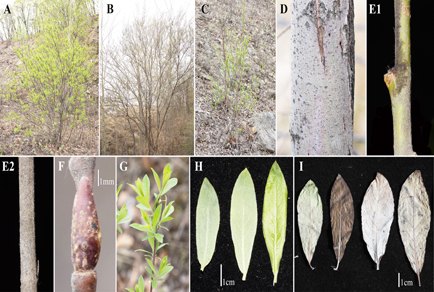
Salix mishanensis, endemic to Heilongjiang Province, China, primarily distributed in the Ussuri River basin, is described and illustrated here. The new species is sympatric with S. bebbiana, S. caprea, S. raddeana, and S. taraikensis and shares morphological similarities with them. It differs from its counterparts in several features: bark fissuring pattern, presence or absence of irregular curvature in perennial branches, indumentum on two-year-old branches and on abaxial surfaces of young and mature leaves, shape of buds and mature leaves, presence of conspicuous stipules, morphology of leaves at the base of pistillate inflorescences, density of pistillate flowers (at full flowering) and capsules along the axis, bract color, pistillate inflorescence length, ovary stipe and style length, and the angle between flowers and the inflorescence axis. Salix mishanensis can be recognized by its non-fissured bark, turgid ovoid-conical buds, smooth adaxial leaf surface, absent or precocious stipules, pistillate flowers at an angle <60° to the rachis, densely arranged capsules, bicolored bracts (white below, black above), ovary stipe 1–2 mm long, and styles 1–1.3 mm long. We assign the new species to S. sect. Cinerella. Furthermore, high-resolution botanical plate, detailed distribution map, and an efficient dichotomous key are provided.
References
- Argus, G.W. (1997) Infrageneric classification of Salix (Salicaceae) in the New World. Systematic Botany Monographs 52: 1–121. https://doi.org/10.2307/25096638
- Argus, G.W. (2010) Salicaceae, Salix. In: Flora of North America, vol. 7. Oxford, New York, pp. 23–164.
- Belyaeva, I.V., Epanchintseva, O.V., Shatalina, A.A. & Semkina, L.A. (2006) Willows of Ural: Atlas and identification key. Russian Academy of Sciences, Ekaterinburg, 173 pp.
- Belyaeva, I.V. & King, C. (2025) 1138. Salix magnifica Hemsl.: Salicaceae. Botanical Magazine 42 (1): 77–94. https://doi.org/10.1111/curt.12631
- Bolshakov, N.M. (1992) Salicaceae. In: Krasnoborov, I.M. & Malyshev, L.I. (Eds.) Flora Sibiriae: Salicaceae–Amaranthaceae, Tomus 5. Nauka, Novosibirsk, pp. 8–59; 187–228 (maps).
- Ding, T.Y. (1995) Origin, divergence and geographical distribution of Salicaceae. Acta Botanica Yunnanica 17 (3): 277–290. https://doi.org/10.15281/jplantres1887.30.274
- Dumortier, B.C. (1825) Verhandeling over het geslacht der wilgen (Salix) en de natuurlijke familie der Amentaceae. Bijdragen tot de Natuurkundige Wetenschappen 1 (1): 44–61.
- Efimova, A.P. (2020) Salicaceae. In: Nikolin, E.G. (Ed.) Manual of highest plants of Yakutiya. Nauka, Novosibirsk, pp. 286–318.
- Fang, Z.F., Zhao, S.D. & Skvortsov, A.K. (1999) Salicaceae, Salix. In: Wu, Z.Y. & Raven, P.H. (Eds.) Flora of China, vol. 4. Science Press, Beijing & Missouri Botanical Garden, St. Louis, pp. 162–274.
- He, L., Liao, S. & Zhang, Z.X. (2014) A new species of Salix (Salicaceae) from Tibet (Xizang), China. Phytotaxa 167 (3): 289–294. https://doi.org/10.11646/phytotaxa.167.3.8
- He, L., Wagner, N.D. & Hörandl, E. (2021) Restriction‐site associated DNA sequencing data reveal a radiation of willow species (Salix L., Salicaceae) in the Hengduan Mountains and adjacent areas. Journal of Systematics and Evolution 59 (1): 44–57. https://doi.org/10.1111/jse.12593
- Hörandl, E., Florineth, F. & Hadacek, F. (2002) Weiden in Osterreich und angrenzenden Gebieten. Ferdinand Berger & Söhne GmbH, Wien & Horn, 164 pp.
- Kimura, A. (1934) Flora of Hokkaido and Saghalien Ⅳ: Dicotyledoneae Aechichlamydeae Saururaceae-Polygonaceae. Journal of the Faculty of Agriculture, Hokkaido Imperial University 26 (4): 389–528.
- Kitagawa, M. (1939) Lineamenta Florae Manshuricae. Report of the Institute of Scientific Research 3: 156–163.
- Linnaeus, C. (1753) Species Plantarum. Impensis Laurentii Salvii, Holmiae, 1200 pp.
- Nakai, T. (1916) Notulae ad Plantas Japoniae et Coreae. XII. Botanical Magazine, Tokyo 30 (356): 274–290.
- Nakai, T. (1930) Flora sylvatica Koreana. Pars XVIII. Piperaceae, Chloranthaceae et Salicaceae. Forest Experiment Station, Government General of Chosen 18: 1–218.
- Nasarow, M.I. (1936) Salicaceae. In: Komarov, V.L. (Ed.) Flora Unionis Rerumpublicarum Sovieticarum Socialisticarum vol. 5, addenda IV. Leningrad: Academy of Sciences of the USSR, pp. 21–228; 707–713.
- Nedoluzhko, V.A. (1995) Salicaceae Mirb. In: Charkevicz, S.S. (Ed.) Plantae vasculares Orientis Extremi sovetici, Tomus 7. Nauka, St. Petersburg, pp. 145–212.
- Ohashi, H. (2000) A systematic enumeration of Japanese Salix (Salicaceae). Journal of Japanese Botany 75 (1): 1–41.
- Ohashi, H. (2001) Salicaceae of Japan. Scientific Reports of Tohoku Imperial University 4 (40): 269–396.
- Sargent, C.S. (1895) The Names of some North American Tree Willows. Garden & Forest 8 (404): 463.
- Schneider, C.K. (1916) Salicaceae, Salix. In: Sargent, C.S. (Ed.) Plantae Wilsonianae, vol. 3. University Press, Cambridge, pp. 40–179.
- Seringe, N.C. (1824) Exemplaires desseches de la revision inedit du genre Salix. chez l’auteur, Genève.
- Siuzew, P.W. (1912) Contributions ad floram Manshuriae. Trudy Botanicheskogo Muzeya Imperatorskoi Akademii Nauk 9: 69–135.
- Skvortsov, A.K. (1968) Willows of the USSR. A taxonomic and geographic revision. Nauka, Moscow.
- Skvortsov, A.K. (1989) Die Weiden (Salix) der Sektion Chamaetia und das Problem der Entstehung der arktischen Flora. Flora 182: 57–67. https://doi.org/10.1016/S0367-2530(17)30394-8
- Skvortsov, A.K. (1998) A New Species of Salix (Salicaceae) from Hainan, China. Harvard Papers in Botany 3 (1): 107–108. [https://www.jstor.org/stable/41761561]
- Skvortsov, A.K. (1999) Willows of Russia and adjacent countries. Taxonomical and geographical revision. Faculty of Mathematics and Natural Sciences Report Series, No. 39. University of Joensuu Press, Joensuu, pp. 1–307.
- Thiers, B. (2025) Index Herbariorum: A global directory of public herbaria and associated staff. New York Botanical Garden’s Virtual Herbarium.
- Valyagina-Malyutina, E.T. (2018) The willows of Russia: an illustrated identification book. KMK Scientific Press, Moscow, 372 pp.
- Wang, Z., Fang, C.F., Zhao, S.D., Chou, Y.L., Dong, S.L., Yu, C.Y., Yang, C.Y. & Chao, N. (1984) Salix. In: Wang, C. & Fang, C.F. (Eds.) Flora Reipublicae Popularis Sinicae, vol. 20 (2). Science Press, Beijing, pp. 81–381.
- Wimmer, C.F. (1849) Verzeichnis der in Schlesien wildwachsenden Weiden. Flora 32: 33–48.
- Zhan, Z.F., Shang, C., Shao, L.Z., Luo, Y.K., Zheng, B.J. & Zhang, Y. (2025) Salix zhixiangiana (Salicaceae), a new species from Northeast China. Phytotaxa 701 (2): 199–206. https://doi.org/10.11646/phytotaxa.701.2.6