

Abstract
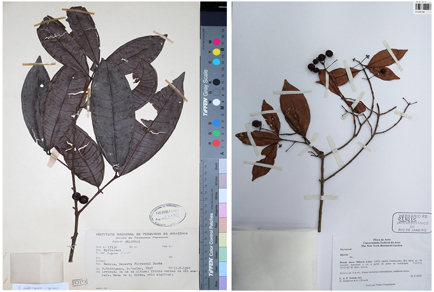
Eugenia pseudoomissa, Myrcia acreana, Myrcia aripuanana, Myrcia viaria, Plinia acreana, P. amazonica and P. impressa, from Amazonian Brazil, are described and illustrated. Eugenia pseudoomissa is morphologically related to E. omissa, but differs by its glabrous condition and larger fruits; Myrcia acreana seems related to M. curtipendula, but differs by its shorter, not branched inflorescences; M. aripuanana is morphologically related to M. grazielae, but differs by the blades not bullate, shorter inflorescences and smaller flowers; M. viaria seems related to M. megapaniculata, but has larger leaves and non-apiculate calyptras; Plinia acreana reminds P. rogersiana, but differs by the blades with a higher number of lateral veins and more developed axes of inflorescences; P. amazonica seems related to P. cerrocampanensis, but differs by its sparse indumentum and smaller fruits, and P. impressa seems related to P. moralesii, but differs by its glabrous condition, wider blades with midvein adaxially impressed and oblate fruits. Additionally, conservation issues are discussed for each species.
References
- Amapá (2023) Secretaria de Meio Ambiente monitora mudanças na foz do rio Araguari. Governo do Estado do Amapá. Available from: https://www.amapa.gov.br/ler_noticia.php?slug=0905/secretaria-de-meio-ambiente-monitora-mudancas-na-foz-do-rio-araguari (accessed 18 April 2025).
- Barrie, F.R. (2004) Synopsis of Plinia (Myrtaceae) in Mesoamerica. Novon 14: 380–400.
- Berg, O. (1855–1856) Revisio Myrtacearum Americae. Linnaea 27: 1–472.
- Burton, G.P., Canteiro, C., Fernandes, T., Grice, H., Lourenço, A.R., Parra-O., C., Santos, M.F. & Lucas, E.J. (2022) A monographic conspectus of Myrcia sect. Calyptranthes (Myrtaceae) from South and Central America. Annals of the Missouri Botanical Garden 107: 87–136. https://doi.org/10.3417/2022726
- Campbell, D.G. (1989) The importance of floristic inventory in the tropics. In: Campbell, D.G. & Hammond, D. (eds.) Floristic inventory of tropical countries: the status of plant systematics, collections, and vegetation, plus recommendations for the future. New York Botanical Garden, New York, pp. 5–30.
- CRIA (Centro de Referência em Informação Ambiental) (2024) SpeciesLink. Available from: https://specieslink.net/ (accessed 31 December 2024).
- De Candolle, A.P. (1827) Myrtacées. In: Bory de Saint-Vincent, J.B.G.M. (org.) Dictionnaire classique d’histoire naturelle, 11. pp. 399–407.
- Ellis, B., Daly, D.C., Hickey, L.J., Johnson, K.R., Mitchell, J.D., Wilf, P. & Wing, S.L. (2009) Manual of leaf architecture. Cornell University, 190 pp. https://doi.org/10.1079/9781845935849.0000
- Gonçalves, E. & Lorenzi, H. (2011) Morfologia vegetal. 2 ed. São Paulo, Plantarum, 544 pp.
- Hickey, M. & King, C. (2000) The Cambridge illustrated glossary of botanical terms. Cambridge University Press, 208 pp.
- IBGE (Instituto Brasileiro de Geografia e Estatística) (2024) Cidades e estados do Brasil. Available from: https://cidades.ibge.gov.br/ (accessed 20 December 2024)
- IBGE (2025a) Marechal Thaumaturgo. Available from https://cidades.ibge.gov.br/brasil/ac/marechal-thaumaturgo/historico (accessed 22 October 2025)
- IBGE (2025b) Biblioteca IBGE. Available from: https://biblioteca.ibge.gov.br/index.php/biblioteca-catalogo?view=detalhes&id=440448 (accessed 18 April 2025)
- IUCN (International Union for the Conservation of Nature and Natural Resources) (2022) Guidelines for using the IUCN Red List Categories and Criteria. Version 15.1. Gland, Switzerland, 108 pp. [https://www.iucnredlist.org/documents/RedListGuidelines.pdf]
- IUCN (2025) Geocat. Available from: https://geocat.iucnredlist.org/editor (accessed 18 April 2025)
- Linnaeus, C. (1753) Species Plantarum, v. 1. Stockholm, 560 pp.
- Lourenço, A.R.L., Parra-O., C., Sánchez-Chávez, E. & Lucas, E. (2018) New combinations and names for continental American Calyptranthes (Myrtaceae: Myrcia s.l.). Phytotaxa 373: 71–85. https://doi.org/10.11646/phytotaxa.373.1.3
- Lucas, E.J., Amorim, B.S., Lima, D.F., Lima-Lourenço, A.R., Nic Lughadha, E.M., Proença, C.E.B., Rosa, P.O., Rosário, A.S., Santos, L.L., Santos, M.F., Souza, M.C., Staggemeier, V.G., Vasconcelos, T.N.C. & Sobral, M. (2018) A new infra-generic classification of the species-rich Neotropical genus Myrcia s.l. Kew Bulletin 73 (9): pp. 1–12. https://doi.org/10.1007/S12225-017-9730-5
- Mattos, J.R. (1995) Novidades taxonômicas em Myrtaceae – X. Loefgrenia 106: 1–4.
- Mazine, F., Bünger, M.O., Faria, J.E.Q., Lucas, E. & Souza, V.C. (2016) Sections in Eugenia (Myrteae, Myrtaceae): nomenclatural notes and a key. Phytotaxa 289: 225–236. https://doi.org/10.11646/phytotaxa.289.3.2
- McDade, L. (1995) Species concepts and problems in practice: insight from botanical monographs. Systematic Botany 20: 606–622. https://doi.org/10.2307/2419813
- McVaugh, R. (1956) Tropical American Myrtaceae—notes on generic concepts and descriptions of previously unrecognized species. Fieldiana Botany 29 (3): 145–228. https://doi.org/10.5962/bhl.title.2444
- McVaugh, R. (1958) Flora of Peru—Myrtaceae. Field Museum Publications in Botany 13: 569–818. https://doi.org/10.2307/4118137
- McVaugh, R. (1963) Tropical American Myrtaceae II. Notes on generic concepts and descriptions of previously unrecognized species. Fieldiana Botany 29 (8): 395–532. https://doi.org/10.5962/bhl.title.3851
- McVaugh, R. (1969) Myrtaceae. In: Flora of the Guayana Highland—part VIII. Memoirs of the New York Botanical Garden, pp. 55–286.
- Nic Lughadha, E., Slade, K., Jennings, L., Boudet-Fernandes, H. & Lucas, E. (2010) Three new species of Myrcia section Gomidesia (Myrtaceae)—from Espírito Santo, Brazil. Kew Bulletin 65: 21–28. https://doi.org/10.1007/s12225-009-9171-x
- Nic Lughadha, E.M., Lucas, E.J. & Woodgyer, E.M. (2012) Additions to Myrcia s.l. from eastern Brazil—taxonomic and nomenclatural novelties in Myrcia s.l. (Myrtaceae). Kew Bulletin 67: 235–243. https://doi.org/10.1007/s12225-012-9350-z
- Porta-Retrato (2011) Porta-retrato Macapá/Amapá. Available from: https://porta-retrato-ap.blogspot.com/2011/02/cachoeira-do-paredao.html (accessed 18 April 2025)
- Reflora (2024) Myrtaceae. In: Flora e Funga do Brasil. Jardim Botânico do Rio de Janeiro. Available from: https://floradobrasil.jbrj.gov.br/FB171 (accessed 27 December 2024)
- Ruiz, H. & Pavón, J. (1798) Systema vegetabilium florae peruvianae et chilensis. Gabrielis de Sancha, Madrid, 456 pp. https://doi.org/10.5962/bhl.title.887
- Sobral, M. & Stehmann, J.R. (2009) An analysis of new angiosperm species discoveries in Brazil (1990–2006). Taxon 58: 227–232. https://doi.org/10.1002/tax.581021
- Sobral, M., Grippa, C.R., Souza, M.C., Aguiar, O.T., Bertoncello, R. & Guimarães, T.B. (2012) Fourteen new species and two taxonomic notes on Brazilian Myrtaceae. Phytotaxa 50: 19–50. https://doi.org/10.11646/phytotaxa.50.1.3
- Stevens, P.F. (2024) Angiosperm Phylogeny Website. Version 14, July 2017. Available from: http://www.mobot.org/MOBOT/research/APweb/ (accessed 27 December 2024)
- Swartz, O. (1788) Nova Genera et Species Plantarum. Stockholm, 158 pp.
- Thiers, B. (2024) Index Herbariorum. A global directory of public herbaria and associated staff. New York Botanical Garden’s Virtual Herbarium. Available from: http://sweetgum.nybg.org/science/ih/ (accessed 31 December 2024)