

Abstract
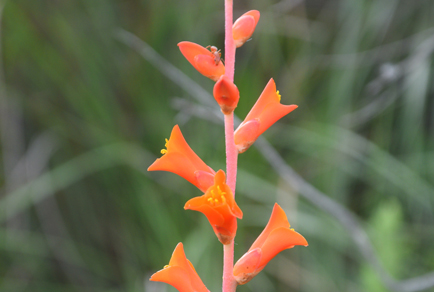
Several species complexes of Dyckia s.s. have been investigated in recent years, with the taxonomy of the genus regarded as one of the most challenging within the family. In this study, we propose the circumscription of the Dyckia remotiflora complex and present a taxonomic-nomenclatural revision for the included taxa: D. remotiflora var. remotiflora, D. remotiflora var. vaginosa stat. nov., D. choristaminea, D. neojonesiana sp. nov., and D. pontesii. Additionally, we propose elevating the taxon D. tandilensis stat. nov. to species status and synonymizing D. remotiflora var. angustior in D. tuberosa, both excluded from the complex. The complex is analyzed in terms of distribution and habitat, conservation, evolution and phylogeny, natural hybrids, morphology and taxonomy, and a key for identification is provided. For each taxon within the complex, we present taxonomic treatment, nomenclatural types for accepted names and synonyms, etymology, distribution and habitat information, as well as morphological and taxonomic observations.
References
- Andrade, B.O., Dröse, W., Aguiar, C.A. de, Aires, E.T., Alvares, D.J., Barbieri, R.L., Carvalho, C.J.B. de, Bartz, M., Becker, F.G., Bencke, G.A., Beneduzi, A., Silva, J.B., Blochtein, B., Boldrini, I.I., Boll, P.K., Bordin, J., Silveira, R.M.B. da, Borges-Martins, M., Bosenbecker, C., Braccini, J., Braun, B., Brito, R., Brown, G.G., Büneker, H.M., Buzatto, C.R., Cavalleri, A., Cechin, S.Z., Colombo, P., Constantino, R., Costa C.F. da, Dalzochio, M.S., Oliveira, M.G. de, Dias, R.A., Santos L.A. dos, Duarte, A. da F., Duarte, J.L.P., Durigon, J., Silva, M.E. da, Ferreira, P.P.A., Ferreira, T., Ferrer, J., Ferro, V.G., Fontana, C.S., Freire, M.D., Freitas, T.R.O., Galiano, D., Garcia1, M., Santos, T.G. dos, Gomes, L.R.P., Gonzatti, F., Gottschalk, M.S., Graciolli, G., Granada, C.E., Grings, M., Guimarães, P.S., Heydrich, I., Iop, S., Jarenkow, J.A., Jungbluth, P., Käffer, M.I., Kaminski, L.A., Kenne, D.C., Kirst, F.D., Krolow, T.K., Krüger, R.F., Kubiak, B.B., Leal-Zanchet, A.M., Loebmann, D., Lucas, D.B., Lucas, E.M., Luza, A.L., Machado, I.F., Madalozzo, B., Maestri, R., Malabarba, L.M., Maneyro, R., Marinho, M.A.T., Marques, R., Marta K. da S., Martins, D. da S., Martins, G. da S., Martins, T.R., Mello, A.S. de, Mello, R.L., Mendonça Junior, M. de S., Morais, A.B.B. de, Moreira, F.F.F., Moreira, L.F.B., Moura, L. de A., Nervo, M.H., Ott, R., Paludo, P., Passaglia, L.M.P., Périco, Petzhold, E.S., Pires, M.M., Poppe, J.L., Quintela, F.M., Raguse-Quadros, M., Pereira, M.J.R, Renner, S., Ribeiro, F.B., Ribeiro, J.R.I, Rodrigues, E.N.L., Rodrigues, Patrícia E.S., Romanowski, H.P., Ruschel, T.P., Saccol, S. da S.A., Savaris, M.A., Silveira, F.S., Schmitz, H.J., Siegloch, A.E., Siewert, R.R., Silva Filho, P.J.S. da, Soares, A.G., Somavilla, A., Sperotto, P., Spies, M.R., Tirelli, F.P., Tozetti, A.M., Verrastro, L., Ely, C.V., Silva, A.Z. da, Zank, C., Zefa, E. & Overbeck, G.E. (2023) 12,500+ and counting: biodiversity of the Brazilian Pampa. Frontiers of Biogeography 15: e59288. https://doi.org/10.21425/F5FBG59288
- Andrade, B.O., Marchesi, E., Burkart, S., Setubal, R.B., Lezama, F., Perelman, S., Schneider, A.A., Trevisan, R., Overbeck, G.E. & Boldrini, I.I. (2018) Vascular plant species richness and distribution in the Río de la Plata grasslands. Botanical Journal of the Linnean Society 188: 250–256. https://doi.org/10.1093/botlinnean/boy063
- Aoki-Gonçalves, F., Queiroz, M.V.D. de, Guimarães, T. de B., Neffa, V.S. & Palma-Silva, C. (2020) High gene flow maintains wide-range species cohesion in a Neotropical epiphyte (Tillandsia aeranthos, Bromeliaceae). Botanical Journal of the Linnean Society 194: 239–252. https://doi.org/10.1093/botlinnean/boaa040
- Baker, J.G. (1877) Systema Iridacearum. Journal of Linnean Society, Botany 16: 61–180. https://doi.org/10.1111/j.1095-8339.1877.tb00172.x
- Baker, J.G. (1871) Dyckia brevifolia. Refugium Botanicum 4: t. 236.
- Baker, J.G. (1884) New Garden Plants. The Gardeners’ Chronicle & Agricultural Gazette 2: 198.
- Baker, J.G. (1889) Handbook of the Bromeliaceae. G. Bell & Sons, London, 243 pp. https://doi.org/10.5962/bhl.title.51681
- Barbará, T., Martinelli, G., Palma-Silva, C., Fay, M.F., Mayo, S.J. & Lexer, C. (2009) Genetic relationships and variation in reproductive strategies in four closely related bromeliads adapted to Neotropical ‘inselbergs’: Alcantarea glaziouana, A. regina, A. geniculata and A. imperialis (Bromeliaceae). Annals of Botany 103: 65–77. https://doi.org/10.1093/aob/mcn226
- Barbará, T., Martinelli, G., Fay, M.F., Mayo, S.J. & Lexer, C. (2007) Population differentiation and species cohesion in two closely related plants adapted to Neotropical high-altitude ‘inselbergs’, Alcantarea imperialis and Alcantarea geniculata (Bromeliaceae). Molecular Ecology 16: 1981–1992. https://doi.org/10.1111/j.1365-294X.2007.03272.x
- Barfuss, M.H.J., Till, W., Leme, E.M.C., Pinzón, J.P., Manzanares, J.M., Halbritter, H., Samuel, R. & Brown, G.K. (2016) Taxonomic revision of Bromeliaceae subfam. Tillandsioideae based on a multi-locus DNA sequence phylogeny and morphology. Phytotaxa 279: 1–97. https://doi.org/10.11646/phytotaxa.279.1.1
- Barreto, A. (1976) Bibliografia Sul-Riograndense 2: K-Z, Conselho Federal de Cultura, Rio de Janeiro, pp. 737–1556.
- Barton, N.H. & Keightley, P.D. (2002) Understanding quantitative genetic variation. Nature Reviews Genetics 3: 11–21. https://doi.org/10.1038/nrg700
- Beauvois, A.M.F.J.P.de (1812) Essai d’une nouvelle agrostographie. Imprimerie de Fain, Paris, 182 pp.
- Beentje, H. (2010) The Kew Plant Glossary: an illustrated dictionary of plant terms. Royal Botanic Gardens, Richmond, 192 pp.
- Beer, J.G. (1856) Die Familie der Bromeliaceen. Wien, Tendler & Comp., 272 pp.
- Bell, A.D. (2008) Plant Form: An Illustrated Guide to Flowering Plant Morphology. New Edition, Timber Press, Portland, 431 pp.
- Berger, A. (1929) Kakteen. Verlagsbuchhandlung von Eugen Ulmer, Stuttgart, 346 pp.
- Berhouet, A.H.B. & Riaño, L.L. (2008) Bromelias del Uruguay. Librería Linardi y Risso, Montevideo, 217 pp.
- Bernardello, L.M., Galetto, L. & Juliani, H.R. (1991) Floral nectar, nectary structure and pollinators in some Argentinean Bromeliaceae. Annals of Botany 67: 401–411. https://doi.org/10.1093/oxfordjournals.aob.a088156
- Boisselier-Dubayle, M.C., Leblois, R., Samadi, S., Lambourdière, J. & Sarthou, C. (2010) Genetic structure of the xerophilous bromeliad Pitcairnia geyskesii on inselbergs in French Guiana – a test of the forest refuge hypothesis. Ecography 33: 175–184. https://doi.org/10.1111/j.1600-0587.2009.05446.x
- Braun, P.J. & Pereira, E.E. (2008) Succulent and Xeromorphic Bromeliads of Brazil. Part 4. Dyckia richardii and D. grandidentata, two new succulent and heavily-armed species from west‐central Brazil. Cactus and Succulent Journal 80: 319–324. https://doi.org/10.2985/0007-9367-80.6.319
- Britton, N.L. & Rose, J.N. (1922) The Cactaceae: descriptions and illustrations of plants of the cactus family 3. The Carnegie Institution of Washington, Washington, 255 pp.
- Brown, G.K. & Gilmartin, A.J. (1984) Stigma structure and variation in Bromeliaceae - Neglected taxonomic characters. Brittonia 36: 364–374. https://doi.org/10.2307/2806597
- Brown, G.K. & Gilmartin, A.J. (1989) Stigma types in Bromeliaceae - A systematic survey. Systematic Botany 14: 110–132. https://doi.org/10.2307/2419055
- Buining, A.F.H. (1968) Notocactus uebelmannianus spec. nova. Kakteen und Andere Sukkulenten 19: 175–176.
- Buining, A.F.H. (1970) Gymnocalycium horstii Buining spec. nov. Kakteen und Andere Sukkulenten 21: 162–165.
- Bull, W. (1892) A Catalogue of New Rare and Beautiful Plants and Orchids 278. Published by the author, London, 128 pp.
- Bull, W. (1974) New plants for 1874. The Gardeners' chronicle 1: 78.
- Büneker, H.M. (2021) Revisão taxonômica do complexo Dyckia selloa (Bromeliaceae, Pitcairnioideae) baseada em caracteres morfológicos. Masters dissertation, Universidade Federal do Rio Grande do Sul, Porto Alegre, 290 pp.
- Büneker, H.M., Carvalho, J.T.D., Almeida, P.S. & Mariath, J.E.A. (2025) Comparative floral morphoanatomy and pollen morphology reveal a new species of the Dyckia selloa complex (Bromeliaceae: Pitcairnioideae) in Rio Grande do Sul, Brazil. Botanical Journal of the Linnean Society: boaf082. https://doi.org/10.1093/botlinnean/boaf082
- Büneker, H.M. & Mariath, J.E.A. (2022) Dyckia pseudodelicata, a new species of the D. selloa complex (Bromeliaceae, Pitcairnioideae) from Rio Grande do Sul, Brazil. Phytotaxa 550: 59–70. https://doi.org/10.11646/phytotaxa.550.1.4
- Büneker, H.M., Guarçoni, E.A.E., Santos-Silva, F. & Forzza, R.C. (2021) Dyckia. In: BFG—The Brazil Flora Group (Ed.) Coleção Flora do Brazil 2020. Jardim Botânico do Rio de Janeiro, pp. 725–1050.
- Büneker, H.M., Pastori, T., Almeida, P.S. de & Mariath, J.E.A. (2023) Dyckia magnifica, a new species of Bromeliaceae (Pitcairnioideae) from Southern Brazil, and the re‐establishment of D. tomentosa, of the D. selloa complex. Phytotaxa 595: 169–185. https://doi.org/10.11646/phytotaxa.595.2.4
- Büneker, H.M., Pontes, R.C., Soares, K.P., Witeck-Neto, L. & Longhi, S.J. (2013) Uma nova espécie reófita de Dyckia (Bromeliaceae, Pitcairnioideae) para a flora do Rio Grande do Sul, Brazil. Revista Brasileira de Biociências 11: 284–289.
- Büneker, H.M., Soares, K.P. & Assis, L.C.de (2016) The Dyckia sordida complex (Bromeliaceae, Pitcairnioideae) and a new species from Minas Gerais, Brazil. Phytotaxa 244: 57–68. https://doi.org/10.11646/phytotaxa.244.1.4
- Büneker, H.M., Soares, K.P. & Witeck-Neto, K (2018) Dyckia pampeana, a new species of Bromeliaceae (Pitcairnioideae) from Pampa grasslands of Brazil and Uruguay. Phytotaxa 362: 97–104. https://doi.org/10.11646/phytotaxa.362.1.8
- Büneker, H.M., Witeck-Neto, L. & Soares, K.P. (2015) Dyckia pontesii (Bromeliaceae, Pitcairnioideae), uma nova espécie do Rio Grande do Sul, Brazil. Rodriguesia 66: 499–504. https://doi.org/10.1590/2175-7860201566217
- Cabrera, A.L. (1968) Bromeliaceae. In: Cabrera, A.L. (Ed.) Flora de la Provincia de Buenos Aires 4(1), Coleccion Cientifica del I.N.T.A., Buenos Aires, 623 pp.
- Cabrera, A.L. & Willink, A. (1973) Biogeografia de America Latina. Secretaria General de la Organización de los Estados Americanos, Washington, 350 pp.
- Campagna, L., Silveira, L.F., Tubaro, P.L. & Lougheed, S.C. (2013) Identifying the sister species to the rapid capuchino seedeater radiation (Passeriformes: Sporophila). The Auk 130: 645–655. https://doi.org/10.1525/auk.2013.13064
- Canela, M.B.F. & Sazima, M. (2005) The pollination of Bromelia antiacantha (Bromeliaceae) in Southeastern Brazil: ornithophilous versus melittophilous features. Plant Biology 7: 411–416. https://doi.org/10.1055/s-2005-865619
- Caponi, G. (2023) Linajes. Esas cosas que evolucionan. Colección Filosofía e historia de las ciencias 3. Editor Universidad El Bosque, Bogotá, 452 pp. https://doi.org/10.18270/9789587394177
- Carrière, E.A. (1888) Vriesea imperialis. Revue Horticole 60: 58.
- Carvalho, J.D.T., Essi, L. & Oliveira, J.M.S. (2017) Flower and floral trichome morphology of species of Dyckia Schult. f. (Bromeliaceae, Pitcairnioideae), and their importance to species characterization and genus taxonomy. Acta Botanica Brasilica 31: 19–28. https://doi.org/10.1590/0102-33062016abb0335
- Carvalho, J.D.T., Oliveira, J.M.S., Freitas, C.C. & Martins, M.S. (2016) Stamen morphoanatomy of Dyckia Schult.f. (Bromeliaceae, Pitcairnioideae) species: new data for taxonomic use. Acta Botanica Brasilica 30: 389–400. https://doi.org/10.1590/0102-33062016abb0112
- Castellanos, A. (1944) Bromeliaceae argentinae novae vel criticae V. Lilloa 10: 445–482.
- Castellanos, A. (1945) Bromeliaceae. In: Descole, H.R. (Ed.) Genera et Species Plantarum Argentinarum 3. pp. 106–378.
- Charpentier, A. (2002) Consequences of clonal growth for plant mating. Evolutionary Ecology 15: 521–530. https://doi.org/10.1023/A:1016057503722
- Chodat, D’R. (1902) Plantae Hasslerianae. Bulletin de L'Herbier Boissier 2: 811–824.
- De Queiroz, K. (2007) Species concepts and species delimitation. Systematic Biology 56: 879–886. https://doi.org/10.1080/10635150701701083
- Deble, L.P. (2021) Cypella cruenta (Iridaceae), the blood‐stained Cypella. Balduinia 67: 2–9. https://doi.org/10.5902/2358198066131
- Dobzhansky, T. (1973) Genética do Processo Evolutivo. Editora Polígono, São Paulo, 453 pp.
- Dorneles, L.L., Zillikens, A., Harter-Marques, B. & Steiner, J. (2012) Effective Pollinators among the diverse Flower Visitors of the Bromeliad Aechmea lindenii in south Brazilian Atlantic Rain Forests. Entomologia Generalis 34: 149–164. https://doi.org/10.1127/entom.gen/33/2011/149
- Duarte, E.F., Carneiro, I.F. & Rezende, M.H. (2009) Morfologia de frutos e sementes e desenvolvimento pós‐seminal de Dyckia goehringii Gross & Rauh (Bromeliaceae). Journal of Neotropical Biology 6: 1–12. https://doi.org/10.5216/rbn.v6i1.12626
- Endress, P.K. (2010) Disentangling confusions in inflorescence morphology: patterns and diversity of reproductive shoot ramification in angiosperms. Journal of Systematics and Evolution 48: 225–239. https://doi.org/10.1111/j.1759-6831.2010.00087.x
- Fitzhugh, K. (2009) Species as Explanatory Hypotheses: Refinements and Implications. Acta Biotheor 57: 201–248. https://doi.org/10.1007/s10441-009-9071-3
- Font Quer, P. (1973) Diccionario de Botânica. Labor, Barcelona, 1244 pp.
- Fortes, A.B. (1959) Geografia física do Rio Grande do Sul. Ed. Globo, Porto Alegre, 393 pp.
- Forzza, R.C. (2001) Filogenia da tribo Puyeae Wittm. e revisão taxonômica do gênero Encholirium Mart. ex Schult. & Schult.f. (Pitcarnioideae‐Bromeliaceae). Thesis for PhD. Universidade de São Paulo, São Paulo, 208 pp.
- Gerloff, N. & Henßen, H. (2008) Notocactus gaucho (M. Machado & Larocca) N. Gerloff & H. Henßen comb. nov. Internoto 4/2008: 75–81.
- Gitaí, J., Paule, J., Zizka, G., Schulte, K. & Benko-Iseppon, A.M. (2014) Chromosome numbers and DNA content in Bromeliaceae: additional data and critical review. Botanical Journal of the Linnean Society 176: 349–368. https://doi.org/10.1111/boj.12211
- Gliddon, C., Belhassen, E. & Gouyon, P.H. (1987) Genetic neighborhoods in plants with diverse systems of mating and different patterns of growth. Heredity 59: 29–32. https://doi.org/10.1038/hdy.1987.93
- Gomes‐da‐Silva, J., Santos‐Silva, F. & Forzza, R.C. (2019) Does nomenclatural stability justify para/polyphyletic taxa? A phylogenetic classification in the xeric clade Pitcairnioideae (Bromeliaceae). Systematics and Biodiversity 17: 467–490. https://doi.org/10.1080/14772000.2019.1646834
- Gonçalves‐Oliveira, R.C., Wöhrmann, T., Benko‐Iseppon, A.M., Krapp, F., Alves, M., Wanderley, M. das G.L. & Weising, K. (2017) Population genetic structure of the rock outcrop species Encholirium spectabile (Bromeliaceae): the role of pollination vs. seed dispersal and evolutionary implications. American Journal of Botany 104: 868–878. https://doi.org/10.3732/ajb.1600410
- Gonçalves, E.G. & Lorenzi, H. (2011) Morfologia vegetal: organografia e dicionário ilustrado de morfologia das plantas vasculares, 2a Edicão. Instituto Plantarum de Estudos da Flora, Nova Odessa, 512 pp.
- Gouda, E.J., Butcher, D. & Dijkgraaf, L. (2023 [cont.updated]) Encyclopaedia of Bromeliads, Version 5. Available from: http://bromeliad.nl/encyclopedia/ (accessed 26 October 2025)
- Graham, R. (1830) Description of several New or Rare Plants which have lately flowered in the neighbourhood of Edinburgh, and chiefly in the Royal Botanic Garden. The Edinburgh New Philosophical Journal 9: 170–178.
- Graham, R. (1835) Dyckia rariflora. Few‐flowered Dyckia. Curtis's Botanical Magazine 62: t. 3449.
- Grant, J.R. (1995) Bromelienstudien. The resurrection of Alcantarea and Werauhia, a new genus. Tropische und Subtropische Pflanzenwelt 91: 1–57.
- Grisebach, A.H.R. (1879) Symbolae ad floram Argentinam: Zweite Bearbeitung argentinischer Pflanzen. Abhandlungen der Königlichen Gesellschaft der Wissenschaften zu Göttingen 24: 1–345. https://doi.org/10.5962/bhl.title.9025
- Groenendael, J.M. van, Klimeš, L., Klimešová, J. & Hendriks, R.J.J. (1996) Comparative ecology of clonal plants. Philosophical Transactions of The Royal Society B Biological Sciences 351: 1331–1339. https://doi.org/10.1098/rstb.1996.0116
- Guarçoni, E.A.E. (2014) Estudos taxonômicos e de anatomia foliar em espécies de Dyckia Schult. & Schult. f. (Bromeliaceae, Pitcairnioideae). Thesis for PhD. Universidade Federal de Viçosa, Viçosa, 175 pp.
- Guarçoni, E.A.E., Azevedo, A.A. & Costa, A.F. (2017) The restablishment of Dyckia oligantha and D. nana (Bromeliaceae, Pitcairnioideae), belonging to the D. macedoi complex. Phytotaxa 306: 49–65. https://doi.org/10.11646/phytotaxa.306.1.4
- Guarçoni, E.A.E., Sartori, M.A. & Paula, C.C.de (2012) Dyckia inflexifolia (Bromeliaceae), a new species from Brazil. Annales Botanici Fennici 49: 407–411. https://doi.org/10.5735/085.049.0616
- Harms, H. (1929) Bromeliaceae novae III. Notizblatt des Botanischen Gartens und Museums zu Berlin‐Dahlem 10: 784–805. https://doi.org/10.2307/3994782
- Harms, H. (1930) Bromeliaceae. In: Engler, A. & Prantl, K. (Eds.) Die Natürlichen Pflanzenfamilien 15(a). Verlag Wilhelm Engelmann, Leipzig, pp. 65–159.
- Hassemer, G. & Büneker, H.M. (2018) (2641) Proposal to reject the name Tradescantia decora (Commelinaceae). Taxon 67: 1032–1033. https://doi.org/10.12705/675.17
- Hassemer, G., Prado, J. & Baldini, R.M. (2020) Diagnoses and descriptions in Plant Taxonomy: Are we making proper use of them? Taxon 69: 1–4. https://doi.org/10.1002/tax.12200
- Hassler, E. (1919) Bromeliacearum paraguariensiam conspectus. Annuair du Conservatoire et du Jardin Botaniques de Genèves 20: 268–341.
- Henning, W. (1965) Phylogenetic systematics. Annual Review of Entomology 10: 97–116. https://doi.org/10.1146/annurev.en.10.010165.000525
- Henning, W. (1979) Phylogenetic Systematics. Translated by D. Dwight Davis and Rainer Zangerl. University of Illinois Press, Urbana, 263 pp.
- Herbert, W. (1826) Pitcairnia albiflos. White Pitcairnia. Curtis's Botanical Magazine 53: t. 2642.
- Herter, W.G. (1945) Auf den Spuren der Naturforscher Sellow und Saint‐Hilaire. Botanische Jahrbücher für Systematik, Pflanzengeschichte und Pflanzengeographie 74: 119–149.
- Hirsch, L.D., Bered, F., Aguiar-Melo, C., Carvalho, L. & Kaltchuk-Santo, E. (2019) IAPT chromosome data 31/9. Taxon 68: E32–E36. https://doi.org/10.1002/tax.12176
- Hirsch, L.D., Zanella, C.M., Aguiar-Melo, C., Costa, L.M.S. & Bered, F. (2020) Interspecific gene flow and an intermediate molecular profile of Dyckia julianae (Bromeliaceae), an endemic species from southern Brazil. Botanical Journal of the Linnean Society 192: 675–690. https://doi.org/10.1093/botlinnean/boz037
- Hmeljevski, K.V., Nazareno, A.G., Bueno, M.B., dos Reis, M.S. & Forzza, R.C. (2017) Do plant populations on distinct inselbergs talk to each other? A case study of genetic connectivity of a bromeliad species in an OCBIL landscape. Ecology and Evolution 7: 4704–4716. https://doi.org/10.1002/ece3.3038
- Hmeljevski, K.V., Reis, A., Montagna, T. & Reis, M.S. (2011) Genetic diversity, genetic drift and mixed mating system in small subpopulations of Dyckia ibiramensis, a rare endemic bromeliad from southern Brazil. Conservation Genetics 12: 761–769. https://doi.org/10.1007/s10592-011-0183-3
- Hoehne, E.C., Kuhlmann, M. & Hadro, O. (1941) O Jardim Botânico de São Paulo. Imprensa Gráfica da “Revista dos Tribunais”, São Paulo, 656 pp.
- IBGE [Instituto Brasileiro de Geografia e Estatística] (2004) Map de Biomas e de Vegetação do Brazil. Available from: ftp://geoftp.ibge.gov.br/informacoes_ambientais/vegetacao/mapas/brasil/biomas.pdf (accessed 2 February 2017)
- Irgang, B.E. & Sobral, M. (1987) Dyckia agudensis (Bromeliaceae), nova espécie do Rio Grande do Sul, Brazil. Napaea 3: 5–7.
- Jussieu, A.L. de (1789) Genera plantarum, secundum ordines naturales disposita. Herrisant & Barrois, Paris, 498 pp.
- Kamke, R., Schmid, S., Zillikens, A., Lopes, B.C. & Steiner, J. (2011) The importance of bees as pollinators in the short corolla bromeliad Aechmea caudata in southern Brazil. Flora 206: 749–756. https://doi.org/10.1016/j.flora.2010.12.004
- Kessler, M. & Krömer, T. (2000) Patterns and ecological correlates of pollination modes among bromeliad communities of Andean Forests in Bolivia. Plant Biology 2: 659–669. https://doi.org/10.1055/s-2000-16642
- Koch, K. (1873) Index seminum in horto botanico berolinensi anno 1873 collectorum. Appendix quarta ad indicem seminum horti botanici Berolinenensis anni 1873. Berlin, pp. 1–7.
- Krapp, F. (2013) Phylogenie und Evolution der Gattung Dyckia (Bromeliaceae). Thesis for PhD. University of Kassel, Kassel, 200 pp.
- Krapp, F., Pinangé, D.S.B., Benko-Iseppon, A.M., Leme, E.M.C. & Weising, K. (2014) Phylogeny and evolution of Dyckia (Bromeliaceae) inferred from chloroplast and nuclear sequences. Plant Systematics and Evolution 300: 1591–1614. https://doi.org/10.1007/s00606-014-0985-0
- Krömer, T., Kessler, M. & Herzog, S.K. (2006) Distribution and flowering ecology of bromeliads along two climatically contrasting elevational transects in the Bolivian Andes. Biotropica 38: 183–195. https://doi.org/10.1111/j.1744-7429.2006.00124.x
- Kroon, H. de, Stuefer, J.F., Dong, M. & During, H.J. (1994) On plastic and nonplastic variation in clonal plant morphology and its ecological significance. Folia Geobotanica 29: 123–138. https://doi.org/10.1007/BF02803790
- Kuhn, S.A., Nogueira, F.M., Chauveau, O. & Mariath, J.E.de A. (2020) Diversity and evolutionary trends of the ovary and ovule in Bromeliaceae. Flora 272: 151691. https://doi.org/10.1016/j.flora.2020.151691
- Kunth, K.S. (1843) Enumeratio Plantarum Omnium Hucusque Cognitarum 4. J.G. Cotta, Stuttgart and Tübingen, 752 pp.
- Kuntze, C.E.O. (1891) Revisio Generum Plantarum 1. s.l., 374 pp.
- L'Héritier, C.L. (1788) Sertum Anglicum. Typis Petri-Francisci Didot, Parisiis, 11 pp.
- Lavergne, S., Thompson, J.D., Garnier, E. & Debussche, M. (2004) The biology and ecology of narrow endemic and widespread plants: a comparative study of trait variation in 20 congeneric pairs. Oikos 107: 505–518. https://doi.org/10.1111/j.0030-1299.2004.13423.x
- Lemaire, C. (1867) Vriesea glaziouana. Bromeliaceae, Pitcairniae. L'Illustration horticole 14: 43–46.
- Leme, E.M.C., Zizka, G., Paule, J., Aguirre-Santoro, J., Heller, S., Ramirez-Morillo, I.M., Halbritter, H., Mariath, J.E.A., Carvalho, J.D.T & Forzza, R.C. (2021) Re-evaluation of the Amazonian Hylaeaicum (Bromeliaceae: Bromelioideae) based on neglected morphological traits and molecular evidence. Phytotaxa 499: 1–60. https://doi.org/10.11646/phytotaxa.499.1.1
- Leme, E.M.C. (1993) Novas bromeliáceaes nativas do Brazil – XI. Pabstia 4: 6–7.
- Leme, E.M.C. (1997) Contribuição ao estudo do gênero Alcantarea II. Bromélia 4: 29–40.
- Leme, E.M.C. (2009) Notes on Alcantarea: A new medium-sized species and additions to A. roberto-kautskyi. Journal of the Bromeliad Society 59: 19–27.
- Leme, E.M.C. & Pereira, E.E. (2003) New Bromelia and Dyckia species (Bromeliaceae) from Central Brazil. Vidalia 1: 21–30.
- Leme, E.M.C. & Kollmann, L.J.C. (2011) New species and a new combination of Brazilian Bromeliaceae. Phytotaxa 16: 1–36. https://doi.org/10.11646/phytotaxa.16.1.1
- Leme, E.M.C., Heller, S., Zizka, G. & Halbritter, H. (2017) New circumscription of Cryptanthus and new Cryptanthoid genera and subgenera (Bromeliaceae: Bromelioideae) based on neglected morphological traits and molecular phylogeny. Phytotaxa 318: 1–88. https://doi.org/10.11646/phytotaxa.318.1.1
- Leme, E.M.C., Zizka, G., Paule, J., Aguirresantoro, J., Heller, S., Ramírez-Morillo, I.M., Halbritter, H., Mariath, J.E.A., Carvalho, J.D.T. de & Forzza, R.C. (2021) Re-evaluation of the Amazonian Hylaeaicum (Bromeliaceae: Bromelioideae) based on neglected morphological traits and molecular evidence. Phytotaxa 499: 1–60. https://doi.org/10.11646/phytotaxa.499.1.1
- Leme, E.M.C., Zizka, G., Souza, E.H., Paule, J., Carvalho, J.D.T., Mariath, J.E.A., Halbritter, H. & Ribeiro, O.B.C. (2022) New genera and a new species in the “Cryptanthoid Complex” (Bromeliaceae: Bromelioideae) based on the morphology of recently discovered species, seed anatomy, and improvements in molecular phylogeny. Phytotaxa 544: 128–170. https://doi.org/10.11646/phytotaxa.544.2.2
- Leme, E.M.C., Ribeiro, O.B.C. & Miranda, Z.J.G. (2012) New species of Dyckia (Bromeliaceae) from Brazil. Phytotaxa 67: 9–37. https://doi.org/10.11646/phytotaxa.67.1.2
- Lenzi, M. & Paggi, G.M. (2019) Reproductive biology of Dyckia excelsa Leme (Bromeliaceae): a xerophyte species from ironstone outcrops in central‐western Brazil. Plant Species Biology 35: 97–108. https://doi.org/10.1111/1442-1984.12261
- Lenzi, M., Matos, J.Z. & Orth, A.I. (2006) Variação morfológica e reprodutiva de Aechmea lindenii (E. Morren) Baker var. lindenii (Bromeliaceae). Acta Botanica Brasilica 20: 487–500. https://doi.org/10.1590/S0102-33062006000200024
- Lessing, C.F. (1832) Synopsis Generum Compositarum. Sumtibus Dunckeri et Humblotii, Berolini, 473 pp.
- Lindley, J. (1836) Dyckia rariflora. Scattered‐flowered Dyckia. Edwards's Botanical Register 21: t. 1782.
- Link, J.H.F. & Otto, C.F. (1828) Icones Plantarum Rariorum Horti Regii Botanici Berolinensis 1. L. Oehmigke, Berlin, 96 pp.
- Linnaeus, C. (1753) Species Plantarum, exhibentes plantas rite cognitas, ad genera relatas, cum differentiis specificis, nominibus trivialibus, synonymis selectis, locis natalibus, secundum systema sexuale digestas 1. Impensis Laurentii Salvii, Holmiae, 560 pp. https://doi.org/10.5962/bhl.title.59734
- Liow, L.H., Van Valen, L. & Stenseth, N.C. (2011) Red Queen: from populations to taxa and communities. Trends in Ecology & Evolution 26: 349–358. https://doi.org/10.1016/j.tree.2011.03.016
- Loddiges, G. (1823) Pitcairnia staminea. The Botanical Cabinet 8: t. 722.
- Lousada, J.M., Lovato, M.B. & Borba, E.L. (2013) High genetic divergence and low genetic variability in disjunct populations of the endemic Vellozia compacta (Velloziaceae) occurring in two edaphic environments of Brazilian campos rupestres. Revista Brasileira de Botânica 36: 45–53. https://doi.org/10.1007/s40415-013-0001-x
- Machado, M.C., Nyffeler, R., Eggli, U. & Larocca e Silva, J.F. (2008) A new species of Parodia (Cactaceae, Notocacteae) from Rio Grande do Sul, Brazil. Novon 18: 214–219. https://doi.org/10.3417/2007088
- MapBiomas Brazil Project - 6.0 version - Validationand refinement system for deforestation alertswith high resolution images. Available from: https://mapbiomas.org/en (accessed 19 April 2022)
- Marchiori, J.N.C. & Durlo, M.A. (1998) Friedrich Sellow e sua contribuição para as Ciências Naturais. Ciência & Ambiente 16: 29–50.
- Marchiori, J.N.C., Büneker, H.M. & Marchiori-Neto, D.L. (2018) Textos inéditos de Friedrich Sellow. 3 – Viagem pela Província de São Pedro do Rio Grande do Sul (1823-1825). Balduinia 61: 1–22. https://doi.org/10.5902/2358198032386
- Menezes, S.L., Ely, C.V., Borges, L.D., Silva, G.H.M., Boldrini, I.I. & Overbeck, G.E. (2018) Plant species richness record in Brazilian Pampa grasslands and implications. Brazilian Journal of Botany 41: 817–823. https://doi.org/10.1007/s40415-018-0492-6
- Menezes, S.L., Ely, C.V., Borges, L.D., Silva, G.H.M., Vélez-Martin, E., Hasenack, H., Trevisan, R., Boldrini, I.I., Pillar, V.D. & Overbeck, G.E. (2022) Reference values and drivers of diversity for South Brazilian grassland plant communities. Anais da Academia Brasileira de Ciências 94: e20201079. https://doi.org/10.1590/0001-3765202220201079
- Mez, C. (1894) Bromeliaceae. In: Martius, C.F.P., Eichler, A.G. & Urban, I. (Eds.) Flora Brasiliensis 3. München, pp. 464–502.
- Mez, C. (1896) Bromeliaceae. In: De Candolle, C. (Ed.) Monographiae Phanerogamarum 9. Sumptibus G. Masson & Cie., Paris, 990 pp.
- Mez, C. (1906) Additamenta monografica 1906. Repertorium Novarum Specierum Regni Vegetabilis 3: 33–45. https://doi.org/10.1002/fedr.19060032902
- Mez, C. (1919) Additamenta monographica 1919. Repertorium Specierum Novarum, Regni Vegetabilis 16: 65–79. https://doi.org/10.1002/fedr.19190160502
- Mez, C. (1935) Bromeliaceae. In: Engler, A. (Ed.) Das Pflanzenreich, regni vegetabilis conspectus 4 (32). W. Engelmann, Leipzig, 667 pp.
- Moraes, M.d'A.de & Messina, T. (2012a) Dyckia remotiflora (Bromeliaceae). Lista Vermelha da Flora Brasileira. Centro Nacional de Conservação da Flora, Instituto de Pesquisas Jardim Botânico do Rio de Janeiro. Available from: https://proflora.jbrj.gov.br/html/Dyckia%20remotiflora_2012.html (accessed 6 October 2024)
- Moraes, M.d'A.de & Messina, T. (2012b) Dyckia choristaminea (Bromeliaceae). Lista Vermelha da Flora Brasileira. Centro Nacional de Conservação da Flora, Instituto de Pesquisas Jardim Botânico do Rio de Janeiro. Available from: https://proflora.jbrj.gov.br/html/Dyckia%20choristaminea_2012.html (accessed 6 October 2024)
- Moura, M.N., Forzza, R.C. & Cristiano, M.P. (2018) Reconstruction of ancestral genome size in Pitcairnioideae (Bromeliaceae): What can genome size tell us about the evolutionary history of its five genera? Botanical Journal of the Linnean Society 186: 321–333. https://doi.org/10.1093/botlinnean/box101
- Nara, A.K. & Webber, A.C. (2002) Biologia floral e polinização de Aechmea beeriana (Bromeliaceae) em vegetação de baixio na Amazônia Central. Acta Amazonica 32: 571–588. https://doi.org/10.1590/1809-43922002324588
- Otto, C.F. & Dietrich, A.G. (1833) Cultur und beschreibung der Dyckia remotiflora, einer pflanze aus der familie der Bromeliaceae. Allgemeine Gartenzeitung 1: 129–131.
- Overbeck, E.G., Pillar, V.De P., Müller, S.C. & Bencke, G.A. (Eds.) (2024) South Brazilian Grasslands. Ecology and Conservation of the Campos Sulinos. Springer Nature Switzerland, 555 pp. https://doi.org/10.1007/978-3-031-42580-6
- Overbeck, G.E., Müller, S.C., Fidelis, A., Pfadenhauer, J., Pillar, V.D., Blanco, C.C., Boldrini, I.I., Both, R. & Forneck, E.D. (2007) Brazil’s neglected biome: The South Brazilian Campos. Perspectives in Plant Ecology, Evolution and Systematics 9: 101–116. https://doi.org/10.1016/j.ppees.2007.07.005
- Palma-Silva, C., Wendt, T., Pinheiro, F., Barbará, T., Fay, M.F., Cozzolino, S. & Lexer, C. (2011) Sympatric bromeliad species (Pitcairnia spp.) facilitate tests of mechanisms involved in species cohesion and reproductive isolation in Neotropical inselbergs. Molecular Ecology 20: 3185–3201. https://doi.org/10.1111/j.1365-294X.2011.05143.x
- Pereira, A.R., Pereira, T.S., Rodrigues, A.S. & Andrade, A.C.S. (2008) Morfologia de sementes e do desenvolvimento pós‐seminal de espécies de Bromeliaceae. Acta Botanica Brasilica 22: 1150–1162. https://doi.org/10.1590/S0102-33062008000400026
- Pfennig, D.W., Wund, M.A., Snell-Rood, E.C., Cruickshank, T., Schlichting, C.D. & Moczek, A.P. (2010) Phenotypic plasticity’s impacts on diversification and speciation. Trends in Ecology and Evolution 25: 459–467. https://doi.org/10.1016/j.tree.2010.05.006
- Pinangé, D.S.B., Krapp, F., Zizka, G., Silvestro, D., Leme, E.M.C., Weising, K. & Benko-Iseppon, A.M. (2017) Molecular phylogenetics, historical biogeography and character evolution in Dyckia (Bromeliaceae, Pitcairnioideae). Botanical Journal of the Linnean Society 183: 39–56. https://doi.org/10.1111/boj.12489
- Pinheiro, F., Cozzolino, S., Draper, D., De Barros, F., Félix, L.P., Fay, M.F. & Palma-Silva, C. (2014) Rock outcrop orchids reveal the genetic connectivity and diversity of inselbergs of northeastern Brazil. BMC Evolutionary Biology 14: 49. https://doi.org/10.1186/1471-2148-14-49
- Rapini, A. (2004) Classes or individuals? The paradox of systematics revisited. Studies in History and Philosophy of Biological and Biomedical Sciences 35: 675–695. https://doi.org/10.1016/j.shpsc.2004.09.006
- Rauh, W. (1987) Dyckia estevesii; Striking new species from the Mato Grosso. Journal of the Bromeliad Society 37: 120–122.
- Rauh, W. (1988) Bromelienstudien (Mitteilung 20). Tropische und subtropische Pflanzenwelt 65: 1–75.
- Rauh, W. (1990) Dyckia braunii, a New, Attractive Species. Journal of Bromeliad Society 40: 25–26.
- Rauh, W. & Gross, E. (1991) Bromelienstudien (Mitteilung 22). Tropische und subtropische Pflanzenwelt 79: 5–31.
- Ravenna, P.F. (1981) Kelissa a new genus of Iridaceae from South Brazil. Adansonia 1: 105–110. https://doi.org/10.1111/j.1756-1051.1981.tb00714.x
- Ravenna, P.F. (1988) A previous valid specific epithet for Gelasine azurea. Phytologia 65: 154.
- Reitz, R. (1962) De catharinensibus Bromeliaceis novis. Sellowia 14: 99–108.
- Reitz, R. (1983) Bromeliáceas e a malária-bromélia endêmica. In: Reitz, R. (Ed.) Flora ilustrada catarinense. Herbário Barbosa Rodrigues, Itajaí, 808 pp.
- Rio Grande do Sul (2014) Decreto 52109. Declara as espécies da flora nativa ameaçadas de extinção no Estado do Rio Grande do Sul. Palácio Piratini, Porto Alegre. Available from: https://www.sema.rs.gov.br/upload/arquivos/202112/01151427-lista-da-flora-ameacada-do-rs.pdf (accessed 6 October 2024)
- Rogalski, J.M., Berkenbrock, I.S., Vieira, N.K. & Reis, A. (2021) Demographic structure of clonal, endemic, and endangered rheophyte bromeliad Dyckia ibiramensis: asexual vs sexual reproduction. Rodriguésia 72: e00752020. https://doi.org/10.1590/2175-7860202172116
- Rogalski, J.M., Reis, A., Reis, M.S. & Hmeljevski, K.V. (2009) Reproductive biology of the rheophyte Dyckia brevifolia Baker (Bromeliaceae), on the Itajaí-Açu River, Santa Catarina, Brazil. Brazilian Journal of Botany 32: 691–702. https://doi.org/10.1590/S0100-84042009000400008
- Rogalski, J.M., Reis, A., Rogalski, M., Montagna, T. & Reis, M.S. (2017) Mating system and genetic structure across all known populations of Dyckia brevifolia: a clonal, endemic, and endangered rheophyte bromeliad. Journal of Heredity 108: 299–307. https://doi.org/10.1093/jhered/esx011
- Ruas, R.de B., Paggi, G.M., Aguiar-Melo, C., Hirsch, L.D. & Bered, F. (2020) Strong genetic structure in Dyckia excelsa (Bromeliaceae), an endangered species found on ironstone outcrops in Pantanal, Brazil. Botanical Journal of the Linnean Society 192: 691–705. https://doi.org/10.1093/botlinnean/boz099
- Ruiz López, H. & Pavon, J.A. (1802) Flora Peruviana, et Chilensis 3. Typis Gabrieli de Sancha, s.l., 95 pp.
- Scharf, U. & Gouda, E.J. (2008) Bringing Bromeliaceae back to homeland botany. Journal of the Bromeliad Society 58: 123–129.
- Schinini, A., Wanderley, M.G.L, Strehl, T., Martins, Z. & Moreira, B. (2008) Bromeliaceae. In: Zuloaga, F.O., Morrone, O.N., Belgrano, M.J., Marticorena, C. & Marchesi, E. (Eds.) Catálogo de las Plantas Vasculares del Cono Sur. Monographs in Systematic Botany from the Missouri Botanical Garden 107: 1–983.
- Schmid, S., Schmid, V.S., Zillikens, A., Harter-Marques, B. & Steiner, J. (2011) Bimodal pollination system of the bromeliad Aechmea nudicaulis involving hummingbirds and bees. Plant Biology 13 (Suppl. 1): 41–50. https://doi.org/10.1111/j.1438-8677.2010.00348.x
- Schultes, J.A. & Schultes, J.H. (1830) Classis VL, Hexandria. In: Roemer, J.J. & Schultes, J.A. (Eds.) Systema Vegetabilium 7(2), Cottaem, Stuttgart, pp. 45–107.
- Schütz, N., Krapp, F., Wagner, N. & Weising, K. (2016) Phylogenetics of Pitcairnioideae s.s. (Bromeliaceae): Evidence from nuclear and plastid DNA sequence data. Botanical Journal of the Linnean Society 181: 323–342. https://doi.org/10.1111/boj.12403
- Simpson, G.G. (1944) Tempo and Mode in Evolution. Columbia Univ. Press, New York, 217 pp.
- Siqueira, S.F.H., Costa, A.F. da & Toni, K.L.G. de (2023) Beyond SEM: Stigmatic margins in Bromeliaceae. Flora 298: 152195. https://doi.org/10.1016/j.flora.2022.152195
- Smith, L.B. (1932) Studies in the Bromeliaceae – III. Contributions from the Gray Herbarium of Harvard University 98: 3–42. https://doi.org/10.5962/p.336146
- Smith, L.B. (1934) Geographical evidence on the lines of evolution in the Bromeliaceae. Sonderdruck aus Botanische Jahrbücher 66: 446–468.
- Smith, L.B. (1940) Studies in the Bromeliaceae – XI. Contributions from the Gray Herbarium of Harvard University 129: 31–35. https://doi.org/10.5962/p.336237
- Smith, L.B. (1943) Bromeliaceas novas ou interessantes do Brazil – II. Arquivos de Botânica do Estado de São Paulo 1: 101–157.
- Smith, L.B. (1955) The Bromeliaceae of Brazil. Smithsonian Miscellaneous Collections 126: 12–290.
- Smith, L.B. (1956) Bromeliaceae of Suriname. Acta Botanica Neerlandica 5: 90–93. https://doi.org/10.1111/j.1438-8677.1956.tb00543.x
- Smith, L.B. (1957) Bromeliáceas notáveis do Herbário do Jardim Botânico do Rio de Janeiro – II. Archivos do Jardim Botânico do Rio de Janeiro 15: 328–332.
- Smith, L.B. (1960) Notes on Bromeliaceae XIV. Phytologia 7: 169–178. https://doi.org/10.5962/bhl.part.5042
- Smith, L.B. (1966) Dyckia marnier-lapostollei. The Bromeliad Society Bulletin 16: 102–103.
- Smith, L.B. (1967) Notes on Bromeliaceae XXV. Phytologia 14: 457–491.
- Smith, L.B. (1970) Notes on Bromeliaceae XXX. Phytologia 19: 281–290. https://doi.org/10.5962/bhl.part.14773
- Smith, L.B. (1971) Notes on Bromeliaceae XXXII. Phytologia 21: 73–96.
- Smith, L.B. (1972) Bromeliaceae. In: Flora del Uruguay 4. R.O. del U., Montevideo, 31 pp.
- Smith, L.B. & Downs, R.J. (1977) Bromeliaceae (Tillandsioideae). Flora Neotropica Monograph 14: 663–1492.
- Smith, L.B. & Downs, R.J. (1979) Bromeliaceae (Bromelioideae). Flora Neotropica Monograph 14: 1493–2142.
- Smith, L.B. & Downs, R.J. (1974) Bromeliaceae (Pitcairnioideae). Flora Neotropica Monograph 14: 1–662.
- Soriano, A., León, R.J.C., Sala, O.E., Lavado, S., Deregibus, V.A., Cauhepé, M.A., Scaglia, O.A., Velázquez, A. & Lemcoff, J. (1992) Río de la Plata Grasslands. In: Coupland, R.T. (Ed.) Ecosystems of the World 8A, Natural Grasslands, Introduction and Western Hemisphere. Elsevier, New York, pp. 367–407.
- Spegazzini, C.L. (1901) Contribucion al estudio de la Flora del Tandil. Sese, Larrañaga y Renovales, Buenos Aires, 60 pp. https://doi.org/10.5962/bhl.title.9302
- Spegazzini, C.L. (1905) Cactacearum Platensium Tentamen. Anales del Museo Nacional de Buenos Aires 4: 477–521.
- Stafleu, F.A. & Cowan, R.S. (1976) Taxonomic literature. A selective guide to botanical publications andcollections with dates, commentaries and types 1: A-G. Regnum Vegetabile 94: 1–1136. https://doi.org/10.5962/bhl.title.48631
- Stafleu, F.A. & Cowan, R.S. (1981) Taxonomic literature. A selective guide to botanical publications andcollections with dates, commentaries and types 3: Lh-O. Regnum Vegetabile 105: 1–980. https://doi.org/10.5962/t.207599
- Stamos, D.N. (2003) The Species Problem. Biological Species, Ontology, and the Metaphysics of Biology. Lexington Books, New York, 380 pp. https://doi.org/10.5771/9780739161180
- Strehl, T. (2004) Novas espécies de Bromeliaceae do Rio Grande do Sul, Brazil. Vidalia 2: 19–25.
- Strehl, T. (2008) New bromeliads, genus Dyckia, from Rio Grande do Sul, Brazil. Bromeliaceae 42: 8–22.
- Strehl, T. & Beheregaray, L.B. (2006) Morfologia de sementes do gênero Dyckia subfamília Pitcairnioideae (Bromeliaceae). Pesquisas Botânicas 57: 103–120.
- Thiers, B. (2020 [continuously updated]) Index Herbariorum: A global directory of public herbaria and associated staff. New York Botanical Garden’s Virtual Herbarium. Available from: http://sweetgum.nybg.org/science/ih/ (accessed January 2020)
- Turland, N.J., Wiersema, J.H., Barrie, F.R., Greuter, W., Hawksworth, D.L., Herendeen, P.S., Knapp, S., Kusber, W.-H., Li, D.-Z., Marhold, K., May, T.W., McNeill, J., Monro, A.M., Prado, J., Price, M.J. & Smith, G.F. (Eds.) (2018) International Code of Nomenclature for algae, fungi, and plants (Shenzhen Code) adopted by the Nineteenth International Botanical Congress Shenzhen, China, July 2017. Regnum Vegetabile 159. Koeltz Botanical Books, Glashütten. https://doi.org/10.12705/Code.2018
- Urban, I. (1893) Biographische Skizzen. 1. Friedrich Sellow (1789-1831). Botanische Jahrbücher für Systematik, Pflanzengeschichte und Pflanzengeographie 17: 177–198.
- Vásquez, R. & Ibisch, P.L. (2012) The bromeliads of Bolivia (XI): Dyckia barthlottii - a new species from the Chaco Dry Forest of Bolivia. Die Bromelie 2012: 123–127.
- Vázquez, D.P., Morris, W.F. & Jordano, P. (2005) Interaction frequency as a surrogate for the total effect of animal mutualists on plants. Ecology Letters 8: 1088–1094. https://doi.org/10.1111/j.1461-0248.2005.00810.x
- Vellozo, J.M.C. (1825) Florae Fluminensis. Typographia Nationali, Flumine Januario, 352 pp.
- Vellozo, J.M.C. (1827) Florae fluminensis Icones 3. Senefelder, Parisiis, 168 pp. https://doi.org/10.5962/bhl.title.890
- Wanderley, M.G.L., Sousa, G.M. & Alves, A. (2014) Dyckia tubifilamentosa (Pitcairnioideae-Bromeliaceae): a new species from Northeastern Brazil. Hoehnea 41: 315–319. https://doi.org/10.1590/S2236-89062014000200012
- Wawra, H. (1862) Neue Pflanzenarten, gesammelt auf der transatlantischen Expedition Sr. k. Hoheit des durchlauchtigsten Herrn Erzherzogs Ferdinand Maximilian. Oesterreichische botanische Zeitschrift 11: 346–349. https://doi.org/10.1007/BF01962979
- Weberling, F. (1989) Morphology of flowers and inflorescences. Cambridge University Press, Cambridge, 432 pp.
- Wilkins, J.S. (2018) Species: the evolution of the idea. CRC Press, Boca Raton, 428 pp. https://doi.org/10.1201/b22202
- Wilson, E.O. & Brown Jr., W.L. (1953) The Subspecies Concept and Its Taxonomic. Systematic Zoology 2: 97–111. https://doi.org/10.2307/2411818
- Winkler, S. (1982) Die Bromeliaceae von Rio Grande do Sul. Documenta Naturae 3: 1–90.
- Wittmack, L. (1916) Bromeliaceae in Die von Dr. Th. Herzog auf seiner zweiten Reise durch Bolivien in den Jahren 1910 und 1911 gesammelten Pflanzen. Teil III. Mededeelingen van's Rijks Herbarium 29: 80–93.
- Zachos, E.F. (2016) Species Concepts in Biology. Historical Development, theoretical Foundations and Practical Relevance. Springer, Cham, 220 pp.
- Zanella, C.M., Janke, A., Palma-Silva, C., Kaltchuk-Santos, E., Pinheiro, F.G., Paggi, G.M., Soares, L.E.S., Goetze, M., Büttow, M.V. & Bered, F. (2012) Genetics, evolution and conservation of Bromeliaceae. Genetics and Molecular Biology 35 (4 suppl): 1020–1026. https://doi.org/10.1590/S1415-47572012000600017