

Abstract
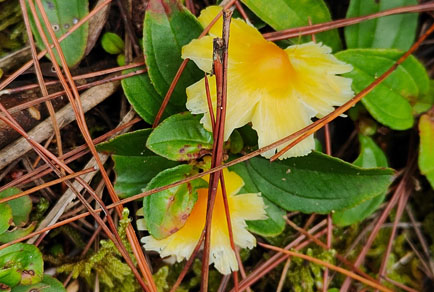
Hygrocybe species are a group of brightly colored mushrooms widely distributed across the world, and they represent the most species-rich genus within Hygrophoraceae. In this study, Hygrocybe nanfengmianensis, a new species in subg. Hygrocybe sect. Hygrocybe subsect. Macrosporae, from Jiangxi Nanfengmian National Nature Reserve is described. Hygrocybe nanfengmianensis is characterized by a yellow to orange pileus, pale yellow to yellow lamellae, clavate basidia (30–39 × 8–10 µm), 2 or 4 sterigmata, and possesses clamp connections at the base. Phylogenetic analysis of the species was performed using the ITS and the LSU sequence data. A full description, illustrations, and phylogenetic analysis results of the new species are provided.
References
- Arnolds, E. (1981) Ecology and coenology of macrofungi in grasslands in Drenthe, the Netherlands. Vol. 1. Part 1. Introduction and Synecology. Gantner Verlag KG, Vaduz, Germany.
- Amolds, E. (1982) Ecology and coenology of macrofungi in grasslands in Drenthe, the Netherlands. Vol. 2. Parts 2 & 3. Autecology and Taxonomy. Bibliotheca Mycologica ISBN 3-7682-1346-3. Gantner Verlag KG, Vaduz, Germany.
- Boertmann, D. (2010) The genus Hygrocybe, 2nd revised edition (Fungi of Northern Europe—vol. 1). Danish Mycological Society, Narayana Press, Copenhagen, 200 pp.
- Cantrell, S.A. & Lodge, D.J. (2000) Hygrophoraceae of the Greater Antilles: Hygrocybe subgenus Hygrocybe. Mycological Research 104 (7): 873–878. https://doi.org/10.1017/S0953756299002142
- Doyle, J. (1987) A rapid DNA isolation procedure for small quantities of fresh leaf tissue. Phytochemical Bulletin 19: 11–15.
- Griffith, G.W., Easton, G.L. & Jones, A.W. (2002) Ecology and diversity of waxcap (Hygrocybe spp.) fungi. Botanical Journal of Scotland 54 (1): 7–22.
- Hall, T.A. (1999) BioEdit: A User-Friendly Biological Sequence Alignment Editor and Analysis Program for Windows 95/98/NT. Nuclc Acids Symposium Series 41 (41): 95–98. https://doi.org/10.1021/bk–1999–0734.ch008
- Horak, E. (1990) Monograph of the New Zealand Hygrophoraceae (Agaricales). New Zealand Journal of Botany 28 (3): 255–309. https://doi.org/10.1080/0028825X.1990.10412313
- Hu, Y., Karunarathna, S.C., Li, H., Galappaththi, M.C., Zhao, C.L., Kakumyan, P. & Mortimer, P.E. (2022) The impact of drying temperature on basidiospore size. Diversity 14 (4): 239.
- Huang, J., Ge, X. & Sun, M. (2000) Modified CTAB protocol using a silica matrix for isolation of plant genomic DNA. Biotechniques 28: 432–434. https://doi.org/10.2144/00283bm08
- Kalyaanamoorthy, S., Minh, B.Q., Wong, T.K.F., von Haeseler, A. & Jermiin, L.S. (2017) ModelFinder: fast model selection for accurate phylogenetic estimates. Nature Methods 14: 587–589.
- Katoh, K. & Standley, D.M. (2013) MAFFT multiple sequence alignment software version 7: improvements in performance and usability. Molecular Biology and Evolution 30: 772–780.
- Kornerup, A. & Wanscher, J.H. (1981) Taschenlexikon der Farben. 3. Aufl. Muster-Schmidt Verlag, Göttingen, 242 pp.
- Lodge, D.J., Padamsee, M., Matheny, P.B., Aime, M.C., Cantrell, S.A., Boertmann, D., Kovalenko, A., Vizzini, A., Dentinger, B.T.M., Kirk, P.M., Ainsworth, A.M., Moncalvo, J.M., Vilgalys, R., Larsson, E., Lücking, R., Griffith, G.W., Smith, M.E., Norvell, L.L., Desjardin, D.E., Redhead, S.A., Ovrebo, C.L., Lickey, E.B., Ercole, E., Hughes, K.W., Courtecuisse, R., Young, A., Binder, M., Minnis, A.M., Lindner, D.L., Ortiz-Santana, B., Haight, J., Læssøe, T., Baroni, T.J., Geml, J. & Hattori, T. (2013–2014) Molecular phylogeny, morphology, pigment chemistry and ecology in Hygrophoraceae (Agaricales). Fungal Diversity 64: 1–99. https://doi.org/10.1007/s13225-013-0259-0
- Nguyen, L.T., Schmidt, H.A., von Haeseler, A. & Minh, B.Q. (2015) IQ-TREE: a fast and effective stochastic algorithm for estimating maximum-likelihood phylogenies. Molecular Biology and Evolution 32: 268–274.
- Rathnayaka, A.R., Tennakoon, D.S., Jones, G.E., Wanasinghe, D.N., Bhat, D.J., Priyashantha, A.H., Stephenson, S.L., Tibpromma, S. & Karunarathna, S.C. (2025) Significance of precise documentation of hosts and geospatial data of fungal collections, with an emphasis on plant-associated fungi. New Zealand Journal of Botany 63 (2–3): 462–489.
- Ronquist, F., Teslenko, M., van der Mark, P., Ayres, D.L., Darling, A., Höhna, S., Larget, B., Liu, L., Suchard, M.A. & Huelsenbeck, J.P. (2012) MrBayes 3.2: efficient Bayesian phylogenetic inference and model choice across a large model space. Systematic Biology 61: 539–542.
- Singer, R. (1986) The Agaricales in Modern Taxonomy, 4th ed. Bishen Singh Mahendra Pal Singh, Dehradun, India, Plates 1–88; pp. 1–981.
- Wang, C.Q., Li, T.H., Huang, H. & Xia, Y.W. (2019) Hygrocybe pseudoacutoconica (Hygrocybeae, Hygrocyboideae, Hygrophoraceae), a new species from a South China Sea Island. Phytotaxa 400 (1): 23–30. https://doi.org/10.11646/phytotaxa.400.1.3
- Young, A.M. (2005) Fungi of Australia: Hygrophoraceae. CSIRO Publishing, Australian Biological Resources Study, Canberra, 188 pp.
- Zhang, D., Gao, F., Jakovlić, I., Zou, H., Zhang, J., Li, W.X. & Wang, G.T. (2020) PhyloSuite: An integrated and scalable desktop platform for streamlined molecular sequence data management and evolutionary phylogenetics studies. Molecular Ecology Resources 20 (1): 348–355. https://doi.org/10.1111/1755-0998.13096