

Abstract
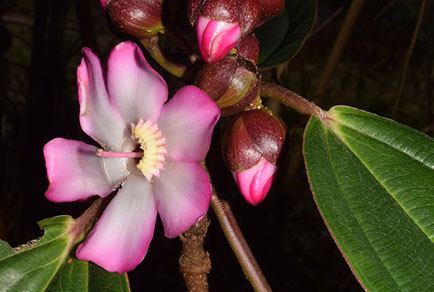
Blakea villosa was published by Alfred Cogniaux in 1908 from material collected in 1905 by Augusto Weberbauer in the Urubamba River valley (Department of Cusco) in southern Peru. Based on recent expeditions to Cusco and examination of herbarium specimens, in this article, we provide a morphological redescription together with taxonomic comments, an identification key for related species (Blakea eden, B. hispida and B. repens), and ecological notes on the floral visitors of Blakea villosa. This species is distinguished by its nodes with fimbriate interpetiolar flaps, abaxial leaf blades with dense velutinous indumentum, petals 30.5–32 mm long, style incurved at apex, and fruits with calyx lobes inflexed, and its flowers are visited by bumblebees and stingless bees, among which we believe the former to be the main pollinators.
References
- Almeda, F. (2001) The octandrous and dodecandrous species of Topobea (Melastomataceae) in Mexico and Central America. Proceedings of the California Academy of Sciences 52: 511–548.
- Almeda, F. (2009) Melastomataceae. In: Davidse, G., Sousa, S.M., Knapp, S. & Chiang, F. (Eds.) Flora Mesoamericana. Universidad Nacional Autonoma de Mexico, Mexico City, pp. 164–338.
- Almeda, F., Mendoza-Cifuentes, H., Penneys, D.S., Michelangeli, F.A. & Alvear, M. (2022) Meriania. In: Bernal, R., Gradstein, S.R. & Celis, M. (Eds.) Catálogo de plantas y líquenes de Colombia. Instituto de Ciencias Naturales, Universidad Nacional de Colombia. Available from: http://catalogoplantasdecolombia.unal.edu.co (accessed 5 October 2022)
- Basso-Alves, J.P., Goldenberg, R. & Teixeira, S. (2017) Ontogeny elucidates the double calyx of Leandra melastomoides (Miconieae, Melastomataceae). International Journal of Plant Sciences 178: 740–752. https://doi.org/10.1086/694079
- Beentje, H. (2016) The Kew Plant Glossary. Second Edition. Royal Botanic Gardens, Kew, 184 pp.
- Brako, L. & Zarucchi, J. (1993) Catálogo de las Angiospermas y Gimnospermas del Perú. Monographs in Systematic Botany from the Missouri Botanical Garden 45: 1–1286.
- Borin, D., de Brito, V.L.G., Leonel, E.D. & Hansen, M. (2024) Buzz pollination: A theoretical analysis via scaling invariance. Physical Review E 110 (5): 054201. https://doi.org/10.1103/PhysRevE.110.054201
- Browne, P. (1756) The Civil and Natural History of Jamaica. Osborne, London, 503 pp. https://doi.org/10.5962/bhl.title.10826
- Bussmann, R.W. (2013) Blakea nareliana (Melastomataceae), a new species from the upper Huallaga in Northern Peru. Revista Peruana de Biología 20: 121–124. https://doi.org/10.15381/rpb.v20i2.2673
- Calderón-Sáenz, E. & Mendoza-Cifuentes, H. (2000) Melastomataceas de los géneros Axinaea, Blakea, Castratella, Centronia, Killipia, Meriania, Monochaetum, Ossaea y Tibouchina en Colombia. Biota Colombiana 1: 336–357.
- Cogniaux, C.A. (1908) Melastomataceae peruvianae. Botanische Jahrbücher für Systematik, Pflanzengeschiechte, und Pflanzengeographie 42 (1): 131–148.
- Cotton, E. & Matezki, S. (2003) Ecuadorian novelties in Blakea and Topobea (Melastomataceae). Brittonia 55: 7–81. https://doi.org/10.1663/0007-196X(2003)055[0073:ENIBAT]2.0.CO;2
- Dellinger, A.S., Scheer, L.M., Artuso, S., Fernández-Fernández, D., Sornoza, F., Penneys, D.S., Tenhaken, R., Dötterl, S. & Schönenberger, J. (2019) Bimodal pollination systems in Andean Melastomataceae involving birds, bats, and rodents. The American Naturalist 194: 104–116. https://doi.org/10.1086/703517
- Dellinger, A.S., Kopper, C., Kagerl, K. & Schönenberger, J. (2022) Pollination in Melastomataceae: a family-wide update on the little we know and the much that remains to be discovered. In: Goldenberg, R., Michelangeli, F.A. & Almeda, F. (Eds.) Systematics, evolution, and ecology of Melastomataceae. Springer, Cham, pp. 585–607. https://doi.org/10.1007/978-3-030-99742-7_26
- Don, D. (1823) An illustration of the natural family of plants called Melastomaceae. Memoirs of the Wernerian Natural History Society 4: 276–329.
- Fernández-Fernández, D., Ulloa Ulloa, C. & Penneys, D. (2016) A new species of Blakea (Blakeeae, Melastomataceae) from Ecuador. Phytotaxa 284: 69–74. https://doi.org/10.11646/phytotaxa.284.1.7
- Fernandez-Hilario, R., Goldenberg, R. & Michelangeli, F.A. (2023) A synopsis of Meriania (Melastomataceae: Merianieae) in Peru. Phytotaxa 602: 1–101. https://doi.org/10.11646/phytotaxa.602.1.1
- Fernandez-Hilario, R., Pillaca-Huacre, L., Villanueva-Espinoza, R., Riva-Regalado, S., Rojas, R., Goldenberg, R. & Michelangeli, F.A. (2024) Taxonomic and chorological novelties in Blakea (Melastomataceae: Pyxidantheae) from Peru with a list of species for the country. Phytotaxa 635: 1–42. https://doi.org/10.11646/phytotaxa.635.1.1
- Gleason, H.A. (1931) Studies on the flora of northern south America-XV. Recent collections of Melastomataceae from Peru and Amazonian Brazil. Bulletin of the Torrey Botanical Club 58: 215–262. https://doi.org/10.2307/2480704
- Gleason, H.A. (1939) Eight undescribed species of Melastomataceae. Bulletin of the Torrey Botanical Club 66: 415–419. https://doi.org/10.2307/2481041
- Gonzáles, P. (2023) Huellas en los Andes, las flores de Augusto Weberbauer. M&G Graphics Peru, Lima, 323 pp.
- Jørgensen, P.M. & León-Yáñez, S. (1999) Catalogue of the vascular plants of Ecuador. Monographs in Systematic Botany from the Missouri Botanical Garden 75: 1–1182.
- Jørgensen, P.M., Nee, M.H. & Beck, S.G. (2014) Catálogo de las Plantas Vasculares de Bolivia. Monographs in Systematic Botany from the Missouri Botanical Garden 127: 1–1744.
- Kopper, C., Schönenberger, J. & Dellinger, A.S. (2024) High floral disparity without pollinator shifts in buzz-bee-pollinated Melastomataceae. New Phytologist 242: 2322–2337. https://doi.org/10.1111/nph.19735
- Konzmann, S., Hilgendorf, F., Niester, C., Rech, A.R. & Lunau, K. (2020) Morphological specialization of heterantherous Rhynchanthera grandiflora (Melastomataceae) accommodates pollinator diversity. Plant Biology 22: 583–590. https://doi.org/10.1111/plb.13102
- León, B. (2006) Melastomataceae endémicas del Perú. Revista Peruana de Biología 13: 428s–452s. https://doi.org/10.15381/rpb.v13i2.1879
- Macbride, J.F. (1929) New and renamed Peruvian Melastomes. Publications of the Field Museum of Natural History. Botanical Series 4: 172–191.
- Macbride, J.F. (1941) Melastomataceae, Flora of Peru. Publications of the Field Museum of Natural History, Botanical Series 13: 249–521.
- Markgraf, F. (1927) Melastomataceae. In: Mildbraed, J. (Ed.) Plantae Tessmannianae peruvianae IV. Notizblatt des Königl. botanischen Gartens und Museums zu Berlin 9 (90): 1139–1154.
- Markgraf, F. (1941) Melastomataceae. In: Diels, L. (Ed.) Neue Arten aus Ecuador IV. Notizblatt des Königl. botanischen Gartens und Museums zu Berlin 15 (3): 366–393.
- Mendoza-Cifuentes, H., Posada-Herrera, J.M. & David, H. (2021) Nuevas propuestas nomenclaturales en Melastomataceae y adiciones de la familia al Catálogo de la Flora de Colombia. Revista de la Academia Colombiana de Ciencias Exactas, Físicas y Naturales 45: 1154–1174. https://doi.org/10.18257/raccefyn.1448
- Mesquita-Neto, J.N., Blüthgen, N. & Schlindwein, C. (2018) Flowers with poricidal anthers and their complex interaction networks—Disentangling legitimate pollinators and illegitimate visitors. Functional Ecology 32: 2321–2332. https://doi.org/10.1111/1365-2435.13204
- Neill, D.A. & Ulloa Ulloa, C. (2011) Adiciones a la flora del Ecuador: segundo suplemento, 2005–2010. Fundación Jatun Sacha, Quito, pp. 202.
- Olivier, A.G. (1789) Abeille. In: Diderot, M.M. & Alembert, D’. (Eds.) Encyclopédie Métodique. Histoire Naturelle. Insectes Vol. 4. Paris: Panckoucke, pp. 46–84.
- Penneys, D.S. & Almeda, F. (2022) An overview of Pyxidantheae (Melastomataceae). In: Goldenberg, R., Michelangeli, F.A. & Almeda, F. (Eds.) Systematics, evolution, and ecology of Melastomataceae. Springer, Gewerbestrasse, pp. 291–306. https://doi.org/10.1007/978-3-030-99742-7_13
- Penneys, D.S. & Jost, L. (2009) Blakea attenboroughii (Melastomataceae: Blakeeae): a new species from Ecuador. Proceedings of the California Academy of Sciences 60: 69–72.
- Penneys, D.S. & Judd, W.S. (2013a) Combined molecular and morphological phylogenetic analyses of the Blakeeae (Melastomataceae). International Journal of Plant Sciences 174: 802–817. https://doi.org/10.1086/670011
- Penneys, D.S. & Judd, W.S. (2013b) A revised circumscription for the Blakeeae (Melastomataceae) with associated nomenclatural adjustments. Phytokeys 20: 17–32. https://doi.org/10.3897/phytokeys.20.4344
- QGIS Development Team (2022) QGIS Geographic Information System version 9.18.1. Open Source Geospatial Foundation Project. [http://www.qgis.org/]
- Rego, J.O., Oliveira, R., Jacobi, C.M. & Schindwein, C. (2018) Constant flower damage caused by a common stingless bee puts survival of a threatened buzz-pollinated species at risk. Apidologie 49: 276–285. https://doi.org/10.1007/s13592-017-0552-0
- Rojas, R., Montiel, O.M., van der Werff, H., Vásquez, R., Valenzuela, L., Monteagudo, A. & Verde, S. (2024) Catálogo de las Plantas Vasculares de la Selva Central, PERÚ. Missouri Botanical Garden. Available from: http://legacy.tropicos.org/Project/SCP (accessed 28 August 2024)
- Ruiz, L.H. & Pavón, J.A. (1798) Systema Vegetabilium Florae Peruvianae et Chilensis. De Sancha, Madrid, 456 pp.
- Soares, N.C. & Morellato, L.P.C. (2018) Crepuscular pollination and reproductive ecology of Trembleya laniflora (Melastomataceae), an endemic species in mountain rupestrian grasslands. Flora 238: 138–147. https://doi.org/10.1016/j.flora.2016.12.005
- Triana, J.J. (1872) I. Les Mélastomacées. Transactions of the Linnean Society of London 28: 1–188. https://doi.org/10.1111/j.1096-3642.1871.tb00222.x
- Tropicos (2024) Database of Missouri Botanical Garden. Missouri Botanical Garden, St. Louis. Available from: http://www.tropicos.org (accessed 28 August 2024)
- Ulloa Ulloa, C. & Neill, D.A. (2005) Cinco años de adiciones a la flora del Ecuador 1999–2004. Missouri Botanical Garden Press, St. Lois, pp. 75.
- Ulloa Ulloa, C., Almeda, F., Goldenberg, R., Kadereit, G., Michelangeli, F.A., Penneys, D.S., Stone, R.D. & Veranso-Libalah, M.C. (2022) Melastomataceae: global diversity, distribution, and endemism. In: Goldenberg, R., Michelangeli, F.A. & Almeda, F. (Eds.) Systematics, evolution, and ecology of Melastomataceae. Springer, Gewerbestrasse, pp. 3–28. https://doi.org/10.1007/978-3-030-99742-7_1
- Urrea, J., Mendoza-Cifuentes, H. & García, N. (2023) Novedades taxonómicas y sinopsis del género Blakea (Melastomataceae, Pyxidantheae) en la Cordillera Oriental, Colombia. Acta Botanica Mexicana 130: e2172. https://doi.org/10.21829/abm130.2023.2172
- Urrea, J., Mendoza-Cifuentes, H., García, N. & Carvajal Rojas, L. (2024) Blakea cubarralensis (Melastomataceae: Pyxidantheae): a new species from Colombia. Phytotaxa 666: 59–66. https://doi.org/10.11646/phytotaxa.666.1.6
- Urrea, J., Mendoza-Cifuentes, H. & Ariza-Cortés, W. (2025) A new species of Blakea (Melastomataceae: Pyxidantheae) from the Eastern Cordillera of Colombia. Brittonia. https://doi.org/10.1007/s12228-025-09840-3
- Vallejo‐Marín, M. (2019) Buzz pollination: studying bee vibrations on flowers. New Phytologist 224 (3): 1068–1074. https://doi.org/10.1111/nph.15666
- Valoyes-Cardozo, Z. & Morales-Puentes, M.E. (2011) Nuevos registros y redescubrimiento de dos especies de Blakea (Melastomataceae) en Chocó, Colombia. Bioetnia 8: 163–170. https://doi.org/10.51641/bioetnia.v8i2.43
- Vásquez, R. (1997) Flórula de las reservas biológicas de Iquitos, Perú: Allpahuayo-Mishana, Explornapo Camp, Explorama Lodge. Monographs in Systematic Botany from the Missouri Botanical Garden 63: 1–1046.
- Vásquez, R. & Rojas, R. del P. (2010) Melastomataceae. In: Vásquez, R., Rojas, R. & van der Werff, H. (Eds.) Flora del Río Cenepa, Amazonas, Perú. Vol 2. Missouri Botanical Garden Press, St. Lois, pp. 943–1006.
- Woodrow, C., Jafferis, N., Kang, Y. & Vallejo-Marín, M. (2024) Buzz-pollinating bees deliver thoracic vibrations to flowers through periodic biting. Current Biology 34 (18): 4104–4113. https://doi.org/10.1016/j.cub.2024.07.044
- Wong Sato, A.A. & Kato, M. (2017) Pollination system of Corylopsis gotoana (Hamamelidaceae) and its stonefly (Plecoptera) co‐pollinator. Plant Species Biology 32 (4): 440–447. https://doi.org/10.1111/1442-1984.12178
- Wurdack, J.J. (1979) Certamen Melastomataceis XXX. Phytologia 43: 339–355.
- Wurdack, J.J. (1980) Melastomataceae. In: Harling, G. & Sparre, B. (Eds.) Flora of Ecuador. No. 13. Univ. Göteborg & Riksmuseum, Stockholm, pp. 1–406.
- Wurdack, J.J. (1986) Atlas of hairs for Neotropical Melastomataceae. Smithsonian Contributions to Botany 63: 1–80. https://doi.org/10.5479/si.0081024X.63
- Wurdack, J.J. (1988) New Melastomataceae from Peru and Bolivia. Brittonia 40: 7–15. https://doi.org/10.2307/2806867
- Zea-Fernández, M.G., Bernabé-Paniagua, K., Wong Sato, A., Fernandez-Hilario, R., Revilla, I. & Churata-Salcedo, J.M. (2024) Proyecto REDES: Estudio de las redes ecológicas de polinización y parasitismo en el territorio peruano. Xilema 32: 24–30.