

Abstract
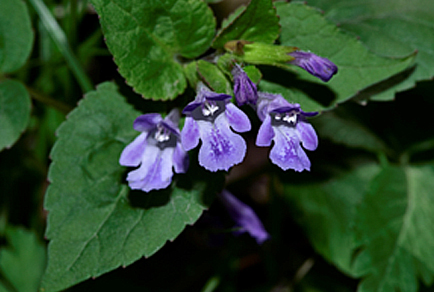
Meehania porphyrea, a new species of Meehania, was discovered during extensive field surveys in the Xiaolongshan National Nature Reserve in Gansu, China. This region is located in the Qinba Mountains of southern Gansu, one of the province's biodiversity hotspots, where the complex environment creates diverse habitats for a wide variety of plant species. Morphologically, M. porphyrea resembles Meehania fargesii (H. Lév.) C. Y. Wu, but the former is distinguished by its overall smaller plant size, often purple abaxial leaf surfaces, pale bluish purple flowers, smaller corolla, and narrow tubular calyx. Based on these distinct characteristics, we describe it here as a new species.
References
- Ben Mahmoud, K., Mezzapesa, G.N., Abdelkefi, F. & Perrino, E.V. (2024) Nutritional value and functional properties of an underexploited Tunisian wild beet (Beta macrocarpa Guss.) in relation to soil characteristics. Euro-Mediterranean Journal for Environmental Integration 9: 705–720. https://doi.org/10.1007/s41207-024-00468-5
- Casella, F., Vurro, M., Valerio, F., Perrino, E.V., Mezzapesa, G.N. & Boari, A. (2023) Phytotoxic Effects of Essential Oils from Six Lamiaceae Species. Agronomy 13: 257. https://doi.org/10.3390/agronomy13010257
- Dein, M., Wickramasinghe, P.C. & Munafo Jr, J.P. (2020) Characterization of key odorants in Meehan’s mint, Meehania cordata. Journal of Agricultural and Food Chemistry 68 (38): 10388–10396.
- Chen, C. (1977) Meehania. In: Wu, C.Y. & Li, H.W. (Eds.) Flora Reipublicae Popularis Sinica. Vol. 65. Science Press, pp. 334–344.
- Deng, T., Nie, Z.L., Drew, B.T., Volis, S., Kim, C., Xiang, C.L., Zhang, J.W., Wang, Y.H. & Sun, H. (2015) Does the Arcto-Tertiary biogeographic hypothesis explain the disjunct distribution of Northern Hemisphere herbaceous plants? The case of Meehania (Lamiaceae). PLoS One 10 (2): e0117171.
- Jin, X.F., Chen, Z.H. & Ding, B.Y. (2018) A new species and a new variety of Lamiaceae from Zhejiang, eastern China. Nordic Journal of Botany 36 (12).
- Li, H.W. & Hedge, I.C. (1994) Meehania Britton. In: Wu, Z.Y. & Raven, P.H. (Eds.) Flora of China. Vol. 17. Beijing/St. Louis: Science Press/ Missouri Botanical Garden, pp. 122–124.
- Özkan, M. (2008) Glandular and eglandular hairs of Salvia Recognita Fisch. and Mey. (Lamiaceae) in Turkey. Bangladesh Journal of Botany 37: 93–95.
- Perrino, E.V., Wagensommer, R.P., Mezzapesa, G.N. & Trani A. (2024) Stachys italica Mill.: synecology, functional compounds and potential use of an Italian endemic taxon. Planta 260: 138. https://doi.org/10.1007/s00425-024-04571-3
- POWO (2025) Plants of the World Online. Facilitated by the Royal Botanic Gardens, Kew. Published on the Internet.
- Takano, A., Sakaguchi, S., Li, P., Matsuo, A., Suyama, Y., Xia, G.H., Liu, X. & Isagi, Y. (2020) A Narrow Endemic or a Species Showing Disjunct Distribution? Studies on Meehania montis-koyae Ohwi (Lamiaceae). Plants 9 (9): 1159.
- Wu, C.Y. & Li, H.W. (1977) Meehania. In: Wu, C.Y. & Li, X.W. (Eds.) Flora Reipublicae Popularis Sinicae. Science Press, Beijing, pp. 334–344.
- Wu, C.Y. (1959) Revisio Labiatarum Sinensium. Acta Phytotaxonomica Sinica 8: 1–66.
- Xia, G.H. & Li, G.Y. (2011) Meehania montis-koyae, a new record of Lamiaceae from China. Guihaia 31 (5): 581–583.