

Abstract
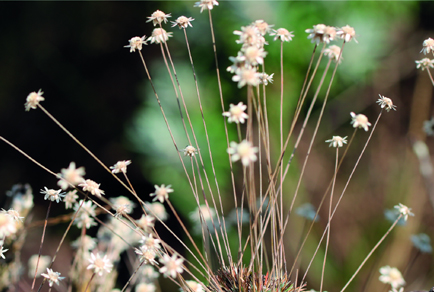
The present work describes and illustrates Comanthera gandarela (Eriocaulaceae), a new and narrowly endemic species. It is unique within the genus for being restricted to ferruginous Campos Rupestres (Cangas) in the Serra do Gandarela, within the Quadrilátero Aquífero-Ferrífero, Minas Gerais, Brazil. The species is distinguished from C. nivea, the morphologically and geographically closest species, by its semi-terete leaves, spathes surpassing the leaves, convex and semi-spherical receptacle and flower disc in mature inflorescences, with involucral bracts reflexed, elongated stem in mature individuals, and canescent leaves. In addition to external morphology, we present anatomical sections of the leaves and scapes, as well as Scanning Electron Microscopy images of the leaf epidermis, scapes, and seeds. The species’ habitat, distribution, population, conservation status, and threats are also discussed. Comanthera gandarela is preliminarily assessed as Critically Endangered under IUCN criteria B1ab(i, ii, iii, iv), facing intense habitat destruction pressure.
References
- Alone, L.B., Albuquerque, M.M.S., Resende, S.V., Carneiro, C.E. & Santana, J.R.F. (2016) Rustificação in vitro em diferentes ambientes e aclimatização de microplantas de Comanthera mucugensis Giul. subsp. mucugensis. Revista Ciência Agronômica 47: 152–161. https://doi.org/10.5935/1806-6690.20160018
- Alves, P.G.M., Scatena, V.L. & Trovó, M. (2013) Anatomy of scapes, bracts, and leaves of Paepalanthus sect. Diphyomene (Eriocaulaceae, Poales) and its taxonomic implications. Brittonia 65: 262–272. https://doi.org/10.1007/s12228-012-9263-z
- Andrade, M.J.G. de, Giulietti, A.M., Rapini, A., Queiroz, L.P. de, Conceição, A.D.S., Almeida, P.R.M. de & van den Berg, C. (2010) A comprehensive phylogenetic analysis of Eriocaulaceae: Evidence from nuclear (ITS) and plastid (psbA-trnH and trnL-F) DNA sequences. Taxon 59: 379–388. https://doi.org/10.1002/tax.592004
- ANM – Agência Nacional de Mineração (n.d.) SIGMINE – Sistema de Informações Geográficas da Mineração. ANM, Brasília. Available from: https://geo.anm.gov.br›portal›apps›webappviewer (accessed 18 Oct 2024)
- Apezzato-Da-Glória, B. & Carmello-Guerreiro, S.M. (2006) Anatomia Vegetal. 2ª edição revista e atualizada. Editora Universidade Federal de Viçosa, Viçosa, MG, 438 pp.
- Augsten, M., Meyer, P.B., Freitas, L.B., Batista, J.A.N. & Stehmann, J.R. (2022) Nicotiana gandarela (Solanaceae), a new species of ‘tobacco’ highly endangered from the Quadrilátero Ferrífero in Brazil. PhytoKeys 190: 113–129. https://doi.org/10.3897/PHYTOKEYS.190.76111
- Bachman, S., Moat, J., Hill, A.W., de la Torre, J. & Scott, B. (2011) Supporting red list threat assessments with GeoCAT: Geospatial conservation assessment tool. Zookeys 150: 117–126. https://doi.org/10.3897/zookeys.150.2109
- Barbosa, M.A.M., Chitwood, D.H., Azevedo, A.A., Araújo, W.L., Ribeiro, D.M., Peres, L.E., Martins, S.C.V. & Zsögön, A. (2019) Bundle sheath extensions affect leaf structural and physiological plasticity in response to irradiance. Plant, Cell & Environment 42: 1575–1589. https://doi.org/10.1111/pce.13495
- Barbosa, L.C.C., Viana, P.L., Teodoro, G.S., Caldeira, C.F.Jr., Ramos, S.J. & Gastauer, M. (2020) A wildfire in an Amazonian canga community maintained important ecosystem properties. International Journal of Wildland Fire 29: 943–949. https://doi.org/10.1071/WF20033
- Barreto, L.C., Echternacht, L. & Garcia, Q.S. (2013) Seed coat sculpture in Comanthera (Eriocaulaceae) and its implications on taxonomy and phylogenetics. Plant Systematics and Evolution 299: 1461–1469. https://doi.org/10.1007/s00606-013-0808-8
- Beauvois, P.de (1812) Essai d’une Nouvelle Agrostographie. Imprimerie de Fain, Paris, 152 pp., 16 pls.
- Beyschlag, W. & Eckstein, J. (2001) Towards a causal analysis of stomatal patchiness: The role of stomatal size variability and hydrological heterogeneity. Acta Oecologica 22: 161–173. https://doi.org/10.1007/s004420050711
- BFG - Brazilian Flora Group (2022) Brazilian Flora 2020: Leveraging the power of a collaborative scientific network. Taxon 71: 178–198. https://doi.org/10.1002/tax.12640
- Bongard, M. (1831) Essai monographique sur les espèces d’Ériocaulon du Brésil. Mémoires de L´Académie Impériale Des Sciences de St-Pétersbourg, Série 6, Sciences Mathématiques, Physiques et Naturelles 1: 601–655.
- Bozzola, J.J. & Russell, L.D. (1999) Electron microscopy: principles and techniques for biologists. 2nd edn. Jones and Bartlett Publishers, Sudbury, Massachusetts, 670 pp.
- Buckley, T.N., Farquhar, G.D. & Mott, K.A. (1999) Carbon-water balance and patchy stomatal conductance. Oecologia 118: 132–143. https://doi.org/10.1007/s004420050757
- Carmo, F.F. do, Mota, R.C. da, Kamino, L.H.Y. & Jacobi, C.M. (2018) Check-list of vascular plant communities on ironstone ranges of south-eastern Brazil: Dataset for conservation. Biodiversity Data Journal 6: e27032. https://doi.org/10.3897/BDJ.6.e27032
- Coan, A.I., Stützel, T. & Scatena, V.L. (2010) Comparative embryology and taxonomic considerations in Eriocaulaceae (Poales). Feddes Repertorium 121: 268–284. https://doi.org/10.1002/fedr.201000016
- Coelho, T.P. (2012) Mineração e dependência no quadrilátero ferrífero-aquífero: o discurso do desenvolvimento minerador e o Projeto Apolo. Dissertação de mestrado, Universidade do Estado do Rio de Janeiro, Rio de Janeiro, 159 pp.
- Corredor, B.A.D. (2016) Anatomia de espécies brasileiras de Eriocaulaceae: Comanthera e Syngonanthus. Repositório Institucional UNESP, Rio Claro, SP, 115 pp.
- Costa, F.N., Trovó, M. & Sano, P.T. (2008) Eriocaulaceae na Cadeia do Espinhaço: riqueza, endemismo e ameaças. Megadiversidade 4: 117–125.
- Cutler, D.F., Botha, T. & Stevenson, D.W. (2009) Anatomia vegetal: uma abordagem aplicada. Artmed Editora, Porto Alegra, RS, 266 pp.
- De Oliveira, B.A., de Oliveira, M.F. & Maciel‐Silva, A.S. (2021) What can bryophyte diversity on Cangas (ironstone outcrops) teach us?. Journal of Vegetation Science 32: e13029. https://doi.org/10.1111/jvs.13029
- Demarco, D. (1999) Histochemical analysis of plant secretory structures. In: Ruzin, S.E. (Ed.) Plant microtechnique and microscopy. Oxford University Press, Oxford, pp. 291–310.
- Echternacht, L. (2012) Sistemática de Comanthera e de Syngonanthus (Eriocaulaceae). Tese de Doutorado, Universidade de São Paulo, São Paulo, 294 pp.
- Echternacht, L. & Parra, L. (2025) Comanthera in Flora and Funga of Brazil. Jardim Botânico do Rio de Janeiro. Available from: https://floradobrasil.jbrj.gov.br/FB52938 (accessed 9 July 2025)
- Echternacht, L., Sano, P.T., Bonillo, C., Cruaud, C., Couloux, A. & Dubuisson, J.-Y. (2014) Phylogeny and taxonomy of Syngonanthus and Comanthera (Eriocaulaceae): evidence from expanded sampling. Taxon 63: 47–63. https://doi.org/10.12705/631.36
- Echternacht, L., Sano, P.T. & Dubuisson, J.Y. (2015) Taxonomic study of Comanthera subg. Thysanocephalus (Eriocaulaceae). Systematic Botany 40: 136–150. https://doi.org/10.1600/036364415X686431
- Escobar, D.F., Zupo, T., da Silva Carvalho, C., Watanabe, M.T.C. & Caldeira, C.F. (2025) Seed persistence and germination strategies of Carajasia cangae (Rubiaceae): an endemic forb from the Amazon ironstone outcrop. Seed Science Research 35: 41–48. https://doi.org/10.1017/S0960258525000017
- Evert, R.F. (2013) Anatomia das plantas de Esau: meristemas, células e tecidos do corpo da planta: sua estrutura, função e desenvolvimento. Editora Blucher, São Paulo, 288 pp.
- Giulietti, A.M., Wanderley, M.das G.L., Longhi-wagner, H.M., Pirani, J.R. & Parra, L.R. (1996) Estudos em “sempre-vivas”: taxonomia com ênfase nas espécies de Minas Gerais. Acta Botanica Brasilica 10: 329–377.
- Giulietti, A.M. (1996) Novas espécies no gênero Syngonanthus Ruhl. (Eriocaulaceae) para o Brasil. Boletim de Botânica da Universidade de São Paulo 15: 63–72.
- Giulietti, A.M., Scatena, V.L., Sano, P.T., Parra, L.R., Queiroz, L.P.de, Harley, R.M., Menezes, N.L., Ysepon, A.M.B., Salatino, A., Salatino, M.L.F., Vilegas, W., Santos, L.C., Ricci, C.V., Bonfim, M.C.P. & Miranda, E.B. (2000) Multidisciplinary studies on neotropical Eriocaulaceae. In: Wilson, K.L. & Morrison, D.A. (Eds.) Monocots: Systematics and evolution. CSIRO Publishing, Collingwood, pp. 580–589.
- Giulietti, A.M., Andrade, M.J.G., Scatena, V.L., Trovó, M., Coan, A.I., Sano, P.T., Santos, F.A.R. & Borges, R.L.B. & Van den Berg, C. (2012) Molecular phylogeny, morphology and their implications for the taxonomy of Eriocaulaceae. Rodriguésia 63: 001–019. https://doi.org/10.1590/S2175-78602012000100001
- Hopper, S.D. (2009) OCBIL theory: towards an integrated understanding of the evolution, ecology and conservation of biodiversity on old, climatically buffered, infertile landscapes. Plant Soil 322: 49–86. https://doi.org/10.1007/s11104-009-0068-0
- Inoue, Y., Kenzo, T., Tanaka-Oda, A., Yoneyama, A. & Ichie, T. (2015) Leaf water use inheterobaric and homobaric leafed canopy tree species in a Malaysian tropicalrain forest. Photosynthetica 53: 177–186. https://doi.org/10.1007/s11099-015-0105-6
- IUCN Standards and Petitions Committee. (2024) Guidelines for Using the IUCN Red List Categories and Criteria. Version 16. Prepared by the Standards and Petitions Committee. Available from: https://www.iucnredlist.org/documents/RedListGuidelines.pdf (accessed February 2025)
- Jacobi, C.M. & Carmo, F.F. (2012) Diversidade Florística nas Cangas do Quadrilátero Ferrífero. Código Editora, Belo Horizonte, 240 pp.
- Johansen, D.A. (1940) Plant microtechnique. McGraw-Hill Publishing Company, Ltd., London, 523 pp.
- Kenzo, T., Ichie, T., Watanabe, Y. & Hiromi, T. (2007) Ecological distribution ofofhomobaric and heterobaric leaves in tree species of Malaysian lowland tropicalrainforest. American Journal of Botany 94: 764–775. https://doi.org/10.3732/ajb.94.5.764
- Kraus, J.E. & Arduin, M. (1997) Manual básico de métodos em morfologia vegetal. Edur, Rio de Janeiro, RJ, 198 pp.
- Lobo, J.L. & Cioni, I.F. (2024) Unidades de Conservação e movimentos sociais na conservação dos campos rupestres ferruginosos: Um estudo no Quadrilátero Aquífero-Ferrífero (Minas Gerais). Ambientes: Revista de Geografia e Ecologia Política 6: 28–68.
- MapBiomas (2024a) Coleção 9 da Série Anual de Mapas de Cobertura e Uso da Terra do Brasil. Projeto MapBiomas – Instituto de Pesquisa Ambiental da Amazônia. Available from: https://mapbiomas.org (accessed 18 Oct 2024)
- MapBiomas (2024b) Coleção 3: Mapeamento anual da área queimada no Brasil (1985–2023). Projeto MapBiomas – Instituto de Pesquisa Ambiental da Amazônia. Available from: https://mapbiomas.org (accessed 18 Oct 2024)
- Marent, B.R., Lamounier, W.L. & Gontijo, B.M. (2011) Conflitos ambientais na Serra do Gandarela, Quadrilátero Ferrífero – MG: mineração X preservação. Revista Geografias 7: 99–113. https://doi.org/10.35699/2237-549x..13311
- Martius, C.F.P. von (1834) Eriocaulaceae. In: Martius, C.F.P. von, Eichler, A.G. & Urban, I. (Eds.) Flora Brasiliensis 3(1): 1–101. Typographia Regia, Monachii.
- Mendes, J.C.R., Secco, R.deS. & Viana, P.L. (2024) An account of a new and endangered tiny species of Phyllanthus (Phyllanthaceae) from Serra da Gandarela, Minas Gerais, Brazil. Brittonia 76: 26–32. https://doi.org/10.1007/s12228-024-09779-x
- Micco, V.D. & Aronne, G. (2002) Morpho-Anatomical traits for plant adaptation to Drought. In: Aroca, R. (Ed.) Plant responses to drought stress: from morphological to molecular features. Springer, Heidelberg, New York, Dordrecht, London, pp. 37–62.
- O’Brien, T.P. & Mccully, M.E. (1981) The study of structure principles and selected methods. Termarcarphi Pty. Ltd., Melbourn, 357 pp.
- Oliveira, A.A.B. (2014) Inventário das emissões atmosféricas na indústria siderúrgica. Pantheon, Rio de Janeiro, RJ, 85 pp.
- Oriani, A., Scatena, V.L. & Sano, P.T. (2005) Anatomia das folhas, brácteas e escapos de Actinocephalus (Koern.) Sano (Eriocaulaceae). Brazilian Journal of Botany 28: 229–240. https://doi.org/10.1590/S0100-84042005000200004
- Parra, L.R. (2000) Redelimitação e revisão de Syngonanthus sect. Eulepis (Bong. ex Koern.) Ruhland, Eriocaulaceae. Ph.D. Thesis, Universidade de São Paulo, São Paulo, 201 pp. https://doi.org/10.11606/T.41.2000.tde-20042001-093840
- Parra, L.R. & Giulietti, A.M. (2011) Comanthera retroflexa (Eriocaulaceae), Two new species of Comanthera (Eriocaulaceae) from Bahia, Brazil. Phytotaxa 27: 1–7. https://doi.org/10.11646/phytotaxa.27.1.1
- Parra, L.R., Giulietti, A.M., de Andrade, M.J.G. & Van den Berg, C. (2010) Reestablishment and new circumscription of Comanthera (Eriocaulaceae). Taxon 59: 1135–1146. https://doi.org/10.1002/tax.594013
- Pizzolato, T.D., Burbano, J.L., Berlin, J.D., Morey, P.R. & Pease, R.W. (1976) An electron microscope study of the path of water movement in transpiring leaves of cotton (Gossypium hirsutum L.). Journal of Experimental Botany 27: 145–161. https://doi.org/10.1093/jxb/27.1.145
- Rocha, D.I., Silva, L.C., Pereira, E.G., Sant’Anna-Santos, B.F., Gontijo, E.R. & Oliva, M.A. (2014) Early detection of injuries in leaves of Clusia hilariana Schltdl. (Clusiaceae) caused by particulate deposition of iron. Revista Árvore 38: 423–432. https://doi.org/10.1590/s0100-67622014000300004
- Rossi, R.D., Martins, C.R., Viana, P.L., Rodrigues, E.L. & Figueira, J.E.C. (2014) Impact of invasion by molasses grass (Melinis minutiflora P. Beauv.) on native species and on fires in areas of campo-cerrado in Brazil. Acta Botanica Brasilica 28: 631–637. https://doi.org/10.1590/0102-33062014abb3390
- Ruhland, W. (1903) Eriocaulaceae. In: Engler, A. (Ed.) Das Pflanzenreich IV. 30 (Heft 13). Wilhelm Engelmann, Leipzig, pp. 1–294.
- Salles, D.M., Carmo, F.F. & Jacobi, C.M. (2019) Habitat loss challenges the conservation of endemic plants in mining-targeted Brazilian mountains. Environmental Conservation 46: 140–146. https://doi.org/10.1017/S0376892918000401
- Scatena, V.L. & Rosa, M.M. (2001) Morphology and anatomy of the vegetative organs and scapes from Aphorocaulon (Paepalanthus, Eriocaulaceae). Brazilian Archives of Biology and Technology 44: 49–58. https://doi.org/10.1590/S1516-89132001000100007
- Scatena, V.L., Vich, D.V. & Parra, L.R. (2004) Anatomia de escapos, folhas e brácteas de Syngonanthus sect. Eulepis (Bong. ex Koern.) Ruhland (Eriocaulaceae). Acta Botanica Brasilica 18: 825–837. https://doi.org/10.1590/S0102-33062004000400013
- Silva, CJ. (2024) Fundamentos de Anatomia Vegetal: conceitos e aplicações em uma abordagem didática. Author’s Ed., Sete Lagoas, MG, 534 pp.
- Silva, L.C., Freitas-Silva, L., Rocha, D.I., Pereira, J.S.C. & Assis, D.E.F. (2020) Leaf morpho-anatomical structure determines differential response among restinga species exposed to emissions from an iron ore pelletizing plant. Water, Air, and Soil Pollution 231: 152. https://doi.org/10.1007/s11270-020-04533-x
- Silveira, A.A. (1928) Floralia Montium, vol. 1. Bello Horizonte, Imprensa Official, 426 pp.
- Silveira, F.A.O., Negreiros, D., Barbosa, N.P.U., Buisson, E., Carmo, F.F., Carstensen, D.W., Conceição, A.A., Cornelissen, T.G., Echternacht, L., Fernandes, G.W., Garcia, Q.S., Guerra, T.J., Jacobi, C.M., Lemos-filho, J.P., Stradic, S.L., Morellato, L.P.C., Neves, F.S., Oliveira, R.S., Schaefer, C.E., Viana, P.L. & Lambers, H. (2016) Ecology and evolution of plant diversity in the endangered campo rupestre: a neglected conservation priority. Plant Soil 403: 129–152. https://doi.org/10.1007/s11104-015-2637-8
- Smith, L.B. (1937) A new genus of Eriocaulaceae. Contributions from the Gray Herbarium of Harvard University 38–39: 117.
- Souza, V.C., Gontijo, F.D., Dornas, T.T., Colletta, G.D., Scatigna, A.V. & Moura, M.N. (2022) Agalinis marianae (Orobanchaceae), a new endangered species endemic to the Quadrilátero Ferrífero, Minas Gerais, Brazil. Acta Botanica Brasilica 36: 1–8. https://doi.org/10.1590/1677-941X-ABB-2021-0318
- Terashima, I. (1992) Anatomy of non-uniform leaf photosynthesis. Photosynthesis research 31: 195–212. https://doi.org/10.1007/BF00035537
- Tresmondi, F., Nogueira, A., Guimarães, E. & Machado, S.R. (2015) Morphology, secretion composition, and ecological aspects of stipular colleters in Rubiaceae species from tropical forest and savanna. The Science of Nature 102: 1–15. https://doi.org/10.1007/s00114-015-1320-5
- Trovó, M., Silva, A.L. & Coan, A.I. (2015) Paepalanthus echinoides (Eriocaulaceae), a new species from central Brazil with notes on leaf and scape anatomy. Phytotaxa 231: 81–88. https://doi.org/10.11646/phytotaxa.231.1.8
- Uhlein, A. & Noce, C.M. (2012) Quadrilátero Ferrífero. In: Hasui, Y., Carneiro, C.D.R., Almeida, F.F.M. de & Bartorelli, A. (Eds.) Geologia do Brasil. Beca, São Paulo, pp. 228–235.
- Zavatin, D.A., Ramos, R., Watanabe, M.T.C., Pedrosa, L.G. & de Lírio, E.J. (2023a) A new species of Mollinedia (Monimiaceae, Laurales) from the Quadrilátero Ferrífero, Brazil. PhytoKeys 234: 189–201. https://doi.org/10.3897/phytokeys.234.109804
- Zavatin, D.A., Almeida, R.B.P., Ramos, R. & Lombardi, J.A. (2023b) Chionanthus monteazulensis (Oleaceae), a new species from the campo rupestre of the Espinhaço Range, Brazil. Phytotaxa 603: 289–296. https://doi.org/10.11646/phytotaxa.603.3.8