
Abstract
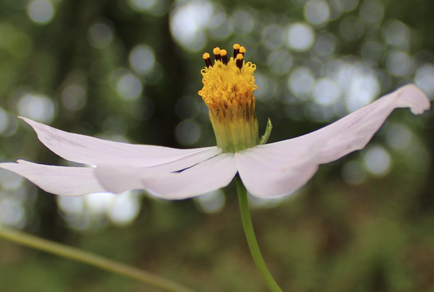
A recent herbaria-based revision and botanical explorations in Guerrero, Mexico, resulted in the discovery of a new species of the genus Cosmos, named C. harkerae. The novelty belongs to C. sect. Discopoda and morphologically resembles C. longipetiolatus and C. sherffii. It differs from them by a combination of traits, including fusiform to subglobose tuberous roots, petiole longitude, leaf morphology, disk florets grouped together resembling a tube, and the cypsela color. All three species live in the Sierra Madre del Sur, but are not sympatric. Cosmos harkerae has been collected from five nearby locations and is classified as Critically Endangered category under IUCN criteria. Finally, a key for the identification of the species in C. sect. Discopoda is provided.
References
- Bachman, S., Moat, J., Hill, A.W., de la Torre, J. & Scott, B. (2011) Supporting Red List threat assessments with GeoCAT: geospatial conservation assessment tool. ZooKeys 150: 117–126. https://doi.org/10.3897/zookeys.150.2109
- Candolle, A.P. de (1836) Prodromus systematis naturalis regni vegetabilis, vol. 5. Treuttel & Würtz, Paris, 706 pp.
- Castro-Castro, A. (2015) Filogenia y evolución del género Cosmos (Asteraceae, Coreopsideae). PhD Thesis. Universidad de Guadalajara, Zapopan, 214 pp.
- Castro-Castro, A., Harker, M., Vargas-Amado, G. & Rodríguez, A. (2013) Two new species of Cosmos section Discopoda (Coreopsideae: Asteraceae) from Jalisco, Mexico. Phytotaxa 146: 35–49. http://dx.doi.org/10.11646/phytotaxa.146.2.1
- Castro-Castro, A., Vargas-Amado, G., Harker, M. & Rodríguez, A. (2014) Macromorphological and cytogenetic analysis of the genus Cosmos (Asteraceae, Coreopsideae), with a key for its identification. Botanical Sciences 92: 363–388. https://doi.org/10.17129/botsci.111
- Castro-Castro, A., Vargas-Amado, G., Castañeda-Nava, J.J., Harker, M., Munguía-Lino, G., Santacruz-Ruvalcaba, F. & Rodríguez, A. (2017) Números cromosómicos para tres especies de Cosmos sección Discopoda (Asteraceae, Coreopsideae), con notas citogeográficas. Acta Botanica Mexicana 118: 41–52. https://doi.org/10.21829/abm118.2017.1199
- Crawford, D.J., Tadesse, M., Mort, M.E., Kimball, R.T. & Randle, C.P. (2009) Coreopsideae. In: Funk, V.A., Susanna, A., Stuessy, T.F. & Bayer, R.J. (Eds.) Systematics, evolution and biogeography of Compositae. International Association for Plant Taxonomy, Vienna, pp. 713–730.
- Feng, Z., Huang, Z., Sun, H. & Liu, S. (2024) Meeting necessity instead of serendipity: miscellaneous nomenclatural notes on Asteraceae. Phytotaxa 644: 124–134. https://doi.org/10.11646/phytotaxa.644.2.4
- Flores-Tolentino, M., Ramírez-Rodríguez, R., Morales-Linares, J., Ibarra-Manríquez, G., Dorado, O. & Villaseñor, J.L. (2023) Delimitación geográfica y florística de la provincia fisiográfica de la Depresión del Balsas, México, con énfasis en el bosque tropical estacionalmente seco. Revista Mexicana de Biodiversidad 94: e944985. https://doi.org/10.22201/ib.20078706e.2023.94.4985
- IUCN (2024) Guidelines for using the IUCN Red List Categories and Criteria, version 16. International Union for the Conservation of Nature. Gland, Switzerland and Cambridge, UK, 122 pp.
- Lindley, J. (1841) Natural Arrangement. Part II. In: Loudon, J.C. (Ed.) An encyclopaedia of plants: comprising the specific character, description, culture, history, application in the arts, and every other desirable particular respecting all the plants indigenous, cultivated in, or introduced to Britain. A. Spottiswoode, London, pp. 1–1329.
- Melchert, T.E. (1967) Systematic studies in the Coreopsidinae (Compositae): new Cosmos from Mexico. SIDA, Contributions to Botany 3: 170–176.
- Morrone, J.J., Escalante, T. & Rodríguez-Tapia, G. (2017) Mexican biogeographic provinces: Map and shapefiles. Zootaxa 4277: 277–279. https://doi.org/10.11646/zootaxa.4277.2.8
- Pruski, J.F., Tadesse, M. & Crawford, D.J. (2015) Studies of Neotropical Compositae-XI. The new generic name Electranthera (Coreopsideae). Phytoneuron 68: 1–17.
- Sánchez-Chávez, E., Rodríguez, A., Castro-Castro, A., Pérez-Farrera, M.A. & Sosa, V. (2019) Spatio-temporal evolution of climbing habit in the Dahlia-Hidalgoa group (Coreopsidae, Asteraceae). Molecular Phylogenetics and Evolution 135: 166–176. https://doi.org/10.1016/j.ympev.2019.03.012
- Sherff, E.E. (1932) Revision of the genus Cosmos. Field Museum of Natural History, Botanical Series 8: 401–447.
- Sherff, E.E. (1955) Cosmos. In: Sherff, E.E. & Alexander, E.J. (Eds.) North American Flora, vol. 2. The New York Botanical Garden, New York, pp. 130–146.
- Simpson, M.G. (2006) Plant Systematics. Elsevier Academic Press. San Diego, CA, 590 pp.
- Sørensen, P.D. (1969) Revision of the genus Dahlia (Compositae, Heliantheae-Coreopsidinae). Rhodora 71: 309–365, 367–416.
- Tadesse, M. & Crawford, D.J. (2023) A monograph of Coreopsis s.s., Burnellia, Gyrophyllum, Pseudoagarista, and Silphidium (Coreopsideae—Compositae). Systematic Botany Monographs 114: 1–283.
- Thiers, B. (2025 [continuously updated]) Index Herbariorum: A global directory of public herbaria and associated staff. New York Botanical Garden’s Virtual Herbarium, New York. Available from: https://sweetgum.nybg.org/science/ih/ (accessed: 19 May 2025)
- Vargas-Amado, G., Castro-Castro, A., Harker, M., Villaseñor, J.L., Ortiz, E. & Rodríguez, A. (2013) Distribución geográfica y riqueza del género Cosmos (Asteraceae, Coreopsideae). Revista Mexicana de Biodiversidad 84: 122–155. https://doi.org/10.7550/rmb.31481
- Vargas-Amado, G., Castro-Castro, A., Harker, M., Vargas-Amado, M.E., Villaseñor, J.L., Ortiz, E. & Rodríguez, A. (2020) Western Mexico is a priority area for the conservation of Cosmos (Coreopsideae, Asteraceae), based on richness and track analysis. Biodiversity and Conservation 29: 545–569. https://doi.org/10.1007/s10531-019-01898-2
- Veldkamp, J.F. & Kreffer, L.A. (1991) Notes on southeast Asian and Australian Coreopsidinae (Asteraceae). Blumea 35: 459–482.