

Abstract
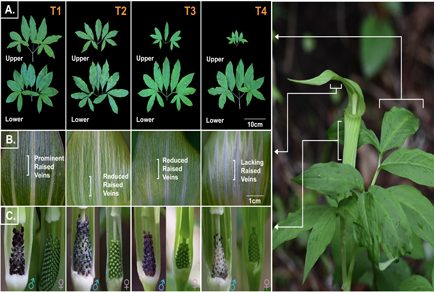
The taxonomic distinction between Arisaema japonicum and A. serratum has long been contentious, with treatments alternating between recognizing them as distinct species or conspecific variants. To resolve their taxonomic status, we conducted an integrative species delimitation analysis combining detailed morphological assessments with genome-wide single nucleotide polymorphism (SNP) data. Morphological investigations revealed continuous trait variation with numerous intermediates, precluding discrete morphological classification. Coalescent-based phylogenetic inference using Singular Value Decomposition Scores (SVDquartets) failed to recover A. japonicum as a monophyletic group, and principal component analysis of SNP data showed no genetic clustering corresponding to species boundaries. Species delimitation using Bayes Factor Delimitation (BFD) overwhelmingly supported a single-species model over competing hypotheses, including those based on previous morphological classifications. Together, these results indicate that A. japonicum does not represent a distinct evolutionary lineage and is best treated as conspecific with A. serratum. Our findings reconcile morphological and genetic data, providing strong support for the synonymization of A. japonicum under A. serratum, thereby resolving a longstanding taxonomic ambiguity within the genus Arisaema.
References
- Beckman Coulter. (2012) SPRI based size selection. Brea, California, pp. 1–14.
- Blume, C.L. (1836) Commentationes botanicæ imprimis de plantis Indiae orientalis. Rumphia 1: 106. https://doi.org/10.5962/bhl.title.51502
- Bouckaert, R., Heled, J., Kühnert, D., Vaughan, T., Wu, C., Xie, D., Suchard, M., Rambaut, A. & Drummond, A. (2014) BEAST 2: a software platform for Bayesian evolutionary analysis. PLoS Computational Biology 10: e1003537. https://doi.org/10.1371/journal.pcbi.1003537
- Boyce, P.C. & Croat, T. (2011) The Überlist of Araceae, totals for published and estimated number of species in Aroid genera. Available from: https://www.researchgate.net/publication/369741356_Uberlist_-_April_2023 (accessed 10 June 2024)
- Catchen, J., Hohenlohe, P., Bassham, S., Amores, A. & Cresko, W. (2013) Stacks: an analysis tool set for population genomics. Molecular Ecology 22: 3124–3140. https://doi.org/10.1111/mec.12354
- Cervantes, C.R., Montes, J.R., Rosas, U. & Arias, S. (2023) Phylogenetic discordance and integrative species delimitation in the Mammillaria haageana species complex (Cactaceae). Molecular Phylogenetics and Evolution 187: 107891. https://doi.org/10.1016/j.ympev.2023.107891
- Chang, C., Chow, C., Tellier, L., Vattikuti, S., Purcell, S. & Lee, J. (2015) Second-generation PLINK: rising to the challenge of larger and richer datasets. GigaScience 4: s13742-015-0047-8. https://doi.org/10.1186/s13742-015-0047-8
- Chen, S. (2023) Ultrafast one-pass FASTQ data preprocessing, quality control, and deduplication using fastp. iMeta 2: e107. https://doi.org/10.1002/imt2.107
- Chifman, J. & Kubatko, L. (2014) Quartet inference from SNP data under the coalescent. Bioinformatics 30: 3317–3324. https://doi.org/10.1093/bioinformatics/btu530
- Cook, J. (2004) Disease, pollinator, and resource limitation influences on the reproductive biology and growing season of Arisaema triphyllum, Jack-in-the-Pulpit. Michigan State University, East Lansing, 144 pp.
- Danecek, P., Bonfield, J., Liddle, J., Marshall, J., Ohan, V., Pollard, M., Whitwham, A., Keane, T., McCarthy, S., Davies, R. & Li, H. (2021) Twelve years of SAMtools and BCFtools. GigaScience 10: giab008. https://doi.org/10.1093/gigascience/giab008
- DeRaad, D. (2022) SNPfiltR: an R package for interactive and reproducible SNP filtering. Molecular Ecology Resources 22: 1–15. https://doi.org/10.1111/1755-0998.13618
- Doyle, J.J. & Doyle, J.L. (1987) A rapid DNA isolation procedure for small quantities of fresh leaf tissue. Phytochemical Bulletin 19: 11–15.
- Engler, A. (1879) Araceae. In: Candolle, A.de & Candolle, C. (Ed.) Monographiæ phanerogamarum: Prodromi nunc continuatio, nunc revisio. Sumptibus G. Masson, Paris, pp. 541.
- Franchet, A. & Savatier, L. (1878) Enumeratio plantarum: in Japonia sponte crescentium hucusque rite cognitarum, adjectis descriptionibus specierum pro regione novarum, quibus accedit determinatio herbarum in libris japonicis So mokou zoussetz xylographice delineatarum. F. Savy, Paris, 507 pp.
- Govaerts, R. (1995) World Checklist of Seed Plants. 1 (1–2). Anversa (Deurne): MIM.
- Gusman, G. & Gusman, L. (2006) The Genus Arisaema: A Monograph for Botanists and Nature Lovers. (Ed. 2). Timber Press, Oregon, pp. 1–474.
- Gusman, G. & Gusman, L. (2008) Validation of new infrageneric taxa in Arisaema (Araceae). Systematics and Geography of Plants 78: 231.
- Jussieu, A.L. (1789) Genera plantarum, secundum ordines naturales disposita, juxta methodum in Horto regio parisiensi exaratam, anno M.DCC.LXXIV. Apud viduam Herissant et Theophilum Barrois, Paris, 23 pp. https://doi.org/10.5962/bhl.title.284
- Knaus, B. & Grunwald, N. (2017) VCFR: a package to manipulate and visualize variant call format data in R. Molecular Ecology Resources 17: 44–53. https://doi.org/10.1111/1755-0998.12549
- Leaché, A., Fujita, M., Minin, V. & Bouckaert, R. (2014) Species delimitation using genome-wide SNP Data. Systematic Biology 63: 534–542. https://doi.org/10.1093/sysbio/syu018
- Li, H. & Durbin, R. (2009) Fast and accurate short read alignment with Burrows-Wheeler transform. Bioinformatics 25: 1754–1760. https://doi.org/10.1093/bioinformatics/btp324
- Linnaeus, C. (1754) Genera Plantarum: Eorumque Characteres Naturales Secundum Numerum, Figuram, Situm, et Proportionem Omnium Fructificationis Partium. (Ed. 5). Impensis Laurentii Salvii, Stockholm, 557 pp. https://doi.org/10.5962/bhl.title.746
- Makino, T. (1901) Observations on the Flora of Japan. Shokubutsugaku zasshi 15: 128–130. https://doi.org/10.15281/jplantres1887.15.167_10
- Makino, T. (1912) Karashu-tishaku. In: Iinuma, C. (Ed.) Sōmoku-Dzusetsu. Seibido, Tokyo, pp. 1229.
- Martius, K.F.P. (1831) Ueber die Art der Befruchtung bei einigen Aroideen und über die Charakteristik mehrerer Gattungen dieser Familie. Flora oder allgemeine botanische Zeitung 14: 449–464.
- McKenna, A., Hanna, M., Banks, E., Sivachenko, A., Cibulskis, K., Kernytsky, A., Garimella, K., Altshuler, D., Gabriel, S., Daly, M. & DePristo, M. (2010) The genome analysis toolkit: a mapreduce framework for analyzing next-generation DNA sequencing data. Genome Research 20: 1297–1303. https://doi.org/10.1101/gr.107524.110
- Montes, J.R., Peláez, P., Willyard, A., Moreno-Letelier, M., Piñero, D. & Gernandt, D. (2019) Phylogenetics of Pinus subsection Cembroides Engelm. (Pinaceae) inferred from low‐copy nuclear gene sequences. Systematic Botany 44: 501–518. https://doi.org/10.1600/036364419X15620113920563
- Montes, J.R., Peláez, P., Moreno‐Letelier, A. & Gernandt, D. (2022) Coalescent‐based species delimitation in North American pinyon pines using low‐copy nuclear genes and plastomes. American Journal of Botany 109: 706–726. https://doi.org/10.1002/ajb2.1847
- Murata, J. & Ohashi, H. (2009) Taxonomic history of Arisaema serratum and A.japonicum. Bunrui 9: 37–45.
- Murata, J. (2011) The Picture Book of Plant Systematics in Color: Arisaema in Japan. Hokuryukan Publishing Co., Tokyo, pp. 81–85.
- Murata, J., Ohno, J., Koeayashi, T. & Ohi-Toma, T. (2018) The Genus Arisaema in Japan. Hokuryukan Publishing Co., Tokyo, pp. 263–277.
- Nakai, T. (1918) Noulae ad Plantas Japoniae et Koreae XVIII. Shokubutsugaku zasshi 32: 215–233. https://doi.org/10.15281/jplantres1887.32.382_215
- Nakai, T. (1929) Conspectus specierum arisaematis Japono-Koreanarum. Shokubutsugaku zasshi 43: 524–540. https://doi.org/10.15281/jplantres1887.43.524
- Nakai, T. (1934) Notlæ ad Plantas Japoniæ & Korea XLIV. Shokubutsugaku zasshi 48: 773–792. https://doi.org/10.15281/jplantres1887.48.773
- Nakai, T. (1935) Notulae ad Plantas Japoniae & Koreae XLVI. Shokubutsugaku zasshi 49: 417–424. https://doi.org/10.15281/jplantres1887.49.417
- Nakai, T. (1940) Notlæ ad Plantas Asiæ Orietnales. XIII. Shokubutsugaku zasshi 54: 61–81.
- Ohi-Toma, T., Wu, S., Murata, H. & Murata, J. (2016) An updated genus-wide phylogenetic analysis of Arisaema (Araceae) with reference to sections. Botanical Journal of the Linnean Society 182: 100–114. https://doi.org/10.1111/boj.12459
- Ortiz, E. (2019) vcf2phylip v2.0: convert a VCF matrix into several matrix formats for phylogenetic analysis. (v2.0). Zenodo.
- Royer, D., Meyerson, L., Robertson, K. & Adams, J. (2009) Phenotypic plasticity of leaf shape along a temperature gradient in Acer rubrum. PLoS One 4: e7653. https://doi.org/10.1371/journal.pone.0007653
- Schott, H.W. & Endlicher, S. (1832) Meletemata botanica. Typis C. Gerold, Vienna, 17 pp. https://doi.org/10.5962/bhl.title.40101
- Schott, H.W. (1856) Synopsis Aroidearum. Typis Congregationis Mechitharisticae, Vienna, 5 pp.
- Scholten, J. & Specht, C.D. (2025) Arisaema species from Shikoku Island, Japan [dataset]. Dryad. https://doi.org/10.5061/dryad.7pvmcvf4q
- Thunberg, C. (1794) Botanical observations on the Flora Japonica. Transactions of the Linnean Society of London 2: 326–342. https://doi.org/10.1111/j.1096-3642.1794.tb00268.x
- Tran, V.T., Hoang, T., Croat, T., Ma, Z., Liu, B., Nguyen, V.D. & Le, C.T. (2022) Reconstruction of the evolutionary biogeography reveals the origin and diversification of Arisaema (Araceae). Acta Botanica Brasilica 36: e2021abb0253. https://doi.org/10.1590/0102-33062021abb0253
- Wickham, H., Averick, M., Bryan, J., Chang, W., Mcgowan, L.D., Francois, R., Grolemund, G., Hayes, A., Henry, L., Hester, J., Kuhn, M., Pedersen, T.L., Miller, E., Bache, S.M., Muller, K., Ooms, J., Robinson, D., Seidel, D.P., Spinu, V., Takahashi, K., Vaughan, D., Wilke, C., Woo, K. & Yutani, H. (2019) Welcome to the tidyverse. Journal of Open Source Software 4: 1686. https://doi.org/10.21105/joss.01686
- Yamashiro, F. & Wada, N. (2002) Size-dependent leaf emergence and expansion pattern in a perennial understory herb Arisaema serratum (Araceae). Journal of Phytogeography and Taxonomy 50: 55–61.