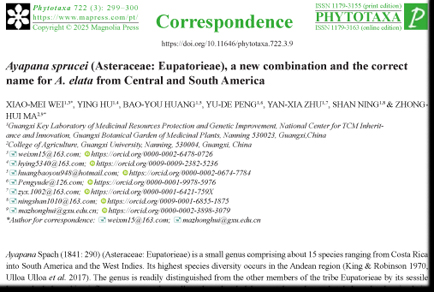

Abstract
N/A
References
- Brako, L. & Zarucchi, J.L. (1993) Catalogue of the flowering plants and Gymnosperms of Peru. Monographs in Systematic Botany from the Missouri Botanical Garden 45: 1–1286.
- King, R.M. & Robinson, H. (1970) Studies in the Eupatorieae (Compositae). XXX. The genus Ayapana. Phytologia 20: 210–212.
- King, R.M. & Robinson, H. (1973) Studies in the Eupatorieae (Compositae). CXIV. The genera of Barro Colorado Island, Panama. Phytologia 27: 233–240.
- King, R.M. & Robinson, H. (1975) Flora of Panama. Family 184. Compositae. Eupatorieae. Annals of the Missouri Botanical Garden 62: 888–1004.
- Linnaeus, C. (1753) Species plantarum. L.Salvius, Holmia [Stockholm], 1200 pp.
- Robinson, B.L. (1919) On tropical American Compositae, chiefly Eupatorieae. Proceedings of the American Academy of Arts and Sciences 55: 3–41.
- Salisbury, R.A. (1796) Prodromus Stirpium in Horto ad Chapel Allerton Vigentium. Londini, 442 pp.
- Spach, É. (1841) Histoire Naturelle des Végétaux. Phanérogames. Vol. 10. Librairie Encyclopedique de Roret, Paris, 572 pp.
- Steetz, J. (1854) Eupatorium elatum Steetz. In: Seemann, B. (ed.) The Botany of the Voyage of H.M.S. Herald, under the Command of Captain Henry Kellett, R.N., C.B., during the Years 1845-51. Lovell Reeve, London, pp. 148–149.
- Turland, N.J., Wiersema, J.H., Barrie, F.R., Gandhi, K.N., Gravendyck, J., Greuter, W., Hawksworth, D.L., Herendeen, P.S., Klopper, R.R., Knapp, S., Kusber, W.-H., Li, D.-Z., May, T.W., Monro, A.M., Prado, J., Price, M.J., Smith, G.F. & Zamora Señoret, J.C. (2025) International Code of Nomenclature for algae, fungi, and plants (Madrid Code). Regnum Vegetabile 162. University of Chicago Press, Chicago. https://doi.org/10.7208/chicago/9780226839479.001.0001
- Ulloa Ulloa, C., Acevedo-Rodríguez, P., Beck, S., Belgrano, M.J., Bernal, R., Berry, P.E., Brako, L., Celis, M., Davidse, G., Forzza, R.C., Gradstein, S.R., Hokche, O., Leon, B., Leon-Yanez, S., Magill, R.E., Neill, D.A., Nee, M., Raven, P.H., Stimmel, H., Strong, M.T., Villasenor, J.L., Zarucchi, J.L., Zuloaga, F.O. & Jørgensen, P.M. (2017) An integrated assessment of the vascular plant species of the Americas. Science 358: 1614–1617.