
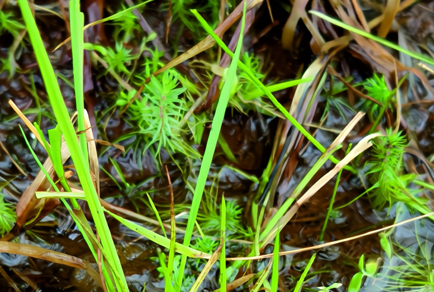

Abstract
Isoetes sahyadrii was described from a T.S. Mahabale specimen at the same site in southern India from which I. dixitii and I. panchganiensis were subsequently typified. Mahabale indicated that his “type specimens” were deposited in the Gujarat College, Ahmadabad herbarium. The later disappearance of that type material and destruction of the type locality, however, combined with an ambiguous protologue to render I. sahyadrii an unresolved taxon in subsequent Isoetes enumerations. The recent rediscovery of Mahabale’s designated type material at Gujarat College, Ahmadabad has permitted reconsideration of I. sahyadrii in the context of subsequent taxonomic decisions. This study confirms earlier suggestions that I. sahyadrii was erroneously based on a mixture of I. dixitii and I. panchganiensis plants. We conclude that the name I. sahyadrii should have been recognized as having a type representing two different species and, under Art. 9.14, most appropriately to have employed the name for I. dixitii. Intervening lectotypification efforts conducted without the benefit of Mahabale’s designated type specimen, however, resulted first in epitypification of I. sahyadrii with the type of I. panchananii, then with a conserved type, that of I. panchganiensis. Both latter species exhibit morphological characteristics contrary to the predominant elements evident in Mahabale’s recently rediscovered specimen and his published protologue. The successful 2022 proposal to conserve that nomenclature, however, makes further nomenclatural clarification very difficult. Accordingly, we accept the current application of the name to the species previously known as I. panchganiensis.
References
- Applequist, W.L. (2020) Report of the Nomenclature Committee for Vascular Plants: 71. Taxon 69 (2): 394. https://doi.org/10.1002/tax.12217
- Applequist, W.L. (2024) Report of the Nomenclature Committee for Vascular Plants: 75. Taxon 71 (1): 288–304. https://doi.org/10.1002/tax.13134
- Brunton, D.F. & Troia, A. (2018) Global review of recent taxonomic research into Isoetes (Isoetaceae), with implications for biogeography and conservation. Fern Gazette 20: 309–333.
- Brunton, D.F., McIntosh, K.L. & Sokoloff, P.C. (2023) A terrestrial hybrid quillwort, Isoetes ×angeloi, hyb. nov (Isoetaceae) from Sicily. Botany Letters 170 (2): 278–284. https://doi.org/10.1080/23818107.2022.2138539
- Fraser-Jenkins, C.R. & Patil, S. (2022) (2880) Proposal to conserve the name of Isoetes sahyadrii (Pteridophyta: Isoetaceae) with a conserved type. Taxon 71 (2): 473–474. https://doi.org/10.1002/tax.12700
- Fraser-Jenkins, C.R. (2015) Lectotypification and epitypification of Isoetes sahyadriensis (Isoetaceae) from S.W. India. Indian Journal of Forestry 38 (3): 231–232.
- Fraser-Jenkins, C.R., Gandhi, K.N., Kholia, B.S. & Benniamin, A. (2017) An annotated checklist of Indian pteridophytes part I (Lycopodiaceae to Thelypteridaceae). Bishen Singh Mahendra Pal Singh Pvt. Ltd., Dehradun, India.
- Hickey, R.J. (1986) Isoetes megaspore surface morphology: nomenclature, variation and systematic importance. American Fern Journal 76 (1): 1–16. https://doi.org/10.2307/1547394
- Mahabale, T.S. (1938) On a new species of Isoetes in India. Current Science 7 (2): 62–63.
- Mazumdar, J., Bandyopadhyay, S. & Bhattacharjee, A. (2020) (013) Proposal to amend Article 9.20. Taxon 69: 631. https://doi.org/10.1002/tax.12253
- Mazumdar, J., Rajput, K. & Patil, S. (2017) (2565) Proposed to reject the name Isoetes sahyadrii (Isoetaceae). Taxon 66 (6): 1470. https://doi.org/10.12705/666.16
- Rao, L.N. (1944) A new species of Isoetes from Bangalore, Mysore State. Current Science 13 (11): 286–287.
- Romero, M.I. & Real, C. (2005) A morphometric study of three closely related taxa in the European Isoetes velata complex. Botanical Journal of the Linnean Society 148: 459–464. https://doi.org/10.1111/j.1095-8339.2005.00419.x
- Shende, D.V. (1945) A new species of Isoetes from the Bombay presidency. Journal of University of Bombay 14B: 50–52.
- Shukla, P.K., Singh, S.K., Brunton, D.F., Shukla, S.K., Patil, A.P. & Dubey, N.K. (2024) Isoetes bilaspurensis (Isoetaceae – Lycopodiopsida), new to Southern India: an extended distribution and redescription. American Fern Journal 114 (2): 127–139. https://doi.org/10.1640/0002-8444-114.2.127
- Shukla, P.K., Srivastava, G.K. & Shukla, S.K. (2002) The quillwort’s (Isoetes) of India: distribution, endemism and species radiation. Biodiversity and Conservation 11 (6): 959–973. https://doi.org/10.1023/a:1015868228530
- Shukla, P.K., Srivastava, G.K., Shukla, S.K. & Singh, S.K. (2007) Cyto-morphology based basal and sub-basal level evolutionary relationship among Isoetes L. species with special reference to Indian taxa. Proceedings of the National Academy of Sciences India 77B: 88–104.
- Singh, S. (2021) Physical geography. Pravalika Publications, Prayagraj, India.
- Singh, S.K., Brunton, D.F., Shukla, P.K., Sokoloff, P.C., Shukla, S.K., Patil, A.K. & Dubey, N.K. (2025) Rediscovery of presumed extinct Isoetes divyadarshanii (Isoetaceae—Lycopodiopsida) in India: New insight on its morphology, taxonomy and conservation status. Phytotaxa 697 (1): 97–108. https://doi.org/10.11646/phytotaxa.697.1.6
- Singh, S.K., Shukla, P.K., Brunton, D.F., Dubey, N.K. & Shukla, S.K. (2021a) The taxonomy and conservation status of Isoetes (Isoetaceae; Lycopodiopsida) in India. Botany Letters 168 (2): 200–226. https://doi.org/10.1080/23818107.2020.1848621
- Singh, S.K., Shukla, P.K., Dubey, N.K. & Shukla, S.K. (2021b) The significance of a new umbellate ornamentation in Isoetes (Isoetaceae: Lycopodiopsida) megaspores. Grana 60: 247–255. https://doi.org/10.1080/00173134.2020.1825794
- Singh, S.K., Shukla, S.K., Dubey, N.K. & Shukla, P.K. (2018) Isoetes × gopalkrishnae (Isoetaceae), a new interspecific sterile hybrid from central India. Phytotaxa 362 (1): 68–76. https://doi.org/10.11646/phytotaxa.362.1.5
- Srivastava, G.K., Pant, D.D. & Shukla, P.K. (1993) The genus Isoetes L. in India. American Fern Journal 83 (4): 105–119.
- Srivastava, G.K., Srivastava, M. & Wagai, S.O. (2001) Quillworts of Sahyadri’s hills (India). Indian Fern Journal 18: 89–101.
- Thiers, B. (2025 [continuously updated]) Index Herbariorum: A global directory of public herbaria and associated staff. New York Botanical Garden’s Virtual Herbarium. Available from: http://sweetgum.nybg.org/science/ih/ (accessed 1 January 2024)
- Turland, N.J., Wiersema, J.H., Barrie, F.R., Gandhi, K.N., Gravendyck, J., Greuter, W., Hawksworth, D.L., Herendeen, P.S., Klopper, R.R., Knapp, S., Kusber, W.-H., Li, D.-Z., May, T.W., Monro, A.M., Prado, J., Price, M.J., Smith, G.F. & Zamora Señoret, J.C. (Eds.) (2025) International Code of Nomenclature for algae, fungi, and plants (Madrid Code) adopted by the Twentieth International Botanical Congress Madrid, Spain, July 2024. Regnum Vegetabile 162. The University of Chicago Press, Chicago & London.
- Venkataraman, K. & Sivaperuman, C. (2018) Biodiversity hotspots in India. In: Sivaperuman, C. & Venkataraman, K. (Eds.) Indian hotspots: vertebrate faunal diversity, conservation and management, Vol. 1. Springer Nature, Singapore, pp. 1–27.
- Wilson, K.L. (2022) Report of the General Committee 27. Taxon 71 (6): 1315–1318. https://doi.org/10.1002/tax.12862
- Wilson, K.L. (2024) Report of the General Committee 31. Taxon 73 (4): 1081–1084. https://doi.org/10.1002/tax.13224
- Yadav, B.B., Singh, S.K., Dubey, N.K., Shukla, S.K. & Srivastava, G.K. (2015) Hydrochemical characterization of some strands of Isoetes dixitei in India. Taiwania 60 (2): 63–70. https://doi.org/10.6165/tai.2015.60.63
- Yadav, B.B., Singh, S.K., Srivastava, M. & Srivastava, G.K. (2012) Comparative studies of six populations of Isoetes panchganiensis from India. Turkish Journal of Botany 36 (6): 667–676. https://doi.org/10.3906/bot-1109-18