

Abstract
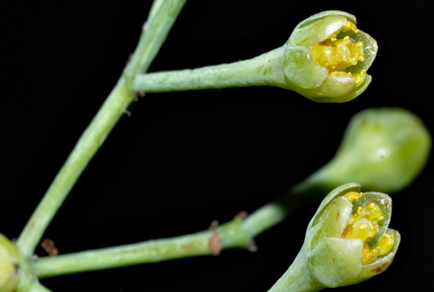
Apollonias is one of the taxonomically understudied genera of the family Lauraceae, which consisted of two disjunct distributed species, Apollonias barbujana from the Canary Islands, Spain and A. arnottii from Western Ghats, India. The key characteristic of the genus is the presence of bilocular anthers compared to other genera of Lauraceae. Based on morphology and molecular data, the Canary Island species A. barbujana, type species of the genus Apollonias, has been transferred to the Neotropical genus Persea. This questions the taxonomic relationship of A. arnottii. Based on morphological characteristics, nomenclature and molecular phylogeny, we shifted A. arnottii to the genus Phoebe. Accordingly, we herein propose the transfer of A. arnottii to the genus Phoebe, with the designation of a lectotype, as Phoebe arnottii.
References
- Alfaro, M.E. & Holder, M.T. (2006) The posterior and the prior in Bayesian phylogenetics. Annual Review of Ecology, Evolution, and Systematics 37: 19–42. https://doi.org/10.1146/annurev.ecolsys.37.091305.110021
- Aublet, J.B.C.F. (1775) Histoire des plantes de la Guiane Françoise, vol. 1. P.F. Didot jeune, Londres, Paris, 621 pp. https://doi.org/10.5962/bhl.title.674
- Baillon, H. (1870) Histoire des plantes, vol. 2. Librairie Hachette, Paris, 512 pp. https://doi.org/10.5962/bhl.title.40796
- Blume, C.L.von (1851) Museum botanicum Lugduno-Batavum, sive stirpium exoticarum novarum vel minus cognitarum ex vivis aut siccis brevis expositio et descriptio, vol. 1, part 21 & part 23. E.J. Brill, Lugduni-Batavorum, pp. [321]–336, [353]–368. https://doi.org/10.5962/bhl.title.274
- Braun, A.C.H. (1853) Ueber die Lorbeerbäume (Laurinen) der Gärten. Verhandlungen des Vereins zur Beförderung des Gartenbaues in den Königlich Preussischen Staaten 21: 69–83. [https://www.biodiversitylibrary.org/page/2949865]
- Bridson, D. & Forman, L. (1992) The herbarium handbook. Royal Botanic Gardens, Kew, Richmond, UK, 303 pp.
- Brown, R. (1810) Prodromus florae Novae Hollandiae et Insulae Van-Diemen, vol. 1. Typis Richardi Taylor et socii, Londini, pp. 145–590. https://doi.org/10.5962/bhl.title.3633
- Buckler, E.S. & Holtsford, T.P. (1996) Zea systematics: ribosomal ITS evidence. Molecular Biology and Evolution 13: 612–622. https://doi.org/10.1093/oxfordjournals.molbev.a025621
- Buckler, E.S., Ippolito, A. & Holtsford, T.P. (1997) The evolution of ribosomal DNA: divergent paralogues and phylogenetic implications. Genetics 145: 821–832. https://doi.org/10.1093/genetics/145.3.821
- Cavanilles, A.J. (1801) De las plantas que el Ciudadano Augusto Broussonet colectó en las costas septentrionales de la Africa y en las islas Canarias. Anales de Ciencias Naturales 3 (7): [5]–78. [https://www.biodiversitylibrary.org/page/8009304]
- Chanderbali, A.S., van der Werff, H. & Renner, S.S. (2001) Phylogeny and historical biogeography of Lauraceae: evidence from the chloroplast and nuclear genomes. Annals of the Missouri Botanical Garden 88: 104–134. https://doi.org/10.2307/2666133
- Chen, J.Q., Li, L., Li, J. & Li, H.W. (2009) Bayesian inference of nrDNA ITS sequences from Machilus (Lauraceae) and its systematic significance. Acta Botanica Yunnanica 31: 117–126. [In Chinese with English abstract; https://journal.kib.ac.cn/EN/10.3724%20SP.J.1143.2009.08206]
- Drinnan, A.N., Crane, P.R., Friis, E.M. & Pedersen, K.R. (1990) Lauraceous flowers from the Potomac Group (mid-Cretaceous) of eastern North America. Botanical Gazette 151: 370–384. https://doi.org/10.1086/337838
- Gangopadhyay, M. (2009) Three new taxa in Lauraceae from India. Bangladesh Journal of Plant Taxonomy 16: 141–149. https://doi.org/10.3329/bjpt.v16i2.3926
- Hemsley, W.B. (1891) Enumeration of all the plants known from China proper, Formosa, Hainan, the Corea, the Luchu archipelago, and the Island of Hongkong, together with their distribution and synonymy. The Journal of the Linnean Society, Botany 26: 370–393. [https://www.biodiversitylibrary.org/page/169173]
- Kalyaanamoorthy, S., Minh, B.Q., Wong, T.K.F., von Haeseler, A. & Jermiin, L.S. (2017) ModelFinder: fast model selection for accurate phylogenetic estimates. Nature Methods 14: 587–589. https://doi.org/10.1038/nmeth.4285
- Kostermans, A.J.G.H. (1939) Enumeratio Lauracearum madagascariensium et ex insulis Mascarenis (Revisio Lauracearum VI). Notulae Systematicae 8: 67–128. [https://biostor.org/reference/266793]
- Kostermans, A.J.G.H. (1952) A historical survey of Lauraceae. II. Journal for Scientific Research (Jakarta) 1 (5): 113–127.
- Kumar, S., Stecher, G. & Tamura, K. (2016) MEGA7: Molecular Evolutionary Genetics Analysis version 7.0 for bigger datasets. Molecular Biology and Evolution 33: 1870–1874. https://doi.org/10.1093/molbev/msw054
- Lamarck, J.B.A.P.M. de (1792) Encyclopédie méthodique. Botanique, vol. 3, part 2. Chez Panckoucke, Paris; Chez Plomteux, Liége, pp. 361–759. https://doi.org/10.5962/bhl.title.824
- Li, J., Christophel, D.C., Conran, J.G. & Li, H.-W. (2004) Phylogenetic relationships within the core Laureae (Litsea complex, Lauraceae) inferred from sequences of the chloroplast gene matK and nuclear ribosomal DNA ITS regions. Plant Systematics and Evolution 246: 19–34. https://doi.org/10.1007/s00606-003-0113-z
- Li, L., Li, J., Rohwer, J.G., van der Werff, H., Wang, Z.-H. & Li, H.-W. (2011) Molecular phylogenetic analysis of the Persea group (Lauraceae) and its biogeographic implications on the evolution of tropical and subtropical amphi-Pacific disjunctions. American Journal of Botany 98: 1520–1536. https://doi.org/10.3732/ajb.1100006
- Li, L., Tan, Y.-H., Meng, H.-H., Ma, H. & Li, J. (2020) Two new species of Alseodaphnopsis (Lauraceae) from southwestern China and northern Myanmar: evidence from morphological and molecular analyses. PhytoKeys 138: 27–39. https://doi.org/10.3897/phytokeys.138.38569
- Li, L., Liu, B., Song, Y., Meng, H.H., Ci, X.Q., Conran, J.G., de Kok, R.P.J., Moraes, P.L.R.de, Ye, J.-W., Tan, Y.-H., Liu, Z.-F., van der Merwe, M., van der Werff, H., Yang, Y., Rohwer, J.G. & Li, J. (2025) Global advances in phylogeny, taxonomy and biogeography of Lauraceae. Plant Diversity 47: 341–364. https://doi.org/10.1016/j.pld.2025.04.001
- Linnaeus, C. (1753) Species plantarum, vol. 1. Impensis Laurentii Salvii, Holmiae, 560 pp. https://doi.org/10.5962/bhl.title.669
- Mabberley, D.J. (2017) Mabberley’s plant-book: a portable dictionary of plants, their classification and uses, 4th ed. Cambridge University Press, Cambridge, UK, 1120 pp. https://doi.org/10.1017/9781316335581
- Meissner, C.D.F. (1864) Lauraceae. In: Candolle, A.L.P.P.de (Ed.) Prodromus systematis naturalis regni vegetabilis, vol. 15 (1). Sumptibus Victoris Masson et filii, Parisiis, pp. 1–260, 503–516. https://doi.org/10.5962/bhl.title.286
- Mez, C.C. (1889) Lauraceae Americanae monographice descriptae. Jahrbuch des Königlichen Botanischen Gartens und des Botanischen Museums zu Berlin 5: 1–556. [https://www.biodiversitylibrary.org/page/44047358]
- Miller, P. (1754) PERSEA, The avocado, or avocado pear. In: The gardeners dictionary, vol. 3, ed. 4. Printed for the author, London, unnumbered. https://doi.org/10.5962/bhl.title.79061
- Minh, B.Q., Nguyen, M.A.T. & von Haeseler, A. (2013) Ultrafast approximation for phylogenetic bootstrap. Molecular Biology and Evolution 30: 1188–1195. https://doi.org/10.1093/molbev/mst024
- Mo, Y.-Q., Li, L., Li, J.-W., Rohwer, J.G., Li, H.-W. & Li, J. (2017) Alseodaphnopsis: a new genus of Lauraceae based on molecular and morphological evidence. PLoS ONE 12 (10): e0186545. https://doi.org/10.1371/journal.pone.0186545
- Moraes, P.L.R.de, Cardoso, D.B.O.S., Gregório, B.S. & Baitello, J.B. (2022) A remarkable new gynodioecious species of Ocotea (Lauraceae) from the Brazilian Atlantic rain forest, and its phylogenetic placement in the Ocotea complex. Edinburgh Journal of Botany 79: 1–23. https://doi.org/10.24823/ejb.2022.1875
- Nees von Esenbeck, C.G.D. (1831) Laurinae Indiae Orientalis. In: Wallich, N. (Ed.) Plantae Asiaticae rariores, vol. 2. Treuttel and Würtz, London, pp. 58–76. https://doi.org/10.5962/bhl.title.468
- Nees von Esenbeck, C.G.D. (1833a) Annexa est Plantarum laurinarum secundum affinitates naturales expositio, ab academiae praeside proposita, qua comprehenditur Hufelandiae laurini generis novi laureato seni consecrati illustratio. Typis Grassii, Barthii et Sociorum, Vratislaviae, pp. 1–25. https://doi.org/10.5962/bhl.title.101773
- Nees von Esenbeck, C.G.D. (1833b) Revisio laurinarum a b. Sellowio in Brasilia collectarum et iam in herbario regio Berolinensi asservatarum. Linnaea 8: 36–51. [https://www.biodiversitylibrary.org/page/98929]
- Nees von Esenbeck, C.G.D. (1836) Systema laurinarum. Sumptibus Veitii et Sociorum, Berolini, 720 pp. https://doi.org/10.5962/bhl.title.422
- Nguyen, L.-T., Schmidt, H.A., von Haeseler, A. & Minh, B.Q. (2015) IQ-TREE: a fast and effective stochastic algorithm for estimating maximum-likelihood phylogenies. Molecular Biology and Evolution 32: 268–274. https://doi.org/10.1093/molbev/msu300
- Robi, A.J. (2014) A taxonomic revision of the family Lauraceae from South India. PhD thesis. Kannur University, Kannur, 354 pp. [http://hdl.handle.net/10603/63795]
- Rohwer, J.G. (1993) Lauraceae. In: Kubitzki, K., Rohwer, J.G. & Bittrich, V. (Eds.) The families and genera of vascular plants: Flowering plants. Dicotyledons, vol. 2. Springer, Berlin, Heidelberg, pp. 366–391. https://doi.org/10.1007/978-3-662-02899-5_46
- Rohwer, J.G. (1994) A note on the evolution of the stamens in the Laurales, with emphasis on the Lauraceae. Botanica Acta 107: 103–110. https://doi.org/10.1111/j.1438-8677.1994.tb00415.x
- Rohwer, J.G. (2000) Toward a phylogenetic classification of the Lauraceae: evidence from matK sequences. Systematic Botany 25: 60–71. https://doi.org/10.2307/2666673
- Rohwer, J.G., Li, J., Rudolph, B., Schmidt, S.A., van der Werff, H. & Li, H. (2009) Is Persea (Lauraceae) monophyletic? Evidence from nuclear ribosomal ITS sequences. Taxon 58: 1153–1167. https://doi.org/10.1002/tax.584009
- Ronquist, F., Teslenko, M., van der Mark, P., Ayres, D.L., Darling, A., Höhna, S., Larget, B., Liu, L., Suchard, M.A. & Huelsenbeck, J.P. (2012) MrBayes 3.2: efficient Bayesian phylogenetic inference and model choice across a large model space. Systematic Biology 61: 539–542. https://doi.org/10.1093/sysbio/sys029
- Sambrook, J. & Russell, D.W. (2001) Molecular cloning: a laboratory manual. 3rd ed. Vol. 1. Cold Spring Harbor Laboratory Press, New York. [http://www.molecularcloning.com/]
- Schaeffer, J.C. (1760) Botanica expeditior. Typis Emanvelis Adami Weissii, Ratisbonae, 338 pp.
- Thompson, J.D., Higgins, D.G. & Gibson, T.J. (1994) CLUSTAL W: improving the sensitivity of progressive multiple sequence alignment through sequence weighting, position-specific gap penalties and weight matrix choice. Nucleic Acids Research 22: 4673–4680. https://doi.org/10.1093/nar/22.22.4673
- Thunberg, C.P. (1783) Nova genera Plantarum, quorum, partem tertiam... Joh. Edman, Upsaliae, pp. 55–70. [https://www.biodiversitylibrary.org/page/46015264]
- Trifinopoulos, J., Nguyen, L.-T., von Haeseler, A. & Minh, B.Q. (2016) W-IQ-TREE: a fast online phylogenetic tool for maximum likelihood analysis. Nucleic Acids Research 44: W232–W235. https://doi.org/10.1093/nar/gkw256
- Turland, N.J., Wiersema, J.H., Barrie, F.R., Greuter, W., Hawksworth, D.L., Herendeen, P.S., Knapp, S., Kusber, W.-H., Li, D.-Z., Marhold, K., May, T.W., McNeill, J., Monro, A.M., Prado, J., Price, M.J. & Smith, G.F. (2018) International Code of Nomenclature for algae, fungi, and plants (Shenzhen Code) adopted by the Nineteenth International Botanical Congress Shenzhen, China, July 2017. Regnum Vegetabile 159. Koeltz Botanical Books, Glashütten. https://doi.org/10.12705/Code.2018
- van der Werff, H. (2001) An annotated key to the genera of Lauraceae in the Flora Malesiana region. Blumea 46: 125–140.
- Webb, P.B. & Berthelot, S. (1846) Laurineae Juss. In: Webb, P.B. & Berthelot, S. (Eds.) Histoire naturelle des Îles Canaries, vol. 3, part 2, section 3. Béthune, Paris, pp. 222–230. https://doi.org/10.5962/bhl.title.60795
- Willdenow, C.L. (1809) Enumeratio plantarum Horti Regii Botanici Berolinensis. In Taberna Libraria Scholae Realis, Berolini, 1099 pp. https://doi.org/10.5962/bhl.title.165500
- Yang, Y.C. (1945) New species, varieties and combinations of Lauraceous plants. Journal of the West China Border Research Society, Series B 15: 70–88.
- Yang, Z., Jin, W.-Y., Liu, B., Ferguson, D.K. & Yang, Y. (2021) Big fruits with tiny tepals: an unusual new species of Lauraceae from southwestern China. PhytoKeys 179: 129–143. https://doi.org/10.3897/phytokeys.179.62050
- Yang, Z., Ferguson, D.K. & Yang, Y. (2025) Differential plastome diversification of the Lauraceae between tropical regions of Asia and America. Botanical Journal of the Linnean Society boaf051. https://doi.org/10.1093/botlinnean/boaf051