

Abstract
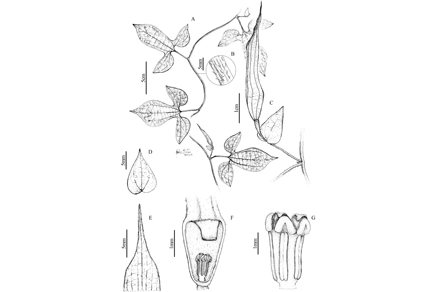
Aristolochia subsect. Pentandrae is a monophyletic assembling of nearly 50 species distributed across the southern USA, Mexico, Guatemala and Belize, and the Antilles. The most consistent characters of the subsection are the pentamerous androecium and gynoecium, two traits not found elsewhere in the family Aristolochiaceae. Here, we report the first record of A. pentandra in Brazil, which also represents the first continental occurrence of Aristolochia subsect. Pentandrae in South America. This finding significantly expands the geographic range for the entire subsection. Here we fully document and discuss the morphology, conservation, and biogeography of this unexpected collection of A. pentandra in the Amazon basin. Additionally, we report the presence of A. stuckertii in Brazil, one of the hexandrous species belonging to the ‘A. lindneri group’, an informal group of five species from central and southern South America, proposed as sister to the subsection Pentandrae. The discovery of A. pentandra in Brazil significantly narrows the geographical disjunction between these two closely related clades.
References
- Akçakaya, H.R., Keith, D.A., Burgman, M., Butchart, S.H.M, Hoffmann, M., Regan, H.M., Harrison, I. & Boakes, E. (2017) Inferring extinctions III: A cost-benefit framework for listing extinct species. Biological Conservation 214: 336–342. https://doi.org/10.1016/j.biocon.2017.07.027
- Bachman, S., Moat, J., Hill, A.W., de la Torre, J. & Scott, B. (2011) Supporting Red List threat assessments with GeoCAT: Geospatial conservation assessment tool. ZooKeys 2011 (150): 117–126.
- Berger, A. (1927) Eine neue Aristolochia aus Bolivien. Notizblatt des Botanischen Gartens und Museums zu Berlin-Dahlem 10 (92): 129–134. https://doi.org/10.2307/3994713
- Brandegee, T.S. (1917) Plant Mexicanae Purpusianae, VIII. University of California Publications in Botany 6 (13): 363–375.
- Bray, W.L. (1898) On the relation of the flora of the Lower Sonoran Zone in North America to the flora of the arid zones of Chili and Argentine. Botanical Gazette 26: 121–147. https://doi.org/10.1086/327722
- Campbell, D.H. (1944) Relations of the temperate floras of North and South America. Proceedings of the California Academy of Sciences 4 ser. 25: 139–146.
- Constance, L. (1963) Amphitropical relationships in the herbaceous flora of the Pacific coast of North and South America: A symposium. Introduction and historical review. The Quarterly Review of Biology 38: 109–116.
- Duchartre, P. (1854) Tentamen methodicae divisionis generis Aristolochia. Annales des Sciences Naturelles, Botanique, ser. 4 2: 29–76.
- Duchartre, P. (1864) Aristolochiaceae. In: de Candolle, A.P. (Ed.) Prodromus systematis naturalis regni vegetabilis, 15 (1). Treuttel et Würtz, Paris, pp. 421–498.
- Freitas, J., Lírio, E.J. de, Barros, F. & González, F. (2020) Aristolochiaceae in Flora do Brasil 2020. Jardim Botânico do Rio de Janeiro. Available from: https://floradobrasil2020.jbrj.gov.br/FB54 (accessed 29 May 2025)
- González, F. (1990) Flora de Colombia. Monografia No. 12. Universidad Nacional de Colombia, Instituto de Ciencias Naturales, Colombia, 184 pp.
- González, F. (1999) A phylogenetic analysis of the Aristolochioideae (Aristolochiaceae). Ph.D. dissertation. The City University of New York, NY.
- González, F. (2001) Una nueva especie de Aristolochia (Aristolochiaceae) de Bolivia. Revista de la Academia Colombiana de Ciencias Exactas, Físicas y Naturales 25 (95): 225–228.
- González, F. (2012) Florística y sistemática filogenética innecesariamente disyuntas: El caso de Aristolochia, Euglypha y Holostylis. Revista de la Academia Colombiana de Ciencias Exactas, Físicas y Naturales 36 (139): 193–202.
- González, F. & Stevenson, D.W. (2000) Gynostemium development in Aristolochia (Aristolochiaceae). Botanische Jahrbücher für Systematik 122: 249–291.
- González, F. & Stevenson, D.W. (2002) A phylogenetic analysis of the subfamily Aristolochioideae (Aristolochiaceae). Revista de la Academia Colombiana de Ciencias Exactas, Físicas y Naturales 26 (98): 25–60.
- González, F., Esquivel, H.E., Murcia, G.A. & Pabón-Mora, N. (2010) Aristolochia pentandra (Aristolochiaceae) in Colombia: biogeographic implications and proposed synapomorphies between the pentandrous species of Aristolochia and its South American sister group. Revista de la Academia Colombiana de Ciencias Exactas, Físicas y Naturales 34: 467–478.
- González, F., Ospina, J.C. & Zanotti, C. (2015) Sinopsis y novedades taxonómicas de la familia Aristolochiaceae para la Argentina. Darwiniana, nueva serie 3 (1): 38–64.
- Harris, J.G. & Harris, M.W. (2001) Plant identification terminology: an illustrated glossary. Spring Lake Pub, 216 pp.
- Heckard, L.R. (1963) The Hydrophyllaceae. The Quarterly Review of Biology 38: 117–123. https://doi.org/10.1086/403794
- Herzog, T.C.J. (1921) Die von Th. Herzog auf seiner zweiten Reise durch Bolivien in den Jahren 1910 und 1911 gesammelten Pflanzen. Mededeelingen van ‘s Rijks-Herbarium 40: 1–77.
- Holmes, W.C., Yip, K.L. & Rushing, A. (2008) Taxonomy of Koeberlinia (Koeberliniaceae). Brittonia 60: 171–184. https://doi.org/10.1007/s12228-008-9026-z
- IUCN (2012) Red List Categories and Criteria: Version 3.1. Second edition. Gland, Switzerland and Cambridge, UK: IUCN, iv + 32 pp.
- IUCN (2024) Guidelines for using the IUCN Red List categories and criteria. Version 16 Prepared by the Standards and Petitions Subcommittee. Available from: https://nc.iucnredlist.org/redlist/content/attachment_files/RedListGuidelines.pdf (accessed 29 May 2025)
- Jacquin, N.J. (1760) Enumeratio Systematica Plantarum quas in insulis Caribaeis vicinaque Americes continente detexit novas, aut jam cognitas emendavit. Apud T. Haak, Lugduni Batavorum, 41 pp.
- Jacquin, N.J. (1763) Selectarum Stirpium Americanarum Historia. Ex Officina Krausiana, Wien, 137 pp.
- Johnston, I.M. (1940) The floristic significance of shrubs common to North and South American deserts. Journal of the Arnold Arboretum 21: 356–363. https://doi.org/10.5962/p.325811
- Klotzsch, F. (1859) Die Aristolochiaceae des Berliner Herbariums. Monatsber. Königl Akad. Wiss. Berlin, pp. 571–625.
- Kunth, C.S. (1817) Asarinae. Nova Genera et Species Plantarum 2: 145–149.
- Murata, J., Ohi, T., Wu, S., Darnaedi, D., Sugawara, T., Nakanishi, T. & Murata, H. (2001) Molecular Phylogeny of Aristolochia (Aristolochiaceae) inferred from matK sequences. Acta Phytotaxonomica & Geobotanica 52: 75–83.
- Ohi-Toma, T., Sugawara, T., Murata, H., Wanke, S., Neinhuis, C. & Murata, J. (2006) Molecular phylogeny of Aristolochia sensu lato (Aristolochiaceae) based on sequences of rbcL, matK, and phyA genes, with special reference to differentiation of chromosome numbers. Systematic Botany 31: 481–492. https://doi.org/10.1600/036364406778388656
- Paizanni Guillén, A., Santana Michel, F.J., Ramírez Amezcua, J.M., Wagner, S.T., Müller, S., Montero Castro, J.C., Wanke, S. & Samain, M.-S. (2016) Four new species of Aristolochia subsection Pentandrae from western Mexico. Systematic Botany 41 (1): 128–141.
- Pfeifer, H.W. (1970) A taxonomic revision of the pentandrous species of Aristolochia. University of Connecticut Publication Series, 134 pp.
- QGIS.org (2025) QGIS Geographic Information System. QGIS Association. Available from: http://www.qgis.org (accessed 15 September 2025)
- Rafinesque, C.S. (1828) Medical Flora; or, Manual of medical botany of the United States of North America, vol. 1. pp. 61–65.
- Solbrig, O. (1972) New approaches to the study of disjunctions with special emphasis on the American Amphitropical Desert disjunctions. In: Valentine, D.H. (ed.) Taxonomy, Phytogeography and Evolution, Academic Press, London, pp. 85–100.
- Spegazzini, C.L. (1899) Plantae novae nonnullae, Americae australis. Comunicaciones del Instituto Nacional de Investigacion de las Ciencias Naturales: Ciencias Botanicas 1: 81–89.
- Standley, P.C. (1937) Studies of American Plants – VIII. Publications of the Field Museum of Natural History, Botanical Series 17 (3): 227–284.
- Sugawara, T., Murata, J., Wu, S., Ohi-Toma, T., Nakanashi, T. & Murata, H. (2001) A cytological analysis of 24 taxa in Aristolochia subgenera Siphisia and Aristolochia (Aristolochiaceae). Acta Phytotaxonomica & Geobotanica 52: 149–158.
- Takhtajan, A.L. (1997) Diversity and classification of flowering plants. Columbia University Press, New York, 643 pp.
- Taubert, P.H.W. (1890) Aristolochiaceae. Beiträge zur Kenntnis der Flora des Central brasilianischen Staates Goyaz. Botanische Jahrbücher für Systematik, Pflanzengeschichte und Pflanzengeographie 12: 13–14.
- Thiers, B. (2024) Index Herbariorum: A global directory of public herbaria and associated staff. New York Botanical Garden’s Virtual Herbarium. Available from: http://sweetgum.nybg.org/science/ih/ (accessed 10 March 2024)
- Wagner, S. (2010) Evolution of shrubs and lianas within Aristolochia subgenus Isotrema–combining molecular phylogeny with biomechanical and anatomical approaches (Evolution von Wuchsformen innerhalb der Aristolochia Untergattung Isotrema–Molekulare Phylogenie kombiniert mit biomechanischen und anatomischen Untersuchungen). Dipl. Biol. Thesis, Fakultät Mathematik und Naturwissenschaften, Technischen Universität Dresden, Germany.
- Wanke, S., González, F. & Neinhuis, C. (2006) Systematics of pipevines: combining morphological and fast-evolving molecular characters to investigate the relationships within subfamily Aristolochioideae (Aristolochiaceae). International Journal of Plant Sciences 167 (6): 1215–1227. https://doi.org/10.1086/508024