
Abstract
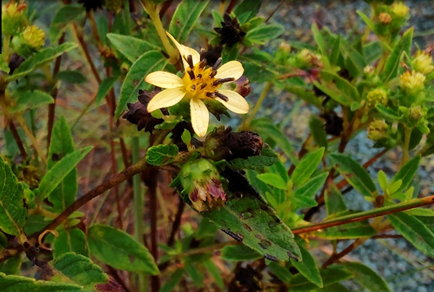
Even though the high plant species richness of Minas Gerais state (Brazil) is widely known, some areas have historically been underrepresented in botanical collections, such as the north and central-west of Minas Gerais. From these two regions, two unexpected records of Wedelia have emerged: a new species and a rediscovery for the state after 70 years. Firstly, the new species is named here W. riopardensis; it resembles W. diffusiflora by elliptic leaf blade (vs. ovate), abaxial surface villose (vs. strigose), involucre 4-seriate (vs. 3-seriate), and disc florets 8.1–9 mm long (vs. ca. 7 mm). Second, since its type collection, about 70 years ago, W. egleri had never been collected again in Minas Gerais; here we present its rediscovery involving a nomenclatural recombination. Morphological descriptions of the two species are provided, with photo plates, mapped geographic distributions, and conservation status discussed. In addition, a map with the updated Global and Brazilian distribution and species richness of Wedelia species is presented and a taxonomic key to the most misidentified Brazilian genera of Asteraceae with Wedelia (Aldama, Calea, and Dimerostemma) is provided to assist with identification of these groups.
References
- Al-Khulaidi, A., Filimban, F., Alfaifi, M. & Al-Namazi, A. (2021) A new record of generic vascular plant for the flora of Saudi Arabia: Aspilia kotschyi (Asteraceae). Saudi Journal of Biological Sciences 28 (3): 1962–1965. https://doi.org/10.1016/j.sjbs.2020.12.048
- Almeida, R., Alves, M., Santana, F. & Roque, N. (2015) New records of thirteen Asteraceae from state of Bahia, Brazil. Check List 11 (1): 1–5. https://doi.org/10.15560/11.1.1524
- Alves, M. & Roque, N. (2016) Flora of Bahia: Asteraceae – Tribe Heliantheae. Sitientibus série Ciências Biológicas 16. https://doi.org/10.13102/scb1127
- Bachman, S., Moat, J., Hill, A., de la Torre, J. & Scott, B. (2011) Supporting Red List threat assessments with GeoCAT: geospatial conservation assessment tool. ZooKeys 150: 117–126. https://doi.org/10.3897/zookeys.150.2109
- Baker, J.G. (1884) Compositae: Helianthoideae. In: Martius, C.F.P. & von Eichler, A.W. (Eds.) Flora brasiliensis, vol. 6. Oldenbourgh, München & Leipzig, pp. 251–258.
- Beentje, H. (2016) The Kew Plant Glossary: an Illustrated Dictionary of Plant Terms. Kew Publishing, Richmond, 184 pp.
- Bringel, J.B.A., Alves, M. & Roque, N. (2024) Taxonomic studies in Wedelia (Asteraceae, Heliantheae) reveal a new species for the Brazilian Cerrado. Phytotaxa 647 (2): 177–188. https://doi.org/10.11646/phytotaxa.647.2.4
- Bueno, V.R. & Heiden, G. (2022) Novelties in Calea sect. Meyeria (Asteraceae, Neurolaeneae) from Brazil. Systematic Botany 47 (2): 575–585. https://doi.org/10.1600/036364422X16512564801632
- Bueno, V.R. & Nakajima, J. (2020) Two new species of Heliantheae (Asteraceae) from Serra do Cabral, Minas Gerais, Brazil. Phytotaxa 472: 41–48. https://doi.org/10.11646/phytotaxa.472.1.5
- Bueno, V.R., Rodrigues, L.S., Sousa, F.D., Souza, I.C., Marzinek, J. & Marques, D. (2024) Wedelia figueiredoana (Asteraceae, Heliantheae), a winged cypselae new species of Wedelia for Brazil. PhytoKeys 249: 37–49. https://doi.org/10.3897/phytokeys.249.135699
- Bueno, V.R., Bentes, M.S., Ramos, R., Zavatin, D.A. & Prata-Silveira, A. (2025a) Three new species of Calea (Asteraceae, Neurolaeneae) from the sky islands of the Espinhaço Range. Phytotaxa 689 (2): 185–203. https://doi.org/10.11646/phytotaxa.689.2.2
- Bueno, V.R., Almeida, M.L.C., Fernandes, M.G.C., Ferreira Jr., C.A., Prata-Silveira, A. & Bentes, M.S. (2025b) Small collections, great findings: three new species and two new state records for Asteraceae from Brazil. Nordic Journal of Botany e04846. https://doi.org/10.1002/njb.04846
- Cassini, H. (1817) Aperçu des genres nouveaux formés par M. Henri Cassini, dans la famille des Synanthérées. Second fascicule. Bulletin des Sciences, par la Société Philomatique de Paris 1817: 10–13.
- Colli‐Silva, M., Vasconcelos, T.N. & Pirani, J.R. (2019) Outstanding plant endemism levels strongly support the recognition of campo rupestre provinces in mountaintops of eastern South America. Journal of Biogeography 46: 1723–1733. https://doi.org/10.1111/jbi.13585
- C.V. Starr Virtual Herbarium (2025) New York Botanical Garden. Available from: http://sweetgum.nybg.org/science/vh/ (accessed 14 September 2025)
- Derby, O.A. (1906) The Serra of Espinhaço, Brazil. Journal of Geology 14: 374–401. https://doi.org/10.1086/621316
- Echternacht, L., Trovó, M., Oliveira, C.T. & Pirani, J.R. (2011) Areas of endemism in the Espinhaço range in Minas Gerais, Brazil. Flora 206 (9): 782–791. https://doi.org/10.1016/j.flora.2011.04.003
- Ellis, B., Daly, D.C., Hickey, L.J., Johnson, K.R., Mitchell, J.D., Wilf, P. & Wing, S.L. (2009) Manual of Leaf Architecture. The New York Botanical Garden Press, New York, 190 pp. https://doi.org/10.1079/9781845935849.0000
- Flora e Funga do Brasil. (2025) Jardim Botânico do Rio de Janeiro. Available from: http://floradobrasil.jbrj.gov.br/ (accessed 27 September 2025)
- Funk, V.A., Susanna, A., Stuessy, T.F. & Robinson, H. (2009) Systematics, evolution and Biogeography of Compositae. International Association for Plant Taxonomy, Vienna, 965 pp.
- Giulietti, A.M., De Menezes, N.L., Pirani, J.R., Meguro, M. & Wanderley, M.D.G.L. (1987) Flora da Serra do Cipó, Minas Gerais: caracterização e lista das espécies. Boletim de Botânica da Universidade de São Paulo 9: 1–151. https://doi.org/10.11606/issn.2316-9052.v9i0p1-151
- Giulietti, A.M., Pirani, J.R. & Harley, R.M. (1997) Espinhaço Range region eastern Brazil. In: Davis, S.D., Heywood, V.H., Herrera-MacBryde, O., Villa-Lobos, J. & Hamilton, A.C. (Eds.) Centres of Plant Diversity: A Guide and Strategy for their Conservation, vol. 3. Information Press, Oxford, UK, pp. 397–404.
- Hickey, L.J. (1973) Classification of the architecture of dicotyledonous leaves. American Journal of Botany 60: 17–33. https://doi.org/10.1002/j.1537-2197.1973.tb10192.x
- IUCN (2024) Guidelines for Using the IUCN Red List Categories and Criteria, version 16. Standards and Petitions Committee. Available from: https://www.iucnredlist.org/documents/RedListGuidelines.pdf (accessed 15 November 2024)
- Jacquin, N.J. (1760) Enumeratio systematica plantarum quas in insulis Caribaeis vicinaque Americes continente detexit novas, aut jam cognitas emendavit. Theodorum Haak, Lugduni Batavorum, 41 pp. https://doi.org/10.5962/bhl.title.737
- Lima, O.N.B., Uhlein, A. & Brito, W. (2007) Estratigrafia do Grupo Bambuí na Serra da Saudade e geologia do depósito fosfático de Cedro do Abaeté, Minas Gerais. Revista Brasileira de Geociências 37 (4): 204–215. https://doi.org/10.25249/0375-7536.200737S4204215
- Linnaeus, C. (1763) Species plantarum, ed. 2, vol. 2. L.Salvius, Stockholm, pp. 785–1684.
- Llave, P. & Lexarza, J.J.M. (1824) Novorum vegetabilium descriptiones, Fasciculus I. Apud Martinum Riveram, Mexico, 32 pp.
- Magri, R., Cabral, A., Prado, J. & Lopes, J. (2024) Two new critically endangered species of Vellozia (Velloziaceae) from the Campos Rupestres of Espinhaço Range, Brazil. Phytotaxa 652 (1): 1–9. https://doi.org/10.11646/phytotaxa.652.1.1
- MapBiomas (2024a) Collection 3 of Annual burned area maps of Brazil (1985–2023), MapBiomas Data, V1. Available from: https://data.mapbiomas.org/dataset.xhtml?persistentId=doi:10.58053/MapBiomas/XUFVIC (accessed 9 September 2024)
- MapBiomas (2024b) Collection 9 of the annual Series of land Use and Coverage Maps of Brazil, MapBiomas Data. Available from: https://code.earthengine.google.com/?accept_repo=users/mapbiomas/user-toolkit (accessed 9 September 2024)
- Minas Gerais, Secretaria da Agricultura, & Serviço de Estatística Geral (1927) Album chorographico municipal do Estado de Minas Geraes. Imprensa Official, Belo Horizonte, 178 maps.
- Miola, D.T.B., Ramos, V.D.V. & Silveira, F.A.O. (2021) A brief history of research in campo rupestre: identifying research priorities and revisiting the geographical distribution of an ancient, widespread Neotropical biome. Biological Journal of the Linnean Society 133: 464–480. https://doi.org/10.1093/biolinnean/blaa175
- Mittermeier, R.A., Turner, W.R., Larsen, F.W., Brooks, T.M. & Gascon, C. (2011) Global biodiversity conservation: the critical role of hotspots. In: Zachos, F. & Habel, J. (Eds.) Biodiversity hotspots: distribution and protection of conservation priority areas. Springer, Berlin & Heidelberg, pp. 3–22. https://doi.org/10.1007/978-3-642-20992-5_1
- Myers, N. (2003) Biodiversity hotspots revisited. BioScience 53 (10): 916–917. https://doi.org/10.1641/0006-3568(2003)053[0916:BHR]2.0.CO;2
- Panero, J.L. (2007) Tribe Heliantheae Cass. In: Kubitzki, K. (Ed.) The Families and Genera of Vascular Plants, vol. 8. Springer, Berlin, pp. 440–477.
- Pirani, J.R. Mello-Silva, R.D. & Giulietti, A.M. (2003) Flora de Grão-Mogol, Minas Gerais, Brasil. Boletim de Botânica da Universidade de São Paulo 21 (1): 1–24. https://doi.org/10.11606/issn.2316-9052.v21i1p1-24
- Pruski, J.F. & Robinson, H.E. (2018) Asteraceae. In: Davidse, G., Sánchez, M.S., Knapp, S. & Cabrera, F.C. (Eds.) Flora Mesoamericana, vol. 5 (2). Missouri Botanical Garden, Saint Louis, pp. 1–608.
- Rapini, A., Mello-Silva, R.D. & Kawasaki, M.L. (2002) Richness and endemism in Asclepiadoideae (Apocynaceae) from the Espinhaço Range of Minas Gerais, Brazil – a conservationist view. Biodiversity and Conservation 11: 1733–1746. https://doi.org/10.1023/A:1020346616185
- Reflora (2025) Reflora—Herbário Virtual. Available from: http://floradobrasil.jbrj.gov.br/reflora/herbarioVirtual/ (accessed 14 September 2025)
- Remor, D. Bringel Jr., J.B.A. & Pastore, J.F.B. (2022) A new combination in Wedelia (Asteraceae-Heliantheae-Ecliptinae) from Brazil. Phytotaxa 545: 103–109. https://doi.org/10.11646/phytotaxa.545.1.9
- Robinson, H. (1981) A revision of the tribal and subtribal limits of the Heliantheae (Asteraceae). Smithsonian Institution Press, City of Washington, 102 pp. https://doi.org/10.5962/bhl.title.131655
- Roque, N., Teles, A.M. & Nakajima, J.N. (Eds.) (2017) A família Asteraceae no Brasil: classificação e diversidade. Edufba, Salvador, 260 pp.
- Santos, F.R. & Hemetrio, N.S. (2025) Serra Da Saudade: história natural e estado de conservação de um desconhecido remanescente do bioma cerrado no oeste de Minas Gerais. SciELO Preprints: 1–36. https://doi.org/10.1590/SciELOPreprints.13039
- Santos, J.U.M.D. (1996) Aspilia Thou. (Asteraceae – Heliantheae). Novas espécies para o estado de Minas Gerais, Brasil. Revista Brasileira de Botânica 19 (1): 87–103.
- Santos, J.U.M.D., Bringel Jr., J.B.A. & Bueno, V.R. (2025) Aspilia in Flora e Funga do Brasil. Jardim Botânico do Rio de Janeiro. Available from: https://floradobrasil.jbrj.gov.br/FB15962 (accessed 14 April 2025)
- Silva, D.N.D., Antonicelli, M.D.C.A. & Guimarães, P.J.F. (2023) Taxonomic Novelties from the Espinhaço Septentrional: Two New Species of Pleroma and the First Records of Melastomataceae from the Morro das Marombas, Minas Gerais, Brazil. Systematic Botany 48 (1): 44–54. https://doi.org/10.1600/036364423X16758873924090
- Smithsonian National Museum of Natural History (2025) Collection NHMN. Available from: https://collections.nmnh.si.edu/search/botany/ (accessed 14 September 2025)
- Specieslink (2025) SpeciesLink network. Available from: https://specieslink.net/search/ (accessed 14 September 2025)
- Strother, J.L. (1991) Taxonomy of Complaya, Elaphandra, Iogeton, Jefea, Wamalchitamia, Wedelia, Zexmenia and Zyzyxia (Compostiae Heliantheae-Ecliptinae). Systematic Botany Monographs 33: 1–111. https://doi.org/10.2307/25027802
- Thiers, B. (2025) [continuously updated] Index Herbariorum: A global directory of public herbaria and associated staff. New York Botanical Garden’s Virtual Herbarium, New York U.S.A. Available from: http://sweetgum.nybg.org/science/ih/ (accessed 14 September 2025)
- Thouars, L.M.A.P. (1806) Genera Nova Madagascariensia, secundum methodum Iussiaenam disposita. Paris, 30 pp. https://doi.org/10.5962/bhl.title.121371
- Tropicos.org (2025) Missouri Botanical Garden. Available from: https://tropicos.org (accessed 14 September 2025).
- Turner, B.L. (1988) New species, names and combinations in Wedelia (Asteraceae-Heliantheae). Phytologia 65: 348–358. https://doi.org/10.5962/bhl.part.13489
- Turner, B.L. (1992) New names and combinations in New World Wedelia (Asteraceae, Heliantheae). Phytologia 72 (5): 389–395. https://doi.org/10.5962/bhl.part.16371
- Turner, B.L. (2004) Two new species of Wedelia (Asteraceae: Heliantheae), with a conspectus of the genus for the Mexico. Phytologia 86: 88–89.
- Zavatin, D.A., Almeida, R.B.P., Ramos, R. & Lombardi, J.A. (2023a) Chionanthus monteazulensis (Oleaceae), a new species from the campo rupestre of Espinhaço Range, Brazil. Phytotaxa 603 (3): 289–296. https://doi.org/10.11646/phytotaxa.603.3.8
- Zavatin, D.A., Ramos, R., Watanabe, M.T.C., Pedrosa, L.G. & de Lírio, E.J. (2023b) A new species of Mollinedia (Monimiaceae, Laurales) from the Quadrilátero Ferrífero, Brazil. PhytoKeys 234: 189–201. https://doi.org/10.3897/phytokeys.234.109804
- Zavatin, D.A., Ramos, R., Salimena, F.R.G. & Cardoso, P.H. (2024) A new species of Lippia (Verbenaceae) from the Espinhaço Range, Minas Gerais, Brazil. Acta Botanica Brasilica 38: e2024. https://doi.org/10.1590/1677-941x-abb-2024-0024
- Zavatin, D.A., Ramos, R., Monge, M. & Harley, R.M. (2025a) A new species of Hypenia (Lamiaceae, Hyptidinae) from the Espinhaço Range, Brazil. Phytotaxa 682 (1): 81–90. https://doi.org/10.11646/phytotaxa.682.1.5
- Zavatin, D.A., Ramos, R., Prado., J., Soares, A.S., Monge., M. & Harley, R.M (2025b) Eriope carpotricha (Lamiaceae, Hyptidinae), a new critically endangered species from the Espinhaço Range of Minas Gerais, Brazil. Nordic Journal of Botany e04959. https://doi.org/10.1002/njb.04959