

Abstract
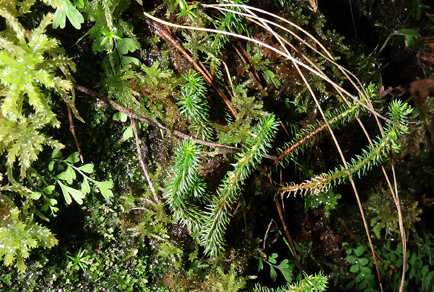
Huperzia wusugongii, a replacement name of H. rubricaulis, was considered as an endemic species known only from a single gathering in northwestern Yunnan. Morphologically similar individuals have been recently found in southwestern Chongqing, southern Sichuan, and southern Yunnan. Molecular-phylogenetic analysis resolved those materials within a group, suggesting that H. wusugongii might have a much broader distribution. However, its taxonomic relationship with the Himalayan species, H. mazumdariana, remains to be tested. Its nomenclatural priority is here discussed under the conspecific hypothesis. Considering its rarity, we studied the associated plants in the Chongqing population and present a detailed list of the accompanying species. Further molecular studies with expanded taxon sampling, including similar species described in Southwest China and neighboring regions, are needed to determine whether these newly documented populations may represent new cryptic endemic species.
References
- Bernhardi, J.J. (1801) Tentamen alterum filices in genera redigendi. Journal für die Botanik 1800 (2): 121–136.
- Burnard, D., Shepherd, L., Peerie, L. & Nunkasci, A. (2016) Phylogenetic relationships of New Zealand Lycopodiaceae. Plant Systematics and Evolution 302: 661–667.
- Chen, D.-K., He, H. & Zhang, L.-B. (2016) Request for a binding decision on whether Huperzia rubricaulis (Alderw.) Holub and H. rubicaulis S.K. Wu & X. Cheng (Lycopodiopsida: Huperziaceae) are sufficiently alike to be confused. Taxon 65: 1184–1185.
- Chen, D.-K., Zhou, X.-M., Rothfels, C.J., Shepherd, L.D., Knapp, R., Zhang, L., Lu, N.T., Fan, X.-P., Wan, X., Gao, X.-F., He, H. & Zhang, L.-B. (2022) A global phylogeny of Lycopodiaceae (Lycopodiales; lycophtes) with the description of a new genus, Brownseya, from Oceania. Taxon 71: 25–51.
- Chen, R.-L., Zhang, F.-Q., Chen, S.-L. & Chi, X.-F. (2023) Checklist of national key protected wild plants on the Qinghai-Tibetan Plateau. Biodiversity Data Journal 11: e103289.
- Cheng, X. (1993) Huperziaceae. In: Wang, W.-T. & Wu, S.-G. (Eds.) Vascular Plants of the Hengduan Mountains, vol. 1. Science Press, Beijing, pp. 1–3.
- Ching, R.-C. (1940) The studies of Chinese ferns XXX. Bulletin of the Fan Memorial Institute of Biology: Botany 10 (1): 1–22.
- Ching, R.-C. (1981) The taxonomy of Chinese Lycopodiaceae (sen. lat.) II. Acta Botanica Yunnanica 3 (3): 291–305.
- Ching, R.-C. (1982) The taxonomy of Chinese Lycopodiaceae (sen. lat.) III. Acta Botanica Yunnanica 4 (2): 119–128.
- Ching, R.-C. & Wu, S.-K. (1983) Pteridophyta. In: Wu, C.-Y. (Ed.) Flora Xizangica, vol. 1. Science Press, Beijing, pp. 1-355.
- Chu, W.-M. (2006) Huperziaceae. In: Wu, Z.-Y. (Ed.) Flora Yunnanica, vol. 20. Science Press, Beijing, pp. 3–35.
- Das, C. & Mazumda, J. (2017) A new name for Huperzia arunachalensis (Lycopodiaceae) from India. International Journal of Advance Research and Innovative Ideas in Education 3 (3): 3112–3113.
- Ebihara, A., Nitta, J.H. & Ito, M. (2010) Molecular species identification with rich floristic sampling: DNA barcoding the pteridophyte flora of Japan. PLoS ONE 5: e15136. https://doi.org/10.1371/journal.pone.0015136
- Field, A.R., Testo, W., Bostock, P.D.B., Holtum, J.A.M. & Waycott, M. (2016) Molecular phylogenetics and the morphology of the Lycopodiaceae subfamily Huperzioideae supports three genera: Huperzia, Phlegmariurus and Phylloglossum. Molecular Phylogenetics and Evolution 94: 635–657.
- Fraser-Jenkins, C.R., Kandel, D.R. & Pariyar, S. (2015) Ferns and Fern-allies of Nepal, vol. 1. National Herbarium and Plant Laboratories, Department of Plant Resources, Ministry of Forests and Soil Conservation, Kathmandu, 508 pp.
- Guindon, S., Dufayard, J.F., Lefort, V., Anisimova, M., Hordijk, W. & Gascuel, O. (2010) New algorithms and methods to estimate Maximum-Likelihood phylogenies: assessing the performance of PhyML 3.0. Systematic Biology 59: 307–321. http://dx.doi.org/10.1093/sysbio/syq010
- Guo, Z.-Y., Liu, H.-M., Wang, K.-K., Fujiwara, T., Liu, Z.-Y., Zhang, X.-C. & Schneider, H. (2024) Huperzia crassifolia (Lycopodiaceae), a new species from China based on morphological characters and molecular evidence. PhytoKeys 246: 27–42.
- Guo, Z.-Y., Zhang, H.-R., Shrestha, N. & Zhang, X.-C. (2016) Complete chloroplast genome of a valuable medicinal plant, Huperzia serrata (Lycopodiaceae), and comparison with its congener. Applications in Plant Sciences 4: 1600071. https://doi.org/10.3732/apps.1600071
- Herter, W. (1909) Beigräge zur Kenntnis der Gattung Lycopodium (Studien über die Untergattung Urostachys). Botanische Jahrbücher für Systematik, Pflanzengeschichte und Pflanzengeographie 43 (heft 1–2, beibl. 98): 1–56, f. 1–4.
- Holub, J. (1964) Lycopodiella, eine neue Gattung der Ordnung Lycopodiales. Preslia 36: 16–22.
- Holub, J. (1985) Transfers of Lycopodium species to Huperzia: with a note on generic classification in Huperziaceae. Folia Geobotanica et Phytotaxonomica 20: 67–80.
- IUCN (2022) Guidelines for Using the IUCN Red List Categories and Criteria, prepared by the Standards and Petitions Committee, version 15. Available from: http://www.iucnredlist.org/documents/RedListGuidelines.pdf (Accessed 7 July 2024)
- Ji, S.-G., Huo, K.-K., Wang, J. & Pan, S.-L. (2008) A molecular phylogenetic study of Huperziaceae based on chloroplast rbcL and psbA-trnH sequences. Journal of Systematics and Evolution 46: 213–219.
- Katoh, K. & Standley, D.M. (2013) MAFFT multiple sequence alignment software version 7: improvements in performance and usability. Molecular Biology and Evolution 30: 772–780. https://doi.org/10.1093/molbev/mst010
- Kung, H.-S. (1980) Materials for the genus Lycopodium L. in Prov. Sichuan, China. Acta Phytotaxonomcia Sinica 18: 234–239.
- Kung, H.-S. (1988) Flora Sichuanica, vol. 6. Sichuan Science & Technology Press, Chengdu, 410 pp.
- Kunze, G. (1843) Phylloglossum genus novum ex ordine novo. Botanische Zeitung (Berlin) 1: 721–723.
- Mazumdar, J. & Mukhopadhyay, R. (2014) Huperzia arunachlensis (Lycopodiaceae) a new lycopod from India. Bionature 34 (2): 33–35.
- Minh, B.Q., Nguyen, M.A.T. & von Haeseler, A. (2013) Ultrafast approximation for phylogenetic bootstrap. Molecular Biology and Evolution 30: 1188–1195. http://dx.doi.org/10.1093/molbev/mst024
- Ministry of Environmental Protection of the People’s Republic of China, Chinese Academy of Sciences (2023) Red list of China’s Biodiversity: Vertebrates 2020, and Higher plants (Decree No. 15, 2023). Available from: https://www.mee.gov.cn/xxgk2018/xxgk/xxgk01/202305/t20230522_1030745.html (accessed: 23 June 2024)
- Nguyen, L.T., Schmidt, H.A., von Haeseler, A. & Minh, B.Q. (2014) IQ-TREE: a fast and effective stochastic algorithm for estimating Maximum-Likelihood phylogenies. Molecular Biology and Evolution 32: 268–274. https://doi.org/10.1093/molbev/msu300
- Pant, D.D. & Pandey, P.S. (1985) The genus Lycopodium L. in India. Phyta Monograph, 3. Society of Indian Plant Taxonomists, Allahabad, pp. 1–136.
- Posada, D. (2008) jModelTest: phylogenetic model averaging. Molecular Biology and Evolution 25: 1253–1256. https://doi.org/10.1093/molbev/msn083
- PPG I (2016) A community-derived classification for extant lycophytes and ferns. Journal of Systematics and Evolution 54: 563–603.
- Ronquist, F. & Huelsenbeck, J.P. (2003) MrBayes 3: Bayesian phylogenetic inference under mixed models. Bioinformatics 19: 1572–4. http://dx.doi.org/10.1093/bioinformatics/btg180
- Shrestha, N. & Zhang, X.C. (2015) Recircumscription of Huperzia serrata complex in China using morphological and climatic data. Journal of Systematics and Evolution 53: 88–103. https://doi.org/10.1111/jse.12120
- State Forestry and Grassland Administration and the Ministry of Agriculture and Rural Affairs, P. R. China (2021) List of wild plants under state protection (Decree No. 15, 2021). Available from: https://www.gov.cn/zhengce/zhengceku/2021-09/09/content_5636409.htm (accessed 23 June 2024)
- Vasconcellos, J.C. & Franco, J.A. (1967) Breves notas sobre Licopodiáceas. Boletim da Sociedade Broteriana, ser 2, 41: 23–25.
- van Alderwerelt van Rosenburgh, C.R.W.K. (1917) New or interesting Malayan ferns 9. Bulletin du Jardin botanique de Buitenzorg, ser. 2, 24: 1–8.
- Wang, P.-S. & Wang, X.-Y. (2001) Pteridophyte flora of Guizhou. Guizhou Science & Technological Publishing House, Guiyang, 727 pp.
- Wikström, N. & Kenrick, P. (1997) Phylogeny of Lycopodiaceae (Lycopsida) and the relationships of Phylloglossum drummondii Kunze based on rbcL sequences. International Journal of Plant Sciences 158: 862–871. https://doi.org/10.1086/297501
- Wikström, N. & Kenrick, P. (2000) Relationships of Lycopodium and Lycopodiella based on combined plastid rbcL gene and trnL intron sequence data. Systematic Botany 25: 495–510. https://doi.org/10.2307/2666692
- Wikström, N., Kenrick, P. & Chase, M.W. (1999) Epiphytism and terrestrialization in tropical Huperzia (Lycopodiaceae). Plant Systematics and Evolution 218: 221–243. https://doi.org/10.1007/BF01089229
- Wirta, H., Várkonyi, G., Rasmussen, C., Kaartinen, R., Schmidt, N.M., Hebert, P.D.N., Barták, M., Blagoev, G., Disney, H., Ertl, S., Gjelstrup, P., Gwiazdowicz, D.J., Huldén, L., Ilmonen, J., Jakovlev, J., Jaschhof, M., Kahanpää, J., Kankaanpää, T., Krogh, P.H., Labbee, R., Lettner, C., Michelsen, V., Nielsen, S.A., Nielsen, T.R., Paasivirta, L., Pedersen, S., Pohjoismäki, J., Salmela, J., Vilkamaa, P., Väre, H., von Tschirnhaus, M. & Roslin, T. (2016) Establishing a community-wide DNA barcode library as a new tool for arctic research. Molecular Ecology Resources 16: 809–822. https://doi.org/10.1111/1755-0998.12489
- Wu, S.-K. & Cheng, X. (1985) Contributions to pteridophyta of the Hengduan Moutains (1). Acta Phytotaxonomica Sinica 23: 400–403.
- Xu, X.-G, Zhou, X.-M. & Zhang, L.-B. (2017) Huperzia wusugongii nom. nov. (Lycopodiopsida: Huperziaceae) from West China. Phytotaxa 296: 98–99. https://doi.org/10.11646/phytotaxa.296.1.9
- Yang, C.-X., Xiong, J.-H., Zhong, S.-L., Wang, H.-Y. & Li, X.-Y. (2009) Keys to the Wascular Plants of Chongqing. Sichuan Science & Technology Press, Chengdu, 1026 pp.
- Zhang, L.-B. (2004) Huperziaceae. In: Wu, Z.-Y. (Ed.) Flora Reipublicae Popularis Sinicae, vol. 6 (3) (volume edited by Zhang, X.-C.). Science Press, Beijing, pp. 1–54.
- Zhang, L.-B. & Kung, H.-S. (1998) A taxonomic study of Huperzia Bernh. (s. s.) sect. Huperzia in China. Acta Phytotaxonomica Sinica 36: 521–529.
- Zhang, L.-B. & Kung, H.-S. (1999) On the taxonomy of Phlegmariurus (Herter) Holub sect. Huperzioides H.S.Kung et L. B. Zhang (sect. nov.) with notes on the infrageneric classification of the genus Phlegmariurus in China. Acta Phytotaxonomica Sinica 37: 40–53.
- Zhang, L.-B. & Iwatsuki, K. (2013) Lycopodiaceae. In: Wu, Z.-Y., Raven, P.H. & Hong, D.-Y. (Eds.) Flora of China, vols 2–3. Science Press, Beijing & Missouri Botanical Presss, St. Louis, pp. 13–34.