

Abstract
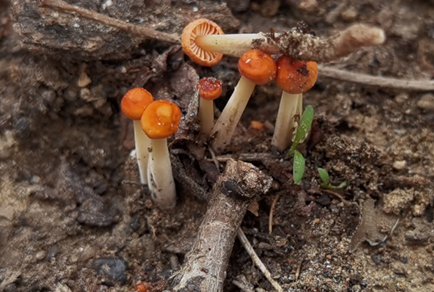
An interesting taxon of genus Marasmius was collected several times from Beijing, China. It is characterized by its small basidiomata, orange convex pileus, long and radicant stipe, hymeniform pilepellis of Globulares-type smooth cells , small cheilocystidia, and ellipsoid basidiospores measuring about 8.4 × 5.3 μm. Morphological and molecular analyses confirmed it as a new species. It is therefore introduced as M. beijingensis sp. nov. Comprehensive descriptions, illustrations, phylogenetic analysis results and comparison with similar taxa are provided.
References
- Aime, N.C., Phillips-Mora, W. (2005) The causal agents of witches’ broom and frosty pod rot of cacao (chocolate, Theobroma cacao) form a new lineage of Marasmiaceae. Mycologia 97 (5): 1012–1022. https://doi.org/10.3852/mycologia.97.5.1012
- Antonín, V. (1987) Setulipes, a new genus of marasmioid fungi (Tricholomatales). Czech Mycology 41: 85–87. https://doi.org/10.33585/cmy.41203
- Antonín, V. (2007) Monograph of Marasmius, Gloiocephala, Palaeocephala and Setulipes in tropical Africa. Fungus Flora of Tropical Africa, National Botanic Garden of Belgium 1: 1–164.
- Antonín, V., Ryoo, R., Shin, H.D. (2010a) Marasmioid and gymnopoid fungi of the Republic of Korea. 2. Marasmius sect. Globulares. Persoonia 24: 49–59. https://doi.org/10.3767/003158510X496107
- Antonín, V., Noordeloos, M.E. (2010b) A monograph of marasmioid and collybioid fungi in Europe. IHW Verlag.
- Antonín, V., Ryoo, R., Shin, H.D. (2012) Marasmioid and gymnopoid fungi of the Republic of Korea. 4. Marasmius sect Siccus. Mycological Progress 11: 615–638. https://doi.org/10.1007/s11557-011-0773-y
- Antonín, V., Ryoo, R., Ka, K.H., Shin, H.D. (2014) Marasmioid and gymnopoid fungi of the Republic of Korea. 6. Marasmius sect Marasmius. Mycoscience 55: 149–157. https://doi.org/10.1016/j.myc.2013.07.003
- Asif, M., Maula, F., Saba, M., Akram, W. & Raza, M. (2024) Taxonomic and phylogenetic evidence reveal a new species and a new record of the genus Marasmius (Marasmiaceae) from Pakistan. Phytotaxa 646 (1): 32–46. https://doi.org/10.11646/phytotaxa.646.1.2
- Boonmee, S., Wanasinghe, D.N., Calabon, M.S., Huanraluek, N., Chandrasiri, S.K.U., Jones, G.E.B., Rossi, W., Leonardi, M., Singh, S.K., Rana, S., Singh, P.N., Maurya, D.K., Lagashetti, A.C., Choudhary, D., Dai, Y.C., Zhao, C.L., Mu, Y.H., Yuan, H.S., He, S.H., Phookamsak, R., Jiang, H.B., Martín, M.P., Dueñas, M., Telleria, M.T., Kałucka, I.L., Jagodziński, A.M., Liimatainen, K., Pereira, D.S., Phillips, A.J.L., Suwannarach, N., Kumla, J., Khuna, S., Lumyong, S., Potter, T.B., Shivas, R.G., Sparks, A.H., Vaghefi, N., Abdel-Wahab, M.A., Abdel-Aziz, F.A., Li, G.J., Lin, W.F., Singh, U., Bhatt, R.P., Lee, H.B., Nguyen, T.T.T., Kirk, P.M., Dutta, A.K., Acharya, K., Sarma, V.V., Niranjan, M., Rajeshkumar, K.C., Ashtekar, N., Lad, S., Wijayawardene, N.N., Bhat, D.J., Xu, R.J., Wijesinghe, S.N., Shen, H.W., Luo, Z.L., Zhang, J.Y., Sysouphanthong, P., Thongklang, N., Bao, D.F., Aluthmuhandiram, J.V.S., Abdollahzadeh, J., Javadi, A., Dovana, F., Usman, M., Khalid, A.N., Dissanayake, A.J., Telagathoti, A., Probst, M., Peintner, U., Garrido-Benavent, I., Bóna, L., Merényi, Z., Boros, L., Zoltán, B., Stielow, J.B., Jiang, N., Tian, C.M., Shams, E., Dehghanizadeh, F., Pordel, A., Javan-Nikkhah, M., Denchev, T.T., Denchev, C.M., Kemler, M., Begerow, D., Deng, C.Y., Harrower, E., Bozorov, T., Kholmuradova, T., Gafforov, Y., Abdurazakov, A., Xu, J.C., Mortimer, P.E., Ren, G.C., Jeewon, R., Maharachchikumbura, S.S.N., Phukhamsakda, C., Mapook, A. & Hyde, K.D. (2021) Fungal diversity notes 1387–1511: taxonomic and phylogenetic contributions on genera and species of fungal taxa. Fungal Diversity 111: 1–335. https://doi.org/10.1007/s13225-021-00489-3
- Bhunjun, C.S., Niskanen, T., Suwannarach, N., Wannathes, N., Chen, Y.J., McKenzie, E.H.C., Maharachchikumbura, S.S.N., Buyck, B., Zhao, C.L., Fan, Y.G., Zhang, J.Y., Dissanayake, A.J., Marasinghe, D.S., Jayawardena, R.S., Kumla, J., Padamsee, M., Chen, Y.Y., Liimatainen, K., Ammirati, J.F., Phukhamsakda, C., Liu, J.K., Phonrob, W., Randrianjohany, É., Hongsanan, S., Cheewangkoon, R., Bundhun, D., Khuna, S., Yu, W.J., Deng, L.S., Lu, Y.Z., Hyde, K.D. & Lumyong, S. (2022) The numbers of fungi: Are the most species genera truly diverse? Fungal Diversity 114: 387–462. https://doi.org/10.1007/s13225-022-00501-4
- Chattopadhyay, P., Biswas, S., Chandra, S., Dutta, A.K. (2025) Marasmius pseudojasminodorus (Marasmiaceae, Agaricales), a new jasmine-scented species from the lateritic region of West Bengal, India. Brittonia. https://doi.org/10.1007/s12228-025-09836-z
- Chernomor, O., von Haeseler, A., Minh, B.Q. (2016) Terrace Aware Data Structure for Phylogenomic Inference from Supermatrices. Systematic Biology 65 (6): 997–1008. https://doi.org/10.1093/sysbio/syw037
- Choudhary, S., Sharma, Y.P., Uniyal, P. (2025) New taxonomic insights: morphological and phylogenetic analysis of a novel Marasmius species in section Globulares from Indian Himalaya. Nordic Journal of Botany e04851. https://doi.org/10.1002/njb.04851
- Desjardin, D. (1989) The genus Marasmius from the Southern Appalachian Mountains. PhD Thesis, University of Tennessee, United States.
- Desjardin, D.E., Perry, B.A., Shay, J.E., Newman, D.S., Randrianjohany, E. (2017) The type species of Tetrapyrgos and Campanella (Basidiomycota, Agaricales) are redescribed and epi-typified. Mycosphere 8 (8): 977–985. https://doi.org/10.5943/mycosphere/8/8/1
- Deng, C.Y., Li, T.H. (2011) Marasmius galbinus, a new species from China. Mycotaxon 115: 495–500. https://doi.org/10.5248/115.495
- Fries, E.M. (1835) Corpus Forarum Provincialium Sueciae. Floram Scanicam. https://doi.org/10.5962/bhl.title.47083
- Fries, E.M. (1838) Epicrisis Systematis Mycologici. Upsaliae
- Gilliam, M.S. (1976) The genus Marasmius in the Northeastern United States and adjacent Canada. Mycotaxon 4: 1–144. https://doi.org/10.5962/p.417747
- Guard, F.E., Dearnaley, J.D., Lebel, T., Barrett, M.D., Bougher, N.L. (2023) Marasmius australotrichotus (Marasmiaceae), a new setose species from Australia, and an intriguing range extension for M. paratrichotus. Nuytsia 34: 203–219. https://doi.org/10.58828/nuy01059
- Guard, F.E., Dearnaley, J., May, T.W., Lebel, T. (2024) Untangling horsehair fungi in Australia: Marasmius crinis‑equi (Marasmiaceae) and related taxa. Mycological Progress 23 (1). https://doi.org/10.1007/s11557-024-01995-9
- He, M.Q., Zhao, R.L., Hyde, K.D., Begerow, D., Kemler, M., Yurkov, A., McKenzie, E.H.C., Raspé, O., Kakishima, M., Sánchez-Ramírez, S., Vellinga, E.C., Halling, R., Papp, V., Zmitrovich, I.V., Buyck, B., Ertz, D., Wijayawardene, N.N., Cui, B.K., Schoutteten, N., Liu, X.Z., Li, T.H., Yao, Y.J., Zhu, X.Y., Liu, A.Q., Li, G.J., Zhang, M.Z., Ling, Z.L., Cao, B., Antonín, V., Boekhout, T., da Silva, B.D.B., De Crop, E., Decock, C., Dima, B., Dutta, A.K., Fell, J.W., Geml, J., Ghobad-Nejhad, M., Giachini, A.J., Gibertoni, T.B., Gorjón, S.P., Haelewaters, D., He, S.H., Hodkinson, B.P., Horak, E., Hoshino, T., Justo, A., Lim, Y.W., Menolli Jr., N., Mešić, A., Moncalvo, J.M., Mueller, G.M., Nagy, L.G., Nilsson, R.H., Noordeloos, M., Nuytinck, J., Orihara, T., Ratchadawan, C., Rajchenberg, M., Silva-Filho, A.G.S., Sulzbacher, M.A., Tkalčec, Z., Valenzuela, R., Verbeken, A., Vizzini, A., Wartchow, F., Wei, T.Z., Weiß, M., Zhao, C.L. & Kirk, P.M. (2019) Notes, outline and divergence times of Basidiomycota. Fungal Diversity 99: 105–367. https://doi.org/10.1007/s13225-019-00435-4
- Hongo, T. (1965) Memoirs of the Faculty of Liberal Arts and Education, Shiga University, Natural Science 15: 74.
- Jenkinson, T.S., Perry, B.A., Schaefer, R.E., Desjardin, D.E. (2014) Cryptomarasmius gen. nov. established in the Physalacriaceae to accommodate members of Marasmius sect. Hygrometrici. Mycologia 106: 86–94. https://doi.org/10.3852/11-309
- Kerekes, J.F., Desjardin, D.E. (2008) Crinipellis brunneipurpurea, a new species from Hawaii. Fungal Diversity 31: 57–64.
- Kirk, P.M., Cannon, P.F., David, J.C., Minter, D.W. & Stalpers, J.A. (2008) Ainsworth and Bisby’s Dictionary of the Fungi (10th ed.). CAB International Press: Wallingford, UK, 783 pp. https://doi.org/10.1079/9780851998268.0000
- Kiyashko, A.A., Malysheva, E.F., Antonín, V., Svetasheva, T.Y., Bulakh, E.M. (2014) Fungi of the Russian Far East 2. New species and new records of Marasmius and Cryptomarasmius (Basidiomycota). Phytotaxa 186 (1): 14–16. https://doi.org/10.11646/phytotaxa.186.1.1
- Koch, R.A., Lodge, D.J., Sourell, S., Nakasone, K., McCoy, A.G., Aime, M.C. (2018) Tying up loose threads: revised taxonomy and phylogeny of an avian-dispersed Neotropical rhizomorph-forming fungus. Mycological Progress 17: 989–998. https://doi.org/10.1007/s11557-018-1411-8
- Koch, R.A., Liu, J., Brann, M., Jumbam, B., Siegel, N., Aime, M.C. (2020) Marasmioid rhizomorphs in bird nests: Species diversity, functional specificity, and new species from the tropics. Mycologia 112 (6): 1086–1103. https://doi.org/10.1080/00275514.2020.1788892
- Kornerup, A. & Wanscher, J.H. (1978) Methuen handbook of colour. Eyre, Methuen: London.
- Kotowski, M.A., Pietras, M. & Łuczaj, Ł. (2019) Extreme levels of mycophilia documented in Mazovia, a region of Poland. Journal Ethnobiology Ethnomedicine 15: 12. https://doi.org/10.1186/s13002-019-0291-6
- Kühner, R. (1933) Études sur le genre Marasmius. Le Botaniste 25: 1‒832.
- Maizatul, M., Suhanah, J., Madihah, A.Z., Idris, A.S., Mohidin, H. (2021) Phylogenetic and pathogenicity evaluation of the marasmioid fungus Marasmius palmivorus causing fruit bunch rot disease of oil palm. Forest Pathology 51 (1): e12660. https://doi.org/10.1111/efp.12660
- Mata, J.L., Hughes, K.W., Petersen, R.H. (2004) Phylogenetic placement of Marasmiellus juniperinus. Mycoscience 45 (4): 214–221. https://doi.org/10.1007/S10267-004-0170-3
- Matheny, P.B., Curtis, J.M., Hofstetter, V., Aime, M.C., Moncalvo, J.M., Ge, Z.W., Yang, Z.L., Slot, J.C., Ammirati, J.F., Baroni, T.J., Bougher, N.L., Hughes, K.W., Lodge, D.J., Kerrigan, R.W., Seidl, M.T., Aanen, D.K., DeNitis, M., Daniele, G.M., Desjardin, D.E., Kropp, B.R., Norvell, L.L., Parker, A., Vellinga, E.C., Vilgalys, R. & Hibbett, D.S. (2006) Major clades of Agaricales: A multilocus phylogenetic overview. Mycologia 98 (6): 984–997. https://doi.org/10.1080/15572536.2006.11832627
- Minh, B.Q., Schmidt, H.A., Chernomor, O., Schrempf, D., Woodhams, M.D., von Haeseler, A. & Lanfear, R. (2020) IQ-TREE 2: New Models and Efficient Methods for Phylogenetic Inference in the Genomic Era. Molecular Biology 37 (5): 1530–1534. https://doi.org/10.1093/molbev/msaa015
- Niveiro, N., RamNrez, N.A., Michlig, A., Lodge, D.J., Aime, M.C. (2020) Studies of Neotropical tree pathogens in Moniliophthora: a new species, M. mayarum, and new combinations for Crinipellis ticoi and C. brasiliensis. MycoKeys 66: 39–54. https://doi.org/10.3897/mycokeys.66.48711
- Oliveira, J.J.S. & Capelari, M. (2012) Two new speciesof Marasmius section Neosessiles (Marasmiaceae) from anAtlantic rain forest area of São Paulo State, Brazil. Nova Hedwigia 95 (1–2): 203–210. https://doi.org/10.1127/0029-5035/2012/0041
- Oliveira, J.J.S., Wartchow, F. & Maia, L.C. (2013) Marasmius (Marasmiaceae, Basidiomycota) from the Brazilian Atlantic Rainforest: new species and new records. Phytotaxa 104 (1): 1–24. https://doi.org/10.11646/phytotaxa.104.1.1
- Oliveira, J.J.S., Wartchow, F. & Maia, L.C. (2014) Marasmius (Marasmiaceae, Basidiomycota) from the Brazilian Pantanal: new species and new records. Phytotaxa 177 (3): 201–218. https://doi.org/10.11646/phytotaxa.177.3.1
- Oliveira, J.J.S., Moncalvo, J.M., Margaritescu, S. & Capelari, M. (2020) A morphological and phylogenetic evaluation of Marasmius sect. Globulares (Globulares-Sicci complex) with nine new taxa from the Neotropical Atlantic Forest. Persoonia 44: 240–277. https://doi.org/10.3767/persoonia.2020.44.09
- Oliveira, J.J.S., Vargas-Isla, R., Cabral, T.S., Rodrigues, D.P. & Ishikawa, N.K. (2024a) Spider Fungi: New species of Marasmius and Pusillomyces in the aerial rhizomorph web-maker guild in Amazonia. Fungal Systematics and Evolution 14: 35–55. https://doi.org/10.3114/fuse.2024.14.03
- Oliveira, J.J.S., Desjardin, D.E., Jenkinson, T.S., Margaritescu, S., Capelari, M. & Moncalvo, J.M. (2024b) Taxonomic revision of Marasmius Fr. and Marasmiaceae Roze ex Kühner based on multigene phylogenetics and morphological evidence. Fungal Diversity 127: 1–54. https://doi.org/10.1007/s13225-024-00534-x
- Phillips, M.W., Cawish, J., Garnett, W. & Aime, M.C. (2006) First report of frosty pod rot (moniliasis disease) caused by Moniliophthora roreri on cacao in Bellize. Plant pathology 55: 584. https://doi.org/10.1111/j.1365-3059.2006.01378.x
- Schoch, C.L., Seifert, K.A., Huhndorf, S., Robert, V., Spouge, J.L., Levesque, C.A. & Chen, W. (2012) Nuclear ribosomal internal transcribed spacer (ITS) region as a universal DNA barcode marker for Fungi. The Proceedings of the National Academy of Sciences 109 (16): 6241–6246. https://doi.org/10.1073/pnas.1117018109
- Shay, J.E., Desjardin, D.E., Perry, B.A., Grace, C.L. & Newman, D.S. (2017) Biodiversity and phylogeny of Marasmius (Agaricales, Basidiomycota) from Madagascar. Phytotaxa 292 (2): 101–149. https://doi.org/10.11646/phytotaxa.292.2.1
- Singer, R. (1959 [1958]) Studies towards a monograph of the South American species of Marasmius. Sydowia 12: 54–145.
- Singer, R. (1965) Monographic studies of South American Basidiomycetes, especially those of east slope of Andes and Brazil. 2. The genus Marasmius in South America. Sydowia 18: 106–358.
- Singer, R. (1976) Marasmieae (Basidiomycetes—Tricholomataceae). Flora Neotropica Monograph 17: 1–347.
- Singer, R. (1986) The Agaricales in Modern Taxonomy (4th ed.). Koeltz Scientific Books, Koenigstein. https://doi.org/10.1007/BF00989420
- Tan, Y.S., Desjardin, D.E., Perry, B.A., Vikineswary, S. & Noorlidah, A. (2009) Marasmius sensu stricto in Peninsular Malaysia. Fungal Diversity 37: 9–100.
- Vilgalys, R. & Hester, M. (1990) Rapid genetic identification and mapping of enzymatically amplified ribosomal DNA from several Cryptococcus species. Journal of Bacteriology 172 (8): 4238–4246. https://doi.org/10.1128/jb.172.8.4238-4246.1990
- Vu, D., Groenewald, M., Vries, M.T., Gehrmann, B., Stielow, U., Eberhardt, A., Al-Hatmi, J.Z., Groenewald, G., Cardinali, J., Houbraken, T., Boekhout, P.W., Crous, V., Robert, G.J.M. & Verkley (2019) Large-scale generation and analysis of filamentous fungal DNA barcodes boosts coverage for kingdom fungi and reveals thresholds for fungal species and higher taxon delimitation. Studies in Mycology 92: 1355nM. https://doi.org/10.1016/j.simyco.2018.05.001
- Wannathes, N., Desjardin, D.E., Hyde, K.D., Perry, B.A. & Lumyong, S. (2009) A monograph of Marasmius (Basidiomycota) from Northern Thailand based on morphological and molecular (ITS sequences) data. Fungal Diversity 37: 209–306. https://doi.org/10.1002/yea.1678
- Wannathes, N., Suwannarach, N., Kumla, J. & Lumyong, S. (2019) Two novel species of Marasmius (Marasmiaceae, Agaricales) from lower northern Thailand. Phytotaxa 403: 111–121. https://doi.org/10.11646/phytotaxa.403.2.4
- White, T.J., Bruns, T., Lee, S. & Taylor, J. (1990) Amplification and direct sequencing of fungal ribosomal RNA genes for phylogenetics. In: PCR Protocols: A Guide to Methods and Applications. Academic Press. https://doi.org/10.1016/B978-0-12-372180-8.50042-1
- Wilson, A.W., Desjardin, D.E. (2005) Phylogenetic relationships in the gymnopoid and marasmioid fungi (Basidiomycetes, euagaric clade). Mycologia 97: 667–679. https://doi.org/10.1080/15572536.2006.11832797
- Zhang, P., Chen, Z.H. (2019) Atlas of Macrofungi in Hunan. Hunan Science & Technology Press, Changshai, 425 pp.
- Zhang, Q.Y., Si, J. & Li, H.J. (2023) A new Marasmius species (Agaricales, Marasmiaceae) with sessile basidiomata growing on wood, from Yunnan, China. Phytotaxa 578: 169–179. https://doi.org/10.11646/phytotaxa.578.2.3
- Zhao, R.L., Li, G.J., Sánchez-Ramírez, S., Stata, M., Yang, Z.L., Wu, G., Dai, Y.C., He, S.H., Cui, B.K., Zhou, J.L., Wu, F., He, M.Q. & Hyde, K.D. (2017) A six-gene phylogenetic overview of Basidiomycota and allied phyla with estimated divergence times of higher taxa and a phyloproteomics perspective. Fungal Diversity 84: 43–74. https://doi.org/10.1007/s13225-017-0381-5