
Abstract
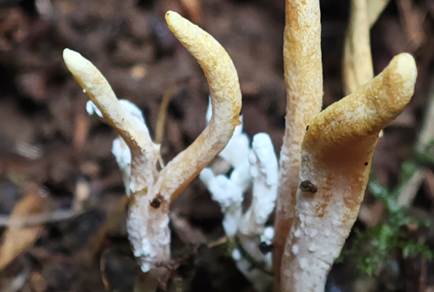
Cordyceps species are an important edible medicinal bioresource, playing pivotal roles in healthcare and biological control, regulating pest populations and enhancing the exploitation of chemical medicine agents. This study describes a novel entomopathogenic Cordyceps collected from Dashahe Nature Reserve in Zunyi City, Guizhou Province, China. Cordyceps mopanshiensis parasitizes lepidopteran pupae and is characterized by its ability to simultaneously produce both stromata and synnemata. It typically develops 2–10 pale yellow to yellowish stromata with semi-immersed perithecia. Compared with related species, the new species exhibits smaller phialides and shorter asci. Multi-gene phylogeny based on combined sequence data of 5-loci genes (ITS, nrLSU, nrSSU, tef1-α, and rpb2) confirmed that it is a new species in Cordyceps. This study enriches the species diversity of Cordyceps, and deepens our understanding of the distribution of Cordyceps species in karst ecosystems.
References
- Bischoff, J.F., Rehner, S.A. & Humber, R.A. (2006) Metarhizium frigidum sp. nov.: a cryptic species of M. anisopliae and a member of the M. flavoviride complex. Mycologia 98 (5): 737–745. https://doi.org/10.3852/mycologia.98.5.737
- Chen, W.H., Liu, C., Han, Y.F., Liang, J.D., Tian, W.Y. & Liang, Z.Q. (2020) Two new recorded species in Cordyceps sensu lato. Microbiology China 47 (3): 710–717. [in Chinese] https://doi.org/10.13344/j.microbiol.china.190449
- Chen, W.H., Liang, J.D., Ren, X.X., Zhao, J.H., Han, Y.F. & Liang, Z.Q. (2022) Species diversity of Cordyceps-like fungi in the Tiankeng karst region of China. Microbiology Spectrum 10 (5): e0197522. https://doi.org/10.1128/spectrum.01975-22
- Deng, L.P., Yu, Q., Yang, X., Chang, C.X., Liang, J.D. & Dai, Y.D. (2024) Cordycipitoid fungal diversity revealed by field investigation and suitable area prediction in the Chishui Danxia landform of Guizhou Province, southwest China. Mycosystema 43 (11): 62–76. [in Chinese] https://doi.org/10.13346/j.mycosystema.240143
- Dong, Q.Y., Wang, Y., Wang, Z.Q., Tang, D.X., Zhao, Z.Y., Wu, H.J. & Yu, H. (2022) Morphology and phylogeny reveal five novel species in the genus Cordyceps (Cordycipitaceae, Hypocreales) from Yunnan, China. Frontiers in Microbiology 13: 846909. https://doi.org/10.3389/fmicb.2022.846909
- Fries, E.M. (1818) Observationes mycologicae praecipue ad illustrandam floram suecicam. pars secunda (Cancellans issue). G. Bonnieri, Copenhagen.
- Guindon, S., Dufayard, J.F., Lefort, V., Anisimova, M., Hordijk, W. & Gascuel, O. (2010) New algorithms and methods to estimate maximum-likelihood phylogenies: assessing the performance of PhyML 3.0. Systematic Biology 59 (3): 307–321. https://doi.org/10.1093/sysbio/syq010
- Kalyaanamoorthy, S., Minh, B.Q., Wong, T.K.F., von Haeseler, A. & Jermiin, L.S. (2017) ModelFinder: fast model selection for accurate phylogenetic estimates. Nature Methods 14 (6): 587–589. https://doi.org/10.1038/nmeth.4285
- Kepler, R.M., Luangsa-ard, J.J., Hywel-Jones, N.L., Quandt, C.A., Sung, G.H., Rehner, S.A., Aime, M.C., Henkel, T.W., Sanjuan, T., Zare, R., Chen, M., Li, Z., Rossman, A.Y., Spatafora, J.W. & Shrestha, B. (2017) A phylogenetically-based nomenclature for Cordycipitaceae (Hypocreales). IMA Fungus 8 (2): 335–353. https://doi.org/10.5598/imafungus.2017.08.02.08
- Kobayasi, Y. (1941) The genus Cordyceps and its allies. Science Reports of the Tokyo Bunrika Daigaku 5: 53–260.
- Kobayasi, Y. (1982) Key to the taxa of the genera Cordyceps and Torrubiella. Transactions of the Mycological Society of Japan 23: 329–364.
- Li, Y.P., Chen, W.H., Han, Y.F., Liang, J.D. & Liang, Z.Q. (2020) Cordyceps yinjiangensis, a new ant-pathogenic fungus. Phytotaxa 453 (3): 284–292. https://doi.org/10.11646/phytotaxa.453.3.10
- Li, Z.Z., Luan, F.G., Hywel-Jones, N.L., Zhang, S.L., Chen, M.J., Huang, B., Sun, C.S., Chen, Z.A., Li, C.R., Tan, Y.J. & Dong, J.F. (2021) Biodiversity of cordycipitoid fungi associated with Isaria cicadae Miquel II: teleomorph discovery and nomenclature of chanhua, an important medicinal fungus in China. Mycosystema 40 (1): 95–107. [in Chinese] https://doi.org/10.13346/j.mycosystema.200119
- Li, D., Chen, W.H., Shu, H.L., Tian, X.L., Liang, J.D. & Han, Y.F. (2024) Cordyceps duyunensis, a new species from Doupeng Mount, Guizhou, China. Phytotaxa 677 (2): 144–154. https://doi.org/10.11646/phytotaxa.677.2.3
- Liang, Z.Q. (1981) Two new species of Paecilomyces from insects. Acta Microbiologica Sinica 21 (1): 31–34+132. [in Chinese]
- Liang, Z.Q., Liu, A.Y., Huang, J.Z. & Jiao, Y.C. (1996) The genus Cordyceps from Kuankuoshui preserve in Guizhou I. Mycosystema 15 (4): 264. [in Chinese] https://doi.org/10.13346/j.mycosystema.1996.04.006
- Liang, Z.Q., Liu, A.Y., Huang, J.Z. & Jiao, Y.C. (1997) The genus Cordyceps and its allies from Kuankuoshui preserve in Guizhou II. Mycosystema 16 (1): 61. [in Chinese] https://doi.org/10.13346/j.mycosystema.1997.01.013
- Liang, Z.Q., Liu, A.Y., Huang, J.Z. & Jiao, Y.C. (2002) Some Cordyceps species and their allies from Suoluo nature preserve in Guizhou. Mycosystema (1): 9–14. [in Chinese]
- Liang, Z.Q., Liu, A.Y., Liu, M.H. & Kang, J. (2003) The genus Cordyceps and its allies from the Kuankuoshui Reserve in Guizhou III. Fungal Diversity 14: 95–101.
- Liang, Z.Q., Liu, A.Y. & Liu, Z.Y. (2007) Cordyceps. In: Flora Fungorum Sinicorum. [in Chinese]
- Link, J.H. (1833) Handbuch zur erkennung der nutzbarsten und am häufigsten vorkommenden gewächse. Haude und Spener, Berlin.
- Lou, H., Lin, J., Guo, L., Wang, X., Tian, S., Liu, C., Zhao, Y. & Zhao, R. (2019) Advances in research on Cordyceps militaris degeneration. Applied Microbiology and Biotechnology 103 (19): 7835–7841. https://doi.org/10.1007/s00253-019-10074-z
- Nguyen, L.T., Schmidt, H.A., von Haeseler, A. & Minh, B.Q. (2015) IQ-TREE: a fast and effective stochastic algorithm for estimating maximum-likelihood phylogenies. Molecular Biology and Evolution 32 (1): 268–274. https://doi.org/10.1093/molbev/msu300
- Peng, X.C., Xiao, Y.P., Zhang, Y., Chomnunti, P., Tangtrakulwanich, K. & Wen, T.C. (2023) Cordyceps poluscapitis sp. nov., an ant-pathogenic fungus from Guizhou, China. Phytotaxa 599 (4): 239–251. https://doi.org/10.11646/phytotaxa.599.4.3
- Ronquist, F., Teslenko, M., van der Mark, P., Ayres, D.L., Darling, A., Höhna, S., Larget, B., Liu, L., Suchard, M.A. & Huelsenbeck, J.P. (2012) MrBayes 3.2: efficient Bayesian phylogenetic inference and model choice across a large model space. Systematic Biology 61 (3): 539. https://doi.org/10.1093/sysbio/sys029
- Rossman, A.Y., Samuels, G.J., Rogerson, C.T. & Lowen, R. (1999) Genera of Bionectriaceae, Hypocreaceae and Nectriaceae (Hypocreales, Ascomycetes). Studies in Mycology 42: 1–248.
- Samson, R.A. (1974) Paecilomyces and some allied hyphomycetes. Studies In Mycology 6: 1–119.
- Shrestha, B., Tanaka, E., Han, J.G., Oh, J., Han, S.K., Lee, K.H. & Sung, G.H. (2014) A brief chronicle of the genus Cordyceps Fr., the oldest valid genus in Cordycipitaceae (Hypocreales, Ascomycota). Mycobiology 42 (2): 93–99. https://doi.org/10.5941/MYCO.2014.42.2.93
- Shrestha, B., Tanaka, E., Hyun, M.W., Han, J.G., Kim, C.S., Jo, J.W., Han, S.K., Oh, J. & Sung, G.H. (2016) Coleopteran and Lepidopteran hosts of the entomopathogenic genus Cordyceps sensu lato. Journal of Mycology 2016 (1): 7648219. https://doi.org/10.1155/2016/7648219
- Sung, G.H., Hywel-Jones, N.L., Sung, J.M., Luangsa-ard, J.J., Shrestha, B. & Spatafora, J.W. (2007) Phylogenetic classification of Cordyceps and the clavicipitaceous fungi. Studies in Mycology 57: 5–59. https://doi.org/10.3114/sim.2007.57.01
- Tamura, K., Stecher, G., Peterson, D., Filipski, A. & Kumar, S. (2013) MEGA6: molecular evolutionary genetics analysis version 6.0. Molecular Biology and Evolution 30 (12): 2725–2729. https://doi.org/10.1093/molbev/mst197
- Vilgalys, R. & Sun, B.L. (1994) Ancient and recent patterns of geographic speciation in the oyster mushroom Pleurotus revealed by phylogenetic analysis of ribosomal DNA sequences. Proceedings of the National Academy of Sciences of the United States of America 91 (10): 4599–4603. https://doi.org/10.1073/pnas.91.10.4599
- Wang, S.B., Huang, Y.P., Fan, M.Z. & Li, Z.Z. (2004) Species diversity of entomogenous fungal flora of Mountains Dabie, Anhui. Biodiversity Science 11 (6): 475–479. [in Chinese] https://doi.org/10.3321/j.issn:1005-0094.2003.06.006
- Wang, Y.B., Yu, H., Dai, Y.D., Wu, C.K., Zeng, W.B., Yuan, F. & Liang, Z.Q. (2015) Polycephalomyces agaricus, a new hyperparasite of Ophiocordyceps sp infecting melolonthid larvae in southwestern China. Mycological Progress 14 (9): 70. https://doi.org/10.1007/s11557-015-1090-7
- Wang, Y.B., Wang, Y., Fan, Q., Duan, D.E., Zhang, G.D., Dai, R.Q., Wen, B.Z., Zi, H.C., Dan, D.L., De, X.T., Zhi, H.Xu., Tao, S., Thi, T.N., Ngoc, L.T., Van, M.D., Can, M.Z., Luo, D.H., Yong, J.L., Xiao, M.Z., Da, R.Y., Tatiana, S., Xing, Z.L., Zhu, L. & Yang, Yu, H. (2020) Multigene phylogeny of the family Cordycipitaceae (Hypocreales): new taxa and the new systematic position of the Chinese Cordycipitoid fungus Paecilomyces hepiali. Fungal Diversity 103: 1–46. https://doi.org/10.1007/s13225-020-00457-3
- Wang, W.K., Wang, J., Kang, C. & Deng, C.Y. (2022) Species diversity of macrofungi in Doupenshan Provincial Nature Reserve, Guizhou, China. Guizhou Science 40 (3). [in Chinese] https://doi.org/10.3969/j.issn.1003-6563.2022.03.001
- Wang, Y., Dong, Q.Y., Luo, R., Fan, Q., Duan, D.E., Dao, V.M., Wang, Y.B. & Yu, H. (2023) Molecular phylogeny and morphology reveal cryptic species in the Cordyceps militaris complex from Vietnam. Journal of Fungi 9 (6): 676. https://doi.org/10.3390/jof9060676
- White, T.J., Bruns, T., Lee, S.J. & Taylor, J.W. (1990) Amplification and direct sequencing of fungal ribosomal RNA genes for phylogenetics. PCR Protocols: a guide to methods and applications 18 (1): 315–322. https://doi.org/10.1016/B978-0-12-372180-8.50042-1
- Wu, X.L., Lian, B., Zou, F.L. & Zhong, J.X. (2005) The ecological of the macrofungi in Mt. Dashahe of Guizhou, China. Guizhou Science 23 (1). [in Chinese] https://doi.org/10.3969/j.issn.1003-6563.2005.01.001
- Zhang, D., Gao, F., Jakovlić, I., Zou, H., Zhang, J., Li, W.X. & Wang, G.T. (2020) PhyloSuite: an integrated and scalable desktop platform for streamlined molecular sequence data management and evolutionary phylogenetics studies. Molecular Ecology Resources 20 (1): 348–355. https://doi.org/10.1111/1755-0998.13096
- Zhang, J., Jian, T., Zhang, Y., Zhang, G. & Ling, J. (2021b) Dynamic content changes of cordycepin and adenosine and transcriptome in Cordyceps kyushuensis Kob at different fermentation stages. Bioprocess and Biosystems Engineering 44 (8): 1793–1803. https://doi.org/10.1007/s00449-021-02561-3
- Zhang, J., Lu, J.J., Zhao, X.C., Kang, C., Wu, Z.J., Deng, C.Y. & Li, Y. (2021a) Preliminary report on the species diversity of Cordyceps sensu lato in the Doupo Mountain area, Guizhou. Journal of Edible Fungi 28 (6): 174–187. [in Chinese] https://doi.org/10.16488/j.cnki.1005-9873.2021.06.022
- Zhang, X., Peng, X., Yang, G., Chen, Q. & Jin, D. (2023) The colonization and effect of Isaria cateinannulata on buckwheat sprouts. Plants 12 (1): 145. https://doi.org/10.3390/plants12010145
- Zhao, Z.Y., Wang, Z.Q., Fan, Q., Tang, D.X., Sun, T., Wang, Y.B., Geng, Y.P. & Yu, H. (2021) Species diversity of Cordyceps sensu lato in Taiji Mountain Nature Reserve, Dali, Yunnan. Ecological Science 40 (3): 128–135. [in Chinese] https://doi.org/10.14108/j.cnki.1008-8873.2021.03.016
- Zhu, G.S., Liu, Z.Y., Wu, X.L. & Liu, Y.X. (2004) The research of Cordyceps in the Karst area of Yun-nan, Guizhou and Guangxi provinces in China. Guizhou Science 22 (1): 1. [in Chinese]
- Zou, X., Han, Y.F., Liang, Z.Q. & Qu, J.J. (2021) Two new species of entomopathogenic fungi producing synnema. Journal of Mountain Agriculture and Biology 40 (6): 1–10. [in Chinese] https://doi.org/10.15958/j.cnki.sdnyswxb.2021.06.001