

Abstract
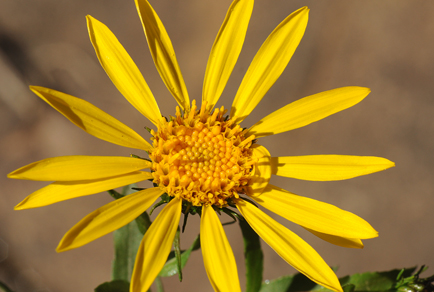
Grindelia rheophila (Asteraceae, Astereae), the first known rheophytic gumweed species is proposed, described, and illustrated here. Unlike most species of the genus, which are adapted to almost permanently dry environments, this new species thrives in dynamic riverine habitats with fast-flowing water. Grindelia rheophila is characterized by the erect to decumbent growth form, long linear-elliptic leaves, and a pappus with hemipaleaceous and bristle elements, which differentiate it from the morphologically similar G. buphthalmoides, G. pulchella and G. scorzonerifolia. The new species is known only at the northern headwaters of the Ibicuí river basin along the edge of the South Brazilian plateau in the state of Rio Grande do Sul, Brazil, where it grows along rocky flood-prone margins of the watercourse, as rapids and waterfalls are influenced by seasonal hydrological fluctuations. We highlight the vulnerability of rheophile ecosystems to anthropogenic threats, particularly dam construction and climate-driven extreme weather events, justifying the recognition of the new species as Critically Endangered (CR A2ac+3c+4ac; B1a,b(i,ii,iii,iv),c(iii)). A watercolor illustration, habitat photographs, a distribution map, and an identification key for Brazilian Grindelia are also provided.
References
- Bachman, S., Moat, J., Hill, A.W., Torre, J. & Scott, B. (2011) Supporting Red List threat assessments with GeoCAT: Geospatial conservation assessment tool. ZooKeys 150: 117–126. https://doi.org/10.3897/zookeys.150.2109
- Bartoli, A. & Tortosa, R.D. (1999) Revisión de las especies sudamericanas de Grindelia (Asteraceae: Astereae). Kurtziana 27: 327–359.
- Bartoli, A. & Tortosa, R.D. (2003) A new species of Grindelia (Asteraceae: Astereae) from the Meseta del Somuncura (Patagonia), Argentina. Brittonia 55: 146–149. https://doi.org/10.1663/0007-196X(2003)055[0146:ANSOGA]2.0.CO;2
- Bartoli, A. & Tortosa, R.D. (2012) Revision of the North American species of Grindelia (Asteraceae). Annals of the Missouri Botanical Garden 98: 447–513. https://doi.org/10.3417/2008125
- Bartoli, A. & Tortosa, R.D. (2014) Grindelia. In: Freire, S.E., Zuloaga, F.O., Belgrano, M.J. & Anton, A.M. (Eds.) Flora Argentina: Flora Vascular de la República Argentina, vol. 7 (1). CONICET, Buenos Aires, pp. 163–181.
- Bartoli, A., Tortosa, R.D., Ratto, R.F. & Schiviniatto, D. (2012) Notas taxonómicas en Asteraceae. Boletín de la Sociedad Argentina de Botánica 47: 145–148.
- Beentje, H. (2016) The Kew Plant Glossary: An Illustrated Dictionary of Plant Terms, 2nd ed. Kew Publishing, Royal Botanic Gardens, Richmond, 192 pp.
- Büneker, H.M. & Mariath, J.E.A. (2022) Dyckia pseudodelicata, a new species of the D. selloa complex (Bromeliaceae, Pitcairnioideae) from Rio Grande do Sul, Brazil. Phytotaxa 550 (1): 59–70. https://doi.org/10.11646/phytotaxa.550.1.4
- Büneker, H.M. & Witeck-Neto, L. (2016) Levantamento de Bromeliaceae na região do curso médio do rio Toropi, Rio Grande do Sul, Brasil. Balduinia 52: 1–14. https://doi.org/10.5902/2358198022371
- Büneker, H.M., Pontes, R.C., Soares, K.P., Neto, L.W. & Longhi, S.J. (2013) Uma nova espécie reófita de Dyckia (Bromeliaceae, Pitcairnioideae) para a flora do Rio Grande do Sul, Brasil. Revista Brasileira de Biociências 11 (3): 284–289.
- Büneker, H.M., Ferrarese, M.D. & do Canto-Dorow, T.S. (2017) Tradescantia multibracteata, a new species of Commelinaceae from Rio Grande do Sul, Brazil. Phytotaxa 308: 89–96. https://doi.org/10.11646/phytotaxa.308.1.7
- Büneker, H.M., Soares, K.P., Assis, L.D. & Witeck-Neto, L. (2018) Taxonomic novelties in Southern Brazilian Amaryllidaceae-III: Hippeastrum multiflorum, a new species from Rio Grande do Sul. Balduínia 64: 34–41. https://doi.org/10.5902/2358198035736
- Cabrera, Á.L. (1931) Revisión de las especies sudamericanas del género Grindelia. Revista Museu La Plata, Sección Botánica 33: 207–249.
- Cabrera, A. & Willink, A. (1973) Biogeografía de América Latina. Organization of American States (OAS), Washington, 137 pp.
- Candolle, A.P. de (1836) Prodromus systematis naturalis regni vegetabilis, vol. 5. Argentoratum [Strasbourg], Treuttel & Würtz, 706 pp.
- Coelho, G.P. & Miotto, S.T.S. (2017) A new species of Buddleja (Scrophulariaceae) from southern Brazil. Systematic Botany 42 (4): 968–973. https://doi.org/10.1600/036364417X696591
- Costa, L.M.S., Goetze, M., Rodrigues, A.V., Seger, G.D.D.S. & Bered, F. (2020) Global rheophytes data set: angiosperms and gymnosperms. Ecology 101 (8): e03056. https://doi.org/10.1002/ecy.3056
- Cárdenas, K.A. & Álvaro, W.R. (2020) Diversidad de briófitos acuáticos en un río de alta montaña tropical. Caldasia 42 (2): 294–305. https://doi.org/10.15446/caldasia.v42n2.77188
- Deble, L.P. & Oliveira-Deble, A.S. (2010) Novelties in Grindelia (Asteraceae: Astereae) from South America. Bonplandia 19: 47–57. https://doi.org/10.30972/bon.1911332
- Deble, L.P. & Sabatino, M. (2022) Rehabilitation of Grindelia argentina (Asteraceae: Astereae) and updates on its geographic range. Balduinia 70: 26–31. https://doi.org/10.5902/2358198073847
- Dunal, M.F. (1819) Note sur deux genres de plantes de la famille des Composées. Mémoires du Muséum d’histoire naturelle 5: 45–58.
- Fernandes, F. (2025) Diversity and conservation of Grindelia (Asteraceae: Astereae) in Brazil. Master’s dissertation, Universidade Federal do Rio Grande do Sul, Porto Alegre, Brazil.
- Figueira, M. & Schindler, B. (2021) Rhamnidium riograndense (Rhamnaceae), a new species from southern Brazil. Phytotaxa 510 (1): 53–60. https://doi.org/10.11646/phytotaxa.510.1.5
- Funk, V.A., Susanna, A., Stuessy, T.F. & Robinson, H. (eds.) (2009) Systematics, Evolution and Biogeography of Compositae. International Association for Plant Taxonomy, Vienna, 1001 pp.
- Garssen, A.G., Baattrup‐Pedersen, A., Voesenek, L.A., Verhoeven, J.T. & Soons, M.B. (2015) Riparian plant community responses to increased flooding: a meta-analysis. Global Change Biology 21 (8): 2881–2890. https://doi.org/10.1111/gcb.12921
- Garssen, A.G., Baattrup‐Pedersen, A., Riis, T., Raven, B.M., Hoffman, C.C., Verhoeven, J.T. & Soons, M.B. (2017) Effects of increased flooding on riparian vegetation: field experiments simulating climate change along five European lowland streams. Global Change Biology 23 (8): 3052–3063. https://doi.org/10.1111/gcb.13687
- Hickey, L.J. (1973) Classification of the architecture of dicotyledonous leaves. American Journal of Botany 60: 17–33. https://doi.org/10.1002/j.1537-2197.1973.tb10192.x
- Hooker, W.J. & Arnott, G.A.W. (1836) Contributions towards a flora of South America and the islands of the Pacific. Companion to the Botanical Magazine 2: 41–52.
- Hopkins, H.C.F. (2007) Geissois bradfordii, a new species of Cunoniaceae from New Caledonia. Kew Bulletin 62 (2): 275–279.
- Hoyos-Gómez, S.E. & Bernal, R. (2018) Rheophytes of the Samaná Norte River, Colombia: a hydroelectric project threatens an endemic flora. Tropical Conservation Science 11: 1–13. https://doi.org/10.1177/1940082918756816
- Iganci, J.R.V., Heiden, G., Miotto, S.T.S. & Pennington, R.T. (2011) Campos de Cima da Serra: the Brazilian Subtropical Highland Grasslands show an unexpected level of plant endemism. Botanical Journal of the Linnean Society 167: 378–393. https://doi.org/10.1111/j.1095-8339.2011.01182.x
- Imaichi, R. & Kato, M. (1997) Speciation and morphological evolution in rheophytes. In: Iwatsuki, K. & Raven, P.H. (Eds.) Evolution and diversification of land plants. Springer, Tokyo, pp. 309–318. https://doi.org/10.1007/978-4-431-65918-1_15
- IUCN (2024) Guidelines for using the IUCN red list categories and criteria, version 16. Prepared by the Standards and Petitions Committee. Available from: https://www.iucnredlist.org/resources/redlistguidelines (accessed: March 2025)
- Luz, L., Bordignon, S.A.D.L. & Thode, V. (2025) Novelties in Glechon (Lamiaceae): Two new species endemic to Rio Grande do Sul (Brazil). Phytotaxa 697: 265–273. https://doi.org/10.11646/phytotaxa.697.3.5
- Marchiori, J.N.C., Canto-Dorow, T.S., Büneker, H.M., Essi, L., Breier, T.B. & Pontes, R.C. (2014) Campos e florestas no curso médio do rio Toropi, Rio Grande do Sul (Brasil): Retrato de um admirável patrimônio ameaçado. Balduinia 45: 1–16. https://doi.org/10.5902/2358198014685
- Martius, C.F.P. von (1844) Historia Naturalis Palmarum. Voyage dans l’Amérique Méridionale. Strasbourg, 140 pp.
- Mitsui, Y., Chen, S.T., Zhou, Z.K., Peng, C.I., Deng, Y.F. & Setoguchi, H. (2008) Phylogeny and biogeography of the genus Ainsliaea (Asteraceae) in the Sino-Japanese region based on nuclear rDNA and plastid DNA sequence data. Annals of Botany 101: 111–124. https://doi.org/10.1093/aob/mcm267
- Morrone, J.J., Escalante, T., Rodríguez-Tapia, G., Carmona, A., Arana, M. & Mercado-Gómez, J.D. (2022) Biogeographic regionalization of the Neotropical region: New map and shapefile. Anais da Academia Brasileira de Ciências 94: e20211167. https://doi.org/10.1590/0001-3765202220211167
- Nesom, G. & Robinson, H. (2007) Tribe Astereae. In: Kadereit, J.W. & Jeffrey, C. (eds.) Kubitzki’s The Families and Genera of Vascular Plants, vol. 8. Springer-Verlag, Berlin, pp. 284–342.
- Philbrick, C.T., Bove, C.P. & Stevens, H.L. (2010) Endemism in neotropical Podostemaceae. Annals of the Missouri Botanical Garden 97: 425–456. https://doi.org/10.3417/2008087
- Pillar, V. & Overbeck, G.E. (2024) Learning from a climate disaster: The catastrophic floods in southern Brazil. Science 385 (6713). https://doi.org/10.1126/science.adr8356
- QGIS Development Team (2015) QGIS Geographic Information System. Open Source Geospatial Foundation Project. Available from: http://qgis.osgeo.org (accessed: March 2025)
- Rauh, W. (1984) Bromelienstudien. Neue und wenig bekannte Arten aus Peru und anderen Ländern. Tropische und Subtropische Pflanzenwelt 50: 1–36.
- Rio Grande do Sul—Casa Militar—Subchefia de Proteção e Defesa Civil. (2024) SisGer-CM | Boletim—Defesa Civil/RS—Lista municípios afetados. Porto Alegre, 24 pp.
- Roque, N. & Bautista, H. (2008) Asteraceae: Caracterização e Morfologia Floral. EDUFBA, Salvador, 266 pp.
- Sabatino, M. & Deble, L.P. (2022) Grindelia peregrinensis (Asteraceae: Astereae) a new species from Southern Buenos Aires Province, Argentina. Brittonia 74 (3): 290–296. https://doi.org/10.1007/s12228-022-09706-y
- Silveira, A.S., Miotto, S.T. & Schmidt, A.R. (2019) Mimosa cerifera, a new species of Mimosa (Fabaceae) from the Pampa biome, Brazil. Phytotaxa 410 (2): 121–130. https://doi.org/10.1600/036364419X697976
- Soares, K.P. & Longhi, S.J. (2011) Uma nova espécie de Butia (Becc.) Becc. (Arecaceae) para o Rio Grande do Sul, Brasil. Ciência Florestal 21 (2): 203–208. https://doi.org/10.5902/198050983223
- Stehmann, J.R. & Larocca, J. (2023) Petunia toropiensis (Solanaceae): A surprising new species endemic from Toropi river basin in southern Brazil. Acta Botanica Brasilica 37: e20220266. https://doi.org/10.1590/1677-941x-abb-2022-0266
- Thiers, B. (2025) Index Herbariorum. Available from: http://sweetgum.nybg.org/science/ih/ (accessed: March 2025)
- Thode, V.A. & Bordignon, S.A.D.L. (2019) Two new species of Glandularia (Verbenaceae) from Rio Grande do Sul and an updated key to the species occurring in Brazil. Phytotaxa 411 (1): 39–48. https://doi.org/10.11646/phytotaxa.411.1.3
- Willdenow, C.L. (1807) Grindelia, eine neue Pflanzengattung. Magazin für die neuesten Entdeckungen in der gesammten Naturkunde, Gesellschaft Naturforschender Freunde zu Berlin 1 (4): 259–261.