

Abstract
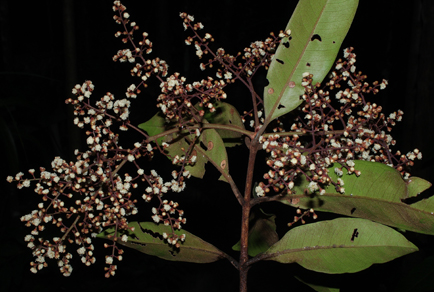
Myrcia vinacea is a new species endemic to the Coastal Atlantic Forest of São Paulo. It is morphologically similar to M. tetraphylla in vegetative features once both share verticillate leaves. However, it differs by its flaking or smooth trunk bark (vs. rough, non-flaking bark), inflorescences with secondary axes, 10–23 cm long (vs. usually without secondary axes, when present, ca. 2 cm long), pedicellate flowers, (vs. sessile), caducous bracts (vs. persistent), and inflorescences and ovaries with reddish trichomes (vs. brownish to grayish). A comparison with other similar species, diagnosis, description, ecological comments, photographic plates, and distribution map are also provided. Myrcia vinacea is preliminarily classified as Vulnerable (VU) due to the decrease in habitat quality and its restricted area of occupation, with few mature individuals.
References
- Arnott, G.A.W. (1834) New genera of plants. The Edinburgh New Philosophical Journal 17: 267.
- Brooks, T.M., Mittermeier, R., da Fonseca, G.A.B., Gerlach, J., Hoffmann, M., Lamoreux, J.F., Mittermeier, C. & Pilgrim, J. (2006) Global biodiversity conservation priorities. Science 313: 58–61. https://doi.org/10.1126/science.1127609
- Caliari, C.P., Souza, V.C. & Mazine, F.F. (2016) Two new species of Myrcia (Myrtaceae) from Brazilian Atlantic Forest. Phytotaxa 267: 7. https://doi.org/10.11646/phytotaxa.267.3.3
- Ching, R.C. (1940) On the genus Gleichenia Smith. Sunyatsenia 5 (4): 269–288.
- CRIA (Centro de Referência e Informação Ambiental) (2024) SpeciesLink Network. Available from: https://specieslink.net/ (accessed 4 November 2024)
- De Candolle, A.P. (1828) Prodromus Systematis Naturalis Regni Vegetabilis 3: 1–494.
- Fernandes, T., Lima, D.F., Lucas, E. & Staggemeier, V.G. (2021) Bringing some order to chaos: two new species of Myrcia separated from M. pubipetala (Myrtaceae). Kew Bulletin 76: 427–442. https://doi.org/10.1007/s12225-021-09962-3
- Gardner, G. (1842) Flora of Brazil. London Journal of Botany 1: 536.
- Grisebach, A.H.R. (1864) Flora of the British West Indian Islands. London, 789 pp. https://doi.org/10.5962/bhl.title.143
- IPNI (2025) International Plant Names Index. Published on the Internet. The Royal Botanic Gardens, Kew, Harvard University Herbaria & Libraries and Australian National Herbarium. Available from: http://www.ipni.org (accessed 31 January 2025)
- IUCN Standards and Petitions Committee (2022) Guidelines for Using the IUCN Red List Categories and Criteria. Version 15.1. Prepared by the Standards and Petitions Committee. Available from: http://www.iucnredlist.org/documents/RedListGuidelines.pdf (accessed 5 November 2024)
- Kiaerskou, H. (1893) Enumeratio Myrtacearum Brasiliensium quas collegerunt viri doctissimi Glaziou, Lund, Mendonca, Raben, Reinhardt, Schenck, Warming aliique. Hauniae: J. Gjellerup. https://doi.org/10.5962/bhl.title.4459
- Lourenço, A. & Alves, M. (2014) A new species and a new geographical record of Calyptranthes (Myrcia s.l., Myrtaceae) from Brazil. Phytotaxa 188: 275–281. https://doi.org/10.11646/phytotaxa.188.5.5
- Lucas, E.J., Amorim, B.S., Lima, D.F., Lima-Lourenço, A.R., Nic Lughadha, E.M., Proença, C.E.B., Rosa, P.O., Rosário, A.S., Santos, L.L., Santos, M.F., Souza, M.C., Staggemeier, V.G., Vasconcelos, T.N.C. & Sobral, M. (2018) A new infra-generic classification of the species-rich Neotropical genus Myrcia s.l. Kew Bulletin 73: 9. https://doi.org/10.1007/s12225-017-9730-5
- Lucas, E.J., Matsumoto, K., Harris, S.A., Nic Lughadha, E.M., Benardini, B. & Chase, M.W. (2011) Phylogenetics, morphology, and evolution of large genus Myrcia s.l. (Myrtaceae). International Journal of Plant Sciences 172: 915–934. https://doi.org/10.1086/660913
- Lucas, E.J., Wilson, C.E., Lima, D.F., Sobral, M. & Matsumoto, K. (2016) A conspectus of Myrcia sect. Aulomyrcia (Myrtaceae). Annals of the Missouri Botanical Garden 101: 648–698. https://doi.org/10.3417/2014015
- Mazine, F.F., Valdemarin, K.S., Giaretta, A. & Sobral, M. (2023) A new species of Eugenia sect. Eugenia (Myrtaceae) from Atlantic Forest in São Paulo, Brazil. Phytotaxa 585 (3): 233–238. https://doi.org/10.11646/phytotaxa.585.3.5
- Mittermeier, R.A., Turner, W.R., Larsen, F.W., Brooks, T.M. & Gascon, C. (2011) Global biodiversity conservation: the critical role of hotspots. In: Zachos, F. & Habel, J. (Eds.) Biodiversity hotspots. Springer, Berlin, Heidelberg. https://doi.org/10.1007/978-3-642-20992-5_1
- Myers, N., Mittermeier, R.A., Mittermeier, C.G., da Fonseca, G.A. & Kent, J. (2000) Biodiversity hotspots for conservation priorities. Nature 403: 853–858. https://doi.org/10.1038/35002501
- POWO (2024) Plants of the World Online. Facilitated by the Royal Botanic Gardens, Kew. Published on the Internet. Available from: https://powo.science.kew.org/ (accessed 4 December 2024)
- Santos, M.F., Amorim, B.S., Burton, G.P., Fernandes, T., Gaem, P.H., Lourenço, A.R.L., Lima, D.F., Rosa, P.O., Santos, L.L.D., Staggemeier, V.G., Vasconcelos, T.N.C. & Lucas, E.J. (2025) Myrcia in Flora e Funga do Brasil. Jardim Botânico do Rio de Janeiro. Available from: https://floradobrasil.jbrj.gov.br/FB10660 (accessed 23 February 2025)
- Santos, M.F. & Barretto, E.H.P. (2023) Myrcia tenondeporan, a new species of Myrtaceae from the Atlantic Forest in the Serra do Mar Mountains, Brazil. Phytotaxa 632: 1. https://doi.org/10.11646/phytotaxa.632.1.6
- São Paulo (2008) Plano de Manejo do Parque Estadual da Serra do Mar. São Paulo: Fundação Florestal 430 pp.
- Sobral, M. & Couto, F. (2006) Four new Myrtaceae from eastern Brazil. Novon 16: 520. https://doi.org/10.5962/bhl.title.744
- Sobral, M., Caliari, C.P., Gressler, E., Mazine, F.F., Magenta, M. & Viana, P.L. (2016) Seven new southeastern Brazilian species of Myrcia (Myrtaceae). Phytotaxa 247: 27–44. https://doi.org/10.11646/phytotaxa.247.1.2
- Staggemeier, V.G., Diniz-Filho, J.A.F., Zipparro, V.B., Gressler, E., Castro, E.R., Mazine, F., Costa, I.R., Lucas, E.J. & Morellato, L.P.C. (2015) Clade-specific responses regulate phenological patterns in Neotropical Myrtaceae. Perspectives in Plant Ecology, Evolution and Systematics 17: 476–490. https://doi.org/10.1016/j.ppees.2015.07.004
- Williams, K.J., Ford, A., Rosauer, D., De Silva, N., Mittermeier, R., Bruce, C., Larsen, F.W. & Margules, C. (2011) Forests of East Australia: the 35th biodiversity hotspot. In: Zachos, F.E. & Habel, J.C. (Eds.) Biodiversity hotspots: distribution and protection of conservation priority areas. Springer, Heidelberg. https://doi.org/10.1007/978-3-642-20992-5_16