

Abstract
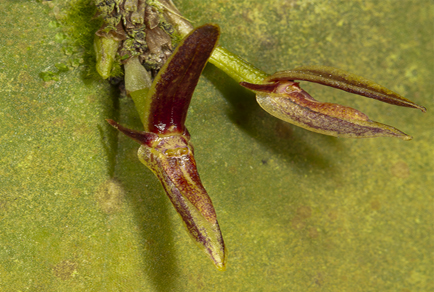
A new species of the genus Pleurothallis, discovered in the department of Boyacá, in the Eastern Andes of Colombia, is presented and illustrated. This species shows morphological similarities with Pleurothallis petroana; however, it differs in its oblong dorsal sepal; narrowly ovate, convex synsepal with strongly revolute margins; and lanceolate lip that is verrucose-papillose. In addition to its taxonomic description, its morphological affinities are discussed, and notes on its ecology and conservation status are provided. Our fieldwork data provide strong evidence to categorize the new species as Endangered under criteria B1ab(v)+B2ab(v) + C2a(i) due to its restricted distribution, commercial use in the local market, and the potential threat to its species range due to the establishment of a mine, and the high level of habitat loss around its occurrence.
References
- Arroyo-Rodríguez, V., Fahrig, L., Tabarelli, M., Watling, J.I., Tischendorf, L., Benchimol, M., Cazetta, E., Faria, D., Leal, I.R., Melo, F.P.L., Morante-Filho, J.C., Santos, B.A., Arasa-Gisbert, R., Arce-Peña, N., Cervantes-López, M.J., Cudney-Valenzuela, S., Galán-Acedo, C., San-José, M., Vieira, I.C.G. & Tscharntke, T. (2020) Designing optimal human-modified landscapes for forest biodiversity conservation. Ecology Letters 23: 1404–1420. https://doi.org/10.1111/ele.13535
- Brooks, T.M., Pimm, S.L., Akçakaya, H.R., Buchanan, G.M., Butchart, S.H.M., Foden, W., Hilton-Taylor, C., Hoffmann, M., Jenkins, C.N., Joppa, L., Li, B.V., Menon, V., Ocampo-Peñuela, N. & Rondinini, C. (2019) Measuring Terrestrial Area of Habitat (AOH) and its utility for the IUCN Red List. Trends in Ecology and Evolution 34: 977–986. https://doi.org/10.1016/j.tree.2019.06.009
- Brown, R. (1813) Clasis XX. Gynandria-Monandria. Hortus Kewensis; or, a Catalogue of the Plants Cultivated in the Royal Botanic Garden at Kew 5: 188–220.
- Damián-Parizaca, A., Monteros, M.F., Coayla Rimachi, D., Walston, J. & Mitidieri-Rivera, N. (2025) A new species of Pleurothallis (Pleurothallidinae, Orchidaceae) from the historic sanctuary of Machupicchu, Perú. PhytoKeys 254: 29–40. https://doi.org/10.3897/phytokeys.254.142116
- Edwards, F.A., Massam, M.R., Cosset, C.C.P., Cannon, P.G., Haugaasen, T., Gilroy, J.J. & Edwards, D.P. (2021) Sparing land for secondary forest regeneration protects more tropical biodiversity than land sharing in cattle farming landscapes. Current Biology 31: 1284–1293. https://doi.org/10.1016/j.cub.2020.12.030
- Fahrig, L. (2013) Rethinking patch size and isolation effects: the habitat amount hypothesis. Journal of Biogeography 40: 1649–1663. https://doi.org/10.1111/jbi.12130
- Fahrig, L. (2017) Ecological responses to habitat fragmentation per se. Annual Review of Ecology, Evolution, and Systematics 48: 1–23. https://doi.org/10.1146/annurev-ecolsys-110316-022612
- Fletcher, R.J. (2005) Multiple edge effects and their implications in fragmented landscapes. Journal of Animal Ecology 74: 342–352. https://doi.org/10.1111/j.1365-2656.2005.00930
- Gilroy, J.J., Woodcock, P., Edwards, F.A., Wheeler, C., Baptiste, B.L.G., Medina Uribe, C.A., Haugaasen, T. & Edwards, D.P. (2014) Cheap carbon and biodiversity co-benefits from forest regeneration in a hotspot of endemism. Nature Climate Change 4: 503–507. https://doi.org/10.1038/nclimate2200
- Gutiérrez, N., Moreno, J.S., Karremans, A.P. & Gil-Amaya, K. (2023) Restrepia santanderensis (Orchidaceae: Pleurothallidinae), a new species from the western slope of the eastern Andes in Colombia. Phytotaxa 598: 293–300. https://doi.org/10.11646/phytotaxa.598.4.3
- González del Pliego, P., Scheffers, B.R., Basham, E.W., Woodcock, P., Wheeler, C., Gilroy, J.J., Medina Uribe, C.A., Haugaasen, T., Freckleton, R.P. & Edwards, D.P. (2016) Thermally buffered microhabitats recovery in tropical secondary forests following land abandonment. Biological Conservation 201: 385–395. https://doi.org/10.1016/j.biocon.2016.07.038
- Hansen, M.C., Potapov, P.V., Moore, R., Hancher, M., Turubanova, S.A., Tyukavina, A., Thau, D., Stehman, S.V., Goetz, S.J., Loveland, T.R., Kommareddy, A., Egorov, A., Chini, L., Justice, C.O. & Townshend, J.R.G. (2013) High-resolution global maps of 21st-century forest cover change. Science 342: 850–853. https://doi.org/10.1126/science.1244693
- Hesselbarth, M.H.K., Sciaini, M., With, K.A., Wiegand, K. & Nowosad, J. (2019) landscapemetrics: an open-source R tool to calculate landscape metrics. Ecography 42: 1648–1657. https://doi.org/10.1111/ecog.04617
- Hinsley, A. & Roberts, D.L. (2018) The wild origin dilemma. Biological Conservation 217: 203–206. https://doi.org/10.1016/j.biocon.2017.11.011
- IUCN Standards and Petitions Committee. (2022) Guidelines for Using the IUCN Red List Categories and Criteria. Version 15.1. Prepared by the Standards and Petitions Committee. Available from: https://www.iucnredlist.org/documents/RedListGuidelines.pdf (25 July 2024)
- Jackson, H.B. & Fahrig, L. (2015) Are ecologists conducting research at the optimal scale? Global Ecology and Biogeography 24: 52–63. https://doi.org/10.1111/geb.12233
- Karremans, A.P. & Jiménez, J.E. (2018) Pleurothallis hawkingii and Pleurothallis vide-vallis (Orchidaceae; Epidendroideae), two new species from Cordillera de Guanacaste in Costa Rica. Phytotaxa 349: 185–191. https://doi.org/10.11646/phytotaxa.349.2.10
- Karremans, A.P., Moreno, J.S., Gil-Amaya, K., Gutiérrez Morales, N., Espinosa, F., Mesa, S., Restrepo, E., Rincón-González, M., Serna, A., Sierra-Ariza, M. & Vieira-Uribe, S. (2023) Colombian Orchidaceae: A catalogue of the Pleurothallidinae. Lankesteriana 23: 181–400. https://doi.org/10.15517/lank.v23i2.56158
- Karremans, A.P. & Vieira-Uribe, S. (2020) Pleurothallids Neotropical Jewels—Volume I. Imprenta Mariscal, Quito, 320 pp.
- Lindley, J. (1836) Notes upon some genera and species of American Orchidaceae. Companion to the Botanical Magazine 2: 353–357.
- Lindley, J. (1859) Folia Orchidacea. An enumeration of the known species of orchids. J. Matthews, London, pp. 9–12.
- Luer, C.A. (1988) A revision of some sections of subgenus Pleurothallis. Lindleyana 3: 133–149.
- Luer, C.A. (1996) New species of Pleurothallis (Orchidaceae) from Ecuador. Lindleyana 11: 54–113.
- Luer, C.A. (2005) Icones Pleurothallidinarum XXVII: Dryadella and Acronia section Macrophyllae-Fasciculatae. Monographs in Systematic Botany from Missouri Botanical Garden 103: 1–311.
- Luer, C.A. (2011) Miscellaneous new species in the Pleurothallidinae (Orchidaceae) excluding species from Brazil. Harvard Papers in Botany 16: 311–360.
- Morales, N.G., Moreno, J.S., Karremans, A.P. & Gil-Amaya, K. (2023) Restrepia santanderensis (Orchidaceae: Pleurothallidinae), a new species from the western slope of the eastern Andes in Colombia. Phytotaxa 598: 293–300. https://doi.org/10.11646/phytotaxa.598.4.3
- Moreno, J.S., Galindo-Tarazona, R., Alegria-Valencia, M., Sierra-Ariza, M.A., Mora-A., D.L. & Tróchez, A.Z. (2023) Blossoming legacies: eight new Lepanthes (Orchidaceae: Pleurothallidinae) species from Los Farallones de Cali National Park named in honor of Colombian women. Harvard Papers in Botany 28: 663–693. https://doi.org/10.3100/hpib.v28iss2.2023.n4
- Parra Sánchez, E., Armenteras, D. & Retana, J. (2016) Edge influence on diversity of orchids in Andean cloud forests. Forests 7: 63. https://doi.org/10.3390/f7030063
- Parra-Sanchez, E. & Baquero, L. (2023) Circumscription, first confirmed locality, and conservation status of Dracula anthracina (Orchidaceae). Systematic Botany 48: 200–207. https://doi.org/10.1600/036364423X16847773873080
- Parra-Sanchez, E., Freckleton, R.P., Hethcoat, M.G., Ochoa-Quintero, J.M. & Edwards, D.P. (2024) Transformation of natural habitat disrupts biogeographical patterns of orchid diversity. Biological Conservation 292: 110538. https://doi.org/10.1016/j.biocon.2024.110538
- Parra-Sanchez, E., Restrepo, E., Alegria-Valencia, M., Moreno, J.S. & Galindo-Tarazona, R. (2023) Lepanthes cordillerana (Orchidaceae) a new species and the landscape threats to its wild populations. Phytotaxa 603: 69–80. https://doi.org/10.11646/phytotaxa.603.1.5
- Parra-Sanchez, E., Rincón-Useche, C., Díaz-Jiménez, S. & Baquero, L. (2025) A new species of Lepanthes discovered under a diversity survey in the Colombian eastern cordillera: Lepanthes angelae (Orchidaceae: Pleurothallidiinae). Phytotaxa 687: 287–294. https://doi.org/10.11646/phytotaxa.687.2.7
- Poeppig, E. & Endlicher, S. (1835) Nova Genera ac species plantarum. Sumptibus Friderici Hofmeister, Leipzig, 110 pp.
- POWO (2025) Plants of the World Online. Facilitated by the Royal Botanic Gardens, Kew. Available from: https://powo.science.kew.org/ (accessed 11 April 2025)
- R Core Team (2022) R: A language and environment for statistical computing. R Foundation for Statistical Computing, Vienna.
- Rojas-Alvarado, G. & Karremans, A.P. (2024) A typological and morphological analysis of the Pleurothallidinae (Orchidaceae) inflorescences. The Botanical Review 90: 221–250. https://doi.org/10.1007/s12229-024-09303-6
- Ruiz, H. & Pavón, J.A. (1794) Florae peruvianae, et chilensis prodromus, sive novorum generum plantarum peruvianarum, et chilensium descriptiones, et icons. Imprenta de Sancha, Madrid, 154 pp.
- Smith, A.C., Fahrig, L. & Francis, C.M. (2011) Landscape size affects the relative importance of habitat amount, habitat fragmentation, and matrix quality on forest birds. Ecography 34: 103–113. https://doi.org/10.1111/j.1600-0587.2010.06201.x
- Sierra-Ariza, M.A. (2023) Two new species of Pleurothallis (Pleurothallidinae) subsection Macrophyllae-Fasciculatae from the Central Andes of Colombia. Lankesteriana 23: 35–44. https://doi.org/10.15517/lank.v23i1.54321
- Swartz, O. (1799a) Dianome epidendri generis Linn. Journal für die Botanik 2: 201–244.
- Sierra-Ariza, M.A. (2024) Pleurothallis cop-biodiversitatis (Pleurothallidinae), a new species from Colombia. Lankesteriana 24: 259–265. https://doi.org/10.15517/lank.v24i3.61038
- Swartz, O. (1799a) Dianome epidendri generis Linn. Journal für die Botanik 2: 201–244.
- Swartz, O.P. (1799b) Dianome epidendri generis. Linn. Nova Acta Regiae Societatis Scientiarum Upsaliensis 6: 61–88.
- Vélez-Abarca, L., Jiménez, M., Gutiérrez Del Pozo, D. & Baquero, L. (2022) Pleurothallis ariana-dayanae, a new species in subsection Macrophyllae-Fasciculatae (Pleurothallidinae) from the Cordillera del Cóndor, Ecuador. Lankesteriana 22: 101–109. https://doi.org/10.15517/lank.v22i2.51750
- Wilson, M., Baquero, L., Driessen, W., Dupree, K., Gil, K., Portilla, J. & Salas Guerrero, M. (2017a) A clarification of the distinction between Pleurothallis talpinaria and Pleurothallis trimeroglossa (Orchidaceae: Pleurothallidinae) and an allied new species from Ecuador. Lankesteriana 17: 133–151. https://doi.org/10.15517/lank.v17i2.29803
- Wilson, M., Dupree, K., Driessen, W., Larsen, B.T., Löckher, A., Niessen, A., Portilla, J., Salas-Guerrero, M., Suárez, M.A. & Tobar-Suárez, F. (2017b) A clarification of the taxonomy of Pleurothallis crocodiliceps (Pleurothallidinae, Orchidaceae) and four new species of Pleurothallis in subgenus Ancipitia. Lankesteriana 17: 165–191. https://doi.org/10.15517/lank.v17i2.29911
- Wilson, M., Zhao, K., Hampson, H., Frank, G., Romoleroux, K., Jiménez, M. & Pérez, Á.J. (2018) A new species of Pleurothallis (Orchidaceae: Pleurothallidinae) in subsection Macrophyllae-Fasciculatae with a unique, highly reduced, morphologically distinct labellum. Lankesteriana 18: 217–230. https://doi.org/10.15517/lank.v18i3.35495
- Wraith, J. & Pickering, C. (2018) Quantifying anthropogenic threats to orchids using the IUCN Red List. Ambio 47: 307–317. https://doi.org/10.1007/s13280-017-0964-0