

Abstract
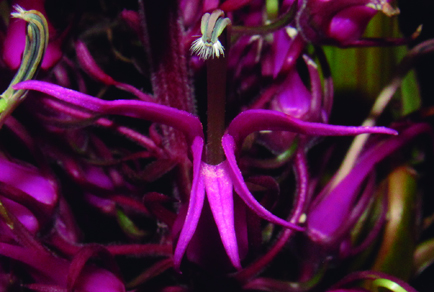
Lobelia bahiana is here described as a new species endemic from the Chapada Diamantina region in Bahia state, Brazil. The new taxon belongs to Lobelia section Rhynchopetalum, the most speciose clade of Lobelia in Brazil. This section includes tall robust herbs with unbranched stems and typical unilabiate or sub-bilabiate corolla tubes. Lobelia bahiana looks morphologically similar to L. organensis, but can be distinguished from it by the dense tomentum on the abaxial surface of leaves, peduncles and rachis of the inflorescences and in the pedicels of flowers (vs. glabrous), by the strong purple color in calyx lobes and hypanthium (vs. greenish), and by the erect calyx lobes, which are bent towards the flower apex (vs. patent, not curved). The new species shares also similarities with Lobelia brasiliensis, being distinguished mainly by the white tomentum (vs. yellowish) and the glabrous ovary and outer surface of corolla (vs. densely tomentose). A full description together with a distribution map, original photographs and line drawings are provided. In addition, a key for the South American species of Lobelia sect. Rhynchopetalum as well as the inclusion of L. bahiana under the vulnerable (VU) category of the IUCN Red List due to its narrow distribution and a restricted area of occupancy are proposed.
References
- Antonelli, A. (2008) Higher level phylogeny and evolutionary trends in Campanulaceae subfam. Lobelioideae: Molecular signal overshadows morphology. Molecular Phylogenetics and Evolution 46: 1–18. https://doi.org/10.1016/j.ympev.2007.06.015
- Bachman, S., Moat, J., Hill, A.W., de la Torre, J. & Scott, B. (2011) Supporting Red List threat assessments with GeoCAT geospatial conservation assessment tool, in E- infrastructures for data publishing in biodiversity science, eds. Smith, V. & Penev, L. Zookeys 150: 117–126. https://doi.org/10.3897/zookeys.150.2109
- Beentje, H. (2010) The Kew Plant Glossary, an illustrated dictionary of plant terms. Royal Botanic Gardens, Kew.
- Bentham, G. (1876) Genera plantarum ad exemplaria imprimis in herbariis Kewensibus servata definita: Sistens dicotyledonum gamopetalarum ordines XXXIX: stylidieas-plantagineas. Vol. 2. No. 2. Reeve, London.
- Coelho, G.P., Iganci, J.R.V & Miotto, S.T.S. (2020) Siphocampylus nebularis (Campanulaceae, Lobelioideae), a New Endemic Species from the Atlantic Forest in Southern Brazil. Systematic Botany 45 (3): 681–687. https://doi.org/10.1600/036364420X15935294613455
- Coelho, G.P., Iganci, J.R.V & Miotto, S.T.S. (2022) Siphocampylus flavescens (Campanulaceae, Lobelioideae), a New Endangered Species from Southeastern Brazil. Systematic Botany 47 (2): 562–566. https://doi.org/10.1600/036364422X16512564801597
- De Candolle, A.P. (1839) Lobeliaceae in Prodromus Systematis Naturalis Regni Vegetabilis 7: 339–496.
- Endlicher, S. (1838) Genera Plantarum Secundum Ordines Naturales. Vol. 1. Fr. Beck, Vienna.
- Flora e Funga do Brasil. (2024) Jardim Botânico do Rio de Janeiro. Available from: http://floradobrasil.jbrj.gov.br (accessed 12 September 2024)
- Fresenius, G. (1838) Diagnoses generum speciarumque novarum in Abyssinia a cl. Rueppell detectarum. Flora 21 (2): 601–616.
- Funez, L.A. & Hassemer, G. (2016) Two narrowly endemic new species of Siphocampylus (Campanulaceae) from Santa Catarina, southern Brazil. Phytotaxa 278: 241–256. https://doi.org/10.11646/phytotaxa.278.3.4
- Gardner, G. (1845) Contributions towards flora of Brazil. London Journal of Botany 4: 97–137.
- Herter, W. (1945) Auf den Spuren der Naturforscher Sellow und Saint-Hilaire. Botanische Jahrbücher für Systematik, Pflanzengeschichte und Pflanzengeographie 74: 119–149.
- IUCN. (2024) Guidelines for using the IUCN red list categories and criteria. Version 16. UK: Standards and Petitions Subcommittee of IUCN. Available from: http://www.iucnredlist.org/documents/RedListGuidelines.pdf (accessed 12 September 2024)
- Lagomarsino, L.P., Antonelli, A., Muchhala, N., Timmermann, A., Mathews, S. & Davis, C.C. (2014) Phylogeny, classification, and fruit evolution of the species‐rich Neotropical bellflowers (Campanulaceae: Lobelioideae). American Journal of Botany 101: 2097–2112. https://doi.org/10.3732/ajb.1400339
- Lammers, T.G. (2007) Campanulaceae. In: Kadereit, J.W. & Jeffrey, C. (Eds.) The Families and Genera of Vascular Plants, VII: Flowering Plants, Eudicots, Asterales. Springer, Berlin, pp. 26–56. https://doi.org/10.1007/978-3-540-31051-8_5
- Lammers, T. (2011) Revision of infrageneric classification of Lobelia L. (Campanulaceae: Lobelioideae). Annals of the Missouri Botanical Garden 98: 37–62. https://doi.org/10.3417/2007150
- Leins, P. & Erbar, C. (1990) On the mechanisms of secondary pollen presentation in the Campanulales‐Asterales‐Complex. Botanica Acta 103: 87–92. https://doi.org/10.1111/j.1438-8677.1990.tb00131.x
- Linnaeus, C. (1753) Species Plantarum. Laurentius Salvius, Stockholm, 1200 pp.
- Murata, J. (1995) A revision of the infrageneric classification of Lobelia (Campanulaceae: Lobelioideae) with special reference to seed coat morphology. Journal of the Faculty of Science, University of Tokyo, Section III. Botany 15: 349–371.
- Pohl, J.E. (1831) Siphocampylus. In: Pohl, J.E. (Ed.) Plantarum Brasiliae icones et descriptiones hactenus ineditae 2: 104–115. Antonii Strauss, Vienna.
- Rollim, I.M. & Oliveira, M.T.L. (2020) A new species of Wahlenbergia (Campanulaceae) from the Itatiaia National Park, Brazil. Phytotaxa 436: 182–186. https://doi.org/10.11646/phytotaxa.436.2.7
- Rollim, I.M. & Oliveira, M.T.L. (2024) Lobelia capixaba, a new microendemic species of L. sect. Rhynchopetalum (Campanulaceae) from Espírito Santo, Brazil. Phytotaxa 668 (3): 286–292. https://doi.org/10.11646/phytotaxa.668.3.8
- Rollim, I.M., Coelho, G.P., Miotto, S.T.S, Iganci, J.R.V. & Oliveira, M.T.L. (2022) Nomenclatural and taxonomic survey of the South American clade of Lobelia section Rhynchopetalum (Campanulaceae). Phytotaxa 539: 45–54. https://doi.org/10.11646/phytotaxa.539.1.5
- Thiers, B. (2025 [continuously updated]) Index Herbariorum: A global directory of public herbaria and associated staff. New York Botanical Garden’s Virtual Herbarium. Available from: http://sweetgum.nybg.org/ih/ (accessed 5 July 2021)
- Vieira, A.O.S. (1988) Estudos Taxonômicos das Espécies de Lobelia L. (Campanulaceae Juss.) que ocorrem no Brasil. M.S. thesis. Universidade Estadual de Campinas, Campinas.
- Vieira, A.O.S. & Shepherd, G.J. (1998) A new species of Lobelia (Campanulaceae) from Brazil. Novon 8: 457–460. https://doi.org/10.2307/3391874
- Wimmer, F.E. (1935) Conspectus Lobelioidearum in Brasilia, Paraguay, Uruguay, Argentina crescientium. Revista Sudamericana de Botánica 2: 89–107.
- Wimmer, F.E. (1953) Campanulaceae-Lobelioideae, II. Teil. In: Mansfeld, R. (Ed.) Das Pflanzenreich, regni vegetabilis conspectus, IV.276b heft 107. Akademie-Verlag, Berlin, pp. 261–814. https://doi.org/10.1515/9783112653081
- Zahlbruckner, A. (1907) Plantae Paraguarienses novae vel minus cognitae. Bulletin de l’Herbier Boissier, sér. 2, 7: 445–460.