

Abstract
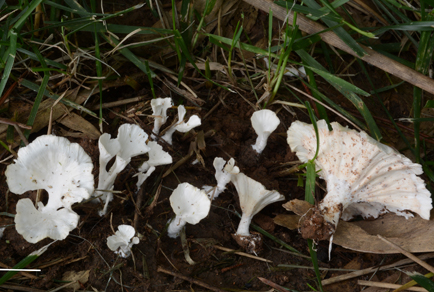
A new species, Cotylidia macrosporum, is described and illustrated from Puzhao Temple of Mount Tai Scenic Area (Tai’an City, Shandong Province, China) and Longdong Scenic Area (Ji’nan City, Shandong Province, China). It is described as a new species based on morphological, molecular and ecological evidence. Our molecular phylogenetic analyses based on DNA sequences of the internal transcribed spacers 1 and 2 with the 5.8S rDNA (ITS) and large subunit of nuclear ribosomal DNA (nrLSU) support the inclusion of this new species in the genus Cotylidia as it forms an independent clade in the phylogenetic tree. Morphologically, Cotylidia macrosporum differs from any known species by the combination of basidiome growing on soil, light brownish white pileus on the surface, and relatively big basidiospores (x = 6.17 ± 0.54 × 4.0 ± 0.47 μm; Q = (1.16–) 1.31–2.0 (–2.37), Qm = 1.57 ± 0.22). We present this new species with illustrated morphological description, phylogeny and comparison with morphologically similar or phylogenetically related species.
References
- Arenal, F., Villarreal, M. & Rubio, V. (2008) Cotylidia muscigena, a new record from Canary Islands. Cryptogamie Mycologie 29 (1): 19–23.
- Boidin, J., Mugnier, J. & Canales, R. (1998) Taxonomie moléculaire des aphyllophorales. Mycotaxon 66: 445–491.
- Dai, Y.C., Wei, Y.L. & Zhang, X.Q. (2004) An annotated checklist of non-poroid Aphyllophorales in China. Annales Botanici Fennici 41: 233–247.
- Doyle, J.J. & Doyle, J. (1987) A rapid DNA isolation procedure for small quantities of fresh leaf material. Phytochemical bulletin 19: 11–15.
- Gardes, M. & Bruns, T.D. (1993) ITS primers with enhanced specificity for basidiomycetes-application to the identification of mycorrhizae and rusts. Molecular Ecology 2: 113–118.
- Gruhn, G., Dumez, S., Moreau, P.A., Roy, M., Morreale, O., Schimann, H. & Courtecuisse, R. (2017) The Genus Resinicium in French Guiana and the West Indies: a Morphological and Molecular Survey, Revealing Resinicium grandisporum sp. nov. Cryptogamie Mycologie 38 (4): 469–483.
- Grum-Grzhimaylo, O.A., Debets, A.J. & Bilanenko, E.N. (2016) The diversity of microfungi in peatlands originated from the White Sea. Mycologia 108 (2): 233–254.
- Hall, T.A. (1999) BioEdit: a user-friendly biological sequence alignment editor and analyses program for Windows 95/98/NT. Nucleic Acids Symposium Series 41: 95–98. https://doi.org/10.1016/S1468-1641(10)60416-1
- Karsten, P.A. (1881) Enumeratio Thelephorearum Fr. et Clavariearum Fr. Fennicarum, systemate novo dispositarum. Revue Mycologique Toulouse 3 (9): 21–23.
- Kolarik, M. & Vohnik, M. (2018) When the ribosomal DNA does not tell the truth: The case of the taxonomic position of Kurtia argillacea, an ericoid mycorrhizal fungus residing among Hymenochaetales. Fungal Biology 122 (1): 1–18.
- Korotkin, H.B., Swenie, R.A., Miettinen, O., Budke, J.M., Chen, K.H., Lutzoni, F., Smith, M.E. & Matheny, P.B. (2018) Stable isotope analyses reveal previously unknown trophic mode diversity in the Hymenochaetales. American Journal of Botany 105 (11): 1869–1887. https://doi.org/10.1002/ajb2.1183
- Kout, J. & Zíbarová, L. (2013) Revision of the genus Cotylidia (Basidiomycota, Hymenochaetales) in the Czech Republic. Czech Mycology 65 (1): 1–13. https://doi.org/10.33585/cmy.65101
- Kretzer, A.M. & Bruns, T.D. (1999) Use of atp6 in fungal phylogenetics: An example from the Boletales. Molecular Phylogenetics and Evolution 13 (3): 483–492. https://doi.org/10.1006/mpev.1999.0680
- Larsson, K.H., Parmasto, E., Fischer, M., Langer, E., Nakasone, K.K. & Redhead, S.A. (2006) Hymenochaetales: a molecular phylogeny for the hymenochaetoid clade. Mycologia 98 (6): 926–936. PMID 17486969. https://doi.org/10.3852/mycologia.98.6.926
- Latha, K.P.D., Raj, K.N.A., Paramban, R. & Manimohan, P. (2015) Two new bryophilous agarics from India. Mycoscience 56: 75–80. https://doi.org/10.1016/j.myc.2014.03.004
- Lentz, P.L. (1955) Stereum and allied genera of fungi in the upper Mississippi valley. 74 pp. https://doi.org/10.5962/bhl.title.63676
- Lonati, G. (2000) Una nuova specie: Cotylidia marsicana. Micologia e Vegetazione Mediterranea 15: 3–5.
- Moncalvo, J.M., Vilgalys, R., Redhead, S.A., Johnson, J.E., James, T.Y., Aime, M.C., Hofstetter, V.S., Verduin, J.W., Larsson, E., Baroni, T.J., Thorn, R.G., Jacobsson, S., Clémençon, H. & Miller, Jr.O.K. (2002) One hundred and seventeen clades of euagarics. Molecular Phylogenetics and Evolution 23 (3): 357–400.
- Nakasone, K.K. (2007) Morphological and molecular studies on Resinicium s. str. Canadian journal of botany 85 (4): 420–436.
- Nylander, J. (2004) MrModeltest 2.2. Computer software distributed by the University of Uppsala. Sweden: Evolutionary Biology Centre.
- Olariaga, I., Huhtinen, S., Lsse, T., Petersen, J.H. & Hansen, K. (2020) Phylogenetic origins and family classification of typhuloid fungi, with emphasis on Ceratellopsis, Macrotyphula and Typhula (Basidiomycota). Studies in Mycology 96.
- Raithelhuber, J. (1973) Zur Abgrenzung der Gattungen Gerronema, Omphalina, Clitocybe und Haasiella. Metrodiana 4: 61–73.
- Redhead, S.A. (2002) Phylogeny of agarics: partial systematics solutions for bryophilous omphalinoid agarics outside of the Agaricales (euagarics). Mycotaxon 82: 151–168.
- Reid, D.A. (1965) A monograph of the stipitate steroid fungi. Beihefte zur Nova Hedwigia 18: 1–382.
- Ronquist, F. & Huelsenbeck, J.P. (2003) Mrbayes 3: Bayesian phylogenetic inference under mixed models. Bioinformatics 19 (12): 1572–1574. https://doi.org/10.1093/bioinformatics/btg180
- Rosenthal, L.M., Larsson, K.H., Branco, S., Chung, J.A., Glassman, S.I., Liao, H.L., Peay, K.G., Smith, D.P., Talbot, J.M., Taylor, J.W., Vellinga, E.C., Vilgalys, R. & Bruns, T.D. (2017) Survey of corticioid fungi in north American pinaceous forests reveals hyperdiversity, underpopulated sequence databases, and species that are potentially ectomycorrhizal. Mycologia 109 (1): 115–127.
- Schoch, C.L., Robbertse, B., Robert, V., Vu, D., Cardinali, G., Irinyi, L., Meyer, W., Nilsson, R.H., Hughes, K., Miller, A.N., Kirk, P.M., Abarenkov, K., Aime, M.C., Ariyawansa, H.A., Bidartondo, M., Boekhout, T., Buyck, B., Cai, Q., Chen, J., Crespo, A., Crous, P.W., Damm, U., De Beer, Z.W., Dentinger, B.T., Divakar, P.K., Dueñas, M., Feau, N., Fliegerova, K., García, M.A., Ge, Z.W., Griffith, G.W., Groenewald, J.Z., Groenewald, M., Grube, M., Gryzenhout, M., Gueidan, C., Guo, L., Hambleton, S., Hamelin, R., Hansen, K., Hofstetter, V., Hong, S.B., Houbraken, J., Hyde, K.D., Inderbitzin, P., Johnston, P.R., Karunarathna, S.C., Kõljalg, U., Kovács, G.M., Kraichak, E., Krizsan, K., Kurtzman, C.P., Larsson, K.H., Leavitt, S., Letcher, P.M., Liimatainen, K., Liu, J.K., Lodge, D.J., Luangsa-ard, J.J., Lumbsch, H.T., Maharachchikumbura, S.S., Manamgoda, D., Martín, M.P., Minnis, A.M., Moncalvo, J.M., Mulè, G., Nakasone, K.K., Niskanen, T., Olariaga, I., Papp, T., Petkovits, T., Pino-Bodas, R., Powell, M.J., Raja, H.A., Redecker, D., Sarmiento-Ramirez, J.M., Seifert, K.A., Shrestha, B., Stenroos, S., Stielow, B., Suh, S.O., Tanaka, K., Tedersoo, L., Telleria, M.T., Udayanga, D., Untereiner, W.A., Diéguez Uribeondo, J., Subbarao, K.V., Vágvölgyi, C., Visagie, C., Voigt, K., Walker, D.M., Weir, B.S., Weiß, M., Wijayawardene, N.N., Wingfield, M.J., Xu, J.P., Yang, Z.L., Zhang, N. & Zhuang, W.Y. & Federhen, S. (2014) Finding needles in haystacks: linking scientific names, reference specimens and molecular data for Fungi. Database (Oxford) 2014: bau061. PMID 24980130; PMCID: PMC4075928. https://doi.org/10.1093/database/bau061
- Shang, B., He, W. & Yu, C.J. (2006) Cotylidia harmandii—a new corticioid fungus in china. Forest Research 19 (1): 114–116.
- Sjökvist, E., Larsson, E., Eberhardt, U., Ryvarden, L. & Larsson, K.H. (2012) Stipitate stereoid basidiocarps have evolved multiple times. Mycologia 104 (5): 1046–1055. https://doi.org/10.3852/11-174
- Smith, S.A. & Dunn, C.W. (2008) Phyutility: a phyloinformatics tool for trees, alignments and molecular data. Bioinformation 24: 715–716. https://doi.org/10.1093/bioinformatics/btm619
- Song, X.H., Lv, X.B. & Li, C.R. (2015) Willingness and motivation of residents to pay for conservation of urban green spaces in Jinan, China. Acta Ecologica Sinica 35 (4): 89–94.
- Stamatakis, A. (2006) RAxML-vI-HPC: maximum-likelihood-based phylogenetic analyses with thousands of taxa and mixed models. Bioinformatics 22: 2688–2690. https://doi.org/10.1093/bioinformatics/btl446
- Varga, T., Krizsan, K., Foldi, C., Dima, B., Sanchez-Garcia, M., Sanchez-Ramirez, S., Szollosi, G.J., Szarkandi, J.G., Papp, V., Albert, L., Andreopoulos, W., Angelini, C., Antonin, V., Barry, K.W., Bougher, N.L., Buchanan, P., Buyck, B., Bense, V., Catcheside, P., Chovatia, M., Cooper, J., Damon, W., Desjardin, D., Finy, P., Geml, J., Haridas, S., Hughes, K., Justo, A., Karasinski, D., Kautmanova, I., Kiss, B., Kocsube, S., Kotiranta, H., LaButti, K.M., Lechner, B.E., Liimatainen, K., Lipzen, A., Lukacs, Z., Mihaltcheva, S., Morgado, L.N., Niskanen, T., Noordeloos, M.E., Ohm, R.A., Ortiz-Santana, B., Ovrebo, C., Racz, N., Riley, R., Savchenko, A., Shiryaev, A., Soop, K., Spirin, V., Szebenyi, C., Tomsovsky, M., Tulloss, R.E., Uehling, J., Grigoriev, I.V., Vagvolgyi, C., Papp, T., Martin, F.M., Miettinen, O., Hibbett, D.S. & Nagy, L.G. (2019) Megaphylogeny resolves global patterns of mushroom evolution. Nature Ecology & Evolution 3 (4): 668–678.
- Vilgalys, R. & Hester, M. (1990) Rapid genetic identification and mapping of enzymatically amplified ribosomal DNA from several Cryptococcus species. Journal of Bacteriology 172 (8): 4238–4246. https://doi.org/10.1128/jb.172.8.4238-4246.1990
- Vizzini, A. (2010) Segnalazioni di muscinputa laevis (Basidiomycota, Agaricomycetes) per il Nord Italia. Micologia e Vegetazione Mediterranea 25: 141–148.
- Vu, D., Groenewald, M., de Vries, M., Gehrmann, T., Stielow, B., Eberhardt, U., Al-Hatmi, A., Groenewald, J.Z., Cardinali, G., Houbraken, J., Boekhout, T., Crous, P.W., Robert, V. & Verkley, G.J.M. (2019) Large-scale generation and analysis of filamentous fungal DNA barcodes boosts coverage for kingdom fungi and reveals thresholds for fungal species and higher taxon delimitation. Studies in Mycology 92: 135–154.
- Wang, P.M., Liu, X.B., Dai, Y.C., Horak, E., Steffen, K. & Yang, Z.L. (2018) Phylogeny and species delimitation of Flammulina: taxonomic status of winter mushroom in East Asia and a new European species identified using an integrated approach. Mycological Progress 17: 1013–1030.
- Wang, P.M. & Yang, Z.L. (2019) Two new taxa of the Auriscalpium vulgare species complex with substrate preferences. Mycological Progress 18: 641–652.
- Welden, A.L. (1958) A contribution toward a monograph of Cotylidia. Lloydia 21: 38–44.
- White, T.J., Bruns, T., Lee, S. & Taylor, J. (1990) Amplification and direct sequencing of fungal ribosomal RNA genes for phylogenetics. In: Innis, M., Gelfand, D., Sninsky, J. & White, T. (Eds.) PCR Protocols: A guide to Methods and Applications. Academic Press, San Diego, pp. 315–322. https://doi.org/10.1016/B978-0-12-372180-8.50042-1
- Yang, C., Xu, Y.Y & Fan, L. (2021) Cotylidia fibrae (Rickenellaceae, Hymenochaetales), a new species from China. Phytotaxa 487 (2): 139–148. https://doi.org/10.11646/phytotaxa.487.2.4
- Yurchenko, E., Wu, S.H. & Maekawa, N. (2020) Three new species of Peniophorella (Basidiomycota) from East Asia. Nova Hedwigia 111 (3–4): 473–495.