
Abstract
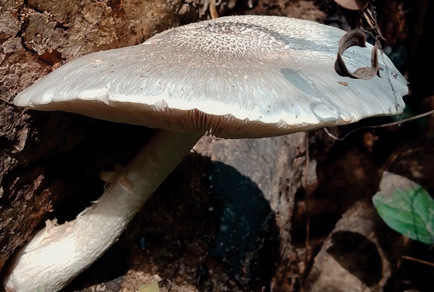
Pluteus xylophilus (Speg.) Singer (1951: 405) is a lignicolous species of the section Pluteus Fr. (1836: 338). It is characterized by a large, plano-convex pileus with a pale gray to grayish brown pileal surface, center often with a broad, low to high umbo, covered with indistinct brown to grayish brown fibrils (darker in the center and paler towards the margin) discoloring radially towards the margin, a cream central stipe with a clavate base and appressed brown fibrils (increasing towards the base), free, crowded and pinkish lamellae, pink spore print, and absence of annulus and volva (Ramírez-Guillén & Guzman 2003, Meijer 2008, Menolli & Capelari 2014, Menolli et al. 2010, 2015). Micromorphologically, this species has broadly ellipsoid to elongate, hyaline, smooth, thick-walled, inamyloid basidiospores, a hymenium with three types of pleurocystidia and dimorphic cheilocystidia, the context composed of inflated and septate, slightly thick-walled hyphae, and a pileipellis, a repent epicutis composed of septate, and elongate, slightly thick to thin-walled hyphae (Singer 1951, 1958, Menolli & Capelari 2014, Menolli et al. 2015). Pluteus xylophilus has a Neotropical distribution with records in Argentina, Bolivia, Brazil, Mexico, Peru, Colombia, and Chile (Spegazzini 1925, Singer & Digilio 1951, Singer 1958, Stijve & Meijer 1993, Valenzuela 2003, Meijer 2006, 2008, Menolli et al. 2015).
References
- Costa, A.L., Lopes, C.F., Ferraz, K.R., de Avila Heberle, M. & Putzke, J. (2022) Diversity and Ecological Associations of Pluteaceae (Fungi, Agaricomycetes, Agaricales) in Brazilian Biomes. Revista Brasileira de Meio Ambiente 10 (2): 219–239.
- De Meijer, A.A.R. (2006) Preliminary list of the macromycetes from the Brazilian State of Paraná. Boletim do Museu Botanico Municipal 68: 1–55.
- De Meijer, A.A.R. (2008) Notable macrofungi from Brazil’s Paraná Pine forest. Embrapa Florestas, Colombo.
- Dias, R.L. & Cortez, V.G. (2013) New records of Pluteus (Agaricales) from Paraná State, Brazil. Mycosphere 4 (5): 937–943. https://doi.org/10.5943/mycosphere/4/5/6
- Drechsler-Santos, E.R., Santos, P.J.P., Gibertoni, T.B. & Cavalcanti, M.A.Q. (2010) Ecological aspects of Hymenochaetaceae in an area of Caatinga (semi-arid) in Northeast Brazil. Fungal Diversity 42: 71–78. https://doi.org/10.1007/s13225-010-0021-9
- Drechsler-Santos, E.R., Robledo, G.L., Lima-Júnior, N.C., Malosso, E., Reck, M.A., Gibertoni, T.B., Cavalcanti, M.A.Q. & Rajchenberg, M. (2016) Phellinotus: a new neotropical genus in the Hymenochaetaceae (Basidiomycota, Hymenochaetales). Phytotaxa 261: 218–239.
- Dryflor, Banda-R.K., Delgado-Salinas, A., Dexter, K.G., Linares-Palomino, R., Oliveira-Filho, A., Prado, D., Pullan, M., Quintana, C., Ricarda Riina, R., Rodríguez, G.M., Weintritt, J., Acevedo-Rodríguez, P., Adarve, J., Álvarez, E., Aranguren, A., Arteaga, J.C., Aymard, G., Castaño, A., Ceballos-Mago, N., Cogollo, A., Cuadros, H., Delgado, F., Devia, W., Dueñas, H., Fajardo, L., Fernández, A., Ángel Fernández, M.A., Franklin, J., Freid, E.H., Galetti, L.A., Gonto R., González-M., R., Graveson, R., Helmer, E.H., Idárraga, A., López, R., Marcano-Veja, H., Martínez, O.G., Maturo, H.M., McDonald, M., McLaren, K., Melo, O., Mijares, F., Mogni, V., Molina, D., Moreno, N.P., Nassar, J.M., Neves, D.M., Oakley, L.J., Oatham, M., Olvera-Luna, A.R., Pezzini, F.F., Dominguez, O.J.R., Ríos, M.E., Rivera, O., Rodríguez, N., Rojas, A., Särkinen, T., Sánchez, R., Smith, M., Vargas, C., Villanueva, B. & Pennington, R.T. (2016) Plant diversity patterns in neotropical dry forests and their conservation implications. Science 353 (6306): 1383–1387. https://doi.org/10.1126/science.aaf5080
- Elias, S.G., Salvador-Montoya, C.A., Costa-Rezende, D.H., Guterres, D.C., Fernandes, M., Olkoski, D. & Drechsler-Santos, E.R. (2020) Studies on the biogeography of Phellinotus piptadeniae (Hymenochaetales, Basidiomycota): Expanding the knowledge on its distribution and clarifying hosts relationships. Fungal Ecology 45: 100912. https://doi.org/10.1016/j.funeco.2020.100912
- Fries, E.M. (1836) Corpus Florarum provincialium suecicae I. Floram Scanicam. Typis Palmblad, Sebell & Co, Upsaliae, 349 pp. https://doi.org/10.5962/bhl.title.47083
- GBIF.org (2025) GBIF Occurrence Download. Available from: https://doi.org/10.15468/dl.3gsg2u (accessed 22 January 2025) https://doi.org/10.15468/dl.3gsg2u
- Gillet, C.C. (1876) Les Hyménomycètes ou Description de tous les Champignons qui Croissent en France. Vol. 1. Ch. Thomas, Alençon, pp. 177–560.
- Grassi, E.M., Romano, G.M. & Schenone, N.F. (2016) Macrohongos presentes en un área de manejo regenerativo de bosque de Mata Atlántica (Misiones, Argentina). Boletín de la Sociedad Argentina de Botánica 51 (2): 223–233. https://doi.org/10.31055/1851.2372.v51.n2.14835
- Justo, A., Minnis, A.M., Ghignone, S., Menolli, N. Jr., Capelari, M., Rodríguez, O., Malysheva, E., Contu, M. & Vizzini, A. (2011) Species recognition in Pluteus and Volvopluteus (Pluteaceae, Agaricales): morphology, geography and phylogeny. Mycological Progress 10: 453–479. https://doi.org/10.1007/s11557-010-0716-z
- Kummer, P. (1871) Der Führer in die Pilzkunde. Verlag von E. Luppe’s Buchhandlung, Zerbst, 146 pp.
- Linares-Palomino, R., Oliveira-Filho, A.T. & Pennington, R.T. (2011) Neotropical Seasonally Dry Forests: Diversity, Endemism and Biogeography of Woody Plants. In: Dirzo, R., Mooney, H., Ceballos, G. & Young, H. (Eds.) Seasonally Dry Tropical Forests: Ecology and Conservation. Island Press, Washington, DC 20009, USA, pp. 3–21. https://doi.org/10.5822/978-1-61091-021-7_1
- Macbride, J.F. (1919) Notes on certain Leguminosae. Contributions from the Gray Herbarium of Harvard University 59: 1–27. https://doi.org/10.5962/p.336032
- Menolli Jr, N., Asai, T. & Capelari, M. (2010) Records and new species of Pluteus from Brazil based on morphological and molecular data. Mycology 1 (2): 130–153. https://doi.org/10.1080/21501203.2010.493531
- Menolli Jr, N. & Capelari, M. (2014) One hundred fourteen years of Pluteus in Brazil: collections studied by Hennings and Rick. Mycotaxon 126 (1): 191–226. https://doi.org/10.5248/126.191
- Menolli Jr, N., de Meijer, A.A. & Capelari, M. (2015) The genus Pluteus (Pluteaceae, Agaricales) from the state of Paraná, Brazil. Nova Hedwigia 100 (1–2): 101–157. https://doi.org/10.1127/nova_hedwigia/2014/0224
- Morrone, J.J., Escalante, T., Rodríguez-Tapia, G., Carmona, A., Arana, M. & Mercado-Gómez, J.D. (2022) Biogeographic regionalization of the Neotropical region: New map and shapefile. Anais da Academia Brasileira de Ciências 94 (1): e20211167. https://doi.org/10.1590/0001-3765202220211167
- National Center for Biotechnology Information (NCBI) (2025) Bethesda (MD): National Library of Medicine (US), National Center for Biotechnology Information; [1988]. Available from: https://www.ncbi.nlm.nih.gov/ (accessed 14 February 2025)
- Niveiro, N. & Albertó, E. (2012) Checklist of the Argentine Agaricales I. Amanitaceae, Pluteaceae and Hygrophoraceae. Mycotaxon 119: 493–494.
- Pennington, R.T., Lehmann, C.E.R. & Rowland, L.M. (2018) Tropical savannas and dry forests. Current Biology 28 (9): R541–R545. https://doi.org/10.1016/j.cub.2018.03.014
- Pennington, R., Lavin, M. & Oliveira-Filho, A. (2009) Woody plant diversity, evolution, and ecology in the tropics: perspectives from seasonally dry tropical forests. Annual Review of Ecology, Evolution and Systematics 40: 437–457. https://doi.org/10.1146/annurev.ecolsys.110308.120327
- Prado, D.E. & Gibbs, P.E. (1993) Patterns of species distributions in the Dry Seasonal Forests of South America. Annals of the Missouri Botanical Garden 80: 902–927. https://doi.org/10.2307/2399937
- Prado, D.E. (2000) Seasonally dry forests of tropical South America: from forgotten ecosystems to a new phytogeographic unit. Edinburgh Journal of Botany 57: 437–461. https://doi.org/10.1017/S096042860000041X
- Prieto-Torres, D.A., Rojas-Soto, O.R., Santiago-Alarcon, D., Bonaccorso, E. & Navarro-Sigüenza, A.G. (2019) Diversity, endemism, species turnover and relationships among avifauna of Neotropical seasonally dry forests. Ardeola 66: 257–277. https://doi.org/10.13157/arla.66.2.2019.ra1
- QGIS Development Team. (2023) QGIS geographic information system, version 3.28. QGIS Association. Available from: [http://qgis.osgeo.org]
- Ramírez-Guillén, F. & Guzmán, G. (2003) Hongos de Zoncuantla, Veracruz I. Nuevos registros para Veracruz y México. Acta Botánica Mexicana (63): 73–82. https://doi.org/10.21829/abm63.2003.921
- Rodríguez, O. (2013) The genus Pluteus (Agaricales, Pluteaceae) in Mexico. Revista Mexicana de Biodiversidad 84: 128–151. https://doi.org/10.7550/rmb.31610
- Salvador-Montoya, C.A., Elias, S.G., Popoff, O.F., Robledo, G.L., Urcelay, C., Góes-Neto, A., Martínez, S. & Drechsler-Santos, E.R. (2022) Neotropical studies on Hymenochaetaceae: unveiling the diversity and endemicity of Phellinotus. Journal of Fungi 8 (3): 216. https://doi.org/10.3390/jof8030216
- Särkinen, T., Iganci, J.R., Linares-Palomino, R., Simon, M.F. & Prado, D.E. (2011) Forgotten forests-issues and prospects in biome mapping using Seasonally Dry Tropical Forests as a case study. BMC ecology 11: 1–16. https://doi.org/10.1186/1472-6785-11-27
- Singer, R. (1951) The Agaricales in modern taxonomy. Lilloa 22: 5–832.
- Singer, R. & Digilio, A.P.L. (1951) Pródomo de la flora Agaricina Argentina. Lilloa 25: 5–461.
- Singer, R. (1958) Monographs of South American Basidiomycetes, especially those of the east slope of the Andes and Brazil. I. The genus Pluteus in South America. Lloydia 21 (4): 195–302.
- Spegazzini, C. (1925) Observaciones y adiciones a la micología Argentina. Boletín de la Academia Nacional de Ciencias Córdoba (Argentina) 28: 266–406.
- Stijve, T. & Meijer, A. (1993) Macromycetes from the State of Paraná, Brazil. 4. The psychoactive species. Arquivos de biologia e tecnologia 36 (2): 313–329.
- Valenzuela, E. (2003) Hongos comestibles silvestres colectados en la X región de Chile. Boletín Micológico 18.