
Abstract
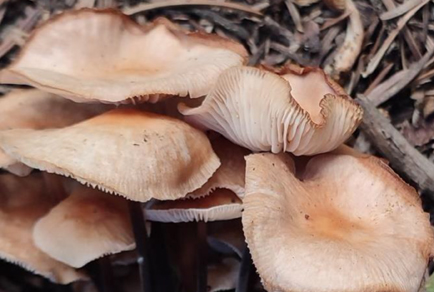
In this study, a new species in Gymnopus is described herein, based on collections made from forests of Kumrat Valley, Pakistan. This species is characterized by small to medium-sized, fragile, fasciculate basidiomata, violet, black to dark reddish-brown stipes, obovoid, ellipsoidal to oblong basidiospores 4.7–8.8 × 3–4.2 µm in size, simple diverticulate pileipellis and stipitipellis. The phylogeny inferred from the concatenated internal transcribed spacers (ITS) and the large subunit (nrLSU) of the nuclear ribosomal DNA, also support the finding that G. violaceigregarius is sister species of G. gansuensis reported from China but the new species is distinct from G. gansuensis and all other known species within the genus Gymnopus with significant bootstrap and Bayesian support. A full description, color photographs, illustrations, phylogenetic tree showing the position of G. violaceigregarius and comparison to similar species is provided.
References
- Ahmad, A., Liu, Q.J., Marwat, K.B., Shah, S., Amir, M. & Mannan, A. (2019) Tree distribution pattern, growing stock characteristics and carbon mitigation potential of different forests ecosystems in Kumrat, Hindukush region of northern Pakistan. Pakistan Journal of Botany 51: 2185–2194. https://doi.org/10.30848/PJB2019-6(3)
- Ahmad, S. (1980) A contribution to the Agaricales of Pakistan. Bulletin of Mycology (Mycological Society of Pakistan) 1 (1): 35–90.
- Aman, N., Khalid, A.N. & Moncalvo, J.M. (2022) A compendium of macrofungi of Pakistan by ecoregions. MycoKeys 89: 171. https://doi.org/10.3897/mycokeys.89.81148
- Antonín, V., Halling, R., Noordeloos, M. (1997) Generic Concepts within the Groups of Marasmius and Collybia Sensu Lato. Mycotaxon 63: 359–368.
- Antonín, V. & Noordeloos, M.E. (1993) A monograph of Marasmius, Collybia and related genera in Europe. Part 1: Marasmius, Setulipes, and Marasmiellus. Libri Botanici 8: 1–256.
- Antonín, V. & Noordeloos, M.E. (1997) A monograph of Marasmius, Collybia and related genera in Europe. Part 2: Collybia, Gymnopus, Rhodocollybia, Crinipellis, Chaetocalathus, and additions to Marasmiellus. Libri Botanici 17: 1–256.
- Antonín, V. & Noordeloos, M.E. (2010) A monograph of marasmioid and collybioid fungi in Europe. IHW-Verlag, Eching, 480 pp.
- Antonín, V., Sedlák, P. & Tomšovský, M. (2013) Taxonomy and phylogeny of European Gymnopus subsection Levipedes (Basidiomycota, Omphalotaceae). Persoonia 31: 179–187. https://doi.org/10.3767/003158513x674043
- Antonín, V., Ďuriška, O., Gafforov, Y., Jančovičová, S., Para, R. & Tomšovský, M. (2017) Molecular phylogenetics and taxonomy in Melanoleuca exscissa group, (Tricholomataceae, Basidiomycota) and the description of M. griseobrunnea sp. nov. Plant Systematics and Evolution 303: 1181–1198. https://doi.org/10.1007/s00606-017-1430-y
- Bas, C. (1969) Morphology and subdivision of Amanita and a monograph of its section Lepidella. Persoonia 5: 285–579.
- Berkeley, M.J. (1874) Notices of North American fungi. Grevillea 1: 145–150. https://doi.org/10.2307/1218613
- Cai, Q., Chen, Z.H., He, Z.M., Luo, H. & Yang, Z.L. (2018) Lepiota venenata, a new species related to toxic mushroom in China. Journal of Fungal Research 16: 63–6.
- Coimbra, V.R.M., Pinheiro, F.G.B., Wartchow, F. & Gibertoni, T.B. (2015) Studies on Gymnopus sect. Impudicae (Omphalotaceae, Agaricales) from Northern Brazil: two new species and notes on G. montagnei. Mycological Progress 14: 110. https://doi.org/10.1007/s11557-015-1131-2
- Crous, P.W., Wingfield, M.J., Burgess, T.I., Hardy, G., Crane, C., Barrett, S., Cano-Lira, J.F., Le Roux, J.J., Thangavel, R., Guarro, J., Stchigel, A.M., Martin, M.P., Alfredo, D.S., Barber, P.A., Barreto, R.W., Baseia, I.G., Cano-Canals, J., Cheewangkoon, R., Ferreira, R.J., Gene, J., Lechat, C., Moreno, G., Roets, F., Shivas, R.G., Sousa, J.O., Tan, Y.P., Wiederhold, N.P., Abell, S.E., Accioly, T., Albizu, J.L., Alves, J.L., Antoniolli, Z.I., Aplin, N., Araujo, J., Arzanlou, M., Bezerra, J.D.P., Bouchara, J.P., Carlavilla, J.R., Castillo, A., Castroagudin, V.L., Ceresini, P.C., Claridge, G.F., Coelho, G., Coimbra, V.R.M., Costa, L.A., da Cunha, K.C., da Silva, S.S., Daniel, R., de Beer, Z.W., Duenas, M., Edwards, J., Enwistle, P., Fiuza, P.O., Fournier, J., Garcia, D., Gibertoni, T.B., Giraud, S., GuevaraSuarez, M., Gusmao, L.F.P., Haituk, S., Heykoop, M., Hirooka, Y., Hofmann, T.A., Houbraken, J., Hughes, D.P., Kautmanova, I., Koppel, O., Koukol, O., Larsson, E., Latha, K.P.D., Lee, D.H., Lisboa, D.O., Lisboa, W.S., Lopez-Villalba, A., Maciel, J.L.N., Manimohan, P., Manjon, J.L., Marincowitz, S., Marney, T.S., Meijer, M., Miller, A.N., Olariaga, I., Paiva, L.M., Piepenbring, M., Poveda-Molero, J.C., Raj, K.N.A., Raja, H.A., Rougeron, A., Salcedo, I., Samadi, R., Santos, T.A.B., Scarlett, K., Seifert, K.A., Shuttleworth, L.A., Silva, G.A., Silva, M., Siqueira, J.P.Z., Souza-Motta, C.M., Stephenson, S.L., Sutton, D.A., Tamakeaw, N., Telleria, M.T., Valenzuela-Lopez, N., Viljoen, A., Visagie, C.M. & Vizzini, A., Wartchow, F., Wingfield, B.D., Yurchenko, E., Zamora, J.C. & Groenewald, J.Z. (2016) Fungal Planet description sheets: 469–557. Persoonia 37: 218–403. https://doi.org/10.3767/003158516x694499
- Desjardin, D.E., Halling, R.E. & Hemmes, D.E. (1999) Agaricales of the Hawaiian Islands. 5. The genera Rhodocollybia and Gymnopus. Mycologia 91 (1): 166–176. https://doi.org/10.2307/3761206
- Desjardin, D.E. & Perry, B.A. (2017) The gymnopoid fungi (Basidiomycota, Agaricales) from the Republic of São Tomé and Príncipe, West Africa. Mycosphere 8 (9): 1317–1391. https://doi.org/10.5943/mycosphere/8/9/5
- Deng, C.Y., Wang, W.K., Li, J.P. & Antonín, V. (2025) Morphology and phylogeny reveal Gymnopus pseudoandrosaceus sp. nov. (Agaricales, Basidiomycota) from southwest China. Phytotaxa 683: 218–228. https://doi.org/10.11646/phytotaxa.683.3
- Earle, F.S. (1909) The genera of the North American gill fungi. Bulletin of the New York Botanical Garden 5: 373–462.
- Edgar, R.C. (2004) MUSCLE: multiple sequence alignment with high accuracy and high throughput. Nucleic Acids Research 32: 1792–1797. https://doi.org/10.1093/nar/gkh340
- Fan, L., Wang, B., Ma, T., Li, B., Ma, J., Lei, X. & Bao, N. (2024) Three new species of Gymnopus and Mycena (Agaricales, Basidiomycota) from northwestern China. Frontiers in Microbiology 15: 1487598. https://doi.org/10.3389/fmicb.2024.1487598
- Feng, W.C., Li, X.Y., Cui, Y.Y. & Cai, Q. (2025) Species diversity of Gymnopus section Levipedes in southwestern China, with a description of three new species. Journal of Fungi 11: 88. https://doi.org/10.3390/jof11020088
- Fries, E. (1838) Epicrisis systematis mycologici, seu synopsis hymenomycetum. Typographia Academica: Upsaliae (Sweden).
- Gardes, M. & Bruns, T.D. (1993) ITS primers with enhanced specificity for Basidiomycetes-Application to the identification of mycorrhizae and rusts. Molecular Ecology 2: 113–118.
- Gray, S.F. (1821) Natural arrangement of British plants. Vol. 1. Baldwin, Craddock, and Joy, London, pp. 1–824.
- Hall, T.A. (1999) BioEdit: a user-friendly biological sequence alignment editor and analysis program for Windows 95/98/NT. Nucleic Acids Symposium Series No. 41: 95–98. https://doi.org/10.1371/journal.pone.0079975
- Halling, R.E. (1996) Notes on Collybia V. Gymnopus section Levipedes in tropical South America, with comments on Collybia. Brittonia 48 (4): 487–494. https://doi.org/10.2307/2807862
- Hu, J.J., Song, L.R., Tuo, Y.L., Zhao, G.P., Yue, L., Zhang, B. & Li, Y. (2022) Multiple evidences reveal new species and a new record of smelly Gymnopus (Agaricales, Omphalotaceae) from China. Frontiers in Microbiology 13: 968617. https://doi.org/10.3389/fmicb.2022.968617
- Iqbal, S.H. & Khalid, A.N. (1996) Materials for the fungus flora of Pakistan. 1. Check list of agarics, their distribution and association with surrounding vegetation. Science International-Lahore 8: 51–64.
- Jang, S., Jang, Y., Lim, Y.W., Kim, C., Ahn, B.J., Lee, S.S. & Kim, J.J. (2016) Phylogenetic Identification of Korean Gymnopus spp. and the First Report of 3 Species: G. iocephalus, G. polygrammus, and G. subnudus. Mycobiology 44: 131–136. https://doi.org/10.5941/Myco.2016.44.3.130
- Khattak, R.H., Teng, L., Mehmood, T., Ahmad, S., Rehman, E.U., Basak, S.M. & Liu, Z. (2022) A Perspective of the Human–Grey Wolf (Canis lupus) Conflicts in Kumrat Valley, Northern Pakistan. Diversity 14: 887. https://doi.org/10.3390/d14100887
- Kühner, R. (1933) Études sur le genre Marasmius. Le Botaniste 25 (1): 57–114.
- Li, J.P., Song, B., Feng, Z., Wang, J., Deng, C.Y. & Yang, Y.H. (2021a) A new species of Gymnopus sect. Androsacei (Omphalotaceae, Agaricales) from China. Phytotaxa 521 (1): 1–14. https://doi.org/10.11646/phytotaxa.521.1.1
- Li, J.P., Li, Yu, Li, T.H., Antonín, V., Hosen, M.I., Song, B., Xie, M.L. & Feng, Z. (2021b) A preliminary report of Gymnopus sect. Impudicae (Omphalotaceae) from China. Phytotaxa 497 (3): 263–276. https://doi.org/10.11646/phytotaxa.497.3.5
- Li, J.P., Antonín, V., Gates, G., Jiang, L., Li, T.H., Li, Y., Song, B. & Deng, C.Y. (2022) Emending Gymnopus sect. Gymnopus (Agaricales, Omphalotaceae) by including two new species from southern China. MycoKeys 87: 183–204. https://doi.org/10.3897/mycokeys.87.76125
- Manawasinghe, I.S., Hyde, K.D., Wanasinghe, D.N., Karunarathna, S.C., Maharachchikumbura, S.S.N., Samarakoon, M.C., Voglmayr, H., Pang, K.-L., Chiang, M.W.-L., Jones, E.B.G., Saxena, R.K., Kumar, A., Rajeshkumar, K.C., Selbmann, L., Coleine, C., Hu, Y., Ainsworth, A.M., Liimatainen, K., Niskanen, T., Ralaiveloarisoa, A., Arumugam, E., Kezo, K., Kaliyaperumal, M., Gunaseelan, S., Dissanayake, A.J., Khalid, A.N., Gajanayake, A.J., Flakus, A., Armand, A., Aptroot, A., Rodrigues, A., Tsurykau, A., López-Villalba, Á., de Farias, A.R.G., Sánchez, A., Góes-Neto, A., Goto, B.T., de Souza, C.A.F., Chuaseeharonnachai, C., Lin, C.-G., Li, C., Denchev, C.M., Guerra-Mateo, D., Tennakoon, D.S., Wei, D.-P., Begerow, D., Alves, E., Drechsler-Santos, E.R., Sousa, E.S., de Medeiros, E.V., Langer, E., Zhang, F., de Souza, F.A., Magurno, F., Barreto, G.G., Moreno, G., Mane, G., Alves-Silva, G., da Silva, G.A., Xia, G., Shen, H.-W., Gui, H., Senanayake, I.C., Luangsa-ard, J.J., Liu, J.-W., Liu, J.-K., Ma, J., Lin, J.-Y., Beserra Jr, J.E.A., Cano-Lira, J.F., Gené, J., Harikrishnan, K., Lu, L., dos Santos, L.A., Xu, L., Lacerda, L.T., Gusmão, L.F.P., Cáceres, M.E.S., Câmara, M.P.S., de Barros-Barreto, M.B.B., Calabon, M.S., Kukwa, M., Kemler, M., de Melo, M.P., Ghobad-Nejhad, M., Luo, M., Ding, M., Doilom, M., Phonemany, M., Usman, M., Thongklang, N., Boonyuen, N., Ashtekar, N., Kularathnage, N.D., Sruthi, O.P., Kwantong, P., Ansil, P.A., Kooij, P.W., Zhao, Q., Alfenas, R.F., de Oliveira, R.J.V., Singh, R., da Silva, R.M.F., Avchar, R., Morey, R., Sharma, R., Xu, R.-J., da Silveira, R.M.B., Xu, R.-F., Jayawardena, R.S., Nanu, S., Nuankaew, S., Tibpromma, S., Boonmie, S., Somrithipol, S., Varghese, S., Moreira, S.I., Rajwar, S., He, S.-C., Kumar, T.K.A., Denchev, T.T., Luangharn, T., de Oliveira, T.G.L., Du, T.-Y., Wen, T.-C., Du, T., Wu, T., Sri-Indrasutdhi, V., Doyle, V.P., Baulin, V., Dong, W., Li, W.-L., Lu, W.-H., Tian, W., dos Vieira, W.A., von Brackel, W., Yu, X.-D., Zhang, X., Liu, X.-F., Peng, X.-C., Chen, Y., Yang, Y., Gao, Y., Xiong, Y.R., Shu, Y., Lu, Y.-Z., Shen, Y.-M., Zhou, Y., Zhang, Y.X., Zhang, W., Luo, Z.-L., Madushani, M.A., Cheewangkoon, R., Song, J.G. & Xu, B. (2024) Fungal diversity notes 1818–1918: Taxonomic and phylogenetic contributions on genera and species of fungi. Fungal Diversity 130 (1): 1–261. https://doi.org/10.1007/s13225-024-00658-y
- Mata, J.L., Hughes, K.W. & Petersen, R.H. (2004) Phylogenetic placement of Marasmiellus juniperinus. Mycoscience 45 (3): 214–221. https://doi.org/10.1007/S10267-004-0170-3
- Mata, J.L., Hughes, K.W. & Petersen, R.H. (2006) An investigation of/omphalotaceae (Fungi: Euagarics) with emphasis on the genus Gymnopus. Sydowia 58 (2): 191–289.
- Miller, M.A., Holder, M.T., Vos, R., Midford, P.E., Liebowvitz, T., Chan, L., Hoover, P. & Warnow, T. (2010) The CIPRES Portals. Available from: https://www.phylo.org/ (accessed 3 October 2021)
- Moreno, G. & Carlavilla, J.R. (2018) Gymnopus inusitatus, una especie rara encontrada en Pinares de Pinus halepensis de Madrid. Boletin Sociedad Micologica de Madrid 42: 107–113.
- Munsell. (1975) Munsell soil color charts. Macbeth Division of Kollmorgen Corporation, Baltimore, Maryland.
- Murrill, W.A. (1916) North American Flora. Vol. 9. The New York Botanical Garden, New York, 362 pp.
- Noordeloos, M.E., Kuyper, T.W. & Vellinga, E.C. (1999) Flora Agaricina Neerlandica (Vol. 4). CRC Press, Florida.
- Noordeloos, M.E. & Antonín, V. (2008) Contribution to a monograph of marasmioid and collybioid fungi in Europe. Czech Mycology 60 (1): 21–27. https://doi.org/10.33585/cmy.60103
- Oliveira, J.J., Vargas-Isla, R., Cabral, T.S., Rodrigues, D.P. & Ishikawa, N.K. (2019) Progress on the phylogeny of the Omphalotaceae: Gymnopus s. str., Marasmiellus s. str., Paragymnopus gen. nov. and Pusillomyces gen. nov. Mycological Progress 18: 713–739. https://doi.org/10.1007/s11557-019-01483-5
- Orton, P.D. (1960) New check list of British agarics and boleti: Part III. Notes on genera and species in the list. Transactions of the British Mycological Society 43 (2): 159–439. https://doi.org/10.1016/S0007-1536(60)80065-4
- Petersen, R.H. & Hughes, K.W. (2014) New North American species of Gymnopus. North American Fungi 9: 1‒22. https://doi.org/10.2509/naf2014.009.003
- Petersen, R.H. & Hughes, K.W. (2016) Micromphale sect. Perforantia (Agaricales, Basidiomycetes); expansion and phylogenetic placement. MycoKeys 18: 1–122. https://doi.org/10.3897/mycokeys.18.10007
- Petersen, R.H. & Hughes, K.W. (2017) Corrigenda for: “Micromphale sect. Perforantia (Agaricales, Basidiomycetes); expansion and phylogenetic placement”. MycoKeys 19: 45–54. https://doi.org/10.3897/mycokeys.19.11565
- Petersen, R.H. & Hughes, K.W. (2020) Two new genera of gymnopoid/marasmioid euagarics. Mycotaxon 135 (1): 1–95. https://doi.org/10.5248/135.1
- Petersen, R.H. & Hughes, K.W. (2021) Collybiopsis and its type species, Co. ramealis. Mycotaxon 136: 263–349. https://doi.org/10.5248/136.263
- Rambaut, A. (2014) FigTree 1.4.2 software. Institute of Evolutionary Biology, University of Edinburgh.
- Rambaut, A., Suchard, M.A. & Xie, D. (n.d.) Tracer v. 1.6. Available from: http://beast.bio.ed.ac.uk/Tracer (accessed 26 June 2023)
- Ronquist, F., Teslenko, M., van der Mark, P., Ayres, D.L., Darling, A., Hohna, S., Larget, B., Liu, L. & Suchard, M.A. & Huelsenbeck, J.P. (2012) Mrbayes 3.2: efficient bayesian phylogenetic inference and model choice across a large model space. Molecular Systems Biology 61: 539–542. https://doi.org/10.1093/sysbio/sys029
- Roussel, H.F.A. (1806) Flore du Calvados et terrains adjacents, composée suivant la méthode de Jussieu. L.-J. Poisson, Caen, 372 pp.
- Ryoo, R., Antonín, V., Ka, K.H. & Tomšovský, M. (2016) Marasmioid and gymnopoid fungi of the Republic of Korea. 8. Gymnopus section Impudicae. Phytotaxa 286 (2): 75–88. https://doi.org/10.11646/phytotaxa.286.2.2
- Ryoo, R., Antonín, V. & Ka, K.H. (2020) Marasmioid and Gymnopoid Fungi of the Republic of Korea. 8. Gymnopus Section Levipedes. Mycobiology 48 (4): 252–262. https://doi.org/10.1080/12298093.2020.1769541
- Saba, M. & Khalid, A.N. (2014) New reports of Gymnopus from Pakistan based on ITS sequences. Mycotaxon 129 (1): 63–72. https://doi.org/10.5248/129.63
- Saba, M., Khan, J., Sarwar, S., Sher, H. & Khalid, A.N. (2020) Gymnopus barbipes and G. dysodes, new records for Pakistan. Mycotaxon 135 (1): 203–212. https://doi.org/10.5248/135.203
- Schoch, C.L., Robbertse, B., Robert, V., Vu, D., Cardinali, G., Irinyi, L., Meyer, W., Nilsson, R.H., Hughes, K., Miller, A.N., Kirk, P.M., Abarenkov, K., Aime, M.C., Ariyawansa, H.A., Bidartondo, M., Boekhout, T., Buyck, B., Cai, Q., Chen, J., Crespo, A., Crous, P.W., Damm, U., De Beer, Z.W., Dentinger, B.T.M., Divakar, P.K., Dueñas, M., Feau, N., Fliegerova, K., García, M.A., Ge, Z.W., Griffith, G.W., Groenewald, J.Z., Groenewald, M., Grube, M., Gryzenhout, M., Gueidan, C., Guo, L., Hambleton, S., Hamelin, R., Hansen, K., Hofstetter, V., Hong, S.B., Houbraken, J., Hyde, K.D., Inderbitzin, P., Johnston, P.R., Karunarathna, S.C., Kõljalg, U., Kovács, G.M., Kraichak, E., Krizsan, K., Kurtzman, C.P., Larsson, K.H., Leavitt, S., Letcher, P.M., Liimatainen, K., Liu, J.K., Lodge, D.J., Luangsaard, J.J., Lumbsch, H.T., Maharachchikumbura, S.S.N., Manamgoda, D., Martín, M.P., Minnis, A.M., Moncalvo, J.M., Mulè, G., Nakasone, K.K., Niskanen, T., Olariaga, I., Papp, T., Petkovits, T., Pino-Bodas, R., Powell, M.J., Raja, H.A., Redecker, D., Sarmiento-Ramirez, J.M., Seifert, K.A., Shrestha, B., Stenroos, S., Stielow, B., Suh, S.O., Tanaka, K., Tedersoo, L., Telleria, M.T., Udayanga, D., Untereiner, W.A., Uribeondo, J.D., Subbarao, K.V., Vágvölgyi, C., Visagie, C., Voigt, K., Walker, D.M., Weir, B.S., Weiß, M., Wijayawardene, N.N., Wingfield, M.J., Xu, J.P., Yang, Z.L., Zhang, N., Zhuang, W.Y. & Federhen, S. (2014) Finding needles in haystacks: linking scientific names, reference specimens and molecular data for fungi. Database 2014: 1–21. https://doi.org/10.1093/database/bau061
- Shibata, H. (1992) Higher Basidiomycetes from Pakistan. In: Nakaike, T. & Malik, S. (Eds.) Cryptogamic Flora of Pakistan, Vol. I. National Science Museum Tokyo and Pakistan Museum of Natural History (Pakistan Science Foundation, Islamabad), pp. 145.
- Singer, R. (1939) Phylogenie und Taxonomie der Agaricales. Schweizerische Zeitschrift fur Pilzkunde 17: 71–73.
- Singer, R. (1945) The Laschia complex (Basidiomycetes). Lloydia 8: 170–230.
- Stamatakis, A. (2014) RAxML version 8: a tool for phylogenetic analysis and post-analysis of large phylogenies. Bioinformatics 30 (9): 1312–1313. https://doi.org/10.1093/bioinformatics/btu033
- Sultana, K., Rauf, C.A., Riaz, A., Naz, F., Irshad, G. & Haque, M. (2011) Checklist of Agarics of Kaghan valley. Pakistan Journal of Botany 43 (3): 1777–1787.
- Vellinga, E.C. (2001) Agaricaceae. In: Noordeloos, M.E., Kuyper, T.W. & Vellinga, E.C. (Eds.) Flora Agaricina Neerlandica 5. A.A. Balkema Publishers, Rotterdam, pp. 54–64.
- Vilgalys, R. & Hester, M. (1990) Rapid genetic identification and mapping of enzymatically amplified ribosomal DNA from several Cryptococcus species. Journal of Bacteriology 172: 4238–4246.
- Vizzini, A., Vladimír Antonín, Sesli, E. & Contu, M. (2015) Gymnopus trabzonensis sp. nov. (Omphalotaceae) and Tricholoma virgatum var. fulvoumbonatum var. nov. (Tricholomataceae), two new white-spored Agarics from turkey. Phytotaxa 226 (2): 119–130. https://doi.org/10.11646/phytotaxa.226.2.2
- Voytas, D. (2000) Agarose gel electrophoresis. Current Protocols in Molecular Biology 51: 2–5.
- Vu, D., Groenewald, M., de Vries, M., Gehrmann, T., Stielow, B., Eberhardt, U., Al-Hatmi, A., Groenewald, J.Z., Cardinali, G., Houbraken, J. & Boekhout, T. (2019) Large-scale generation and analysis of filamentous fungal DNA barcodes boosts coverage for kingdom Fungi and reveals thresholds for fungal species and higher taxon delimitation. Studies in Mycology 92: 135–154. https://doi.org/10.1016/j.simyco.2018.05.001
- White, T.J., Bruns, T., Lee, S. & Taylor, J. (1990) Amplification and direct sequencing of fungal ribosomal RNA genes for phylogenetics. In: Innis, M.A., Gelfand, D.H., Sninsky, J.J. & White, T.J. (Eds.) PCR protocols: a guide to methods and applications. Academic Press, San Diego, pp. 315–322. https://doi.org/10.1016/B978-0-12-372180-8.50042-1
- Wilson, A., Desjardin, D. & Horak, E. (2004) Agaricales of Indonesia: 5. The Genus Gymnopus from Java and Bali. Sydowia 56: 137–210.
- Wilson, A.W. & Desjardin, D.E. (2005) Phylogenetic relationships in the gymnopoid and marasmioid fungi (Basidiomycete, euagarics clade). Mycologia 97 (3): 667–679. https://doi.org/10.1080/15572536.2006.11832797
- Wu, F., Zhou, L., Yang, Z., Bau, T., Li, T. & Dai, Y. (2019) Resource diversity of Chinese macrofungi: edible, medicinal and poisonous species. Fungal Diversity 98: 1–76. https://doi.org/10.1007/s13225-019-00432-7