

Abstract
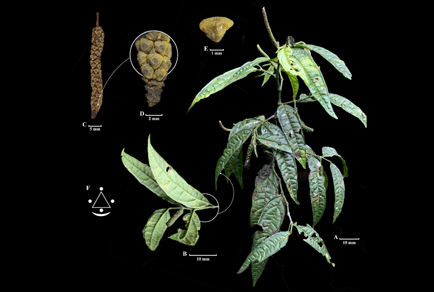
Piper trujilloi, a new species from the northwestern Amazon basin, is described and illustrated, and its phylogenetic relationships are discussed. It occurs in the Amazon foothills (a region composed of low hills and plains systems) and the humid forests of the Andes of Colombia (on the eastern slope of the Eastern Cordillera) in the department of Caquetá. Piper trujilloi is a small suffrutex, morphologically similar to P. dunstervilleorum. It can be differentiated by its lamina shape and pubescence, length of inflorescence peduncles, and pubescence of the floral bracts. Molecular sequence data support its inclusion in Piper subgenus Pennistylosum, a group highly diversified in the NW Amazon basin. A key to Amazonian suffrutescent Piper species with small and narrow laminas is provided. This species is one of several taxa described from the department of Caquetá in the last decade, a species-rich region that continues to produce new taxa.
Se describe e ilustra Piper trujilloi, una nueva especie del noroeste de la cuenca amazónica, y se discuten sus relaciones filogenéticas. Esta nueva especie se encuentra en las estribaciones (piedemonte) de los Andes y el Amazonas (una región compuesta por colinas bajas y sistemas de llanuras), en los bosques húmedos en la vertiente oriental de la Cordillera Oriental, departamento de Caquetá. P. trujilloi es un pequeño sufrútice morfológicamente similar a P. dunstervilleorum. Se puede diferenciar por la forma y pubescencia de su lámina, longitud de los pedúnculos de la inflorescencia y la pubescencia de las brácteas florales. Los datos de secuencias moleculares respaldan su inclusión en el subgénero Pennistylosum de Piper, un grupo muy diversificado en la cuenca noroeste del Amazonas. Se proporciona una clave para las especies de Piper sufrutescentes amazónicas con láminas pequeñas y estrechas. Esta especie es uno de los varios taxones descritos en el departamento de Caquetá en la última década, una región rica en especies que sigue produciendo nuevos taxones.
Palabras clave: bosques tropicales, Caquetá, Noroeste de la Amazonia
References
- Accidentalshrike. (2023) Piper consanguineum observation in iNaturalist. Available from: https://www.inaturalist.org/observations/177090191 (accessed 19 March 2026)
- Asmarayani, R. (2018) Phylogenetic relationships in Malesian-Pacific Piper (Piperaceae) and their implications for systematics. Taxon 67: 693–724. https://doi.org/10.12705/674.2
- Bachman, S., Moat, J., Hill, A.W., de laTorre, J. & Scott, B. (2011) Supporting red list threat assessments with GeoCAT: geospatial conservation assessment tool. ZooKeys 150: 117–126. https://doi.org/10.3897/zookeys.150.2109
- Barthlott, W., Mutke, J., Rafiqpoor, D., Kier, G. & Kreft, H. (2005) Global centers of vascular plant diversity. Nova Acta Leopoldina NF 92: 61–83.
- BHL. (2026 [continuously updated]) Biodiversity Heritage Library. Available from: https://www.biodiversitylibrary.org/ (accessed 28 January 2026)
- Bornstein, A.J. (2024) A formal nomenclature at the rank of subgenus for Neotropical Piper (Piperaceae). Phytoneuron 75: 1–7.
- Callejas-Posada, R. (2020) Piperaceae. In: Davidse, G., Ulloa Ulloa, C., Hernández, H.M. & Knapp, S. (Eds.) Flora Mesoamericana, vol. 2, part 2. Missouri Botanical Garden Press, Saint Louis.
- CRIA (Centro de Referência e Informação Ambiental). (2026 [continuously updated]) speciesLink network. Available from: https://specieslink.net/ (accessed 15 January 2026)
- De Candolle, C. (1869) Piperaceae. In: De Candolle, A.P. (Ed.) Prodromus Systematis Naturalis Regni Vegetabilis 16. pp. 235–471.
- Doyle, J.J. & Doyle, J.L. (1987) A rapid DNA isolation procedure for small quantities of fresh leaf tissue. Phytochemical Bulletin 19: 11–15.
- GBIF. (2026) Global Biodiversity Information Facility. GBIF. Available from: https://www.gbif.org/ (accessed 15 January 2026) https://doi.org/10.7717/peerj.7387/supp-1
- González, J.J., Etter, A.A., Sarmiento, A.H., Orrego, S.A., Ramírez, C., Cabrera, E., Vargas, D., Galindo, G., García, M.C. & Ordoñez, M.F. (2011) Análisis de tendencias y patrones espaciales de deforestación en Colombia. Instituto de Hidrología, Meteorología y Estudios Ambientales-IDEAM, Bogotá, 64 pp.
- Görts-van Rijn, A.R.A. (2007) Piperaceae. In: Jansen-Jacobs, M.J. (Eds.) Flora of the Guyanas, Series A, Phanerogams Fascicle 24. Royal Botanic Gardens, Kew, pp. 15–202.
- Guayasamin, J.M., Ribas, C.C., Carnaval, A.C., Carrillo, J.D., Hoorn, C., Lohmann, L.G., Riff, D., Ulloa Ulloa, C. & Albert, J.S. (2024) Evolution of Amazonian biodiversity: A review. Acta Amazonica 54: e54bc21360. https://doi.org/10.1590/1809-4392202103601
- IPNI. (2026) International Plant Names Index. The Royal Botanic Gardens, Kew, Harvard University Herbaria & Libraries and Australian National Herbarium. Published on the Internet: http://www.ipni.org (accessed 15 January 2026)
- IUCN. (2024) The IUCN Red List Categories and Criteria, ver. 16. Prepared by the Standards and Petitions Committee. Available from: http://www.iucnredlist.org/documents/RedListGuidelines.pdf (accessed 14 May 2026)
- Jaramillo, M.A. (2023) Piper alwynii (Piperaceae), a new species from the Cordillera del Cóndor at the border of Peru and Ecuador. Novon 31: 255–261. https://doi.org/10.3417/2023862
- Jaramillo, M.A., Callejas, R., Davidson, C., Smith, J.F., Stevens, A.C. & Tepe, E.J. (2008) A phylogeny of the tropical genus Piper using ITS and the chloroplast intron psbJ-petA. Systematic Botany 33: 647–660. https://doi.org/10.1600/036364408786500244
- Jaramillo, M.A. & Manos, P.S. (2001) Phylogeny and the patterns of floral diversity in the genus Piper (Piperaceae). American Journal of Botany 88: 706–716. https://doi.org/10.2307/2657072
- Jaramillo, M.A., Nossa-Silva, D. & Majín-Ladino, A.F. (2024) Piper globirhachis, a segregate species across the Marañon River Valley, and the resurrection of Pleiostachyopiper Trel. as a distinct subgenus of Neotropical Piper. Systematic Botany 49: 271–282. https://doi.org/10.1600/036364424X17189138775911
- Jaramillo, M.A., Rodríguez-Duque, D. & Escobar-Alba, M. (2023) A new species of Piper (Piperaceae) with peltate leaves from Serranía de las Quinchas, Colombia. PhytoKeys 227: 9–24. https://doi.org/10.3897/phytokeys.227.101405
- Jaramillo, M.A., Trujillo-Trujillo, E. & Aymard Corredor, G.A. (2025) A new species of Schlegelia (Schlegeliaceae) from the Colombian Amazon forest. Webbia 80: 281–289. https://doi.org/10.36253/jopt-17967
- JSTOR Global Plants. (2026 [continuously updated]) JSTOR Global Plants. Available from: https://plants.jstor.org/ (accessed 15 January 2026)
- Kunth, K. (1839) Bemerkungen über die Familie der Piperaceen. Linnaea 13: 562–726.
- Linnaeus, C. (1753) Species plantarum. Impensis Laurentii Salvii, Stockholm, 560 pp.
- López-Floriano, O.M., Croat, T.B. & Trujillo-Trujillo, E. (2024) Three new species of Anthurium sect. Belolonchium from the eastern slopes of the Eastern Andean Cordillera in Colombia. Novon, A Journal for Botanical Nomenclature 32: 52–59. https://doi.org/10.3417/2024889
- Miquel, F.A.W. (1843) Systema Piperacearum. Kramers, Rotterdam, 304 pp.
- Moonlight, P.W., Baldaszti, L., Cardoso, D., Elliott, A., Särkinen, T. & Knapp, S. (2024) Twenty years of big plant genera. Proceedings of the Royal Society B: Biological Sciences 291. https://doi.org/10.1098/rspb.2024.0702
- Murillo-Serna, J.S., Trujillo-Trujillo, E., David-Higuita, H.A., Perdomo, O. & Mendoza-Cifuentes, H. (2025) Allomaieta isauroi (Melastomataceae, Cyphostyleae): a new species from the Andean-Amazonian foothills of Colombia. Phytotaxa 711: 81–88. https://doi.org/10.11646/phytotaxa.711.1.6
- Pérez-Escobar, O.A., Zizka, A., Bermúdez, M.A., Meseguer, A.S., Condamine, F.L., Hoorn, C., Hooghiemstra, H., Pu, Y., Bogarín, D., Boschman, L.M., Pennington, R.T., Antonelli, A. & Chomicki, G. (2022) The Andes through time: evolution and distribution of Andean floras. Trends in Plant Science 27: 364–378. https://doi.org/10.1016/j.tplants.2021.09.010
- Plants of the World. POWO. (2026 [continously updated]) World Checklist of Vascular Plants. Available from: https://powo.science.kew.org/ (accessed 15 January 2026)
- RAISG. (2022) Deforestacion en la Amazonia al 2025: bajo un enfoque de accesibilidad al bosque. Informe Técnico. Red Amazónica de Información Socio-ambiental y Georeferenciada, Bogotá, 106 pp.
- Sabatini, F.M., Jiménez-Alfaro, B., Jandt, U., Chytrý, M., Field, R., Kessler, M., Lenoir, J., Schrodt, F., Wiser, S.K., Arfin Khan, M.A.S., Attorre, F., Cayuela, L., De Sanctis, M., Dengler, J., Haider, S., Hatim, M.Z., Indreica, A., Jansen, F., Pauchard, A., Peet, R.K., Petřík, P., Pillar, V.D., Sandel, B., Schmidt, M., Tang, Z., van Bodegom, P., Vassilev, K., Violle, C., Alvarez-Davila, E., Davidar, P., Dolezal, J., Hérault, B., Galán-de-Mera, A., Jiménez, J., Kambach, S., Kepfer-Rojas, S., Kreft, H., Lezama, F., Linares-Palomino, R., Monteagudo Mendoza, A., N Dja, J.K., Phillips, O.L., Rivas-Torres, G., Sklenář, P., Speziale, K., Strohbach, B.J., Vásquez Martínez, R., Wang, H.F., Wesche, K. & Bruelheide, H. (2022) Global patterns of vascular plant alpha diversity. Nature Communications 13. https://doi.org/10.1038/s41467-022-32063-z
- Salazar, D., Jaramillo, A. & Marquis, R.J. (2016a) The impact of plant chemical diversity on plant–herbivore interactions at the community level. Oecologia 181: 1199–1208. https://doi.org/10.1007/s00442-016-3629-y
- Salazar, D., Jaramillo, M.A. & Marquis, R.J. (2016b) Chemical similarity and local community assembly in the species rich tropical genus Piper. Ecology 97: 3176–3183. https://doi.org/10.1002/ecy.1536
- World Flora Online. (2026) Available from: http://www.worldfloraonline.org/ (accessed 30 March 2026)
- Sen, S., Dayanandan, S., Davis, T., Ganesan, R., Jagadish, M.R., Mathew, P.J. & Ravikanth, G. (2019) Origin and evolution of the genus Piper in Peninsular India. Molecular Phylogenetics and Evolution 138: 102–113. https://doi.org/10.1016/j.ympev.2019.05.033
- Smith, J., Hastings, C., Davidson, C., Buerki, S., Novak, S. & Bornstein, A. (2026) A single widespread species or multiple narrow endemics: a search for boundaries within the Piper amalago complex (Piperaceae). Molecular Phylogenetics and Evolution 214. https://doi.org/10.1016/j.ympev.2025.108457
- Stamatakis, A. (2014) RAxML version 8: A tool for phylogenetic analysis and post-analysis of large phylogenies. Bioinformatics 30: 1312–1313. https://doi.org/10.1093/bioinformatics/btu033
- Steyermark, J.A. (1984) Flora de Venezuela. Piperaceae. Vol. 2 Segunda Parte. Ediciones Fundación Educación Ambiental, Caracas, 619 pp.
- Steyermark, J.A. & Callejas-Posada, R. (1997) Piperaceae. In: Berry, P.E., Yatskievych, K. & Holst, B. (Eds.) Flora of the Venezuelan Guyana, Vol. 7. Missouri Botanical Garden Press, Saint Louis, pp. 681–738.
- Thiers, B. (2026 [continually updated]) Index Herbariorum: A global directory of public herbaria and associated staff. New York Botanical Garden s virtual herbarium. Available from: http://sweetgum.nybg.org/ih/ (accessed 10 January 2026)
- Trelease, W. (1936) Piperaceae. In: Macbride, J.F. (Ed.) Flora of Peru. Publications of the Field Museum of Natural History, Botanical Series, Chicago, pp. 3–253.
- Trelease, W. & Yuncker, T.G. (1950) The Piperaceae of Northern South America. 2 Vols. University of Illinois Press, Urbana.
- TROPICOS. (2026 [continuously updated]) Tropicos.org. Missouri Botanical Garden. Available from: https://tropicos.org/ (accessed 15 January 2026)
- Trujillo Calderón, W. & Jaramillo, M.A. (2019) An emended description of Piper cochleatum and a new species of Piper (Piperaceae) from the Amazonian slopes of the Colombian Andes. Phytotaxa 408: 59–68. https://doi.org/10.11646/phytotaxa.408.1.4
- Trujillo, W. & Jaramillo, M.A. (2021) Taxonomic novelties of Piper (Piperaceae) from the Amazonian slopes of the Northern Andes. Brittonia 73: 67–76. https://doi.org/10.1007/s12228-020-09638-5
- Trujillo, W. & Vargas, V. (2022) Las especies de Piper: en la vertiente amazónica de los Andes, Caquetá. Guía de campo. Editorial–Universidad de la Amazonia, Florencia, Caquetá, Colombia, 258 pp.
- Trujillo, W., Jaramillo, M.A., Toro, D. & Balslev, H. (2023) Over- and under-described: new species, new synonyms, and a new name in the megadiverse genus Piper (Piperaceae) on the east Andean slopes. Phytotaxa 601: 263–284. https://doi.org/10.11646/phytotaxa.601.3.4
- Trujillo, W., Trujillo, E.T. & Jaramillo, M.A. (2021) Piper callejasii (Piperaceae), a new species from the eastern slopes of the Andes, northern South America. Novon, A Journal for Botanical Nomenclature 29: 200–205. https://doi.org/10.3417/2021659
- Trujillo, W., Trujillo, E.T., Ortiz-Morea, F.A., Toro, D.A. & Jaramillo, M.A. (2022) New Piper species from the eastern slopes of the Andes in northern South America. PhytoKeys 206: 25–48. https://doi.org/10.3897/PHYTOKEYS.206.75971
- Yuncker, T.G. (1972) The Piperaceae of Brazil I. Piper–group I, II, III and IV. Hoehnea 2: 19–336.
- Yuncker, T.G. (1973) The Piperaceae of Brazil II. Piper–group V, Ottonia; Pothomorphe; and Sarcorhachis. Hoehnea 3: 29–284.