
Abstract
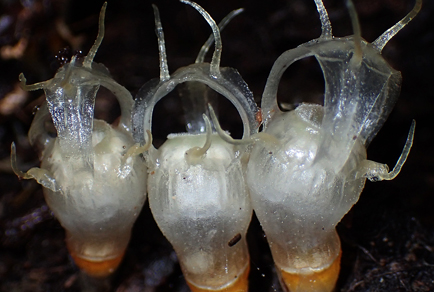
A comprehensive morphological and taxonomic revision of Thismia abei (Thismiaceae), a mycoheterotrophic species endemic to Japan, is presented. The history of its discovery and subsequent studies is overviewed, and the actual place of valid publication of its basionym, Glaziocharis abei, is established. The typification of T. abei is revised accordingly, and a drawing that illustrated the first documented record of the species is designated as a new lectotype. The current knowledge of the morphology of the species is updated based on new data on its floral anatomy, as follows. The inner tepals are confirmed to be postgenitally fused into a mitre. The stamens are shown to be united into a tube through perfect postgenital fusion. Each anther theca consists of two microsporangia, and the anther is thus tetrasporangiate. Each microsporangium dehisces by its own longitudinal slit. The pyramidal structure terminating the stylar column is demonstrated to consist largely of free styles (which are united into a tubular portion only at the base of this structure). The styles are proven to bear paired stigmas at their bases. For the first time, detailed photographs of the flower structure of T. abei are published herein. The current knowledge of the geographical distribution of the species is summarised and shown on a map. Its conservation status is assessed as Critically Endangered (CR).
References
- Abe, C. (1947) Strange plants? Awa-no-Shizen [Nature of Awa] 1 (1): 6. [In Japanese]
- Abe, C. (1949) Historical study of Awa plants. Educational Review 2: 35–43. [In Japanese]
- Abe, C. (1950) On the habitat of Glaziocharis abei. Journal of Japanese Botany 25 (9–12): 197–199. [In Japanese] https://doi.org/10.51033/jjapbot.25_9-12_3210
- Abe, C. (1951a) Life form of the Glaziocharis abei and its environment. Awa-no-Shizen [Nature of Awa] 2 (1): 5–7. [In Japanese]
- Abe, C. (1951b) Glaziocharis abei Akasawa and its full view and anatomy. Tokushima Prefectural Educational Materials: 72, 75. [In Japanese]
- Abe, C. (1955) The occurrence of Tanuki-no-shokudai, and its forms. Awa-no-Shizen [Nature of Awa] 2 (2): 12. [In Japanese]
- Abe, C. (1967) Glaziocharis abei Akasawa. Tokushima Plants: 94–95. [In Japanese]
- Abe, C. (1990) Flora of Tokushima Prefecture. Education Publishing Center, Tokushima City, 580 pp. [In Japanese]
- Akasawa, Y. (1948a) On a new species of Thismiaceae. Awa-no-Shizen [Nature of Awa] 1 (2): 4–7. [In Japanese]
- Akasawa, Y. (1948b) The strange plant: Tanuki-no-shokudai. Tokushima Science 2: 5–8. [In Japanese]
- Akasawa, Y. (1950a) A new species of Glaziocharis (Burmanniaceae) found in Japan. Journal of Japanese Botany 25 (9–12): 193–196. https://doi.org/10.51033/jjapbot.25_9-12_3209
- Akasawa, Y. (1950b) The scientific name of the “Tanuki-no-shokudai” was established. Awa-no-Shizen [Nature of Awa] 2 (1): 1–3. [In Japanese]
- Anonymous (1979) Agreement on the effective publication of botanical names (Japanese Society for Plant Taxonomy, September 28, 1978). Journal of Japanese Botany 54 (3): 95–96. [In Japanese] https://doi.org/10.51033/jjapbot.54_3_6970
- Asano, Y., Okada, H., Yamana, K., Kanegae, H. & Suetsugu, K. (2024) New records of Thismia abei (Thismiaceae) from Kagoshima Prefecture, Japan. Journal of Phytogeography and Taxonomy 72 (1): 67–69. [In Japanese] https://doi.org/10.18942/chiribunrui.0721-12
- Barykina, R.P., Veselova, T.D., Deviatov, A.G., Djalilova, H.H., Iljina, G.M. & Chubatova, N.V. (2004) Handbook of the botanical microtechniques. Moscow University Press, Moscow, 311 pp. [In Russian]
- Beccari, O. (1878) Malesia: raccolta di osservazioni botaniche intorno alle piante dell’arcipelago Indo-Malese e Papuano pubblicata da Odoardo Beccari, destinata principalmente a descrivere ed illustrare le piante da esso raccolte in quelle regioni durante i viaggi eseguiti dall’anno 1865 all’anno 1878, vol. 1. Genova, Tip. del R. Istituto Sordo-muti, 379 pp. https://doi.org/10.5962/bhl.title.79357
- Beentje, H.J. (2016) The Kew plant glossary: an illustrated dictionary of plant terms. 2nd ed. Royal Botanic Gardens, Kew, London, 184 pp.
- Corner, E.J.H. & Watanabe, K. (1969) Illustrated guide to tropical plants. Hirokawa, Tokyo, 1147 pp. [In Japanese]
- Dančák, M., Hroneš, M., Sochor, M., Uvírová, A., Blažek, V.T., Siti-Munirah, M.Y. & Yiing, L.C. (2025) Thismia velaris and T. dasyantha, two new species of Thismia section Thismia subsect. Odoardoa (Thismiaceae) from Sarawak, Malaysia. Phytotaxa 715 (2): 117–128. https://doi.org/10.11646/phytotaxa.715.2.2
- Feller, B., Dančák, M., Hroneš, M., Sochor, M., Suetsugu, K. & Imhof, S. (2022) Mycorrhizal structures in mycoheterotrophic Thismia spp. (Thismiaceae): functional and evolutionary interpretations. Mycorrhiza 32: 269–280. https://doi.org/10.1007/s00572-022-01076-3
- Griffith, W. (1845) On the root-parasites referred by authors to Rhizantheae, and their allies [end]. Proceedings of the Linnean Society of London 1 (23): 221.
- Harms, H. (ed.) (1935) International rules of botanical nomenclature adopted by the International Botanical Congresses of Vienna, 1905, and Brussels, 1910: revised by the International Botanical Congress of Cambridge, 1930. G. Fischer, Jena, 151 pp.
- Hatusima, S. (1976) Two new species of Burmanniaceae from Japan. Journal of Geobotany 24 (1): 2–10.
- Honda, M. & Tuyama, T. (1948) “Strange plants” discovered by Abe Konichi. Journal of Japanese Botany 22 (1–2): 27–29. [In Japanese] https://doi.org/10.51033/jjapbot.22_1-2_2978
- Hutchinson, J. (1934) The families of flowering plants arranged according to a new system based on their probable phylogeny, vol. 2. Monocots. Macmillan and Co., London, 243 pp.
- Ikeda, H. (2015) A discovery of a “raccoon dog mummy”!? Ouroboros 19 (3): 11–12. [In Japanese]
- Ikeda, H., Shimizu, A., Ogawa, M., Ibaragi, Y. & Akiyama, S. (2014) Lectotypification of Glaziocharis abei (Burmanniaceae). Journal of Japanese Botany 89 (3): 176–180. https://doi.org/10.51033/jjapbot.89_3_10509
- IUCN Red List Categories and Criteria (2012) IUCN Red List Categories and Criteria: Version 3.1. Second edition. IUCN, Gland and Cambridge, 32 pp.
- Japanese Society for Plant Systematics (2025) Thismia abei. In: Ministry of the Environment, Japan (Eds.) The 5th Red Databook Vascular Plants: Threatened wildlife of Japan. Ministry of the Environment, Tokyo, pp. 542–544. [In Japanese]
- Kitamura, S., Murata, G. & Koyama, T. (1972) Coloured illustrations of herbaceous plants of Japan, vol. 3 (Monocotyledoneae). Hoikusha Publishing, Osaka, 464 pp. [In Japanese]
- Kumar, P., Gale, S.W., Li, J.H., Bouamanivong, S. & Fischer, G.A. (2017) Thismia nigricoronata, a new species of Burmanniaceae (Thismieae, Dioscoreales) from Vang Vieng, Vientiane Province, Laos, and a key to subgeneric classification. Phytotaxa 319 (3): 225–240. https://doi.org/10.11646/phytotaxa.319.3.2
- Mahood, Q., van Eerd, D. & Irvin, E. (2013) Searching for grey literature for systematic reviews: challenges and benefits. Research Synthesis Methods 5: 221–234. https://doi.org/10.1002/jrsm.1106
- Masamune, G. (1969) Color illustrated flora of Nippon, vol. 8. Koyo Shoin, Tokyo, 295 pp. [In Japanese]
- Matsui, H. (2019) The first record of Thismia abei (Akasawa) Hatus. in Ehime Prefecture. Journal of the Ehime Botanical Society 48: 61. [In Japanese]
- Matsumoto, M. & Yamada, T. (1994) New locality of Thismia abei (Akasawa) Hatusima in Shizuoka Prefecture. Journal of Japanese Botany 69 (5): 324–327. [In Japanese] https://doi.org/10.51033/jjapbot.69_5_8930
- Merckx, V.S.F.T. & Smets, E.F. (2014) Thismia americana, the 101st anniversary of a botanical mystery. International Journal of Plant Sciences 175 (2): 165–175. https://doi.org/10.1086/674315
- Mueller, F.J.H.V. (1891) Notes on a new Tasmanian plant of the order Burmanniaceae. Papers and Proceedings of the Royal Society of Tasmania 1890: 232–235. https://doi.org/10.26749/SRKX5808
- Nuraliev, M.S. & Sennikov, A.N. (2024) A checklist of Thismia section Labiothismia (Thismiaceae), reinstated to include Asian species earlier placed in the neotropical T. sect. Glaziocharis. Phytotaxa 662 (1): 93–101. https://doi.org/10.11646/phytotaxa.662.1.7
- Nuraliev, M.S. & Sennikov, A.N. (2025) A new section in Asian Thismia (Thismiaceae), T. sect. Mirabiles, and its checklist. Phytotaxa 682 (3): 259–266. https://doi.org/10.11646/phytotaxa.682.3.6
- Nuraliev, M.S., Beer, A.S., Kuznetsov, A.N. & Kuznetsova, S.P. (2014) Thismia mucronata (Thismiaceae), a new species from Southern Vietnam. Phytotaxa 167 (3): 245–255. https://doi.org/10.11646/phytotaxa.167.3.3
- Nuraliev, M.S., Yudina, S.V., Shepeleva, E.A., Truong, B.V., Do, T.X., Beer, A.S. & Remizowa, M.V. (2021) Flower structure in Thismia (Thismiaceae, Dioscoreales): new insights from anatomy, vasculature and development. Botanical Journal of the Linnean Society 195 (3): 501–531. https://doi.org/10.1093/botlinnean/boaa066
- Nuraliev, M.S., Yudina, S.V., Dac, L.X., Kuznetsov, A.N., Kuznetsova, S.P. & Semenyuk, I.I. (2024) Thismia papillata (Thismiaceae), a new species from northern Vietnam. Phytotaxa 655 (3): 261–271. https://doi.org/10.11646/phytotaxa.655.3.4
- Ohashi, H. (2015) Thismiaceae. In: Ohashi, H., Kadota, Y., Kihara, H., Murata, J. & Yonekura, H. (Eds.) Wild flowers of Japan. Revised edition, vol. 1: Cycadaceae to Cyperaceae. Heibonsha, Tokyo, pp. 143–145. [In Japanese]
- Ohwi, J. (1953) Flora of Japan. Shibundo, Tokyo, 1383 pp. [In Japanese]
- Ohwi, J. (1965a) Flora of Japan. Revised edition. Shibundo, Tokyo, 1560 pp. [In Japanese]
- Ohwi, J. (1965b) Flora of Japan. English edition. Smithsonian Institution, Washington, 1067 pp.
- Ruzin, S.E. (1999) Plant microtechnique and microscopy. Oxford University Press, Oxford, 322 pp.
- Satake, Y. (1982) Burmanniaceae. In: Satake, Y., Ohwi, J., Kitamura, S., Watari, S. & Tominari, T. (Eds.) Wild flowers of Japan, herbaceous plants, vol. 1: Monocotyledoneae. Heibonsha, Tokyo, pp. 63–64. [In Japanese]
- Schlechter, F.R.R. (1921) Die Thismieae. Notizblatt des Königl. Botanischen Gartens und Museums zu Berlin 8 (71): 31–45. https://doi.org/10.2307/3994560
- Sennikov, A.N. (2022) The concept of epitypes in theory and practice. Nordic Journal of Botany 2022 (8): e03535 [1–4]. https://doi.org/10.1111/njb.03535
- Sennikov, A.N. (2024a) Taraxacum stepanekii, a replacement name for Taraxacum roseolum Kirschner & Štěpánek non Charit., with nomenclatural notes on the taxonomic legacy of Boris S. Kharitontsev in the digital era. Botanica 30 (1): 51–58. https://doi.org/10.35513/Botlit.2024.1.6
- Sennikov, A.N. (2024b) The taxonomic circumscription and nomenclatural history of Pilosella suecica (Asteraceae): A special case of grey literature in taxonomic botany. Plants 13 (10): e1301 [1–19]. https://doi.org/10.3390/plants13101301
- Sennikov, A.N. & Belyaeva, I.V. (2025) Correctable or not? The case of plant epithets derived from the Elbrus/Elburs Mountains in Iran, with further notes on taxonomic grey literature. Taxon https://doi.org/10.1002/tax.70064
- Sennikov, A.N., Lazkov, G.A., Ganybaeva, M.R., Friesen, N. & German, D.A. (2025) Taxonomic corrections and new records for vascular plants of Kyrgyzstan, 6. Nordic Journal of Botany 2025 (9): e04731 [1–38]. https://doi.org/10.1002/njb.04731
- Severova, E.E., Polevova, S.V., Yudina, S.V., Truong, B.V., Do, T.X., Chantanaorrapint, S., Suetsugu, K., Tagane, S., Guo, X., Schelkunov, M.I. & Nuraliev, M.S. (2021) Palynological study of Asian Thismia (Thismiaceae: Dioscoreales) reveals an unusual pollen type. Plant Systematics and Evolution 307 (5): e54 [1–19]. https://doi.org/10.1007/s00606-021-01778-9
- Shepeleva, E.A., Schelkunov, M.I., Hroneš, M., Sochor, M., Dančák, M., Merckx, V.S.F.T., Kikuchi, I.A.B.S., Chantanaorrapint, S., Suetsugu, K., Tsukaya, H., Mar, S.S., Luu, H.T., Li, H.Q., Logacheva, M.D. & Nuraliev, M.S. (2020) Phylogenetics of the mycoheterotrophic genus Thismia (Thismiaceae: Dioscoreales) with a focus on the Old World taxa: delineation of novel natural groups and insights into the evolution of morphological traits. Botanical Journal of the Linnean Society 193 (3): 287–315. https://doi.org/10.1093/botlinnean/boaa017
- Shin, T. (1974) Two species of the genus Glaziocharis (Burmanniaceae) from southern Kyushu. Journal of Japanese Botany 49 (1): 3–6. [In Japanese] https://doi.org/10.51033/jjapbot.49_1_6343
- Simpson, M.G. (2019) Plant systematics. 3rd ed. Elsevier, Burlington, 761 pp. https://doi.org/10.1016/B978-0-12-812628-8.50001-8
- Siti-Munirah, M.Y. & Alias, S.M. (2025) Thismia aliasii (Thismiaceae), a new species from Terengganu, Peninsular Malaysia. PhytoKeys 254: 175–188. https://doi.org/10.3897/phytokeys.254.136085
- Siti-Munirah, M.Y., Siew, T.G., Mat-Tahir, M.F. & Azhar, A. (2025) Thismia selangorensis (Thismiaceae): a new mitriform fairy lantern species from Selangor, Malaysia. PhytoKeys 267: 9–21. https://doi.org/10.3897/phytokeys.267.157968
- Smith, J.J. (1927) An interesting new Thismia. Bulletin du Jardin Botanique de Buitenzorg Ser. 3 9: 220–222.
- Sokoloff, D.D., Remizowa, M.V., Timonin, A.C., Oskolski, A.A. & Nuraliev, M.S. (2018) Types of organ fusion in angiosperm flowers (with examples from Chloranthaceae, Araliaceae and monocots). Biologia Serbica 40 (1): 16–46. https://doi.org/10.5281/zenodo.1424458
- Suetsugu, K. & Ishida, K. (2011) New locality and fungal association of Thismia abei (Thismiaceae). Journal of Phytogeography and Taxonomy 59: 43–45. https://doi.org/10.24517/00053454
- Suetsugu, K. & Okada, H. (2025) High mycorrhizal specificity in the monotypic mycoheterotrophic genus Relictithismia (Thismiaceae). Mycorrhiza 35: 29 [1–8]. https://doi.org/10.1007/s00572-025-01202-x
- Suetsugu, K. & Sueyoshi, M. (2021) Fairy lanterns may lure pollinators by mimicking fungi. Frontiers in Ecology & the Environment 19 (4): 233. https://doi.org/10.1002/fee.2342
- Suetsugu, K., Yamana, K. & Okada, H. (2023) Rediscovery of the presumably extinct fairy lantern Thismia kobensis (Thismiaceae) in Hyogo Prefecture, Japan, with discussions on its taxonomy, evolutionary history, and conservation. Phytotaxa 585 (2): 102–112. https://doi.org/10.11646/phytotaxa.585.2.2
- Suetsugu, K., Nakamura, Y., Nakano, T. & Tagane, S. (2024) Relictithismia kimotsukiensis, a new genus and species of Thismiaceae from southern Japan with discussions on its phylogenetic relationship. Journal of Plant Research 137 (3): 411–422. https://doi.org/10.1007/s10265-024-01532-5
- Sukhorukov, A.P., Wen, Z., Krinitsina, A.A., Fedorova, A.V., Verloove, F., Kushunina, M., Léger, J.-F., Chambouleyron, M., Tanji, A. & Sennikov, A.N. (2025) A revised taxonomy of the Bassia scoparia complex (Camphorosmoideae, Amaranthaceae s.l.) with an updated distribution of B. indica in the Mediterranean Region. Plants 14 (3): e398 [1–25]. https://doi.org/10.3390/plants14030398
- Thiers, B. (2025 [continuously updated]) Index Herbariorum: A global directory of public herbaria and associated staff. New York Botanical Garden’s Virtual Herbarium. Available from: http://sweetgum.nybg.org/science/ih/ (accessed 26 November 2025)
- Tillett, S. & Newbold, E. (2006) Grey literature at the British Library: revealing a hidden resource. Interlending and Document Supply 32: 70–73. https://doi.org/10.1108/02641610610669769
- Tsukaya, H. (2016) Burmanniaceae. In: Iwatsuki, K., Boufford, D.E. & Ohba, H. (Eds.) Flora of Japan, vol. IVb. Kodansha LTD, Tokyo, pp. 194–197.
- Turland, N.J., Wiersema, J.H., Barrie, F.R., Gandhi, K.N., Gravendyck, J., Greuter, W., Hawksworth, D.L., Herendeen, P.S., Klopper, R.R., Knapp, S., Kusber, W.-H., Li, D.Z., May, T.W., Monro, A.M., Prado, J., Price, M.J., Smith, G.F. & Zamora Señoret, J.C. (Eds.) (2025) International Code of Nomenclature for algae, fungi, and plants (Madrid Code). Regnum Vegetabile 162. University of Chicago Press, Chicago. https://doi.org/10.7208/chicago/9780226839479.001.0001
- Warming, E. (1901) Sur quelques Burmanniacées recueillies au Brésil par le Dr. A. Glaziou. Oversigt Over Det Kgl. Danske Videnskabernes Selskabs Forhandlinger 1901 (6): 173–188.
- Ya, J.D., Chen, H.Y., Zhang, W., Zhu, R.B., Cai, J. & Yu, W.B. (2024) Phylogenetic and biogeographical analyses of Thismia (Thismiaceae) support T. malipoensis as the eighth species in China. Willdenowia 54 (1): 47–63. https://doi.org/10.3372/wi.54.54102