
Abstract
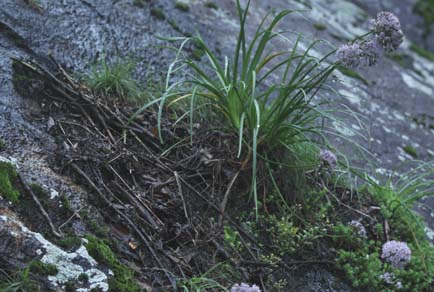
Allium heterophyllum (sect. Rhizirideum) was initially described based on a single population and preliminarily assessed as Near Threatened (NT). Here, we present a comprehensive update on its taxonomy and conservation status based on extensive field investigations of five wild populations, combined with morphological and molecular analyses. We discovered key diagnostic characteristics previously unrecorded, notably vegetative propagation via rhizome bulblets, dynamic scape curvature during anthesis, and leaf heteroblasty between juvenile and adult plants. Significant intraspecific variation was also documented in leaf cross-section morphology, floral coloration (white vs. pale purple), and the presence or absence of nectaries. To clarify its phylogenetic position, we conducted a reconstruction using 166 ITS sequences and 113 complete chloroplast genomes, encompassing all 26 recognized species within the section. Allium heterophyllum was resolved as a distinct monophyletic clade within sect. Rhizirideum, although cytonuclear discordance was observed: the nuclear topology placed it sister to the A. burjaticum complex, while the plastid topology resolved it as sister to the A. senescens clade. Based on its expanded distribution in Henan and Shaanxi provinces and a stable population size of approximately 10,000 individuals, we recommend revising its conservation status to Least Concern (LC). Finally, a revised morphological description and an updated identification key for all 26 recognized species of sect. Rhizirideum are provided.
References
- Boissier, P.E. (1882) Flora Orientalis: sive, Enumeratio plantarum in Oriente a Graecia et Aegypto ad Indiae fines hucusque observatarum, vol. 5. H. Georg, Genevae & Basilea, 190 pp.
- Capella-Gutiérrez, S., Silla-Martínez, J.M. & Gabaldón, T. (2009) trimAl: a tool for automated alignment trimming in large-scale phylogenetic analyses. Bioinformatics 25: 1972–1973. https://doi.org/10.1093/bioinformatics/btp348
- Chen, S., Zhou, Y., Chen, Y. & Gu, J. (2018) fastp: an ultra-fast all-in-one FASTQ preprocessor. Bioinformatics 34: i884–i890. https://doi.org/10.1093/bioinformatics/bty560
- Cheng, R.Y., Li, J., Xie, D.F., He, X.J., Zhou, R.X., Li, Q., Yu, Y. & Zhou, S.D. (2025a) Effects of Mountain Uplift and Climatic Oscillations on Phylogeography and Species Divergence of Notholirion (Liliaceae). Journal of Heredity: 1–21. https://doi.org/10.1093/jhered/esaf032
- Cheng, R.Y., Yang, J.T., Tan, J.B., Zhou, S.D., He, X.J. & Xie, D.F. (2025b) Allium peikingense (Amaryllidaceae, Allioideae), a new species from Beijing, China. Phytotaxa 720: 209–223. https://doi.org/10.11646/phytotaxa.720.3.2
- Choi, H.J. & Oh, B.U. (2010) A new species and a new combination of Allium sect. Rhizirideum (Alliaceae) from northeastern China and Korea. Brittonia 62: 199–205. https://doi.org/10.1007/s12228-009-9124-6
- Choi, H.J., Jang, C.G., Kim, S.H., Kim, Y.C. & Park, H.S. (2021) Notes on Allium section Rhizirideum (Amaryllidaceae) in South Korea and northeastern China: with a new species from Ulleungdo Island. PhytoKeys 176: 1–19. https://doi.org/10.3897/phytokeys.176.63378
- Don, G. (1827) A monograph of the genus Allium. Memoirs of the Wernerian Natural History Society 6: 1–102.
- Doyle, J. (1987) A rapid DNA isolation procedure for small amounts of fresh leaf tissue. Phytochemical Bulletin 19: 11–15.
- Friesen, N. (1987) Allium L. In: Malyschev, L.I. & Peshkova, G.A. (Eds.) Flora of Siberia, vol. 4. Nauka, Novosibirsk, pp. 55–97.
- Friesen, N., Fritsch, R.M. & Blattner, F.R. (2006) Phylogeny and new intrageneric classification of Allium (Alliaceae) based on nuclear ribosomal DNA ITS sequences. Aliso 22: 372–395. https://doi.org/10.5642/aliso.20062201.31
- Friesen, N., Smirnov, S., Leweke, M., Seregin, A. & Fritsch, R. (2021) Taxonomy and phylogenetics of Allium section Decipientia (Amaryllidaceae): Morphological characters do not reflect the evolutionary history revealed by molecular markers. Botanical Journal of the Linnean Society 197: 190–228. https://doi.org/10.1093/botlinnean/boab023
- Fritsch, R.M. & Friesen, N. (2002) Evolution, domestication and taxonomy. In: Rabinowitch, H.D. & Currah, L. (Eds.) Allium Crop Science (pp. 5–30). Wallingford, UK: CABI. https://doi.org/10.1079/9780851995106.0005
- Fu, X., Xie, D.F., Zhou, Y.Y., Cheng, R.Y., Zhang, X.Y., Zhou, S.D. & He, X.J. (2023) Phylogeny and adaptive evolution of subgenus Rhizirideum (Amaryllidaceae, Allium) based on plastid genomes. BMC Plant Biology 23: 70. https://doi.org/10.1186/s12870-022-03993-z
- Govaerts, R., Kington, S., Friesen, N., Fritsch, R., Snijman, D.A., Marcucci, R., Silverstone-Sopkin, P.A. & Brullo, S. (2021) World checklist of Amaryllidaceae: Royal Botanic Gardens, Kew.
- Hanelt, P. & Fritsch, R.M. (1994) Notes on some infrageneric taxa of Allium L. Kew Bulletin 49: 559–564. https://doi.org/10.2307/4114484
- Jang, J.E., Park, J.S., Jung, J.Y., Kim, D.K., Yang, S. & Choi, H.J. (2021) Notes on Allium section Rhizirideum (Amaryllidaceae) in South Korea and northeastern China: with a new species from Ulleungdo Island. PhytoKeys 176: 1–19. https://doi.org/10.3897/phytokeys.176.63378
- Jang, J.E., Choi, H.J. & Son, D.C. (2025) Allium alatoscapum, a replacement name for the northeastern Asian taxon previously known as Allium spirale. Korean Journal of Plant Taxonomy 55: 119–122. https://doi.org/10.11110/kjpt.2025.55.2.119
- Kalyaanamoorthy, S., Minh, B.Q., Wong, T.K.F., von Haeseler, A. & Jermiin, L.S. (2017) ModelFinder: fast model selection for accurate phylogenetic estimates. Nature Methods 14: 587–589. https://doi.org/10.1038/nmeth.4285
- Katoh, K., Kuma, K., Toh, H. & Miyata, T. (2005) MAFFT version 5: improvement in accuracy of multiple sequence alignment. Nucleic Acids Research 33: 511–518. https://doi.org/10.1093/nar/gki198
- Kearse, M., Moir, R., Wilson, A., Stones-Havas, S., Cheung, M., Sturrock, S., Buxton, S., Cooper, A., Markowitz, S., Duran, C., Thierer, T., Ashton, B., Meintjes, P. & Drummond, A. (2012) Geneious Basic: an integrated and extendable desktop software platform for the organization and analysis of sequence data. Bioinformatics 28: 1647–1649. https://doi.org/10.1093/bioinformatics/bts199
- Khan, N., Fritsch, R., Sultan, A. & Khan, T. (2021) Allium (Amaryllidaceae) species in Pakistan: two new records and a new species from Zhob (Balochistan). Pakistan Journal of Botany 53: 1–7. https://doi.org/10.30848/PJB2021-5(1)
- Koch, W.D.J. (1837) Synopsis Florae Germanicae et Helveticae. F. Wilmans, Frankfurt, 844 pp.
- Kumar, S., Stecher, G., Li, M., Knyaz, C. & Tamura, K. (2018) MEGA X: molecular evolutionary genetics analysis across computing platforms. Molecular Biology and Evolution 35: 1547–1549. https://doi.org/10.1093/molbev/msy096
- Li, Q.Q., Zhou, S.D., He, X.J., Yu, Y., Zhang, Y.C. & Wei, X.Q. (2010) Phylogeny and biogeography of Allium (Amaryllidaceae: Allieae) based on nuclear ribosomal internal transcribed spacer and chloroplast rps16 sequences, focusing on the inclusion of species endemic to China. Annals of Botany 106: 709–733. https://doi.org/10.1093/aob/mcq177
- Linnaeus, C. (1753) Species Plantarum, vol. 1. L. Salvius, Stockholm, 560 pp.
- Martínková, J., Klimeš, A., Puy, J. & Klimešová, J. (2020) Response of clonal versus non-clonal herbs to disturbance: Different strategies revealed. Perspectives in Plant Ecology, Evolution and Systematics 44: 125529. https://doi.org/10.1016/j.ppees.2020.125529
- Maximowicz, C.J. (1859) Primitiae Florae Amurensis. Kaiserliche Akademie der Wissenschaften, St. Petersburg, 504 pp.
- Nguyen, L.T., Schmidt, H.A., von Haeseler, A. & Minh, B.Q. (2015) IQ-TREE: a fast and effective stochastic algorithm for estimating maximum-likelihood phylogenies. Molecular Biology and Evolution 32: 268–274. https://doi.org/10.1093/molbev/msu300
- Nguyen, N.H., Driscoll, H.E. & Specht, C.D. (2008) A molecular phylogeny of the wild onions (Allium; Alliaceae) with a focus on the western North American center of diversity. Molecular Phylogenetics and Evolution 47: 1157–1172. https://doi.org/10.1016/j.ympev.2007.12.006
- Pearse, I., Becker, Z., Ode, P., Gaskin, J. & West, N. (2025) Low genetic diversity in populations of a clonal invasive plant limits sexual reproduction. American Journal of Botany 112: e70083. https://doi.org/10.1002/ajb2.70083
- Singh, N., Gusain, A., Nigam, M. & Mishra, A. (2025) The pharmacological and therapeutic versatility of Allium species: a comprehensive exploration of bioactive constituents and biological activities. Discover Applied Sciences 7. https://doi.org/10.1007/s42452-025-06800-0
- Sinitsyna, T.A., Herden, T. & Friesen, N. (2016) Dated phylogeny and biogeography of the Eurasian Allium section Rhizirideum (Amaryllidaceae). Plant Systematics and Evolution 302: 1–18. https://doi.org/10.1007/s00606-016-1333-3
- Tillich, M., Lehwark, P., Pellizzer, T., Ulbricht-Jones, E.S., Fischer, A., Bock, R. & Greiner, S. (2017) GeSeq—versatile and accurate annotation of organelle genomes. Nucleic Acids Research 45: w6–w11. https://doi.org/10.1093/nar/gkx391
- Tzagolova, V.G. (1974) Allium ser. Tenuissima Tzag. Botanicheskie Materialy Gerbariya Instituta Botaniki Akademii Nauk Kazakhskoi S.S.R. 8: 18.
- Wendelbo, P. (1969) New subgenera, sections and subsections of Allium L. Botaniska Notiser 122: 25–28.
- White, T.J., Bruns, S., Lee, S. & Taylor, J. (1990) Amplification and direct sequencing of fungal ribosomal RNA genes for phylogenetics. Trends in Biochemical Sciences 38: 315–322. https://doi.org/10.1016/B978-0-12-372180-8.50042-1
- Willdenow, C.L. (1799) Species Plantarum. Editio quarta, vol. 2 (1). G.C. Nauk, Berlin, 823 pp.
- Xie, D.F., Cheng, R.Y., Price, M., Chen, J.P., Lei, J.Q., Zhang, Y.Y. & He, X.J. (2022) Allium heterophyllum (Amaryllidaceae), a new species from Henan, China. PhytoKeys 190: 53–67. https://doi.org/10.3897/phytokeys.190.77449
- Xu, J.M. & Kamelin, R.V. (2000) Allium. In: Wu, Z.Y. & Raven, P.H. (Eds.) Flora of China 24. Science Press, Beijing & Missouri Botanical Garden Press, St. Louis, pp. 165–202.
- Yang, J.Y., Kim, S.H., Gil, H.Y., Choi, H.J. & Kim, S.C. (2023) New insights into the phylogenetic relationships among wild onions (Allium, Amaryllidaceae), with special emphasis on the subgenera Anguinum and Rhizirideum, as revealed by plastomes. Frontiers in Plant Science 14: 1124277. https://doi.org/10.3389/fpls.2023.1124277
- Yu, S.O., Lee, S. & Lee, W. (1981) Allium senescens var. minus S.O.Yu, S.Lee & W.Lee. Korean Journal of Plant Taxonomy 11: 32. https://doi.org/10.11110/kjpt.1981.11.1.021