
Abstract
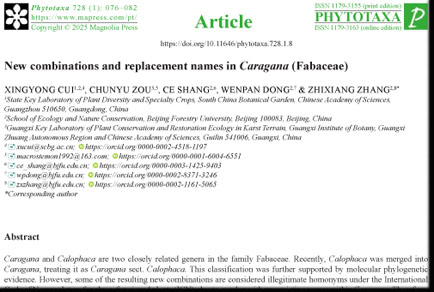
Caragana and Calophaca are two closely related genera in the family Fabaceae. Recently, Calophaca was merged into Caragana, treating it as Caragana sect. Calophaca. This classification was further supported by molecular phylogenetic evidence. However, some of the resulting new combinations are considered illegitimate homonyms under the International Code of Nomenclature for algae, fungi, and plants (ICN), due to overlap with pre-existing names within Caragana. Therefore, these taxa require renaming or replacement with available epithets. In this study, we review the new combinations within Caragana and propose five replacement names to resolve the nomenclatural conflicts, along with two new combinations.
References
- Candolle, Ad. (1825) Prodromus Systematis Naturalis Regni Vegetabilis. In 2. Treuttel et Würtz, Paris, 270 pp.
- Cui, X., Li, E., He, J., Wang, Y., Shang, C., Zhong, B., Viruel, J., Dong, W. & Zhang, Z. (2025) Ancient hybridization drives arid adaptation and species diversification in Caragana (Fabaceae). New Phytologist 247: 2454–2472. https://doi.org/10.1111/nph.70360
- Cui, X., Liu, K., Li, E., Zhang, Z. & Dong, W. (2024) Chloroplast Genomes Evolution and Phylogenetic Relationships of Caragana species. International Journal of Molecular Sciences 25 (12): 6786. https://doi.org/10.3390/ijms25126786
- Duan, L., Li, S.-J., Su, C., Sirichamorn, Y., Han, L.-N., Ye, W., Lôc, P.K., Wen, J., Compton, J.A., Schrire, B., Nie, Z.-L. & Chen, H.-F. (2021) Phylogenomic framework of the IRLC legumes (Leguminosae subfamily Papilionoideae) and intercontinental biogeography of tribe Wisterieae. Molecular Phylogenetics and Evolution 163: 107235. https://doi.org/10.1016/j.ympev.2021.107235
- Duan, L., Yang, X., Liu, PL., Johnson, G., Wen, J. & Chang, ZY. (2016) A molecular phylogeny of Caraganeae (Leguminosae, Papilionoideae) reveals insights into new generic and infrageneric delimitations. PhytoKeys 70: 111. https://doi.org/10.3897/phytokeys.70.9641
- Fabricius, P. (1763) Caragana. Enumeratio Methodica Plantarum, ed2. Helmstad Co, Paris, 421 pp.
- Thiers, B. (2025) Index Herbariorum: A global directory of public herbaria and associated staff. New York Botanical Garden’s Virtual Herbarium, New York Botanical Garden’s Virtual Herbarium.
- Wu, Z., Raven, P. & Hong, D. (2010) Flora of China. In 10. Missouri Botanical Garden Press, Missouri, 528 pp.
- Zhang, M.L., Wen, Z.B., Fritsch, P.W. & Sanderson, S.C. (2015) Spatiotemporal evolution of Calophaca (Fabaceae) reveals multiple dispersals in central Asian mountains. PLoS One 10 (4): e0123228. https://doi.org/10.1371/journal.pone.0123228