
Abstract
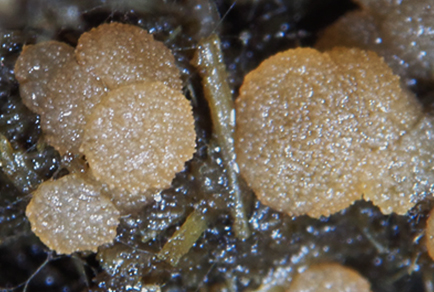
The fimicolous Mexican Pezizales are an interesting group of fungi for which there is a lack of adequate studies. Two new species of coprophilous Pezizales are described based on morphological, histochemical, and molecular characters from a cleared tropical montane cloud forest in western Mexico (Talpa, Jalisco), where they thrive in the excreta of cows and horses. This study utilizes certain histochemical characters as taxonomic markers to identify and distinguish the species. Iodophanus jaliscoensis Alv.-Cortés, R.Valenz. & Raymundo sp. nov. with paraphyses with carotenoid pigments that react with ferric sulfuric chloride (FeCl3-H2SO4), generating a sky blue hue (23C4), and Boubovia talpensis Alv.-Cortés, Mart.-Pineda & Raymundo sp. nov. with paraphyses with unsaturated derivatives of golden color (4C6) with potassium permanganate (KMnO4). Bouvobia species is a newly recorded genus in the TMCF and the country. This group of fungi is a crucial source of metabolites, and this research lays the foundation for future studies in taxonomy and biotechnology.
References
- Álvarez-Cortés, P.M., Martínez-Pineda, M., Raymundo, T. & Valenzuela, R. (2025) Identificación taxonómica y pruebas histoquímicas de ascomicetos coprófilos del municipio Zempoala, Hidalgo, México, incluyendo una nueva especie de Coprotus. Acta Botanica Mexicana 132: e2369. https://doi.org/10.21829/abm132.2025.2369
- Aguirre-Acosta, E. & Ulloa, M. (1982) Primer registro en México sobre la sucesión de hongos en el estiércol de vaca. Boletín de la Sociedad Mexicana de Micología 17: 76–88. https://doi.org/10.18268/bsgm2024v76n1a300124
- Bautista, N., Chacón, S. & Guzmán, G. (1986) Ascomycetes poco conocidos de México, III. Especies del estado de Morelos. Scientia Fungorum 3 (2): 85–104. https://doi.org/10.33885/sf.1986.3.655
- Bell, A. (2005) An illustrated guide to the coprophilous Ascomycetes of Australia. CBS Biodiversity Series 3, Utrecht, The Netherlands, 172 pp.
- Bills, G.F., Gloer, J.B. & An, Z. (2013) Coprophilous fungi: antibiotic discovery and functions in an underexplored arena of microbial defensive mutualism. Current Opinion in Microbiology 6 (5): 549–565. https://doi.org/10.1016/j.mib.2013.08.001
- Chacón, S. & Medel-Ortíz, R. (1992) Ascomycetes poco conocidos de México VI. Algunos Discomycetes y Pyrenomycetes. Scientia Fungorum 3 (8): 55–62. https://doi.org/10.33885/sf.1992.3.787
- Cinto, I.E. & Dokmetzian, D.A. (2006) Iodophanus granulipolaris (Ascomycota—Pezizales): first record from Argentina. A morphological and physiological study. Hickenia 3 (62): 277–284.
- Dokmetzian, D.A., Ramos, A.M., Cinto, I., Suárez, M.E. & Ranalli, M.E. (2005) Seis especies del género Coprotus (Pyronemataceae) de Argentina estudiadas en cultivo. Hickenia 3 (57): 243–252.
- Figueroa-Viramontes, U., Núñez-Hernández, G., Delgado, J.A. & Cueto-Wong, J.A., Flores-Margez, G.P. (2009) Estimación de la producción de estiércol y de la excreción de nitrógeno, fósforo y potasio por bovino lechero en la Comarca Lagunera. In: Orona, C., Salazar, S. & Fortis, H. (Eds.) Agricultura Orgánica. FAZ-UJED, Gómez Palacios, Durango, pp. 128–151. https://doi.org/10.21640/ns.v11i22.1709
- Gual-Díaz, M. & Rendon-Correa, A. (2018) Los bosques mesófilos de montaña de México. Agroproductividad 10: 3–9.
- Güngör, H. (2014) Ascodesmidaceae J. Schröt. a new family (Ascomycota) record for the Turkish mycota. Biological Diversity and Conservation 7 (2): 115–116.
- Guzmán, G. (1972) Macromicetos mexicanos en el herbario The National Fungus Collection de E.U.A. Boletín de la Sociedad Botánica de México 32: 31–55. https://doi.org/10.17129/botsci.1115
- Guzmán, G. & Tapia, F. (1998) The known morels in Mexico, a description of a new blushing species, Morchella rufobrunnea and new data on M. guatemalensis. Mycologia 90: 705–714. https://doi.org/10.1080/00275514.1998.12026960
- Hall, T.A. (1999) BioEdit: a user-friendly biological sequence alignment editor and analysis program for Windows 95/98/NT. Nucleic Acids Symposium Series 41: 95–98.
- Hansen, K., Læssøe, T. & Pfister, D.H. (2001) Phylogenetics of the Pezizaceae, with an emphasis on Peziza. Mycologia 93 (5): 958–990. https://doi.org/10.1080/00275514.2001.12063229
- Huelsenbeck, J.P. & Ronquist, F. (2001) MRBAYES: Bayesian inference of phylogenetic trees. Bioinformatics 17 (8): 754–755. https://doi.org/10.1093/bioinformatics/17.8.754
- Katoh, K., Misawa, K., Kuma, K.I. & Miyata, T. (2002) MAFFT: a novel method for rapid multiple sequence alignment based on fast Fourier transform. Nucleic Acids Research 30 (14): 3059–3066. https://doi.org/10.1093/nar/gkf436
- Katoh, K. & Standley, D.M. (2013) MAFFT multiple sequence alignment software version 7: improvements in performance and usability. Molecular Biology and Evolution 30 (4): 772–780. https://doi.org/10.1093/molbev/mst010
- Katoh, K., Rozewicki, J. & Yamada, K.D. (2017) MAFFT online service: multiple sequence alignment, interactive sequence choice and visualization. Briefings in Bioinformatics 20 (4): 1160–1166. https://doi.org/10.1093/bib/bbx108
- Kimbrough, W.J., Luck-Allen, E.R. & Cain, R.F. (1969) Iodophanus, the Pezizaceae segregate of Ascophanus (Pezizales). American Journal of Botany 56 (10): 1187–1202. https://doi.org/10.1002/j.1537-2197.1969.tb09775.x
- Kimbrough, W.J., Luck-Allen, E.R. & Cain, R.F. (1971) North America species of Coprotus (Thelebolaceae: Pezizales). Canadian Journal of Botany 50: 957–997. https://doi.org/10.1139/b72-116
- Kristiansen, R. (2016) The genus Boubovia (Velen.) Svrček in Norway. Agarica 37: 51–65. https://doi.org/10.5617/agarica.11685
- Kruys, A. & Ericson, L. (2007) Species richness of coprophilous Ascomycetes in relation to variable food intake by herbivores. Fungal Diversity 30: 73–82.
- Kušan, I., Matočec, N., Jadan, M., Tkalčec, Z. & Mešić, A. (2018) An overview of the genus Coprotus (Pezizales, Ascomycota) with notes on the type species and description of C. epithecioides sp. nov. MycoKeys 29: 15–47. https://doi.org/10.3897/mycokeys.29.22978
- López, A. & García, J. (2001) Trichophaea boudieri. Funga Veracruzana 37: 1–2.
- Martínez-González, C.R., Ramírez-Mendoza, R., Jiménez-Ramírez, J., Gallegos-Vázquez, C. & Luna-Vega, I. (2017) Improved method for genomic DNA extraction for Opuntia Mill. (Cactaceae). Plant Methods 13 (1): 1–10. https://doi.org/10.1186/s13007-017-0234-y
- Maddison, W.P. & Maddison, D.R. (2021) Mesquite: a modular system for evolutionary analysis.Version 3.70. Available from: http://mesquiteproject.org (accessed May 2025)
- Medel-Ortíz, R. & Calonge, F.D. (2004) Aportación al conocimiento de los Discomycetes de México, con especial referencia al género Helvella. Boletín de la Sociedad Micológica de Madrid 28: 151–159.
- Medel-Ortíz, R., Calonge, F.D. & Guzmán, G. (2006) Nuevos registros de Pezizales (Ascomycota) de Veracruz. Scientia Fungorum 3 (23): 83–86. https://doi.org/10.33885/sf.2006.3.982
- Medel-Ortíz, R. & Chacón, S. (2000) Contribución al conocimiento del género Plectania (Pezizales, Sarcosomataceae) en México. Acta Botanica Mexicana 50: 11–19. https://doi.org/10.21829/abm50.2000.839
- Medel-Ortíz, R., Guzmán, G. & Chacón, S. (1995) New data on the genus Wynnea in Mexico. Mycotaxon 55: 295–299. https://doi.org/10.5962/p.415892
- Medel-Ortíz, R., Guzmán, G., Chacón, S. & Korf, R. (1996) Iodowynnea, a new genus of the Pezizales known from Africa and tropical America. Mycotaxon 59: 127–135. https://doi.org/10.5962/p.416023
- Medardi, G. (2006) Una specie artica reperita in Italia: Iodophanus hyperboreus T. Schumach. Revista Catalana de Micología 28: 41–46.
- Müller, K., Quandt, D., Müller, J. & Neinhuis, C. (2005) PhyDE®-Phylogenetic data editor. Program distributed by the authors, version 10.0. Available from: https://www.phyde.de (accessed 1 May 2025)
- Mungai, P., Chukeatirote, E., Njogu, J.G. & Hyde, K.D. (2012) Coprophilous Ascomycetes in Kenya: Saccobolus species from wildlife dung. Mycosphere 3: 111–129. https://doi.org/10.5943/mycosphere/3/2/2
- Pompa-González, A. & Cifuentes, A. (1991) Estudio taxonómico de los Pezizales de los estados de Guerrero, Hidalgo, estado de México y Michoacán. Scientia Fungorum 3 (7): 87–111. https://doi.org/10.33885/sf.1991.3.776
- Rambaut, A., Drummond, A.J., Xie, D., Baele, G. & Suchard, M.A. (2018) Posterior summarization in Bayesian phylogenetics using Tracer 1.7. Systematic Biology 67 (5): 901. https://doi.org/10.1093/sysbio/syy032
- Raymundo, T., Soto-Agudelo, R., Bautista-Hernández, S., Morales-Campos, A. & Valenzuela, R. (2016) Catálogo de los ascomicetos del bosque mesófilo de montaña de Tlanchinol, Hidalgo, México. Boletín de la Sociedad Micológica de Madrid 40: 79–104. https://doi.org/10.21829/abm105.2013.224
- Raymundo, T. & Valenzuela, R. (2021) Smardaea isoldae sp. nov. from a tropical cloud forest in Mexico. Mycotaxon 136: 97–106. https://doi.org/10.5248/136.97
- Raymundo, T., Valenzuela, R., García-Martínez, Y., Bravo-Álvarez, M., Ramírez-Martínez, J., Hernández, S., Palacios-Pacheco, M. & Luna-Vega, I. (2019) Ascomycetes (Fungi) from the relic forest of Fagus grandifolia subsp. mexicana in eastern Mexico. Phytotaxa 418: 1–41. https://doi.org/10.11646/phytotaxa.418.1.1
- Raymundo, T., Valenzuela, R., Martínez-González, C.R., García-Jiménez, J., Cobos-Villagrán, A., Sánchez-Flores, M., de la Fuente, J., Martínez-Pineda, M., Pérez-Valdespino, A. & Ramírez-Martínez, J.C. (2023) New Ascomycetes from the Mexican tropical montane cloud forest. Journal of Fungi 9 (9): 933. https://doi.org/10.3390/jof9090933
- Raymundo, T., Valenzuela, R. & Ramírez-Martínez, J.C. & Martínez-Pineda, M. (2020) New records of Ascomycetes from tropical montane cloud forest of eastern Mexico. Phytotaxa 454: 161–185. https://doi.org/10.11646/phytotaxa.454.3.1
- Richardson, M.J. (1972) Coprophilous Ascomycetes on different dung types. Transactions of the British Mycological Society 58: 37–48. https://doi.org/10.1016/S0007-1536(72)80069-X
- Sánchez-Flores, M., García-Jiménez, J., Raymundo, T., Martínez-González, C.R., Hernández del Valle, J.F., Hernández-Muñoz, M.A., de la Fuente, J.I., Esqueda, M., Ávila-Ortiz, A. & Valenzuela, R. (2024) Eleven new species of the genus Tarzetta (Tarzettaceae, Pezizales) from Mexico. Journal of Fungi 10 (10): 403. https://doi.org/10.3390/jof10060403
- Sánchez-Jacóme, M.R. & Guzmán-Dávalos, L. (2005) New records of Ascomycetes from Jalisco, Mexico. Mycotaxon 92: 177–191. https://doi.org/10.5962/p.414559
- Sandmann, G. (2022) Carotenoids and their biosynthesis in fungi. Molecules 27 (4): 1431.
- Stamatakis, A. (2014) RAxML version 8: a tool for phylogenetic analysis and post-analysis of large phylogenies. Bioinformatics 30 (9): 1312–1313. https://doi.org/10.1093/bioinformatics/btu033
- Swofford, D.L. (2002) PAUP*: phylogenetic analysis using parsimony (*and other methods). Version 4.0b10. Sinauer Associates, Sunderland, Mass.
- Valenzuela, R., Guzmán, G. & Castillo, J. (1981) Descripciones de especies de macromicetos poco conocidas en México, con discusiones sobre su ecología y distribución. Scientia Fungorum 15: 67–120.
- Valenzuela, R., Raymundo, T., Reyes, P., Guzmán-Guillermo, J., Acosta, S., Ramírez-Martínez, J. & Luna-Vega, I. (2021) Ascomycetes from the relic forest of Oreomunnea mexicana, Oaxaca, Mexico. Phytotaxa 528: 19–44. https://doi.org/10.11646/phytotaxa.528.1.3
- Yao, Y.J. & Spooner, B.M. (1996) Delimitation of Boubovia and Pulvinula. Mycological Research 100: 193–194. https://doi.org/10.1016/S0953-7562(96)80120-1
- Zhang, Z., Schwartz, S., Wagner, L. & Miller, W. (2000) A greedy algorithm for aligning DNA sequences. Journal of Computational Biology 7 (1–2): 203–214. https://doi.org/10.1089/10665270050081478