
Abstract
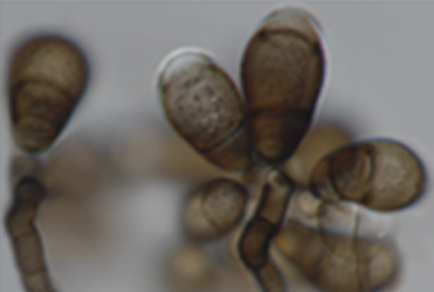
A new species of endophytic fungus, described herein as Curvularia nelumbonicola, was isolated from the leaves of lotus (Nelumbo nucifera Gaertn.) collected in Uttaradit Province, Thailand. This species is described using morphological characteristics and multi-gene molecular analyses. Morphologically, C. nelumbonicola is similar to C. chonburiensis and C. pisi, but it can be distinguished by its mostly shorter conidiophores. Multi-gene phylogenetic analyses based on a combination of the internal transcribed spacer (ITS) region of ribosomal DNA, glyceraldehyde-3-phosphate dehydrogenase (GAPDH), and translation elongation factor 1-alpha (TEF1) genes revealed that C. nelumbonicola forms a monophyletic clade and is clearly distinct from C. chonburiensis and C. pisi as well as other Curvularia species. A full description, illustrations, and a phylogenetic tree showing the position of C. nelumbonicola are provided.
References
- Ahmadpour, A., Heidarian, Z., Ghosta, Y., Alavi, Z., Alavi, F., Manamgoda, D.S., Karunarathna, S.C. & Rampelotto, P.H. (2025) Morphological and molecular characterization of Curvularia species from Iran, with description of two novel species and two new records. Mycologia 117: 261–285. https://doi.org/10.1080/00275514.2025.2450754
- Berbee, M.L., Pirseyedi, M. & Hubbard, S. (1999) Cochliobolus phylogenetics and the origin of known, highly virulent pathogens, inferred from ITS and glyceraldehyde-3-phosphate dehydrogenase gene sequences. Mycologia 91: 964–977. https://doi.org/10.2307/3761627
- Carter, E. & Boudreaux, C. (2004) Fatal cerebral phaeohyphomycosis due to Curvularia lunata in an immunocompetent patient. Journal of Clinical Microbiology 42: 5419–5423. https://doi.org/10.1128/JCM.42.11.5419-5423.2004
- Chaisarn, D., Suwannarach, N., Lumyong, S., Youpensuk, S. & Pathom-aree, W. (2023) First report of Curvularia hominis as a causal agent of riceberry rice leaf spot in northern Thailand. Chiang Mai Journal of Science 50: 1–10. https://doi.org/10.12982/CMJS.2023.066
- Chen, K.L. & Kirschner, R. (2018) Fungi from leaves of lotus (Nelumbo nucifera). Mycological Progress 17: 275–293. https://doi.org/10.1007/s11557-017-1324-y
- Cui, W.L., Lu, X.Q., Bian, J.Y., Qi, X.L., Li, D.W. & Huang, L. (2020) Curvularia spicifera and Curvularia muehlenbeckiae causing leaf blight on Cunninghamia lanceolata. Plant Pathology 69: 1139–1147. https://doi.org/10.1111/ppa.13198
- da Cunha, K.C., Sutton, D.A., Fothergill, A.W., Gené, J., Cano, J., Madrid, H., de Hoog, S., Crous, P.W. & Guarro, J. (2013) In vitro antifungal susceptibility and molecular identity of 99 clinical isolates of the opportunistic fungal genus Curvularia. Diagnostic Microbiology and Infectious Disease 76: 168–174. https://doi.org/10.1016/j.diagmicrobio.2013.02.034
- Darriba, D., Taboada, G.L., Doallo, R. & Posada, D. (2012) jModelTest 2: more models, new heuristics and parallel computing. Nature Methods 9: 772. https://doi.org/10.1038/nmeth.2109
- Digra, S. & Nonzom, S. (2025) New host record of Curvularia species endophytic to Elaeagnus angustifolia. New Zealand Journal of Botany 63: 1468–1478. https://doi.org/10.1080/0028825X.2025.2503777
- Edgar, R.C. (2004) MUSCLE: multiple sequence alignment with high accuracy and high throughput. Nucleic Acids Research 32: 1792–1797. https://doi.org/10.1093/nar/gkh340
- Felsenstein, J. (1985) Confidence limits on phylogenies: an approach using bootstrap. Evolution 39: 783–791. https://doi.org/10.2307/2408678
- Ferdinandez, H.S., Manamgoda, D.S., Udayanga, D., Deshappriya, N., Munasinghe, M.S. & Castlebury, L.A. (2021) Molecular phylogeny and morphology reveal three novel species of Curvularia (Pleosporales, Pleosporaceae) associated with cereal crops and weedy grass hosts. Mycological Progress 20: 431–451. https://doi.org/10.1007/s11557-021-01681-0
- Ferdinandez, H.S., Manamgoda, D.S., Udayanga, D., Munasinghe, M.S. & Castlebury, L.A. (2023) Molecular phylogeny and morphology reveal two new graminicolous species, Curvularia aurantia sp. nov. and C. vidyodayana sp. nov. with new records of Curvularia spp. from Sri Lanka. Fungal Systematics and Evolution 12: 219–246. https://doi.org/10.3114/fuse.2023.12.11
- Gateta, T., Suwannarach, N., Kumla, J., Nuangmek, W., Seemakram, W., Srisapoomi, T. & Boonlue, S. (2024) Trichoderma thailandense sp. nov. (Hypocreales, Hypocreaceae), a new species from Thailand. Phytotaxa 669: 233–246. https://doi.org/10.11646/phytotaxa.669.3.4
- Guo, Z.J., Amenyogbe, M.K., Chen, S.Q., Rashad, Y.M., Deng, J.X. & Luo, H. (2025) Morphological and phylogenetic analyses reveal two novel species of Curvularia (Pleosporales, Pleosporaceae) from southern China. MycoKeys 120: 139–156. https://doi.org/10.3897/mycokeys.120.156570
- Hall, B.G. (2013) Building phylogenetic trees from molecular data with MEGA. Molecular Biology and Evolution 30: 1229–1235. https://doi.org/10.1093/molbev/mst012
- Han, W.B., Lu, Y.H., Zhang, A.H., Zhang, G.F., Mei, Y.N., Jiang, N., Lei, X., Song, Y.C., Ng, S.W. & Tan, R.X. (2014) Curvulamine, a new antibacterial alkaloid incorporating two undescribed units from a Curvularia species. Organic Letters 16: 5366–5369. https://doi.org/10.1021/ol502572g
- Jeewon, R. & Hyde, K.D. (2016) Establishing species boundaries and new taxa among fungi: Recommendations to resolve taxonomic ambiguities. Mycosphere 7: 1669–1677. https://doi.org/10.5943/mycosphere/7/11/4
- Jones, E.B.G. & Pang, K.L. (2012) Tropical aquatic fungi. Biodiversity and Conservation 21: 2403–2423. https://doi.org/10.1007/s10531-011-0198-6
- Kaur, M., Mishra, R.C., Lahane, V., Kumari, A., Yadav, A.K., Garg, M., Barrow, C.J. & Goel, M. (2024) Chemical characterization and biological activity of Curvularia lunata, an endophytic fungus isolated from lemongrass (Cymbopogon citratus). Brazilian Journal of Microbiology 55: 3261–3267. https://doi.org/10.1007/s42770-024-01503-x
- Khan, N.A., Asaf, S., Ahmad, W., Jan, R., Bilal, S., Khan, I., Khan, A.L., Kim, K.M. & Al-Harrasi, A. (2023) Diversity, lifestyle, genomics, and their functional role of Cochliobolus, Bipolaris and Curvularia species in environmental remediation and plant growth promotion under biotic and abiotic stressors. Journal of Fungi 9: e254. https://doi.org/10.3390/jof9020254
- Kusai, N.A., Azmi, M.M.Z., Zulkifly, Yusof, M.T. & Zainudin, N.A.I.M. (2016) Morphological and molecular characterization of Curvularia and related species associated with leaf spot disease of rice in Peninsular Malaysia. Rendiconti Lincei. Scienze fisiche e naturali 27: 205–214. https://doi.org/10.1007/s12210-015-0458-6
- Kumla, J., Kaewnunta, A. & Suwannarach, N. (2025) Lentinus saisamorniae (Polyporaceae, Polyporales), a new edible macrofungus from northern Thailand. Phytotaxa 705: 149–161. https://doi.org/10.11646/phytotaxa.705.2.2
- Kumla, J., Phonrob, W., Lumyong, S. & Suwannarach, N. (2024) Crinipellis siamensis (Marasmiaceae, Agaricales), a new macrofungus from northern Thailand. Phytotaxa 666: 135–145. https://doi.org/10.11646/phytotaxa.666.2.4
- Kumla, J., Suwannarach, N. & Wannathes, N. (2021) Hymenagaricus saisamornae sp. nov. (Agaricales, Basidiomycota) from northern Thailand. Chiang Mai Journal of Science 48: 827–836.
- Heidarian, Z., Arzanlou, M. & Ahmadpour, A. (2020) Molecular phylogeny and morphology differentiate several new records and novel hosts for Curvularia species in Iran. Nova Hedwigia 111: 151–171. https://doi.org/10.1127/nova_hedwigia/2020/0592
- Hyde, K.D., Norphanphoun, C., Chen, J., Dissanayake, A.J., Doilom, M., Hongsanan, S., Jayawardena, R.S., Jeewon, R., Perera, R.H., Thongbai, B., Wanasinghe, D.N., Wisitrassameewong, K., Tibpromma, S. & Stadler, M. (2018) Thailand’s amazing diversity – up to 96% of fungi in northern Thailand are novel. Fungal Diversity 93: 215–239. https://doi.org/10.1007/s13225-018-0415-7
- Madrid, H., da Cunha, K.C., Gené, J., Dijksterhuis, J., Cano, J., Sutton, D.A., Guarro, G. & Crous, P.W. (2014) Five new Curvularia species from clinical specimens. Persoonia 33: 48–60. https://doi.org/10.3767/003158514X683538
- Manamgoda, D.S., Cai, L., McKenzie, E.H.C., Crous, P.W., Madrid, H., Chukeatirote, E., Shivas, R.G., Tan, Y.P. & Hyde, K.D. (2012) A phylogenetic and taxonomic re-evaluation of the Bipolaris–Cochliobolus–Curvularia complex. Fungal Diversity 56: 131–144. https://doi.org/10.1007/s13225-012-0189-2
- Manamgoda, D.S., Rossman, A.Y., Castlebury, L.A., Chukeatirote, E. & Hyde, K.D. (2015) A taxonomic and phylogenetic re-appraisal of the genus Curvularia (Pleosporaceae): human and plant pathogens. Phytotaxa 212: 175–198. https://doi.org/10.11646/phytotaxa.212.3.1
- Marin-Felix, Y., Groenewald, J.Z., Cai, L., Chen, Q., Marincowitz, S., Barnes, I., Bensch, K., Braun, U., Camporesi, E., Damm, U. & de Beer, Z.W. (2017) Genera of phytopathogenic fungi: GOPHY 1. Studies in Mycology 86: 99–216. https://doi.org/10.1016/j.simyco.2017.04.002
- Marin-Felix, Y., Hernandez-Restrepo, M. & Crous, P.W. (2020) Multi-locus phylogeny of the genus Curvularia and description of ten new species. Mycological Progress 19: 559–588. https://doi.org/10.1007/s11557-020-01576-6
- Mehta, T., Meena, M. & Nagda, A. (2022) Bioactive compounds of Curvularia species as a source of various biological activities and biotechnological applications. Frontiers in Microbiology 13: e1069095. https://doi.org/10.3389/fmicb.2022.1069095
- Nandhini, C., Ganesh, P. & Yoganathan, K. (2019) Potential control of Echinochloa crusgalli (Barnyard grass) by Curvularia lunata as a mycoherbicide. Journal of Drug Delivery and Therapeutics 9: 737–741. https://doi.org/10.22270/jddt.v9i6-s.3751
- Paloi, S., Kumla, J., Karunarathna, S.C., Lumyong, L. & Suwannarach, N. (2023) Taxonomic and phylogenetic evidence reveal two new Russula species (Russulaceae, Russulales) from northern Thailand. Mycological Progress 22: e72. https://doi.org/10.1007/s11557-023-01921-5
- Rambaut, A. (2012) FigTree. Available from: http://tree.bio.ed.ac.uk/software/figtree/ (accessed 27 February 2025)
- Raza, M., Zhang, Z.F., Hyde, K.D., Diao, Y.Z. & Cai, L. (2019) Culturable plant pathogenic fungi associated with sugarcane in southern China. Fungal Diversity 99: 1–104. https://doi.org/10.1007/s13225-019-00434-5
- Rehner, S.A. & Buckley, E. (2005) A Beauveria phylogeny inferred from nuclear ITS and EF1-α sequences: evidence for cryptic diversification and links to Cordyceps teleomorphs. Mycologia 97: 84–98. https://doi.org/10.3852/mycologia.97.1.84
- Rita de Cássia, M., de Barros Gomes, E., Pereira Jr, N., Marin-Morales, M.A., Machado, K.M.G. & de Gusmão, N.B. (2013) Biotreatment of textile effluent in static bioreactor by Curvularia lunata URM 6179 and Phanerochaete chrysosporium URM 6181. Bioresource Technology 142: 361–367. https://doi.org/10.1016/j.biortech.2013.05.066
- Ronquist, F., Teslenko, M., Van der Mark, P., Ayres, D.L., Darling, A., Höhna, S., Larget, B., Liu, L., Suchard, M.A. & Huelsenbeck, J.P. (2012) MrBayes 3.2: efficient Bayesian phylogenetic inference and model choice across a large model space. Systematic Biology 61: 539–542. https://doi.org/10.1093/sysbio/sys029
- Samaradiwakara, N.P., de Farias, A.R.G., Tennakoon, D.S., Aluthmuhandiram, J.V.S., Bhunjun, C.S., Chethana, K.W.T., Kumla, J. & Lumyong, S. (2023) Appendage- bearing Sordariomycetes from Dipterocarpus alatus leaf litter in Thailand. Journal of Fungi 9: e625. https://doi.org/10.3390/jof9060625
- Senwanna, C., Kumla, J., Kodchasee, P., Duangkon, N. & Suwannarach, N. (2025) Additions of new endolichenic fungi to Herpotrichiellaceae (Chaetothyriales, Ascomycota) from northern Thailand. MycoKeys 120: 193–229. https://doi.org/10.3897/mycokeys.120.153906
- Sivanesan, A. (1987) Graminicolous species of Bipolaris, Curvularia, Drechslera, Exserohilum and their teleomorphs. Mycological Papers 158: 154–185.
- Stamatakis, A. (2006) RAxML-VI-HPC: maximum likelihood-based phylogenetic analyses with thousands of taxa and mixed models. Bioinformatics 22: 2688–2690. https://doi.org/10.1093/bioinformatics/btl446
- Supaphon, P., Preedanon, S., Hiranrat, W. & Hiranrat, A. (2018) Antimicrobial and antioxidant activities of extracts from fungal endophytes and their host plant (Nelumbo nucifera). Thai Science and Technology Journal 26: 136–154. https://doi.org/10.14456/tstj.2018.12
- Suwannarach, N., Kumla, J. & Lumyong, S. (2021) Spegazzinia camelliae sp. nov. (Didymosphaeriaceae, Pleosporales), a new endophytic fungus from northern Thailand. Phytotaxa 483: 117–128. https://doi.org/10.11646/phytotaxa.483.2.4
- Suwannarach, N., Kumla, J., Pathom-aree, W., Hyde, K.D. & Lumyong, S. (2022) Changes in the understanding of fungal diversity based on research in the tropics. Chiang Mai Journal of Science 49: v–viii. https://doi.org/10.12982/CMJS.2022.061
- Tan, Y.P., Crous, P.W. & Shivas, R.G. (2018) Cryptic species of Curvularia in the culture collection of the Queensland Plant Pathology Herbarium. MycoKeys 35: 1–25. https://doi.org/10.3897/mycokeys.35.25665
- Tan, Y.P., Madrid, H., Crous, P.W. & Shivas, R.G. (2014) Johnalcornia gen. et. comb. nov., and nine new combinations in Curvularia based on molecular phylogenetic analysis. Australasian Plant Pathology 43: 589–603. https://doi.org/10.1007/s13313-014-0315-6
- Techaoei, S., Jirayuthcharoenkul, C., Jarmkom, K., Dumrongphuttidecha, T. & Khobjai, W. (2020) Chemical evaluation and antibacterial activity of novel bioactive compounds from endophytic fungi in Nelumbo nucifera. Saudi Journal of Biological Sciences 27: 2883–2889. https://doi.org/10.1016/j.sjbs.2020.08.037
- Tibpromma, S., Hyde, K.D., McKenzie, E.H.C., Bhat, D.J., Phillips, A.J., Wanasinghe, D.N., Samarakoon, M.C., Jayawardena, R.S., Dissanayake, A.J., Tennakoon, D.S, Doilom, M., Phookamsak, R., Tang, A.M.C., Xu, J.C., Mortimer, P.E., Promputtha, I., Maharachchikumbura, S.S.N., Khan, S. & Karunarathna, S.C. (2018) Fungal diversity notes 840–928: micro-fungi associated with Pandanaceae. Fungal Diversity 93: 1–160. https://doi.org/10.1007/s13225-018-0408-6
- Vázquez, M.A., Cabrera, E.C.V., Aceves, M.A. & Mallol, J.L.F. (2019) Cellulolytic and ligninolytic potential of new strains of fungi for the conversion of fibrous substrates. Biotechnology Research and Innovation 3: 177–186. https://doi.org/10.1016/j.biori.2018.11.001
- White, T.J., Burns, T., Lee, S. & Taylor, J.W. (1990) Amplification and direct sequencing of fungal ribosomal RNA genes for phylogenetics. In: Innis, M.A., Gelfand, D.H., Sninsky, J.J. & White, T.J. (Eds.) PCR protocols: a guide to methods and applications. Academic Press, New York, pp. 315–322. https://doi.org/10.1016/B978-0-12-372180-8.50042-1
- Wijayawardene, N.N., Hyde, K.D., Dai, D.Q., Sánchez-García, M., Goto, B.T., Saxena, R.K., Erdoğdu, M., Selçuk, F., Rajeshkumar, K.C., Aptroot, A., Błaszkowski, J., Boonyuen, N., da Silva, G., de Souza, F.A., Dong, W., Ertz, D., Haelewaters, D., Jones, E.B.G., Karunarathna, S.C., Kirk, P.M., Kukwa, M., Kumla, J., Leontyev, D.V., Lumbsch, H.T., Maharachchikumbura, S.S.N., Marguno, F., Martínez-Rodríguez, P., Mešić, A., Monteiro, J.S., Oehl, F., Pawłowska, J., Pem, D., Pfliegler, W.P., Phillips, A.J.L., Pošta, A., He, M.Q., Li, J.X., Raza, M., Sruthi, O.P., Suetrong, S., Suwannarach, N., Tedersoo, L., Thiyagaraja, V., Tibpromma, S., Tkalčec, Z., Tokarev, Y.S., Wanasinghe, D.N., Wijesundara, D.S.A., Wimalaseana, S.D.M.K., Madrid, H., Zhang, G.Q., Gao, Y., Sánchez-Castro, I., Tang, L.Z., Stadler, M., Yurkov, A. & Thines, M. (2022) Outline of Fungi and fungus-like taxa—2021. Mycosphere 13: 53–453. https://doi.org/10.5943/mycosphere/13/1/2
- Yasanthika, W.A.E., Tennakoon, D.S., Farias, A.R.G.D., Chethana, K.W.T., Bhat, D.J. & Wanasinghe, D.N. (2023) Isolation and characterization of novel Dothideomycetes species from forest soils in Chiang Rai and Krabi (Thailand): additions to the diversity of Curvularia and Verruconis. Phytotaxa 609: 17–44. https://doi.org/10.11646/phytotaxa.609.1.3
- Yin, C., Jin, L., Sun, F., Xu, X., Shao, M. & Zhang, Y. (2018) Phytotoxic and antifungal metabolites from Curvularia crepinii QTYC-1 isolated from the gut of Pantala flavescens. Molecules 23: e951. https://doi.org/10.3390/molecules23040951