

Abstract
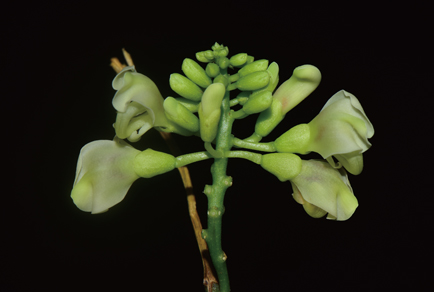
A new species, Apios brevis, is here described and illustrated. This species is currently known only from Qianshan and Yuexi Counties of Anhui Province in eastern China. Phylogenetic analyses based on nuclear ribosomal ITS and chloroplast matK sequences demonstrate that A. brevis is most closely related to A. chindiana and A. fortunei, but it can be readily distinguished from the latter two by its pinnately 3-foliolate leaves, remarkably shorter inflorescences, and smaller flowers. Due to insufficient population data, A. brevis is tentatively assessed as Data Deficient (DD) according to IUCN Red List criteria. An updated key to Apios species is also provided.
References
- Baker, J.G. (1879) Leguminosae. In: Hooker, J.D. (Ed.) The Flora of British India 2. L. Reeve, London, pp. 56–306.
- Ben Mahmoud, K., Mezzapesa, G.N., Abdelkefi, F. & Perrino, E.V. (2024) Nutritional value and functional properties of an underexploited Tunisian wild beet (Beta macrocarpa Guss.) in relation to soil characteristics. Euro-Mediterranean Journal for Environmental Integration 9: 705–720. https://doi.org/10.1007/s41207-024-00468-5
- Brullo, S., Tomaselli, V. & Wagensommer, R.P. (2015) A new species of Odontites (Orobanchaceae) from southern Italy. Phytotaxa 213: 271–281. https://doi.org/10.11646/phytotaxa.213.3.7
- Carrière, É.A. (1866) Plantes nouvelles, rares ou peu connues. Revue Horticole 1866: 379–380.
- Dunn, S.T. (1903) Descriptions of new Chinese plants. Journal of the Linnean Society (Botany) 35: 483–518. https://doi.org/10.1111/j.1095-8339.1903.tb00699.x
- Elder, D., Klein, J., Antonelli, A. & Silvestro, D. (2020) raxmlGUI 2.0: A graphical interface and toolkit for phylogenetic analyses using RAxML. Methods in Ecology and Evolution 12: 373–377. https://doi.org/10.1111/2041-210X.13512
- Fabricius, P.C. (1759) Enumeratio, Methodica Plantarum. Litteris Ioannis Drimbornii, Helmstadii, 239 pp.
- Franchet, A.R. (1890) Plantae Delavayanae, fasc. 3. P. Klincksieck, Paris, pp. 161–240. https://doi.org/10.5962/bhl.title.10529
- Handel-Mazzetti, H. (1933) Symbolae Sinicae 7 (3). J. Springer, Wien, pp. 449–730.
- Houzeau de Lehaie, J. (1906) Le Bambou Son Etude, Sa Culture, Son Emploi. Kessinger Publishing, 300 pp.
- IUCN (2024) Guidelines for using the IUCN Red List categories and criteria. Version 16. Prepared by the Standards and Petitions Subcommittee. Available from: https://nc.iucnredlist.org/documents/RedListGuidelines.pdf (accessed 6 August 2025)
- Katoh, K., Misawa, K., Kuma, K. & Miyata, T. (2002) MAFFT: a novel method for rapid multiple sequence alignment based on fast Fourier transform. Nucleic Acids Research 30: 3059–3066. https://doi.org/10.1093/nar/gkf436
- Kearse, M., Moir, R., Wilson, A., Stones-Havas, S., Cheung, M., Sturrock, S., Buxton, S., Cooper, A., Markowitz, S., Duran, C., Thierer, T., Ashton, B., Meintjes, P. & Drummond, A. (2012) Geneious Basic: an integrated and extendable desktop software platform for the organization and analysis of sequence data. Bioinformatics 28: 1647–1649. https://doi.org/10.1093/bioinformatics/bts199
- Lee, S.K. & Wei, Y.T. (1995) Apios. In: Lee, S.K. (Ed.) Flora Reipublicae Popularis Sinicae 41. Science Press, Beijing, pp. 199–206.
- Letunic, I. & Bork, P. (2024) Interactive Tree of Life (iTOL) v6: recent updates to the phylogenetic tree display and annotation tool. Nucleic Acids Research 52: W78–W82. https://doi.org/10.1093/nar/gkae268
- Li, J., Jiang, J., Stel, H.V., Homkes, A., Corajod, J., Brown, K. & Chen, Z. (2014) Phylogenetics and biogeography of Apios (Fabaceae) inferred from sequences of nuclear and plastid genes. International Journal of Plant Sciences 175: 764–780. https://doi.org/10.1086/676972
- Maximowicz, C.J. (1873) Diagnoses plantarum novarum Japoniae et Mandshuriae. Bulletin de l’Académie Impériale des Sciences de Saint-Pétersbourg 18: 371–402.
- Medikus, F.C. (1787) Versuch einer neuen Lehrart. Vorlesungen der Churpfälzischen physikalisch-ökonomischen Gesellschaft 2: 354–356.
- Nguyen, L.T., Schmidt, H.A., von Haeseler, A. & Minh, B.Q. (2015) IQTREE: A fast and effective stochastic algorithm for estimating maximum likelihood phylogenies. Molecular Biology and Evolution 32: 268–274. https://doi.org/10.1093/molbev/msu300
- Perrino, E.V., Silletti, G.N., Erben, M. & Wagensommer, R.P. (2018) Viola cassinensis subsp. lucana (Violaceae), a new subspecies from the Lucanian Apennine, southern Italy. Phyton (Horn, Austria) 58: 109–115. https://doi.org/10.12905/0380.phyton58(2)-2018-0109
- Robinson, B.L. (1898) A new species of Apios from Kentucky. Botanical Gazette 25: 450–453. https://doi.org/10.1086/327705
- Sa, R. & Gilbert, M.G. (2010) Apios. In: Wu, Z.Y., Raven, P.H. & Hong, D.Y. (Eds.) Flora of China 10. Missouri Botanical Garden, St. Louis, pp. 203–204.
- Siti-Munirah, M.Y. & Dome, N. (2023) Thismia kenyirensis (Thismiaceae), a new species from Taman Negeri Kenyir, Terengganu, Peninsular Malaysia. PhytoKeys 221: 61–72. https://doi.org/10.3897/phytokeys.221.98571
- Trifinopoulos, J., Nguyen, L.T., von Haeseler, A. & Minh, B.Q. (2016) W-IQ-TREE: a fast online phylogenetic tool for maximum likelihood analysis. Nucleic Acids Research 44: W232–W235. https://doi.org/10.1093/nar/gkw256
- Wallich, N. (1830) Plantae Asiaticae Rariores 1. Treuttel and Würtz, London, 68 pp.
- Wang, J.-F., Jiang, K.-W., Zhong, J.-P., Chen, Y., Wu, D.-H., Li, B.-H., Pan, B., Wan, K.-Y., Chen, Z.-H. & Wu, L.-H. (2025) Apios chindiana (Fabaceae: Papilionoideae: Phaseoleae), a new species from East China. Phytotaxa 697: 245–254. https://doi.org/10.11646/phytotaxa.697.3.3
- Yang, Y.K., Liu, L.H., Wu, J.K., Wu, P.L. & Yu, J.J. (2004) New Taxa of the family Leguminosae from China (1). The Chinese Academic Medical Magazine of Organisms 3: 62–76.
- Zhang, F., Feng, S., Zhou, J., Zhang, R., Liu, L., Yang, C., Yu, X. & Pan, B. (2018) Apios chendezhaoana (Fabaceae), an overlooked species and a new combination from China: evidence from morphological and molecular analyses. Phytotaxa 371: 1–16. https://doi.org/10.11646/phytotaxa.371.1.1