

Abstract
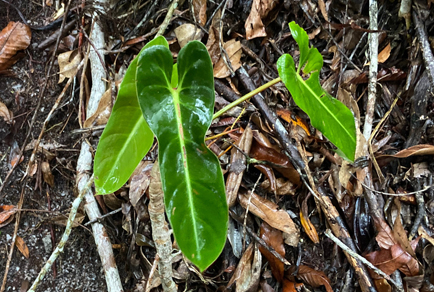
Here we describe Philodendron quartziticola, a new species of Araceae from the Atlantic Forest of Espírito Santo, Southeastern Brazil. The species is commonly associated with quartzitic substrates, in addition to environments locally referred to as “Morros de Sal”, which are characterized by saccharoidal quartzite formations. Morphological comparisons with closely related taxa are provided to delimit the new species, as well as photographic plates, field images, and a distribution map to document its morphology and range. This discovery is particularly relevant due to the species’ occurrence in environments heavily impacted by mineral extraction and land-use change.
References
- Bachman, S., Moat, J., Hill, A.W., la Torre, J. & Scott, B. (2011) Supporting Red List threat assessments with GeoCAT: geospatial conservation assessment tool. ZooKeys 150: 117–126. https://doi.org/10.3897/zookeys.150.2109
- Beentje, H. (2010) The Kew plant glossary: an illustrated dictionary of plant terms. Royal Botanic Gardens, Kew, 160 pp. Available from: https://staugorchidsociety.org/PDF/The-Kew-Plant-Glossary-an-Illustrated-Dictionary-of-Plant-Terms-by-Beentje-Henk-z-lib.org_.pdf (accessed 1 July 2025)
- Boyce, P.C., Croat, T.B. & Hay, A. (2025 onwards) The Überlist of Araceae, totals for published and estimated number of species in aroid genera. International Aroid Society. Available from: http://www.aroid.org/ueberlist (accessed 30 July 2025)
- Brade, A.C. (1956) Melastomataceae novae IV. Arquivos do Jardim Botânico do Rio de Janeiro 14: 211–240.
- Bunting, G.S. (1987) Two new species of Brazilian Philodendron Araceae. Phytologia 61: 441–443.
- Calazans, L., Antas, N. & Sakuragui, C. (2015) Philodendron luisae (Araceae), a new species from Rio de Janeiro State, Brazil. Botanical Studies 56: 1–6 https://doi.org/10.1186/s40529-015-0082-x
- Calazans, L.S.B. (2020) A new species of Philodendron (Araceae) from an enclave of Atlantic rainforest in Minas Gerais State, Brazil. Phytotaxa 452: 217–223. https://doi.org/10.11646/phytotaxa.452.3.4
- Calazans, L.S.B., Valadares, R.T. & Sakuragui, C.M. (2024) Sobrexploração de Philodendron spiritus-sancti G.S.Bunting e a necessidade de implantação de uma política para a conservação de imbés. Paubrasilia 7: publicação contínua. https://doi.org/10.33447/paubrasilia.2024.e0150
- De Candolle, A.P. (1839 [1840]) Icones selectae plantarum quas in systemate universali ex herbariis Parisiensibus, prasertim ex Lessertiano. vol. 4. Parisiis, pp. 52 + 100 pl.
- Dejean, P.F.M.A. (1821) Catalogue de la collection de Coléoptères de M. le Baron Dejean. Imprimerie Lanoë, Librairie Crevot, Paris, 136 pp. https://doi.org/10.5962/bhl.title.11259
- Dutra, V.F., Guarnier, J.C., Firmino, A.D., Tuler, A.C., Peixoto, A.L., Kameyama, C., Saiter, F.Z., Barroso, F.G., Siqueira, G.S., Heiden, G., Shimizu, G.H., de Lima, H.C., Dias, H.M., Gomes, J.M.L., Trarbach, J., Rossini, J., Marinho, L.C., Simonelli, M., Ribeiro, M., Barros, P.H.D., dos Santos, P.M.L.A., Goldenberg, R. & Cardoso, W.C. (2020) Angiospermas eudicotiledôneas ameaçadas de extinção no estado do Espírito Santo. In: Fraga, C.N., Formigoni, M.H. & Chaves, F.G. (Eds.) Fauna e flora ameaçadas de extinção no estado do Espírito Santo, Instituto Nacional da Mata Atlântica, Santa Teresa, pp. 192–215.
- Dutra Junior, D.L.S. (2024) Araceae Juss. do município de Maricá, estado do Rio de Janeiro, Brasil. Tese de Doutorado, Universidade Federal do Rio de Janeiro, Rio de Janeiro, 207 pp.
- European Space Agency (2024) Copernicus Global Digital Elevation Model. Distributed by OpenTopography. Available from: https://doi.org/10.5069/G9028PQB (accessed 5 August 2025)
- Fraga, C.N., Formigoni, M.H. & Chaves, F.G. (2019) Fauna e flora ameaçadas de extinção no estado do Espírito Santo. Instituto Nacional da Mata Atlântica, Santa Teresa, 432 pp.
- Goldenberg, R., Bacci, L.F., Bochorny, T. & Reginato, M. (2022) Two new species of Miconia s.lat. (Melastomataceae) from Espírito Santo, Brazil. Nordic Journal of Botany 40: e03396. https://doi.org/10.1111/njb.03396
- Gonçalves, E.G. & Salviani, E.R. (2001) Notes on a wild population of Philodendron spiritus-sancti G.S.Bunting (Philodendron ‘Santa Leopoldina’). Aroideana 24: 18–23.
- Gonçalves, E.G. (2002) New aroid taxa from Brazil. Aroideana 25: 16–35.
- Gottsberger, G. & Amaral, A. (1984) Pollination strategies in Brazilian Philodendron species. Berichte der Deutschen Botanischen Gesellschaft 97: 391–410 . https://doi.org/10.1111/j.1438-8677.1984.tb03477.x
- Guimarães, P.J.F., Michelangeli, F.A., Sosa, K. & Santiago Gómez, J.R. (2019) Systematics of Tibouchina and allies (Melastomataceae: Melastomateae): a new taxonomic classification. Taxon 68: 937–1002. https://doi.org/10.1002/tax.12151
- IUCN (2012) The IUCN Red List Categories and Criteria, version 3.1. Second edition. IUCN Species Survival Commission, IUCN, Gland, Switzerland; Cambridge, United Kingdom, 32 pp.
- IUCN Standards and Petitions Committee (2019) Guidelines for using the IUCN Red List Categories and Criteria. Version 14. IUCN, Gland, Switzerland and Cambridge, UK. Available from: https://www.iucnredlist.org/resources/redlistguidelines (accessed 30 July 2025)
- L’Héritier de Brutelle, C.L. (1788) Sertum Anglicum, seu plantae rariores quae in hortis juxta Londinum, imprimis in horto domini Banks, excoluntur, tabulis aeneis. London, 36 pp. https://doi.org/10.5962/bhl.title.11440
- Loss-Oliveira, L., Sakuragui, C.M., Soares, M.L. & Schrago, C.E.G. (2016) Evolution of Philodendron (Araceae) species in Neotropical biomes. PeerJ 4: e1744 . https://doi.org/10.7717/peerj.1744
- MacLeish, N.F.F. (1987) Revision of Eremanthus (Compositae: Vernonieae). Annals of the Missouri Botanical Garden 74: 265–290. https://doi.org/10.2307/2399398
- Martius, C.F.P. von (1824) Historia Naturalis Palmarum. vol. 2. T.O. Weigel, Leipzig, 152 pp + 101 pl.
- Mattos, J.R., Coelho, M.A.N. & Baumgratz, J.F.A. (2023) New species of Philodendron (Araceae) from the Brazilian Atlantic Forest. Rodriguésia 74: e01652021. https://doi.org/10.1590/2175-7860202374004
- Maia, A., Dötterl, S., Gonçalves, E., Silberbauer-Gottsberger, I. & Gottsberger, G. (2022) Sympatric species of Philodendron (Araceae) share a common pollinator in the fragmented coastal Atlantic Forest of southeastern Brazil. SSRN Electronic Journal. https://doi.org/10.2139/ssrn.4200026
- Magno, A. & Calazans, L.S. (2025) Unveiling an iconic Philodendron (Araceae) species from the Atlantic Forest of Espírito Santo State, Brazil. Phytotaxa 689: 223–232. https://doi.org/10.11646/phytotaxa.689.2.5
- Mayo, S.J. (1990) History and infrageneric nomenclature of Philodendron (Araceae). Kew Bulletin 45: 37–71. https://doi.org/10.2307/4114436
- Mayo, S.J. (1991) A revision of Philodendron subgenus Meconostigma (Araceae). Kew Bulletin 46: 601–681. https://doi.org/10.2307/4110410
- Mayo, S.J., Bogner, J. & Boyce, P.C. (1997) The genera of Araceae. Royal Botanic Gardens, Kew, 370 pp.
- Michael, D.R. & Lindenmayer, D.B. (2012) Vegetation structure and floristics of granite landforms in the South-west Slopes of New South Wales. Cunninghamia 12: 309–323. https://doi.org/10.7751/cunninghamia.2012.12.022
- Paliso’t de Beauvois, A.M.F.J. (1812) Essai d’une nouvelle agrostographie. Paris, Imprimerie de Fain, 54 pp.
- Moraes, P.L.R. & Brotto, M.L. (2024) Persea quarciticola (Lauraceae), a new species from Espírito Santo, Brazil. Brittonia 76: 10–18 https://doi.org/10.1007/s12228-024-09782-2
- Porembski, S. & Barthlott, W. (2000) Inselbergs: biotic diversity of isolated rock outcrops in tropical and temperate regions. Ecological Studies 146. Springer-Verlag, Berlin, Heidelberg, New York, Tokyo, 524 pp.
- Sakuragui, C.M. (2001) Two new species of Philodendron (Araceae) from Brazil. Novon 11: 102–104.
- Sakuragui, C., Calazans, L., Barroso de Morais, E., Nadruz, M. & Pellegrini, M. (2011) Diversity and conservation of Philodendron SCHOTT (Araceae) in Atlantic Forest of Rio de Janeiro State, Brazil. Feddes Repertorium 122: 472–496. https://doi.org/10.1002/fedr.201200014
- Sakuragui, C.M., Calazans, L.S.B., Soares, M.L., Mayo, S.J. & Ferreira, J.B. (2020) Philodendron in Flora do Brasil 2020. Jardim Botânico do Rio de Janeiro. Available from: http://floradobrasil.jbrj.gov.br/reflora/floradobrasil/FB5015 (accessed 30 July 2025)
- Sakuragui, C.M., Mayo, S.J. & Zappi, D.C. (2005) Taxonomic revision of Brazilian species of Philodendron section Macrobelium. Kew Bulletin 60: 465–513.
- Scarano, F.R. (2002) Structure, function and floristic relationships of plant communities in stressful habitats marginal to the Brazilian Atlantic rainforest. Annals of Botany 90: 517–524. https://doi.org/10.1093/aob/mcf189
- Schott, H.W. (1829) Für Liebhaber der Botanik. Wiener Zeitschrift für Kunst, Literatur, Theater und Mode 94: 779–780.
- Schott, H.W. (1856) Synopsis Aroidearum complectens enumerationem systematicam generum et specierum hujus ordinis. Typis Congregationis Mechitharisticae, Vienna, 140 pp.
- Schlechtendal, D.F.L. von (1833) Clusia hilariana. Linnaea: Ein Journal für die Botanik in ihrem ganzen Umfange 8: 181.
- Schwartsburd, P.B., Miranda, C.V. & Prado, J. (2016) Oleandra (Oleandraceae) in the Brazilian Atlantic Forest. American Fern Journal 106: 202–203. https://doi.org/10.1640/AFJ-D-16-00004.1
- Stearn, W.T. (2004) Botanical Latin, ed. 4. Timber Press, Portland, 546 pp.
- Silva, L.E.F. & Trovó, M. (2019) Paepalanthus calvescens (Eriocaulaceae), a new species from Espírito Santo, Brazil. Phytotaxa 397: 193–198. https://doi.org/10.11646/phytotaxa.397.2.7
- SOS Mata Atlântica & INPE (2022) Atlas dos remanescentes florestais da Mata Atlântica—Relatório anual. Available from: https://www.sosma.org.br/ (accessed 8 July 2025)
- Sprengel, K.P. (1822) Neue Entdeckungen im Ganzen Umfang der Pflanzenkunde. vol. 3. Friedrich Fleischer, Leipzig, 409 pp.
- Thiers, B. (2024 [continuously updated]) Index Herbariorum: A global directory of public herbaria and associated staff, The New York Botanical Garden. Available from: http://sweetgum.nybg.org/ih/ (accessed 12 September 2024)
- Trovó, M., Fraga, C.N. & Sano, P.T. (2016) Paepalanthus capixaba (Eriocaulaceae), a new microendemic species from Espírito Santo, Brazil. Phytotaxa 258: 83–88. https://doi.org/10.11646/phytotaxa.258.2.3
- Valadares, R.T. & Sakuragui, C.M. (2014) A new species of Anthurium (Araceae) sect. Urospadix subsect. Obscureviridia from Espírito Santo, eastern Brazil. Systematic Botany 39: 31–35. https://doi.org/10.1600/036364414X678161
- Valadares, R.T. & Sakuragui, C.M. (2016) A família Araceae Juss. nas restingas do Estado do Espírito Santo. Boletim do Museu de Biologia Mello Leitão (Nova Série) 38: 187–255.
- Vianna, M.C. & Pereira, J.F. (2002) Novitates Vochysiae—I. Boletim do Museu Nacional 117: 1–10.
- Veloso, E.M., Rangel-Filho, A.L.R. & Lima, J.C.A. (1991) Classificação da Vegetação Brasileira, Adaptada a um Sistema Universal. IBGE, Departamento de Recursos Naturais e Estudos Ambientais, Rio de Janeiro, 124 pp.
- Zotz, G., Almeda, F., Arias, S., Hammel, B. & Pansarin, E. (2021) Do secondary hemiepiphytes exist? Journal of Tropical Ecology 37: 286–290. https://doi.org/10.1017/S0266467421000407