

Abstract
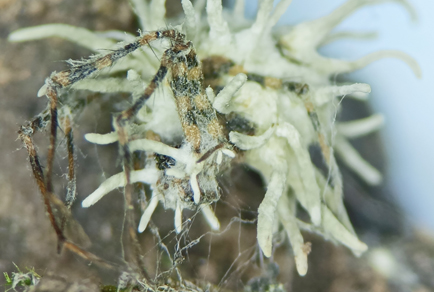
Spider-pathogenic fungi are predominantly found in Cordycipitaceae, with only rare occurrences in Ophiocordycipitaceae. Among the Ophiocordycipitaceae, Ophiocordyceps is the largest genus and is known for its ecological adaptability and broad host range and potential applications in sustainable pest management. Ophiocordyceps species thrive in tropical and subtropical regions, particularly in southwestern China, a biodiversity hotspot and key region for conservation of fungal diversity. During a survey in Southwest China, a new species, Ophiocordyceps linyphiidarum was identified. This species is distinguished from other Ophiocordyceps species by its specific spider host (Linyphiidae), and unique morphological characteristics, including longer polyblastic phialides and polymorphic, non-velutinous conidia. Phylogenetic analyses based on combined datasets of SSU, LSU, ITS, tef-1α, rpb1, and rpb2 further support its distinctiveness from related species. The discovery of O. linyphiidarum contributes to our understanding of ecosystem dynamics, supports climate-resilient biological control strategies, and emphasizes the value of exploring fungi as part of nature-based solutions for sustainable production and ecosystem health. The new species is formally described, illustrated, and compared with morphologically similar taxa.
References
- Araújo, J.P.M. & Hughes, D.P. (2016) Diversity of entomopathogenic fungi: which groups conquered the insect body? Advances in Genetics 94: 1–39. https://doi.org/10.1016/bs.adgen.2016.01.001
- Araújo, J.P.M., Evans, H.C., Kepler, R. & Hughes, D.P. (2018) Zombie-ant fungi across continents: 15 new species and new combinations within Ophiocordyceps. I. Myrmecophilous hirsutelloid species. Studies in Mycology 90: 119–160. https://doi.org/10.1016/j.simyco.2017.12.002
- Aung, O.M., Kang, J.C. & Liang, Z.Q. (2006) Cordyceps mrciensis sp. nov. from a spider in Thailand. Mycotaxon 97: 235–240.
- Ban, S., Sakane, T. & Nakagiri, A. (2015) Three new species of Ophiocordyceps and overview of anamorph types in the genus and the family Ophiocordyceptaceae. Mycological Progress 14 (1): 1–12. https://doi.org/10.1007/s11557-014-1017-8
- Bishop, L. (1990) Entomophagous fungi as mortality agents of ballooning spiderlings. Journal of Arachnology 18: 237–238.
- Capella-Gutiérrez, S., Silla-Martínez, J.M. & Gabaldón, T. (2009) trimAl: a tool for automated alignment trimming in large-scale phylogenetic analyses. Bioinformatics 25 (15): 1972–1973. https://doi.org/10.1093/bioinformatics/btp348
- Castlebury, L.A., Rossman, A.Y., Sung, G.H., Hyten, A.S. & Spatafora, J.W. (2004) Multigene phylogeny reveals new lineage for Stachybotrys chartarum, the indoor air fungus. Mycological Research 108 (8): 864–872. https://doi.org/10.1017/S0953756204000607
- Chiriví, J., Danies, G. & Sierra, R. (2017) Metabolomic profile and nucleoside composition of Cordyceps nidus sp. nov. (Cordycipitaceae): a new source of active compounds. PLoS One 12: e0179428. https://doi.org/10.1371/journal.pone.0179428
- Evans, R.E. (1967) Some entomogenous fungi. Proceedings of the Boston Society of Natural History 21: 33–36.
- Evans, H.C., Fogg, T., Buddie, A.G., Yeap, Y.T. & Araújo, J.P.M. (2025) The araneopathogenic genus Gibellula (Cordycipitaceae: Hypocreales) in the British Isles, including a new zombie species on orb‐weaving cave spiders (Metainae: Tetragnathidae). Fungal Systematics and Evolution 15: 153–178. https://doi.org/10.3114/fuse.2025.15.07
- Hall, T., Biosciences, I. & Carlsbad, C. (2011) BioEdit: an important software for molecular biology. GERF Bulletin of Biosciences 2 (1): 60–61.
- Hennings, P.C. (1897) Fungi Camerunenses II. Engler’s Botanischen Jahrbücher für Systematik, Pflanzengeschichte und Pflanzengeographie 23: 537–558.
- Huang, B., Fan, M.Z. & Li, Z.Z. (1998) A new species of Hymenostilbe. Mycosystema 17: 193–194.
- Hughes, D.P., Araújo, J. & Loreto, R. (2016) From so simple a beginning: the evolution of behavioral manipulation by fungi. Advances in Genetics 94: 437–469. https://doi.org/10.1016/bs.adgen.2016.01.004
- Hyde, K.D., Noorabadi, M.T., Thiyagaraja, V., He, M.Q., Johnston, P.R., Wijesinghe, S.N., Armand, A., Biketova, A.Y., Chethana, K.W.T., Erdoğdu, M., Ge, Z.W., Groenewald, J.Z., Hongsanan, S., Kušan, I., Leontyev, D.V., Li, D.W., Lin, C.G., Liu, N.G., Maharachchikumbura, S.S.N., Matočec, N., May, T.W., McKenzie, E.H.C., Mešić, A., Perera, R.H., Phukhamsakda, C., Piątek, M., Samarakoon, M.C., Selcuk, F., Senanayake, I.C., Tanney, J.B., Tian, Q., Vizzini, A., Wanasinghe, D.N., Wannasawang, N., Wijayawardene, N.N., Zhao, R.L., Abdel-Wahab, M.A., Abdollahzadeh, J., Abeywickrama, P.D., Abhinav, Absalan, S., Acharya, K., Afshari, N., Afshan, N.S., Afzalinia, S., Ahmadpour, S.A., Akulov, O., Alizadeh, A., Alizadeh, M., Al-Sadi, A.M., Alves, A., Alves, V.C.S., Alves-Silva, G., Antonín, V., Aouali, S., Aptroot, A., Apurillo, C.C.S., Arias, R.M., Asgari, B., Asghari, R., Assis, D.M.A., Assyov, B., Atienza, V., Aumentado, H.D.R., Avasthi, S., Azevedo, E., Bakhshi, M., Bao, D.F., Baral, H.O., Barata, M., Barbosa, K.D., Barbosa, R.N., Barbosa, F.R., Baroncelli, R., Barreto, G.G., Baschien, C., Bennett, R.M., Bera, I., Bezerra, J.D.P., Bhunjun, C.S., Bianchinotti, M.V., Błaszkowski, J., Boekhout, T., Bonito, G.M., Boonmee, S., Boonyuen, N., Bortnikov, F.M., Bregant, C., Bundhun, D., Burgaud, G., Buyck, B., Caeiro, M.F., Cabarroi-Hernández, M., Cai, M.F., Cai, L., Calabon, M.S., Calaça, F.J.S., Callalli, M., Câmara, M.P.S., Cano-Lira, J., Cao, B., Carlavilla, J.R., Carvalho, A., Carvalho, T.G., Castañeda-Ruiz, R.F., Catania, M.D.V., Cazabonne, J., Cedeño-Sanchez, M., Chaharmiri-Dokhaharani, S., Chaiwan, N., Chakraborty, N., Cheewankoon, R., Chen, C., Chen, J., Chen, Q., Chen, Y.P., Chinaglia, S., Coelho-Nascimento, C.C., Coleine, C., Costa-Rezende, D.H., Cortés-Pérez, A., Crouch, J.A., Crous, P.W., Cruz, R.H.S.F., Czachura, P., Damm, U., Darmostuk, V., Daroodi, Z., Das, K., Davoodian, N., Davydov, E.A., da Silva, G.A., da Silva, I.R., da Silva, R.M.F., da Silva Santos, A.C., Dai, D.Q., Dai, Y.C., de Groot, M.D., De Kesel, A., De Lange, R., de Medeiros, E.V., de Souza, C.F.A., de Souza, F.A., dela Cruz, T.E.E., Decock, C., Delgado, G., Denchev, C.M., Denchev, T.T., Deng, Y.L., Dentinger, B.T.M., Devadatha, B., Dianese, J.C., Dima, B., Doilom, M., Dissanayake, A.J., Dissanayake, D.M.L.S., Dissanayake, L.S., Diniz, A.G., Dolatabadi, S., Dong, J.H., Dong, W., Dong, Z.Y., Drechsler-Santos, E.R., Druzhinina, I.S., Du, T.Y., Dubey, M.K., Dutta, A.K., Elliott, T.F., Elshahed, M.S., Egidi, E., Eisvand, P., Fan, L., Fan, X., Fan, X.L., Fedosova, A.G., Ferro, L.O., Fiuza, P.O., Flakus, A., Fonseca, E.O.W., Fryar, S.C., Gabaldón, T., Gajanayake, A.J., Gannibal, P.B., Gao, F., García-Sánchez, D., García-Sandoval, R., Garrido-Benavent, I., Garzoli, L., Gasca-Pineda, J., Gautam, A.K., Gené, J., Ghobad-Nejhad, M., Ghosh, A., Giachini, A.J., Gibertoni, T.B., Gentekaki, E., Gmoshinskiy, V.I., Góes-Neto, A., Gomdola, D., Gorjón, S.P., Goto, B.T., Granados-Montero, M.M., Griffith, G.W., Groenewald, M., Grossart, H.P., Gu, Z.R., Gueidan, C., Gunarathne, A., Gunaseelan, S., Guo, S.L., Gusmão, L.F.P., Gutierrez, A.C., Guzmán-Dávalos, L. & Zvyagina, E. (2024) The 2024 outline of fungi and fungus-like taxa. Mycosphere 15 (1): 5146–6239. https://doi.org/10.5943/mycosphere/15/1/25
- Joseph, R.A., Masoudi, A., Valdiviezo, M.J. & Keyhani, N.O. (2025) Discovery of Gibellula floridensis from infected spiders and analysis of the surrounding fungal entomopathogen community. Journal of Fungi 10: 694. https://doi.org/10.3390/jof10100694
- Kalyaanamoorthy, S., Minh, B.Q., Wong, T.K.F., von Haeseler, A. & Jermiin, L.S. (2017) ModelFinder: fast model selection for accurate phylogenetic estimates. Nature Methods 14 (6): 587–589. https://doi.org/10.1038/nmeth.4285
- Katoh, K. & Standley, D.M. (2013) MAFFT multiple sequence alignment software version 7: improvements in performance and usability. Molecular Biology and Evolution 30 (4): 772–780. https://doi.org/10.1093/molbev/mst010
- Kobayasi, Y. (1941) The genus Cordyceps and its allies. Science Reports of the Tokyo Bunrika Daigaku 5: 53–260.
- Kobayasi, Y. & Shimizu, D. (1976) The genus Cordyceps and its allies from New Guinea. Bulletin of the National Science Museum, Tokyo, Ser B 2: 133–152.
- Kobayasi, Y. & Shimizu, D. (1980) Cordyceps species from Japan 3. Bulletin of the National Science Museum, Tokyo, Series B, Botany 6 (4): 125–145.
- Koval, E.Z. (1976) Species novae fungorum entomophilorum hyphomycetalum. Novosti Sistematiki Nizshikh Rastenii 13: 203–208.
- Kuephadungphan, W., Petcharad, B., Tasanathai, K., Thanakitpipattana, D., Kobmoo, N., Khonsanit, A., Samson, R.A. & Luangsa-ard, J.J. (2022) Multi-locus phylogeny unmasks hidden species within the specialised spider-parasitic fungus, Gibellula (Hypocreales, Cordycipitaceae) in Thailand. Studies in Mycology 101: 245–286. https://doi.org/10.3114/sim.2022.101.04
- Long, F.Y., Qin, L.W., Xiao, Y.P., Hyde, K.D. & Wen, T.C. (2021) Multigene phylogeny and morphology reveal a new species, Ophiocordyceps vespulae, from Jilin Province, China. Phytotaxa 478: 33–48. https://doi.org/10.11646/phytotaxa.280.2.4
- Lu, Y., Tang, D., Liu, Z., Zhao, J., Chen, Y., Ma, J., Luo, L. & Yu, H. (2024) Genomic comparative analysis of Ophiocordyceps unilateralis sensu lato. Frontiers in Microbiology 15: 1293077. https://doi.org/10.3389/fmicb.2024.1293077
- Luangsa-ard, J.J., Ridkaew, R., Tasanathai, K., Thanakitpipattana, D. & Hywel-Jones, N. (2011) Ophiocordyceps halabalaensis: a new species of Ophiocordyceps pathogenic to Camponotus gigas in Hala Bala Wildlife Sanctuary, Southern Thailand. Fungal Biology 115 (7): 608–614. https://doi.org/10.1016/j.funbio.2011.03.002
- Luangsa-ard, J.J., Tasanathai, K., Thanakitpipattana, D., Khonsanit, A. & Stadler, M. (2018) Novel and interesting Ophiocordyceps spp. (Ophiocordycipitaceae, Hypocreales) with superficial perithecia from Thailand. Studies in Mycology 89: 125–142. https://doi.org/10.1016/j.simyco.2018.02.001
- Maharachchikumbura, S.S.N., Hyde, K.D., Jones, E.B.G., McKenzie, E.H.C., Huang, S.K., Abdel-Wahab, M.A., Daranagama, D.A., Dayarathne, M., D’souza, M.J., Goonasekara, I.D., Hongsanan, S., Jayawardena, R.S., Kirk, P.M, Konta, S., Liu, J.K., Liu, Z.Y., Norphanphoun, C., Pang, K.L., Perera, R.H, Senanayake, I.C., Shang, Q.J, Shenoy, B.D, Xiao, Y.P., Bahkali, A.H., Kang, J.C, Somrothipol, S., Suetrong, S., Wen, T.C. & Xu, J.C. (2015) Towards a natural classification and backbone tree for Sordariomycetes. Fungal Diversity 72 (1): 199–301. https://doi.org/10.1007/s13225-015-0331-z
- Maharachchikumbura, S.S.N., Chen, Y., Ariyawansa, H.A., Hyde, K.D., Haelewaters, D., Perera, R.H., Samarakoon, M.C., Wanasinghe, D.N., Bustamante, D.E., Liu, J., Lawrence, D.P., Cheewangkoon, R. & Stadler, M. (2021) Integrative approaches for species delimitation in Ascomycota. Fungal Diversity 109: 155–179. https://doi.org/10.1007/s13225-021-00486-6
- Mains, E.B. (1950) Entomogenous species of Akanthomyces, Hymenostilbe and Insecticola in North America. Mycologia 42: 566–589. https://doi.org/10.2307/3755572
- Mains, E.B. (1955) Some entomogenous species of Isaria. Papers of the Michigan Academy of Science 40: 23–32.
- Miller, M.A., Pfeiffer, W. & Schwartz, T. (2010) Creating the ClPRES Science Gateway for inference of large phylogenetic trees. In: 2010 Gateway Computing Environments Workshop (GCE). IEEE, pp. 1–8. https://doi.org/10.1109/GCE.2010.5676129
- Mongkolsamrit, S., Noisripoom, W., Arnamnart, N., Lamlertthon, S., Himaman, W., Jangsantear, P., Samson, R.A. & Luangsa-ard, J.J. (2019) Resurrection of Paraisaria in the Ophiocordycipitaceae with three new species from Thailand. Mycological Progress 18 (9): 1213–1230. https://doi.org/10.1007/s11557-019-01518-x
- Mongkolsamrit, S., Noisripoom, W., Tasanathai, K., Khonsanit, A., Thanakitpipattana, D., Lamlertthon, S., Himaman, W., Crous, P.W., Stadler, M. & Luangsa-ard, J.J. (2024) Uncovering cryptic species diversity of Ophiocordyceps (Ophiocordycipitaceae) associated with Coleoptera from Thailand. Fungal Systematics and Evolution 14: 223–250. https://doi.org/10.3114/fuse.2024.14.15
- Nylander, J.A.A. (2004) MrModeltest v2. Program distributed by the author. Evolutionary Biology Centre, Uppsala University.
- Peng, F., Chen, M.J. & Huang, B. (2008) A new record of Hymenostilbe in China. Mycosystema 27: 452–454.
- Petch, T. (1931) Notes on entomogenous fungi. Transactions of the British Mycological Society 16: 55–75. https://doi.org/10.1016/S0007-1536(31)80006-3
- Petch, T. (1932) A list of the entomogenous fungi of Great Britain. Transactions of the British Mycological Society 17: 170–178. https://doi.org/10.1016/S0007-1536(32)80012-4
- Petch, T. (1935) Notes on entomogenous fungi. Transactions of the British Mycological Society 19: 161–194. https://doi.org/10.1016/S0007-1536(35)80008-9
- Petch, T. (1948) A revised list of British entomogenous fungi. Transactions of the British Mycological Society 31: 286–304. https://doi.org/10.1016/S0007-1536(48)80014-8
- Qu, J., Yu, L., Zhang, J., Han, Y. & Zou, X. (2018) A new entomopathogenic fungus, Ophiocordyceps ponerus sp. nov., from China. Phytotaxa 343: 116–126. https://doi.org/10.11646/phytotaxa.343.2.2
- Quandt, C.A., Kepler, R.M., Gams, W., Araújo, J.P.M., Ban, S., Evans, H.C., Hughes, D., Humber, R., Hywel-Jones, N., Li, Z.Z., Luangsa-ard, J.J., Rehner, S.A., Sanjuan, T., Sato, H., Shrestha, B., Sung, G.H., Yao, Y.J., Zare, R. & Spatafora, J.W. (2014) Phylogenetic-based nomenclatural proposals for Ophiocordycipitaceae (Hypocreales) with new combinations in Tolypocladium. IMA Fungus 5 (1): 121–134. https://doi.org/10.5598/imafungus.2014.05.01.12
- Rambaut, A., Drummond, A.J., Xie, D., Baele, G. & Suchard, M.A. (2018) Posterior summarization in Bayesian phylogenetics using tracer 1.7. Systematic Biology 67 (5): 901–904. https://doi.org/10.1093/sysbio/syy032
- Ronquist, F., Teslenko, M., van der Mark, P., Ayres, D.L., Darling, A., Höhna, S., Larget, B., Liu, L., Suchard, M.A. & Huelsenbeck, J.P. (2012) MrBayes 3.2: efficient Bayesian phylogenetic inference and model choice across a large model space. Systematic Biology 61 (3): 539–542. https://doi.org/10.1093/sysbio/sys029
- Saltamachia, S.J. & Araújo, J.P.M. (2020) Ophiocordyceps desmidiospora, a basal lineage within the "zombie-ant fungi" clade. Mycologia 112 (6): 1171–1183. https://doi.org/10.1080/00275514.2020.1732147
- Samson, R.A. & Evans, H.C. (1975) Notes on entomogenous fungi from Ghana. III. The genus Hymenostilbe. Proceedings of the Koninklijke Nederlandse Akademie van Wetenschappen Ser C 78: 73–80.
- Samson, R.A. & Evans, H.C. (1992) New species of Gibellula on spiders (Araneidae) from South America. Mycologia 84: 300–314. https://doi.org/10.1080/00275514.1992.12026143
- Sanjuan, T.I., Franco-Molano, A.E., Kepler, R.M., Spatafora, J.W., Tabima, J., Vasco-Palacios, A.M. & Restrepo, S. (2015) Five new species of entomopathogenic fungi from the Amazon and evolution of neotropical Ophiocordyceps. Fungal Biology 119 (10): 901–916. https://doi.org/10.1016/j.funbio.2015.06.010
- Schoch, C.L., Seifert, K.A., Huhndorf, S., Robert, V., Spouge, J.L., Levesque, C.A., Chen, W., Bolchacova, E., Voigt, K., Crous, P.W. & Miller, A.N. (2012) Nuclear ribosomal internal transcribed spacer (ITS) region as a universal DNA barcode marker for Fungi. Proceedings of the National Academy of Sciences 109 (16): 6241–6246. https://doi.org/10.1073/pnas.1117018109
- Shang, Y., Xiao, G. & Zheng, P. (2016) Divergent and convergent evolution of fungal pathogenicity. Genome Biology and Evolution 8: 1374–1387. https://doi.org/10.1093/gbe/evw082
- Sharma, A., Kaur, E., Joshi, R., Kumari, P., Khatri, A., Swarnkar, M.K., Kumar, D., Acharya, V. & Nadda, G. (2023) Systematic analyses with genomic and metabolomic insights reveal a new species, Ophiocordyceps indica sp. nov. from treeline area of Indian Western Himalayan region. Frontiers in Microbiology 14: 1188649. https://doi.org/10.3389/fmicb.2023.1188649
- Shrestha, B., Tanaka, E. & Hyun, M.W. (2017) Mycosphere essay 19. Cordyceps species parasitize hymenopteran and hemipteran insects. Mycosphere 8: 1424–1442. https://doi.org/10.5943/mycosphere/8/9/8
- Shrestha, B., Kubátová, A., Tanaka, E., Oh, J., Yoon, D.H., Sung, J.M. & Sung, G.H. (2019) Spider-pathogenic fungi within Hypocreales (Ascomycota): their current nomenclature, diversity, and distribution. Mycological Progress 18 (8): 983–1003. https://doi.org/10.1007/s11557-019-01512-3
- Simmons, D.R., Lund, J., Levitsky, T. & Groden, E. (2015) Ophiocordyceps myrmicarum, a new species infecting invasive Myrmica rubra in Maine. Journal of Invertebrate Pathology 125: 23–30. https://doi.org/10.1016/j.jip.2014.12.010
- Spatafora, J.W., Sung, G.H., Sung, J.M., Hywel-Jones, N.L. & White, J.J.F. (2007) Phylogenetic evidence for an animal pathogen origin of ergot and the grass endophytes. Molecular Ecology 16 (8): 1701–1711. https://doi.org/10.1111/j.1365–294X.2007.03225.x
- Spatafora, J.W., Quandt, C.A. & Kepler, R.M. (2015) New 1F1N species combinations in Ophiocordycipitaceae (Hypocreales). IMA Fungus 6: 357–362. https://doi.org/10.5598/imafungus.2015.06.02.07
- Stamatakis, A. (2014) RAxML version 8: A tool for phylogenetic analysis and post-analysis of large phylogenies. Bioinformatics 30 (9): 1312–1313. https://doi.org/10.1093/bioinformatics/btu033
- Sun, T., Zou, W., Dong, Q., Huang, O., Tang, D. & Yu, H. (2022) Morphology, phylogeny, mitogenomics andmetagenomics reveal a new entomopathogenic fungus Ophiocordyceps nujiangensis (Hypocreales, Ophiocordycipitaceae) from Southwestern China. MycoKeys 94: 91–108. https://doi.org/10.3897/mycokeys.94.89425
- Sung, G.H., Hywel-Jones, N.L., Sung, J.M., Luangsa-ard, J.J., Shrestha, B. & Spatafora, J.W. (2007) Phylogenetic classification of Cordyceps and the clavicipitaceous fungi. Studies in Mycology 57: 5–59. https://doi.org/10.3114/sim.2007.57.01
- Tang, D., Huang, O., Zou, W., Wang, Y., Wang, Y., Dong, Q., Sun, T., Yang, G. & Yu, H. (2023) Six new species of zombie-ant fungi from Yunnan in China. IMA Fungus 14 (1): 9. https://doi.org/10.1186/s43008-023-00114-9
- Tasanathai, K., Noisripoom, W., Chaitika, T., Khonsanit, A., Hasin, S. & Luangsa-ard, J.J. (2019) Phylogenetic and morphological classification of Ophiocordyceps species on termites from Thailand. MycoKeys 56: 101–129. https://doi.org/10.3897/mycokeys.56.37636
- Tehan, R.M., Dooley, C.B., Barge, E.G., McPhail, K.L. & Spatafora, J.W. (2023) New species and new combinations in the genus Paraisaria (Hypocreales, Ophiocordycipitaceae) from the U.S.A., supported by polyphasic analysis. MycoKeys 100: 69–94. https://doi.org/10.3897/mycokeys.100.110959
- Thiyagaraja, V., Hyde, K.D., Piepenbring, M., Davydov, E.A., Dai, D.Q., Abdollahzadeh, J., Bundhun, D., Chethana, K.W.T., Crous, P.W., Gajanayake, A.J., Gomdola, D., Haelewaters, D., Johnston, P.R., Mardones, M., Perera, R.H., Senanayake, I.C., Tibpromma, S., Yasanthika, W.A.E., Abbasi, M.W., Abdel-Wahab, M.A., Absalan, S., Acharya, K., Afshari, N., Aouali, S., Aptroot, A., Apurillo, C.C.S., Armand, A., Avasthi, S., Bao, D.F., Bhat, D.J., Blondelle, A., Boonmee, S., Boonyuen, N., Braun, U., Čadež, N., Calabon, M.S., Cazabonne, J., Chakraborty, N., Cheewangkoon, R., Chen, K.H., Coleine, C., Darmostuk, V., Daroodi, Z., Dasgupta, D., de Groot, M.D., De Hoog, S., Deng, W., Dissanayake, A.J., Dissanayake, L.S., Doilom, M., Dong, W., Ertz, D., Fortuna, J.L., Gautam, A.K., Gorczak, M., Groenewald, M., Groenewald, J.Z., Gunarathne, A., Han, Y., Hongsanan, S., Hou, C.L., Htet, Y.M., Htet, Z.H., Huang, Q., Huang, S.K., Huanraluek, N., Jayalal, R.G.U., Jayasiri, S.C., Jayawardena, R.S., Jiang, S.H., Jones, E.B.G., Karimi, O., Karunarathna, S.C., Khuna, S., Kossmann, T., Kularathnage, N.D., Lestari, A.S., Li, C.J.Y., Li, J.F., Lin, C.G., Liu, J.K., Liu, X., Liu, Y., Lu, L., Lu, Y.Z., Luo, Z.L., Ma, J., Madagammana, A.S., Maharachchikumbura, S.S.N., Marasinghe, D.S., Martzoukou, E., Marin-Felix, Y., Miller, A.N., Monkai, J., Noorabadi, M.T., Norphanphoun, C., Olariaga, I., Opiña, L.A.D., Pang, K.L., Peng, X., Péter, G., Phillips, A.J.L., Pineda, M.M., Prieto, M., Quan, Y., Quandt, A., Rajeshkumar, K.C., Rambold, G., Raymundo, T., Raza, M., Réblová, M., Samaradiwakara, N.P., Sarma, V.V., Schultz, M., Seifollahi, E., Selbmann, L., Su, H., Sun, Y.R., Tehler, A., Tennakoon, D.S., Thambugala, K.M., Tian, W.H., Tsurykau, A., Valenzuela, R., Verma, R.K., Wang, J., Wang, W.P., Wang, X.Y., Wang, Y., Wang, Z., Wei, D.P., Wen, T., Wijayawardene, N.N., Wimalasena, M.K., Worthy, F.R., Wu, H.X., Xu, L., Yakovchenko, L.S., Yu, F.M., Zeng, X.Y., Zhang, S.N., Zhang, Z.Y., Zhao, Q. & Wanasinghe, D.N. (2025) Orders of Ascomycota. Mycosphere 16 (1): 536–1411. https://doi.org/10.5943/mycosphere/16/1/8
- Vega, F.E., Meyling, N.V. & Luangsa-ard, J.J. (2012) Fungal entomopathogens. In: Vega, F.E. & Kaya, H.K. (Eds.) Insect Pathology, 2nd edn. Academic Press, San Diego, pp. 172–220.
- Vilgalys, R. & Hester, M. (1990) Rapid genetic identification and mapping of enzymatically amplified ribosomal DNA from several Cryptococcus species. Journal of Bacteriology 172 (8): 4238–4246. https://doi.org/10.1128/jb.172.8.4238-4246
- Wang, Y.B., Nguyen, T., Dai, Y., Yu, H., Zeng, W. & Wu, C. (2018) Molecular phylogeny and morphology of Ophiocordyceps unituberculata sp. nov. (Ophiocordycipitaceae), a pathogen of caterpillars (Noctuidae, Lepidoptera) from Yunnan, China. Mycological Progress 17: 745–753. https://doi.org/10.1007/s11557-017-1370-5
- Wang, Y., Wu, H., Tran, N., Zhang, G., Souvanhnachit, S., Wang, Y. & Yu, H. (2021) Ophiocordyceps furcatosubulata, a new entomopathogenic fungus parasitizing beetle larva (Coleoptera: Elateridae). Phytotaxa 482: 268–278. https://doi.org/10.11646/phytotaxa.482.3.5
- Wang, T., Chang, X.Y., Huang, B., Li, Z.Z. & Chen, M.J. (2024) Species diversity of spider-pathogenic fungi in China. Mycosystema 43 (3): 230–243. https://doi.org/10.13346/j.mycosystema.230243
- Wen, T.C., Zhu, R.C., Kang, J.C., Huang, M.H., Tan, D.B., Ariyawansha, H., Hyde, K.D. & Liu, H. (2013) Ophiocordyceps xuefengensis sp. nov. from larvae of Phassus nodus (Hepialidae) in Hunan Province, southern China. Phytotaxa 123 (1): 41–50. https://doi.org/10.11646/phytotaxa.123.1.2
- White, T.J., Bruns, T., Lee, S. & Taylor, J. (1990) Amplification and direct sequencing of fungal ribosomal RNA genes for phylogenetics: PCR-protocols and applications-A laboratory manual. In: PCR Protocols: a Guide to Methods and Applications. pp. 315–322. https://doi.org/10.1016/B978-0-12-372180-8.50042-1
- World Spider Catalog (2025) Natural History Museum Bern, version 15.5. Available from: http://wsc.nmbe.ch (accessed 28 January 2025)
- Xiao, Y.P., Hongsanan, S., Hyde, K.D., Brooks, S., Xie, N., Long, F.Y. & Wen, T.C. (2019) Two new entomopathogenic species of Ophiocordyceps in Thailand. MycoKeys 47: 53–74. https://doi.org/10.3897/mycokeys.47.29898
- Yang, Z.L., Qin, J., Xia, C., Hu, Q., Li, Q.Q. & Yang, Z.L. (2015) Ophiocordyceps highlandensis, a new entomopathogenic fungus from Yunnan, China. Phytotaxa 204 (4): 287–295. https://doi.org/10.11646/phytotaxa.204.4.5
- Yang, Y., Xiao, Y.P., Yu, G.J., Wen, T.C., Deng, C.Y., Meng, J. & Lu, Z.H. (2021) Ophiocordyceps aphrophoridarum sp. nov., a new entomopathogenic species from Guizhou, China. Biodiversity Data Journal 9: e66115. https://doi.org/10.3897/BDJ.9.e66115
- Yang, Y., Jayawardena, R.S., Lu, Y.Z., Xie, S.Q., Tian, X.G., Wang, J.P., Zhou, S.X. & Xiao, Y.P. (2024) Four new Ophiocordyceps species in China. Mycosystema 43 (3): 230–256. https://doi.org/10.13346/j.mycosystema.230256
- Zeng, X.Y., Tan, T.J., Tian, F.H., Wang, Y. & Wen, T.C. (2023) OFPT: a one-stop software for fungal phylogeny. Mycosphere 14 (1): 1730–1741. https://doi.org/10.5943/mycosphere/14/1/20
- Zha, L.S., Kryukov, V.Y., Ding, J.H., Jeewon, R. & Chomnunti, P. (2021) Novel taxa and species diversity of Cordyceps sensu lato (Hypocreales, Ascomycota) developing on wireworms (Elateroidea and Tenebrionoidea.Coleoptera). MycoKeys 78: 79–117. https://doi.org/10.3897/mycokeys.78.61836