

Abstract
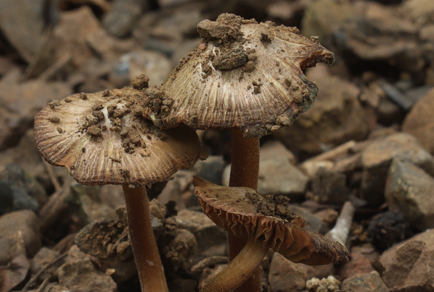
Inocybe caryicola, a new species associated with Carya illinoinensis and discovered in Yunnan province, China, is described based on morphological characteristics and phylogenetic analyses. Inocybe caryicola is distinctly characterized by the pileus of young basidiomata with an obvious cortina, relatively small basidiospores that are angular to polygonal and have 11–13 distinct nodules, 2- or 4-spored basidia, and the presence of subclavate cauloparacystidia. This study provides a detailed description of the new species, photographs of the basidiomata, as well as microscopic images of the basidiospores under light microscopy (LM) and basidiospores under scanning electron microscopy (SEM). Molecular phylogenetic analyses based on ITS, LSU, and rpb2 show that Inocybe caryicola forms a highly supported clade, which is sister to the clade jointly formed by I. chondrospora and I. kuberae.
References
- Ashraf, U., Webster, G., Razzaq, A., Afshan, N.U.S., Christofides, S.R., Naseer, A., Ali, M., Niazi, A.R., Weightman, A. & Khalid, A.N. (2025) Inocybe crenata sp. nov. (subsec. Geophyllinae, sect. Tardae) from Conifer Dominated Forests of Pakistan. Mycobiology 53 (2): 1–9. https://doi.org/10.1080/12298093.2024.2398273
- Bandini, D., Brandrud, T.E., Dima, B., Dondl, M., Fachada, V., Hussong, A., Mifsud, S., Oertel, B. & Thüs, H. (2022) Fibre caps across Europe: type studies and 11 new species of Inocybe (Agaricales, Basidiomycota). Integrative Systematics 5: 1–85. https://doi.org/10.18476/2022.901982
- Bandini, D., Oertel, B. & Eberhardt, U. (2022) Noch mehr Risspilze (3): Einundzwanzig neue Arten der Familie Inocybaceae. Mycologia Bavarica 22: 31–138.
- Bandini, D., Oertel, B. & Eberhardt, U. (2021) A fresh outlook on the smooth-spored species of Inocybe: type studies and 18 new species. Mycological Progress 20: 1019–1114. https://doi.org/10.1007/s11557-021-01712-w
- Bandini, D., Oertel, B., Moreau, P.A., Thines, M. & Ploch, S. (2019) Three new hygrophilous species of Inocybe, subgenus Inocybe. Mycological Progress 18: 1101–1119. https://doi.org/10.1007/s11557-019-01509-y
- Bonito, G., Brenneman, T. & Vilgalys, R. (2011) Ectomycorrhizal fungal diversity in orchards of cultivated pecan (Carya illinoinensis; Juglandaceae). Mycorrhiza 21: 601–612. https://doi.org/10.1007/s00572-011-0368-0
- Bougher, N.L., Matheny, P.B. & Gates, G.M. (2012) Five new species and records of Inocybe (Agaricales) from temperate and tropical Australia. Nuytsia 22 (2): 57–74. https://doi.org/10.58828/nuy00630
- Brison, F.R. (1974) Pecan Culture. Capital Printing, Austin, Texas, 300 pp.
- Capella-Gutiérrez, S., Silla-Martínez, J.M. & Gabaldón, T. (2009) trimAl: a tool for automated alignment trimming in large-scale phylogenetic analyses. Bioinformatics 25 (15): 1972–1973. https://doi.org/10.1093/bioinformatics/btp348
- Chen, X., Yu, W.-J., Bau, T., Matheny, P.B., Horak, E., Liu, Y., Qin, L.-W., Tang, L.-P., Ge, Y.-P., Liu, T.-Z. & Fan, Y.-G. (2024) Contributions to the Inocybe umbratica–paludinella (Agaricales) group in China: taxonomy, species diversity, and molecular phylogeny. Journal of Fungi 10 (12): 893. https://doi.org/10.3390/jof10120893
- Dovana, F., Ferisin, G., Bizio, E., Bandini, D., Olariaga, I. & Esteve-Raventos, F. (2020) A morphological and phylogenetic characterisation of Inocybe similis (Agaricales, Inocybaceae), a rare species described by Bresadola in 1905. Phytotaxa 474 (1): 71–80. https://doi.org/10.11646/phytotaxa.474.1.7
- Dovana, F., Bandini, D., Eberhardt, U., Olariaga, I., Bizio, E., Ferisin, G. & Esteve-Raventós, F. (2023) Re-valuation of the taxonomic status of species within the Inocybe similis complex. Journal of Fungi 9 (6): 679. https://doi.org/10.3390/jof9060679
- Esteve-Raventós, F., Larsson, E., Pancorbo, F., Bizio, E., Altés, A., Turégano, Y., Moreno, G. & Olariaga, I. (2024) A taxonomic and phylogenetic contribution on Inosperma section Inosperma (Agaricales, Inocybaceae) in Europe: Calamistratum and Geraniodorum groups. Journal of Fungi 10 (6): 374. https://doi.org/10.3390/jof10060374
- Esteve-Raventós, F., Moreno, G., Bizio, E. & Alvarado, P. (2015) Inocybe flavobrunnescens, a new species in section Marginatae. Mycological Progress 14: 14. https://doi.org/10.1007/s11557-015-1036-0
- Fan, Y.-G. & Bau, T. (2014) Inocybe miyiensis, a new two-spored species in section Marginatae from China. Nova Hedwigia 98 (1–2): 179–185. https://doi.org/10.1127/0029-5035/2013/0135
- Fan, Y.-G. & Bau, T. (2013) Two striking Inocybe species from Yunnan Province, China. Mycotaxon 123 (1): 169–181. https://doi.org/10.5248/123.169
- Fries, E.M. (1863) Monographia Hymenomycetum Sueciae. C.A. Leffler, Uppsala, 355 pp.
- Gao, J.-L., Ge, Y.-P., Matheny, P.B., He, P.-M., Wu, X.-P., Bau, T., Yu, W.-J. & Fan, Y.-G. (2025) A phylogeny of the Inocybe alienospora group (Agaricales) with emphasis on seven new species from China and emendation of sect. Leptocybe. Mycology 16 (2): 812–855. https://doi.org/10.1080/21501203.2024.2380069
- Gardes, M. & Bruns, T.D. (1993) ITS primers with enhanced specificity for basidiomycetes‐application to the identification of mycorrhizae and rusts. Molecular ecology 2 (2): 113–118. https://doi.org/10.1111/j.1365-294X.1993.tb00005.x
- Ge, Z.-W., Brenneman, T., Bonito, G. & Smith, M.E. (2017) Soil pH and mineral nutrients strongly influence truffles and other ectomycorrhizal fungi associated with commercial pecans (Carya illinoinensis). Plant and Soil 418: 493–505. https://doi.org/10.1007/s11104-017-3312-z
- Ge, Z.-W., Xu, T.-X., Qu, H. & Ma, Y.-R. (2021) Three new species of Smithiomyces from tropical Asia support an amphi-Pacific disjunct distribution in the genus. Mycologia 113 (5): 1009–1021. https://doi.org/10.1080/00275514.2021.1936832
- Hall, T.A. (1999) BioEdit: a user-friendly biological sequence alignment editorand analysis program for Windows 95/98/NT. Nucleic acids symposium series 41: 95–98.
- Hoang, D.T., Chernomor, O., von Haeseler, A., Minh, B.Q. & Vinh, L.S. (2017) UFBoot2: Improving the Ultrafast Bootstrap Approximation. Molecular Biology and Evolution 35 (2): 518–522. https://doi.org/10.1093/molbev/msx281
- Kalyaanamoorthy, S., Minh, B.Q., Wong, T.K., Von Haeseler, A. & Jermiin, L.S. (2017) ModelFinder: fast model selection for accurate phylogenetic estimates. Nature methods 14: 587–589. https://doi.org/10.1038/nmeth.4285
- Katoh, K. & Standley, D.M. (2013) MAFFT multiple sequence alignment software version 7: improvements in performance and usability. Molecular Biology Evolution 30 (4): 772–780. https://doi.org/10.1093/molbev/mst010
- Kaygusuz, O., Bandini, D., Knudsen, H. & Piepenbring, M. (2024) Two new species of Inocybe (Inocybaceae: Agaricomycetes) from Turkey based on morphological characteristics and phylogenetic evidence. Turkish Journal of Botany 48 (3): 145–154. https://doi.org/10.55730/1300-008X.2803
- Khan, M.B., Naseer, A., Aqdus, F., Ishaq, M., Fiaz, M. & Khalid, A.N. (2022) Inocybe quercicola sp. nov. (Agaricales, Inocybaceae), from Pakistan. Microbial Biosystems 6 (2): 22–29. https://doi.org/10.21608/mb.2022.109930.1047
- Kokkonen, K. & Vauras, J. (2012) Eleven new boreal species of Inocybe with nodulose spores. Mycological Progress 11: 299–341. https://doi.org/10.1007/s11557-011-0783-9
- Kornerup, A. & Wanscher, J.H.K. (1978) The Methuen Handbook of Colour (3rd ed., Reprint). Eyre Methuen Ltd: London, UK, 252 pp.
- Koch, K. (1869) Dendrologie. F. Enke, Erlangen, 735 pp.
- Larsson, A. (2014) AliView: a fast and lightweight alignment viewer and editor for large datasets. Bioinformatics 30 (22): 3276–3278. https://doi.org/10.1093/bioinformatics/btu531
- Latha, K.P.D. & Manimohan, P. (2015) Inocybe griseorubida, a new species of Pseudosperma clade from tropical India. Phytotaxa 221 (2): 166–174. https://doi.org/10.11646/phytotaxa.221.2.6
- Latha, K.P.D., Manimohan, P. & Matheny, P.B. (2016) A new species of Inocybe representing the Nothocybe lineage. Phytotaxa 267 (1): 40–50. https://doi.org/10.11646/phytotaxa.267.1.4
- Li, H.-J., Zhang, H.-S., Zhang, Y.-Z., Zhang, K.-P., Zhou, J., Yin, Y., Jiang, S.-F., Ma, P.-B., He, Q., Zhang, Y.-T., Wen, K., Yuan, Y., Lang, N., Lu, J.-J. & Sun, C.-Y. (2020) Mushroom Poisoning Outbreaks—China, 2019. China CDC Weekly 2 (2): 19–24. https://doi.org/10.46234/ccdcw2020.005
- Li, H.-J., Zhang, H.-S., Zhang, Y.-Z., Zhou, J., Yin, Y., He, Q., Jiang, S.-F., Ma, P.-B., Zhang, Y.-T., Wen, K., Yuan, Y., Lang, N., Cheng, B.-W., Lu, J.-J. & Sun, C.-Y. (2021) Mushroom Poisoning Outbreaks—China, 2020. China CDC Weekly 3 (3): 41–45. https://doi.org/10.46234/ccdcw2021.014
- Li, H.-J., Zhang, H.-S., Zhang, Y.-Z., Zhou, J., Yin, Y., He, Q., Jiang, S.-F., Ma, P.-B., Zhang, Y.-T., Yuan, Y., Lang, N., Cheng, B.-W., Wang, M. & Sun, C.-Y. (2022) Mushroom Poisoning Outbreaks—China, 2021. China CDC Weekly 4 (3): 35. https://doi.org/10.46234/ccdcw2022.010
- Li, H.-J., Zhang, Y.-Z., Zhang, H.-S., Zhou, J., Liang, J.-Q., Yin, Y., He, Q., Jiang, S.-F., Zhang, Y.-T., Yuan, Y., Lang, N., Cheng, B.-W., Wang, M. & Sun, C.-Y. (2023) Mushroom Poisoning Outbreaks—China, 2022. China CDC Weekly 5 (3): 45–50. https://doi.org/10.46234/ccdcw2023.009
- Li, H.-J., Zhang, Y.-Z., Zhang, H.-S., Zhou, J., Chen, Z.-H., Liang, J.-Q., Yin, Y., He, Q., Jiang, S.-F., Zhang, Y.-T., Yuan, Y., Lang, N., Cheng, B.-W., Zhong, J.-J., Li, Z.-F. & Sun, C.-Y. (2024) Mushroom Poisoning Outbreaks—China, 2023. China CDC Weekly 6 (4): 64–68. https://doi.org/10.46234/ccdcw2024.014
- Liu, G.-H., Fan, Y.-G., Wang, J.-R. & Liu, Y. (2025) Inocybe qiluensis (Agaricales), a new nodulose-spored species with hygrophanous pileus from Shandong province, China. Phytotaxa 683 (3): 205–217. https://doi.org/10.11646/phytotaxa.683.3.2
- Matheny, P.B., Liu, Y., Ammirati, J.F. & Hall, B.D. (2002) Using RPB1 sequences to improve phylogenetic inference among mushrooms (Inocybe, Agaricales). American Journal of Botany 89 (4): 688–698. https://doi.org/10.3732/ajb.89.4.688
- Matheny, P.B. (2005) Improving phylogenetic inference of mushrooms with RPB1 and RPB2 nucleotide sequences (Inocybe; Agaricales). Molecular Phylogenetics and Evolution 35 (1): 1–20. https://doi.org/10.1016/j.ympev.2004.11.014
- Matheny, P.B., Hobbs, A.M. & Esteve-Raventós, F. (2020) Genera of Inocybaceae: New skin for the old ceremony. Mycologia 112 (1): 83–120. https://doi.org/10.1080/00275514.2019.1668906
- Matheny, P.B. & Swenie, R.A. (2018) The Inocybe geophylla group in North America: a revision of the lilac species surrounding I. lilacina. Mycologia 110 (3): 618–634. https://doi.org/10.1080/00275514.2018.1469880
- Minh, B.Q., Schmidt, H.A., Chernomor, O., Schrempf, D., Woodhams, M.D., von Haeseler, A. & Lanfear, R. (2020) IQ-TREE 2: New Models and Efficient Methods for Phylogenetic Inference in the Genomic Era. Molecular Biology and Evolution 37 (5): 1530–1534. https://doi.org/10.1093/molbev/msaa015
- Patocka, J., Wu, R., Nepovimova, E., Valis, M., Wu, W. & Kuca, K. (2021) Chemistry and toxicology of major bioactive substances in Inocybe mushrooms. International Journal of Molecular Sciences 22 (4): 2218. https://doi.org/10.3390/ijms22042218
- Rambaut, A. (2018) FigTree Version 1.4.4. Available from: http://tree.bio.ed.ac.uk (accessed 19 April 2024)
- Ronquist, F., Teslenko, M., Van Der Mark, P., Ayres, D.L., Darling, A., Höhna, S., Larget, B., Liu, L., Suchard, M.A. & Huelsenbeck, J.P. (2012) MrBayes 3.2: efficient Bayesian phylogenetic inference and model choice across a large model space. Systematic Biology 61 (3): 539–542. https://doi.org/10.1093/sysbio/sys029
- Ryberg, M., Larsson, E. & Jacobsson, S. (2010) An evolutionary perspective on morphological and ecological characters in the mushroom family Inocybaceae. Molecular Phylogenetics and Evolution 55 (2): 431–442. https://doi.org/10.1016/j.ympev.2010.02.011
- Sulzbacher, M., Janner Hamann, J., Fronza, D., Jacques, R., Giachini, A., Grebenc, T. & Antoniolli, Z. (2019) Fungos ectomicorrízicos em plantações de nogueira-pecã eo potencial da truficultura no Brasil. Ciência Florestal 29 (2): 975–987. https://doi.org/10.5902/1980509827581
- Vilgalys, R. & Hester, M. (1990) Rapid genetic identification and mapping of enzymatically amplified ribosomal DNA from several Cryptococcus species. Journal of Bacteriology 172 (8): 4238–4246. https://doi.org/10.1128/jb.172.8.4238-4246.1990
- White, T., Bruns, T., Lee, S. & Taylor, J. (1990) Amplification and direct sequencing of fungal ribosomal RNA genes for phylogenetics. In: Innis, M., Gelfand, D., Sninsky, J. & White, T. (Eds.) PCR Protocols: A Guide to Methods and Applications. Academic Press, New York, NY, USA, pp. 315–322. https://doi.org/10.1016/B978-0-12-372180-8.50042-1
- Xiang, C.-Y., Gao, F.-L., Jakovlic, I., Lei, H.-P., Hu, Y., Zhang, H., Zou, H., Wang, G.-T. & Zhang, D. (2023) Using PhyloSuite for molecular phylogeny and tree-based analyses. Imeta 2 (1): e87. https://doi.org/10.1002/imt2.87
- Zhang, R.-Q., Lü, F.-D. & He, F. (2001) Cultural Regionalization for the Introduced Pecan Tree in China I. Comparative Study of the Site Conditions between USA and China. Journal of Central South Forestry University 21 (2): 1–5. https://doi.org/10.14067/j.cnki.1673-923x.2001.02.001